Accelerate Wealth Creation: Focus on Increasing Income Through Expertise, Not Risky Investments or Excessive Cost Cutting
This video emphasizes that the most effective way to build wealth is by significantly increasing your income, rather than relying on speculative investments or extreme expense cutting. Many people err by attempting to strike it rich with volatile assets like individual stocks or cryptocurrencies, which is likened to playing the lottery. Another common misconception is that wealth is primarily built by cutting expenses, but this only helps maintain wealth, not create it. The speaker argues that focusing on income growth, specifically by becoming an expert in your chosen field, is key. Becoming an expert requires dedication, consistent effort, and time spent mastering one area, which allows you to command higher compensation and, in turn, provides more capital for impactful investments.

Accelerating Your Wealth Creation [00:00:00]
- The video is based on Chapter 2 of "The Book of Wealth: 10 Steps to Financial Freedom."
- The core topic is how to expedite the journey to becoming wealthy.
Common Mistakes in Wealth Building [00:00:21]
- Most people incorrectly focus on two main strategies that hinder wealth creation.
Mistake 1: Trying to Strike It Rich on an Investment [00:00:41]
- Many attempt to become wealthy by finding a single investment that will yield massive returns.
- Examples include stock picking, cryptocurrency, or even collectible items like Pokémon cards.

Common mistakes in wealth building include trying to strike it rich on speculative investments like stock picking, crypto, or even collectible items. [ 00:01:00 ]
- Examples include stock picking, cryptocurrency, or even collectible items like Pokémon cards.
- The speaker shares his personal experience of trying to "shortcut" wealth through stock picking in his 20s, which ultimately failed.
- This mentality often stems from a feeling that it's the only viable path to wealth, especially with moderate income.
- Analogy: This approach is compared to playing the lottery, where only a tiny fraction of participants win, while the vast majority do not.
- Recommendation: While these activities can be for "fun and speculation," they should not be considered a primary wealth-building strategy. Focusing on them misallocates valuable time and energy.
Mistake 2: Overly Focusing on Cutting Expenses [00:04:52]
- A common belief is "it's not what you make, it's what you keep."

Another common mistake is overly focusing on cutting expenses, which has limited impact on accelerating wealth. [ 00:05:09 ] - Limitation: There's a finite limit to how much expenses can be cut, and many individuals have already reduced their spending to necessities.
- Function: Cutting expenses helps maintain wealth and manage finances, but it is not the primary driver for accelerating wealth creation.
The Key to Accelerating Wealth: Increase Your Income [00:05:26]
- Increasing income is presented as the most effective strategy for wealth acceleration.
The most effective strategy to accelerate wealth creation is to focus on increasing your income, unlike speculative investments or extreme cost-cutting. [ 00:06:59 ] - Benefits:
- It is easier to become wealthy when your income is higher.
- It is easier to stay wealthy with a higher income.
- Addressing the Counterargument: While stories exist of high-income earners (e.g., lottery winners, celebrities) going broke, these are the minority. It's mathematically easier to go broke on a low income than a high income, as low income often means all money immediately goes to expenses.
- Prioritization: The emphasis should be on prioritizing efforts to increase income, rather than fixating on speculative investments or extreme cost-cutting.
How to Increase Your Income [00:07:22]
- There are three main ways to increase income:
- Work more hours: This includes overtime, taking an additional job, or starting a side hustle.
- Get a higher-paying job: This might involve switching professions entirely.
- Get paid more for what you do: This means increasing your value within your current field.

Three primary ways to increase income: working more hours, getting a higher-paying job, or getting paid more for what you currently do. [ 00:07:48 ]
- The speaker indicates a preference for Option 3, focusing on efficiency rather than working more hours or completely restarting a career.
Becoming an Expert in Your Field [00:08:28]
- The most effective way to get paid more for what you do is by becoming an expert.
- Observation: People at the top of any field consistently make the most money.
- Examples:
- An average accountant makes about $80,000, while a partner at a big accounting firm can make $700,000 annually.

There's a significant difference in income between an average professional and an expert in the same field, highlighting the value of expertise. [ 00:09:08 ] - An average chef makes around $60,000, but celebrity chefs earn millions.
- An average church pastor might make $50,000, whereas figures like Joel Osteen earn tens of millions.
- Executive secretaries 15 years ago earned $150,000, significantly more than the average secretary.
- An average accountant makes about $80,000, while a partner at a big accounting firm can make $700,000 annually.
- Consideration for Career Change: In fields with very small pay gaps between average and expert (e.g., cashier: $15/hour vs. $20/hour), switching to a different occupation might be advisable.
- Importance for Wealth Building: In the early stages of wealth accumulation, income is the primary driver, not investment returns.
- With low income, even excellent investment returns are minimal because there's little capital to invest.
- Higher disposable income from a higher-paying job allows for larger investments, which then meaningfully contribute to wealth through returns.
Ingredients to Becoming an Expert [00:11:15]
- Becoming an expert in any field primarily requires two components:
- Time: Dedicate significant time to one field to gain experience and master it.
- Warning about Switching Careers: Frequent career changes can be a setback due to wasted time spent learning a new field from scratch.
- Time: Dedicate significant time to one field to gain experience and master it.

The Financial End Goal [00:16:43]
- The ultimate financial goal is to accumulate enough money so that investment returns become substantial and meaningful.
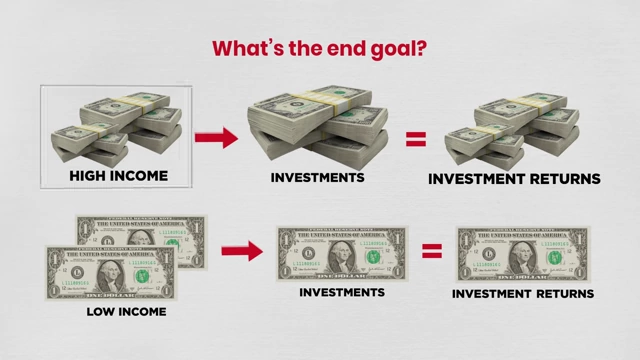
A higher income enables more significant investments, leading to more meaningful investment returns and faster wealth accumulation compared to starting with low income. [ 00:17:26 ] - This allows for financial freedom, enabling one to work less, retire early, and enjoy financial security with reduced stress.
- A low initial income makes it challenging to reach this "critical mass" for investments.
- Therefore, increasing income is the fastest way to achieve the end goal, as it provides more capital for impactful investments.