Understanding Game Theory: Strategies for Life's Dilemmas
Summary:
This video introduces Game Theory as a "cheat code to life," exploring how rational choices can be calculated in various situations. It delves into several classic game theory problems:
- The Prisoner's Dilemma (Golden Balls): Demonstrates that while rational strategy dictates "stealing" to maximize individual gain, this often leads to a worse collective outcome (Nash equilibrium). Human irrationality often leads to "splitting" in reality.
- The Kidnapping Dilemma: Illustrates that in a one-shot scenario with high stakes, the purely rational choice (eliminating the hostage) may conflict with moral preferences but offers a guaranteed positive outcome for the kidnapper.
- Conventions: Explains how human biases (like preferring "heads" in a coin flip) and social conventions (like tipping or shaking hands) influence outcomes and can be leveraged.
- Mixed Strategy Equilibrium (Duel & Poker): Shows that in games with inherent uncertainty, a truly random approach can be the optimal strategy to prevent predictability.
- The Ultimatum Game: Highlights how human emotions like "spite" override pure rationality, leading players to reject unfair offers even if it means getting nothing.
- Repeated Prisoner's Dilemma (Tit for Tat): Presents the "Tit for Tat" strategy (start cooperative, retaliate if provoked, forgive quickly, be clear) as the most effective approach for repeated interactions in life, balancing niceness with firmness.
A visually dynamic title card reading "GAME THEORY IS THE CHEAT CODE TO LIFE" against a colorful, abstract background with golden spherical elements. [ 00:01:10 ]
The Game of Life and Game Theory [00:00:01]
- Life is portrayed as a complicated game filled with situations requiring choices [00:00:19]
- Many situations have an objectively correct strategy, but knowing it in the moment is challenging [00:00:42]
- Game theory proposes that choices can be reduced to mathematical formulas to calculate optimal outcomes [00:01:09]
A visually dynamic title card reading "GAME THEORY IS THE CHEAT CODE TO LIFE" against a colorful, abstract background with golden spherical elements. [ 00:01:10 ]
The Prisoner's Dilemma: The "Golden Balls" Game [00:01:17]
- Game Mechanics: Contestants choose to "Split" a jackpot with an opponent or "Steal" it for themselves, simultaneously and secretly [00:01:25]
- Three possible outcomes:
- Both choose Split: Share the jackpot [00:01:44]
- One chooses Steal, other Split: Stealer takes all [00:01:47]
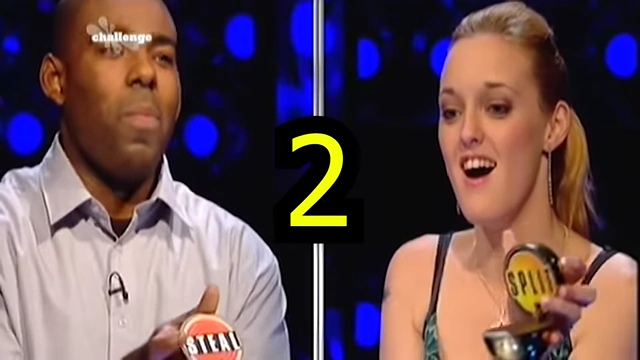
A split screen showing two contestants from 'Golden Balls'; one has chosen 'Steal', the other 'Split', resulting in the stealer taking all. [ 00:01:51 ] - Both choose Steel: Both receive nothing [00:01:52]
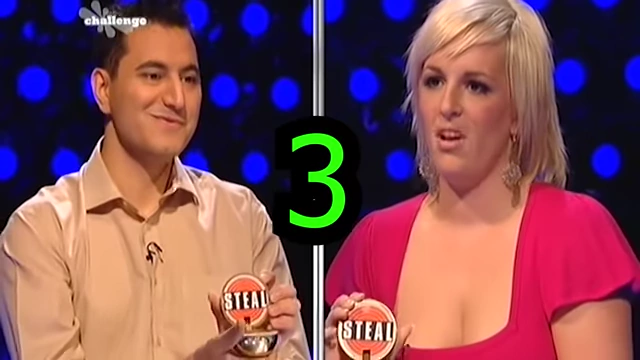
Two contestants on 'Golden Balls' both holding 'Steal' balls, indicating they both chose to steal and thus receive nothing. [ 00:01:54 ]
- Three possible outcomes:
- Game Theory's Rational Choice: To "Steal" [00:02:10]
- Stealing leads to either a win or a draw, while splitting leads to a draw or a loss [00:02:14]
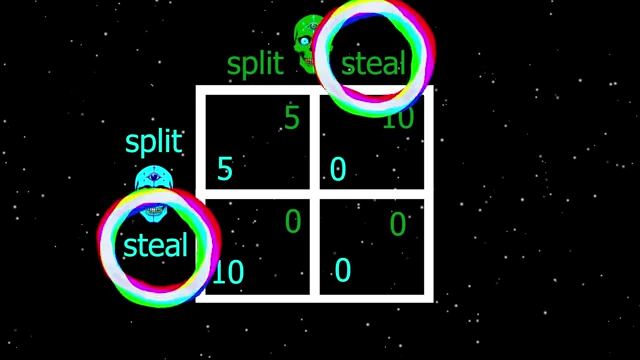
A payoff matrix illustrating the outcomes for "split" and "steal" choices for two players in a game theory scenario, with values assigned to each outcome. [ 00:02:59 ] - This is a Nash equilibrium: neither player gains from changing their choice once the other's choice is known [00:02:33]
- Rational Paradox: The best rational choice (steal) often leads to the least desirable outcome (both steal, get nothing) [00:02:56]
- Stealing leads to either a win or a draw, while splitting leads to a draw or a loss [00:02:14]
- Real-World Observation vs. Theory:
- Analysis of 289 "Golden Balls" episodes showed "Split" chosen 53% of the time, "Steel" 47% [00:03:18]

A graphic displaying 'SPLIT' with '53%' overlaid, indicating the percentage of players who chose to split in Golden Balls. [ 00:03:25 ] 
A graphic displaying 'STEAL' with '47%' overlaid, indicating the percentage of players who chose to steal in Golden Balls. [ 00:03:28 ] - This suggests 53% of people behave irrationally from a game theory perspective [00:03:33]
- Recommendation: In a prisoner's dilemma, a purely rational approach dictates choosing to betray/steal [00:03:40]

Two contestants on the "Golden Balls" game show facing a decision, with the "Split" option clearly visible for one player. [ 00:01:30 ]
- Analysis of 289 "Golden Balls" episodes showed "Split" chosen 53% of the time, "Steel" 47% [00:03:18]
The Kidnapping Dilemma [00:03:56]
- Scenario: You've kidnapped a celebrity, ransom is paid, and now face the choice to release or eliminate the hostage [00:04:01]

A kidnapper with a skull mask stands over a distraught female hostage in a wooden room, illustrating the scenario. [ 00:04:02 ] - Key complication: The hostage knows your identity, making release a risk of imprisonment [00:04:16]
- Game Theory's Rational Choice: To eliminate the hostage [00:04:53]
- This choice guarantees freedom and wealth, outweighing the moral cost or the desire for the most ideal outcome (release and silence) [00:05:03]
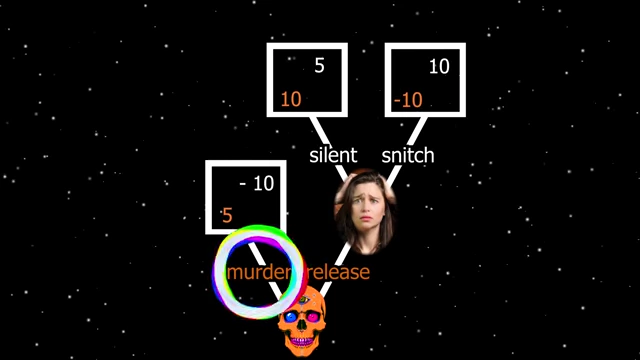
A decision tree diagram illustrating the choices and outcomes for a kidnapper (murder or release) and a hostage (silent or snitch), with numerical values representing the perceived utility for each player. [ 00:04:59 ] - Other factors like Stockholm syndrome or future technologies could alter the probabilities, but the base principle remains: secure the guaranteed victory [00:05:07]
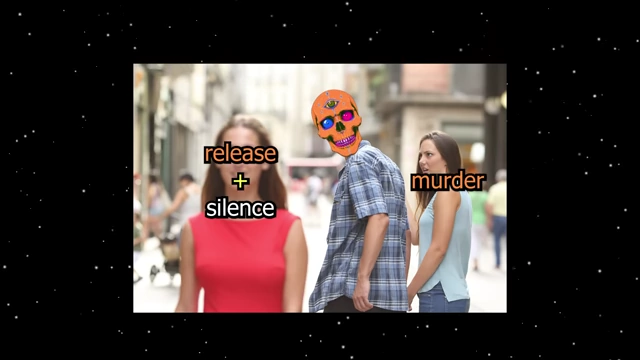
A "distracted boyfriend" meme illustrating the choice between "release + silence" (preferred but risky) and "murder" (guaranteed outcome for kidnapper). [ 00:05:37 ]
- This choice guarantees freedom and wealth, outweighing the moral cost or the desire for the most ideal outcome (release and silence) [00:05:03]
Conventions and Human Bias [00:05:50]
- Coin Flip Example: While a coin flip is 50/50, humans have a slight bias towards picking "heads" (around 60%) because it often comes to mind first [00:06:08]
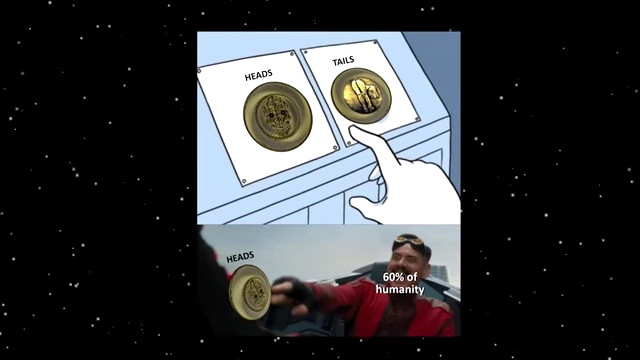
A meme showing a hand pointing to "Tails" while text states "60% of Humanity" picks "Heads", illustrating human bias in a 50/50 choice. [ 00:06:18 ] - Conventions: Unspoken rules or tendencies people follow [00:06:37]
- Knowledge of these conventions can provide an advantage in games (e.g., predicting an opponent's coin call) [00:06:40]
- Real-Life Conventions as Games:
- Driving on the correct side of the road prevents accidents [00:06:59]

A person with a skull mask driving a tiny red car on the right side of the road, illustrating the convention of driving on a specific side. [ 00:07:03 ] - Tipping waiters can lead to better service [00:07:11]

A collage showing various ways of leaving a tip on a table, illustrating the social convention of tipping. [ 00:07:13 ] - Shaking hands builds trust [00:07:22]

Donald Trump and Vladimir Putin shaking hands, illustrating the convention of shaking hands to build trust. [ 00:07:24 ] - Paying taxes maintains government and society [00:07:30]
- Money itself is a convention, with only imaginary value [00:07:36]

Stacks of US dollar bills, representing money as a fundamental economic convention. [ 00:07:39 ]
- Driving on the correct side of the road prevents accidents [00:06:59]
- Conventions in game theory reduce uncertainty [00:08:15]
Mixed Strategy Equilibrium: The Duel [00:08:23]
- Scenario: A pistol duel where two players walk towards each other with one bullet each, able to fire at any point [00:08:34]
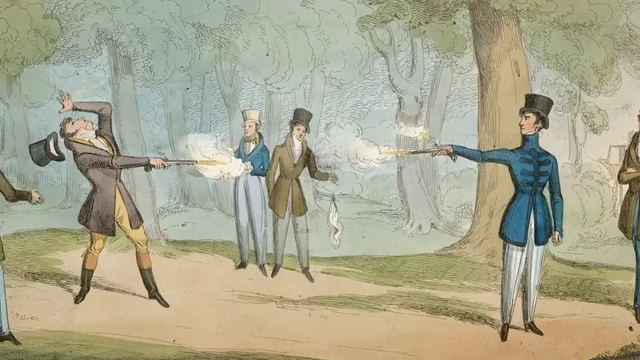
An old-fashioned illustration of two men engaged in a pistol duel in a field, with one firing his weapon. [ 00:09:07 ] - Dilemma: Firing too early risks a miss and leaves you vulnerable; waiting too long risks being shot by the opponent [00:09:11]
- Game Theory Conclusion: There is no "best" time to shoot [00:09:05]
- This is a mixed strategy equilibrium: with all factors equal, a random shot is the optimal strategy [00:09:10]
- Poker Analogy: Randomly bluffing (mixing strategies) prevents opponents from accurately assessing your hand and predicting your moves [00:09:25]
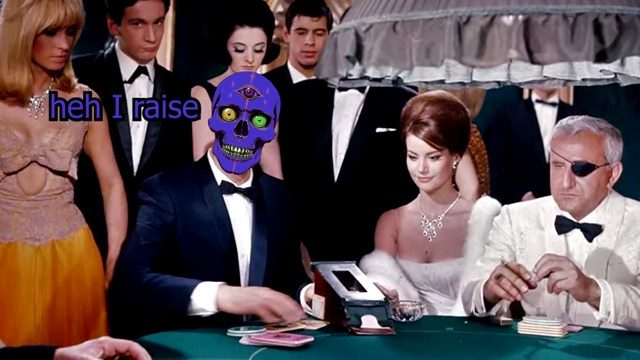
A man with a skull mask in a poker game, with the text 'heh I raise', illustrating the act of bluffing as a mixed strategy. [ 00:09:32 ] - Intuition in Real Life: In many life situations, intuition, reading people's tendencies, body language, and emotions are often more valuable than pure statistical advantages, as emotions are hard to quantify [00:09:57]
The Ultimatum Game: Human Spite vs. Rationality [00:10:23]
- Game Mechanics: Player 1 proposes a split of money, Player 2 accepts or declines (both get nothing if declined) [00:10:26]
- Game Theory's Rational Choice:
- Reality: Human Spite: People often refuse to behave rationally when they feel they are being treated unfairly [00:11:12]
- If Player 1 offers a very unequal split (e.g., 90:10), Player 2 is highly likely to decline out of spite, leading both to get nothing [00:11:41]
- In reality, Player 1's best choice is a 50/50 split to ensure acceptance [00:11:26]

Two figures with skull masks sit across a table laden with stacks of money. The figure on the right is pushing away the money, signifying a refusal, with "0 Blank Coins ($0.00)" visible, indicating no winnings. [ 00:10:37 ] 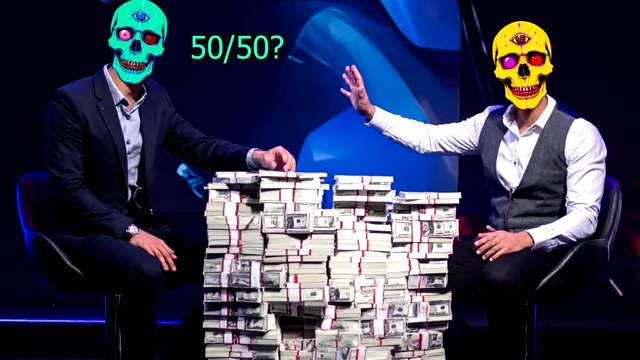
Two figures with skull masks sit across a table with money. The figure on the right gestures towards the money with "50/50?" written, suggesting a question about an equal split. [ 00:11:26 ]
The Repeated Prisoner's Dilemma: The "Tit for Tat" Strategy [00:12:03]
- Impact of Repetition: When games are repeated, players learn from mistakes, significantly altering optimal strategies [00:12:07]
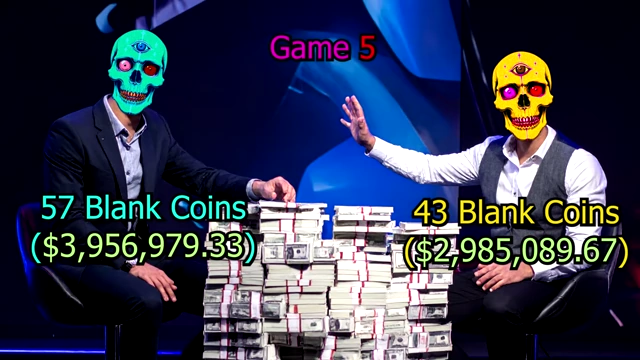
Two players with skull masks negotiating a money split (57/43) in 'Game 5', demonstrating how repeated interactions can lead to mutual equilibrium. [ 00:12:23 ] - Axelrod's Tournament: Professor Robert Axelrod conducted contests where computer programs played repeated Prisoner's Dilemmas [00:12:58]
- "Nice" programs (those that cooperate initially) performed better on average than aggressive programs [00:13:24]
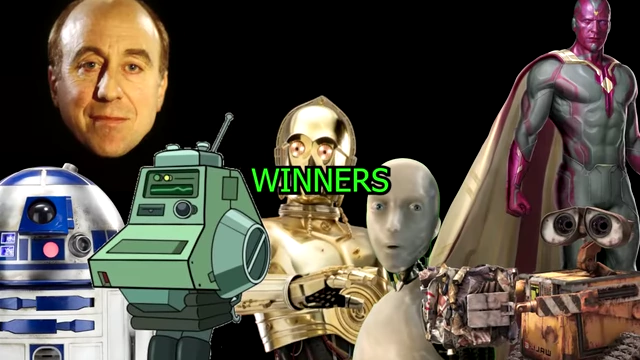
A collage of friendly-looking robots and characters, labeled 'WINNERS', representing the success of "nice" programs in Axelrod's tournament. [ 00:13:25 ] 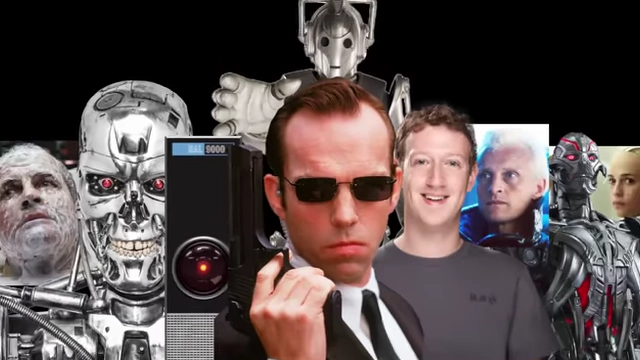
A collage of aggressive-looking robots and characters, representing the "mean" programs that performed poorly in Axelrod's tournament. [ 00:13:27 ]
- "Nice" programs (those that cooperate initially) performed better on average than aggressive programs [00:13:24]
- The Winning Strategy: "Tit for Tat" [00:13:48]
- This program consistently scored the most points due to four qualities:
- Niceness: Never the first to betray/steal [00:14:15]
- Retaliation: Immediately mirrors an opponent's betrayal in the next round [00:14:23]
- Forgiveness: Holds grudges for only one round and returns to cooperation if the opponent does [00:14:28]
- Clarity: Its method is clear and cannot be misunderstood or manipulated [00:14:37]
- This program consistently scored the most points due to four qualities:
- Life Application: "Tit for Tat" empirically demonstrates that an "eye for an eye" approach (reciprocal cooperation/retaliation) is a better strategy than "turn the other cheek" in repeated interactions [00:14:46]
- It allows one to be pleasant without being a pushover, and strong without being aggressive [00:15:05]
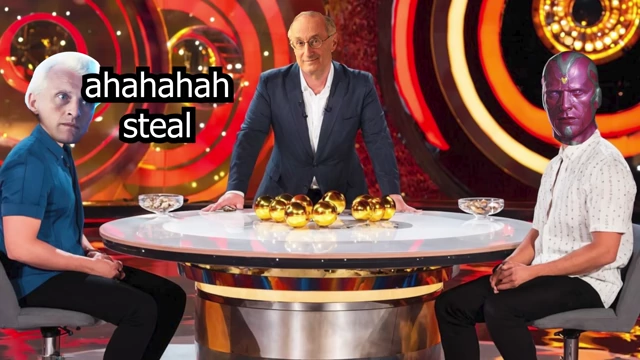
A game show scene with a host and two players with skull-like faces. One player's thought bubble says "ahahahah steal" while the other's says "bruh we were doing so well," illustrating the impact of a player choosing to steal. [ 00:14:15 ]
- It allows one to be pleasant without being a pushover, and strong without being aggressive [00:15:05]
Conclusion: Game Theory as a Cheat Code for Life [00:15:17]
- Applying principles like Tit for Tat, learning from losses, and strategically incorporating randomness can serve as a "cheat code" for navigating life's challenges [00:15:17]
- Acknowledges that inherent advantages like intelligence, charisma, wealth, and genetics also significantly impact life outcomes, but these are beyond individual control [00:15:22]

A colorful, glowing funnel of light-like particles pours into a vibrant, swirling landscape, visually representing a "cheat code" or abundant success. [ 00:15:15 ]