Examining Canada's Economic Stagnation: Productivity Emergency, Housing Market, and Policy Failures
Summary:
- Canada, despite its rich natural resources, stable democracy, and educated populace, has experienced a significant economic slowdown, dropping in global happiness rankings and seeing its GDP per capita fall from 80% to around 70% of the American level over a decade [2:54]. The Bank of Canada has even declared a "productivity emergency" [4:03].
- This decline is attributed to a combination of factors: a protected domestic economy with highly concentrated telecom [7:13] and banking sectors [8:12] leading to high costs and low investment; a housing market that incentivized speculation over production, with home prices nearly tripling between 2005 and 2026 [10:51]; and a persistent productivity gap compounded by low R&D spending [10:11] and low overall investment levels [10:20].
- The problematic housing market, characterized by high price-to-income ratios [13:52] and reliance on parental gifts for down payments [14:18], has led to declining homeownership among younger generations and a significant happiness disparity between older and younger Canadians [17:04].
- Canada faces a "leaky bucket problem" [21:54], losing highly skilled immigrants—often educated in Canada—to better economic opportunities, exemplified by figures like Elon Musk [19:35]. The economy is also heavily dependent on raw material exports to the U.S. [24:13] and hampered by significant internal trade barriers [28:21].
- Despite these challenges, Canada possesses extraordinary endowments, world-class pension funds [30:20], and a strong fiscal position [30:20], offering a clear path to unlock its potential as an economic superpower through strategic reforms [30:20].
Introduction: Canada's Economic Paradox [0:35]
- Canada, in 2012, was widely considered an ideal economy [0:40].
- On paper, Canada should be one of the wealthiest nations [0:58].
- A brief period of outperformance [1:28].
- In 2012, the median Canadian household net worth surpassed its American counterpart for the first time [1:30].
- This was driven by a global commodity boom and the Canadian dollar trading at or above parity with the US dollar [1:50].
- High energy prices, a headwind for the US, were a massive tailwind for Canada [2:01].


The Slow Decline: A "Productivity Emergency" [2:08]
- The era of outperformance has vanished [2:13].
- Canada's economic decline is a "slow, but always polite stagnation" [2:18].
- Decline in happiness index [2:25].
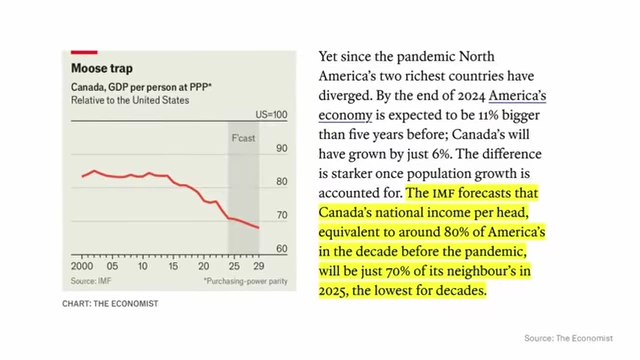
- Falling national income per capita [2:54].
- IMF forecasts indicate Canada's national income per head will fall from around 80% of America's level to just 70% in 2025 [2:54].
- This will be the lowest level in decades [3:03].
- If Canadian provinces were US states, Alberta would rank around 20th wealthiest, while Ontario would rank 48th (below Montana and Alabama) [3:05].
- ![A panoramic view of the Toronto skyline at dusk, with the CN Tower prominent [3:05]](sc0017_t00.03.18.webp)
- New Brunswick would rank dead last, below Mississippi [3:29].
- A "productivity emergency" [4:03].
- The Bank of Canada senior deputy governor, Carolyn Rogers, flagged Canada's weak productivity as an "emergency" in a 2024 speech [4:03].
- ![Bloomberg article headline "Bank of Canada's Rogers Flags Weak Productivity 'Emergency'" 4:03]
- Canada has the second-worst productivity record in the Group of Seven [4:06].
- The Bank of Canada senior deputy governor, Carolyn Rogers, flagged Canada's weak productivity as an "emergency" in a 2024 speech [4:03].
Underlying Issues: Compounding Errors [3:50]
Protected Industries & Lack of Competition [7:10]
- Telecommunications: Three dominant carriers (Bell, Rogers, Telus) hold 89% of wireless subscribers [7:13].
-
smartphones displaying the logos of Rogers, Telus, and Bell, with the Canadian Parliament building in the background [7:13]

Three [ 00:07:15 ] - Canada has some of the highest mobile phone bills globally [7:24].
- ![Bar chart showing Canada's cell phone prices are among the most expensive globally for 100 gigabytes [7:24]](sc0036_t00.07.29.webp)
- Regulatory barriers have prevented meaningful competition [7:49].
- ![MEI article "The CRTC undermines investment in Canadian telecom infrastructure" [7:49]](sc0038_t00.08.04.webp)
- The industry prioritizes lobbying over network investment [8:00].
-
- Banking: Five major banks (RBC, TD, Scotiabank, BMO, CIBC) hold 90% of deposits [8:12].
-
CIBC, RBC, TD, BMO, and Scotiabank [8:12]

Logos of five major Canadian banks: [ 00:08:15 ] - The system is designed for stability, avoiding the 2008 financial crisis [8:25].
- ![Article "Why Was Canada Exempt from the Financial Crisis?" [8:25]](sc0042_t00.08.36.webp)
- Stability comes at the cost of dynamism, with conservative capital allocation towards proven assets over new ventures [8:40].
- ![Quote from Y Combinator stating Canadian startups that reincorporated in the U.S. have twice the average valuation [8:40]](sc0044_t00.09.05.webp)
- The term "rent-seeking" is used for this by economists, while Canadians call it a "stable industry" [9:27].
-
- Airlines, groceries, and broadcasting sectors show similar patterns of limited competition [9:12].
- Telecommunications: Three dominant carriers (Bell, Rogers, Telus) hold 89% of wireless subscribers [7:13].
Productivity Gap and R&D Underinvestment [9:36]
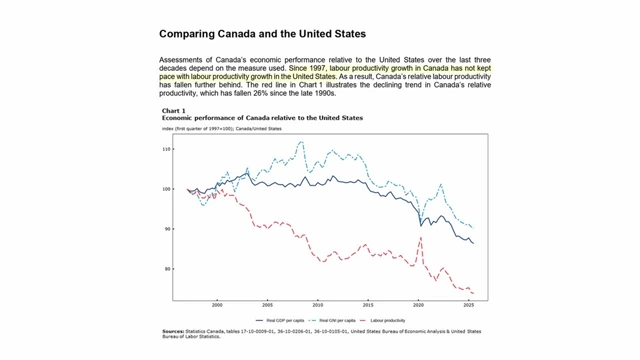
- Canada's labor productivity has declined relative to American productivity over time [9:36].
- Since 1997, the two economies have diverged by a cumulative 26 percentage points [9:47].
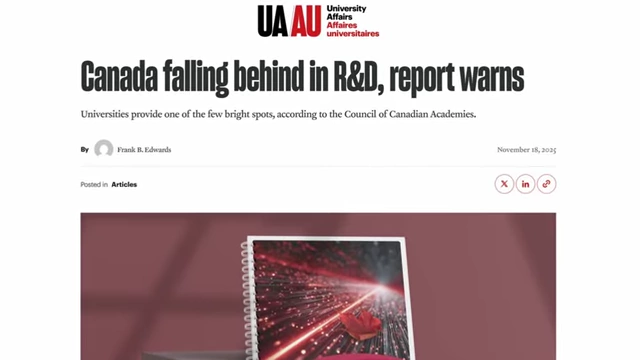
- Canada spends less than half the OECD average on research and development as a share of GDP [10:11].
- This figure has been below average for two decades, resulting in workers doing the same things in the same ways as a generation ago [10:20].
- ![Financial Times chart "Canada has low investment levels for a nation of its size" plotting Gross fixed capital formation vs. Total land area for various countries [10:20]](sc0105_t00.23.21.webp)
- ![Fraser Institute article "Government adds 950,000 jobs since 2015, accounting for 30% of total employment growth in Canada" [10:20]](sc0107_t00.23.40.webp)
Housing Market Distortion [10:44]
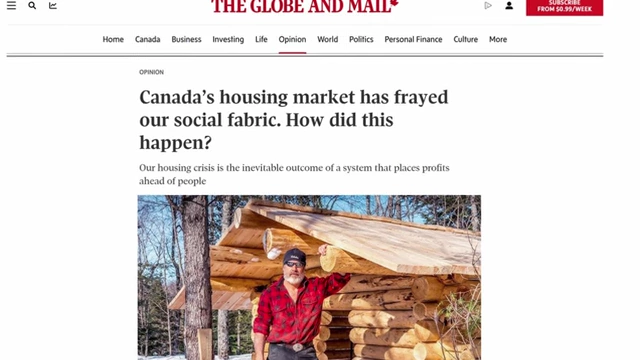
- Canadian home prices have nearly tripled between 2005 and 2026 [10:51].
- The average home price went from $237,000 in 2005 to $661,000 in early 2026 [10:51].
-
IN SELECT MARKETS (March 1999 = 100) showing steep increases in Toronto, Vancouver, Montreal, Edmonton, Ottawa-Gatineau, and Calgary [10:51]

Graph of CANADIAN HOUSING PRICES [ 00:10:57 ] - ![Graph titled "Residential average price Canada" showing a consistent upward trend from Jan 2005 to Jan 2026, with a peak around 2022 [10:51]*](sc0058_t00.11.42.webp)
-
- The average home price went from $237,000 in 2005 to $661,000 in early 2026 [10:51].
- Housing prices have outperformed stocks over time on a straight price appreciation basis, but not when dividends are reinvested [11:17].
-
investment that has outperformed stocks and Canadian real estate so far this century" [11:17]

The Globe and Mail article headline "The [ 00:11:20 ] - A home's value rise is due to land scarcity and planning restrictions, not productive activity [12:02].
- ![CMP article headline "Canada house prices surge – income gaps expand" [12:02]](sc0062_t00.13.45.webp)
-
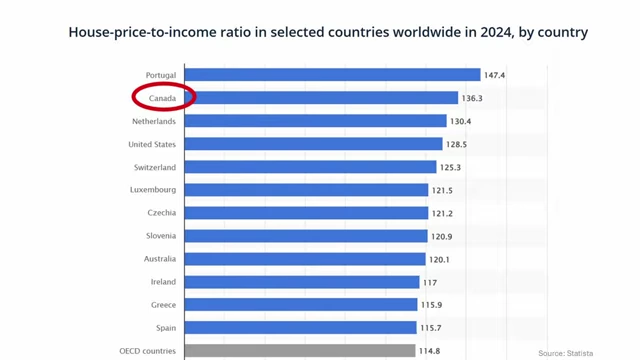
- Housing price-to-income ratios are very high, e.g., 17 times in Vancouver and 12-17 times in major cities [13:52].
- The phenomenon of "gifting for a down payment" is rising [14:18].
- In 2020-2021, one-third of first-time buyers received parental gifts, averaging $82,000, which is more than the median individual after-tax income [14:19].
- ![Chart showing "Gifting to first-time buyers—rising fast," with graphs for percentage of first-time buyers receiving gifts and average gift amount [14:18]](sc0066_t00.14.29.webp)
- In 2020-2021, one-third of first-time buyers received parental gifts, averaging $82,000, which is more than the median individual after-tax income [14:19].
- This creates a problematic incentive structure where putting money into real estate is a rational economic choice due to leverage and tax-free capital gains [13:18].
- This policy effectively asks the majority of voters to accept a reduction in the value of their single largest asset [16:07].
- Homeownership has declined from a peak of 69% in 2011 to 66.5% in 2021, while renter households grew twice as fast as owner households [15:55].
- ![ViewHomes.ca summary of "Key Homeownership Stats in Canada" highlighting the decline in homeownership and faster growth of renter households 15:55]
- Youth unhappiness and wealth disparity [16:32].
- Canadians over 60 still rank in the global top 10 for happiness, while those under 25 rank 71st, a dramatic drop since 2011 [17:04].
- Young Canadians' net assets are significantly lower than older generations [18:09].
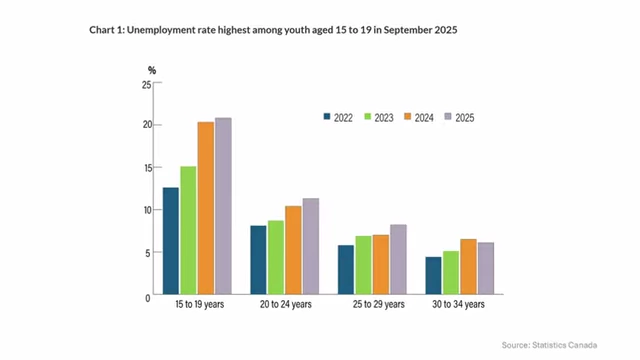
- Youth unemployment reached 14.7% in late 2025, with nearly a million young Canadians classified as "NEET" (not in employment, education, or training) [18:45].
- Canadian home prices have nearly tripled between 2005 and 2026 [10:51].
Brain Drain and Talent Incubation for the US [19:35]
- One in five immigrants leaves Canada within 25 years, with highly educated individuals leaving faster [20:29].
- ![Key Findings from Statistics Canada stating "One in five immigrants leave Canada within 25 years of landing. Highly educated immigrants are leaving faster" [20:29]](sc0095_t00.20.33.webp)
- 22,000-35,000 Canadians move to the US annually, with 60% of US work visa applicants from Canada being non-Canadian born [20:42].
- Canada acts as a "talent incubator" for the US economy, attracting, educating, and then losing skilled immigrants to higher-paying, lower-tax markets [21:54].
- ![Cover of "The Leaky Bucket 2025" report by The Conference Board of Canada, focusing on retention trends in highly skilled immigrants [21:54]](sc0097_t00.21.20.webp)
- One in five immigrants leaves Canada within 25 years, with highly educated individuals leaving faster [20:29].
Dependence on US Trade & Internal Trade Barriers [24:08]
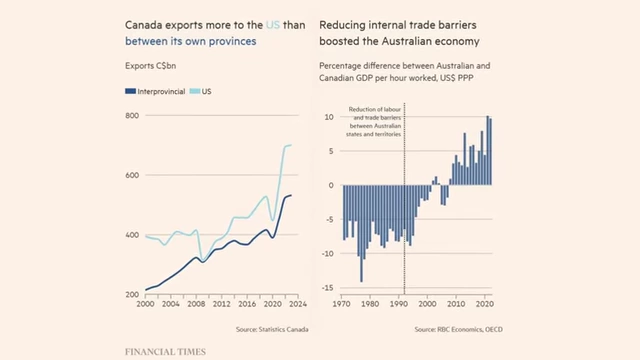
- Approximately 75% of Canadian exports go to the US [24:13].
-
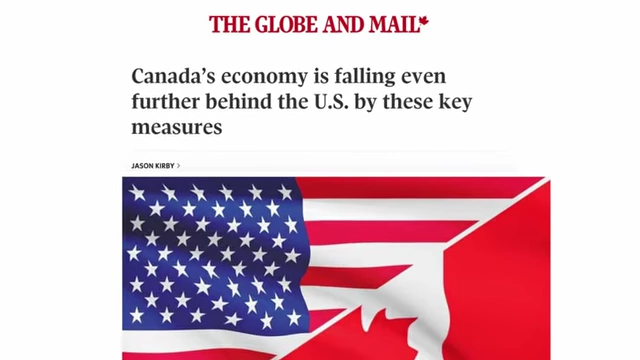
Globe and Mail article headline "Canada’s economy is falling even further behind the U.S. by these key measures" [24:13]
The [ 00:22:07 ] -
"nearly 75% of Canadian exports go to the U.S." [24:13]
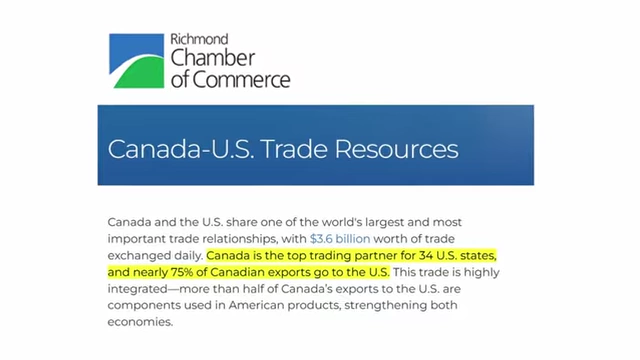
Richmond Chamber of Commerce text stating [ 00:24:15 ] -
areas where Canada is losing or falling behind [24:27]
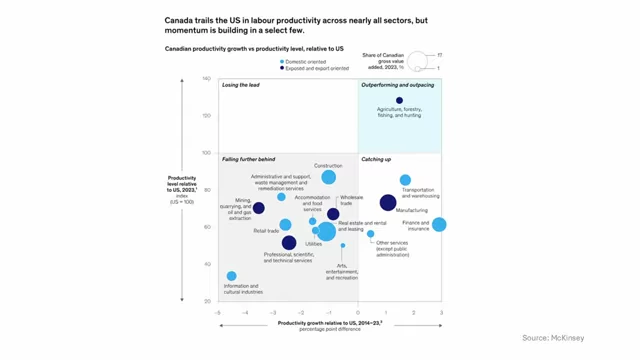
McKinsey chart comparing Canadian productivity growth and level relative to the US across various sectors, highlighting [ 00:22:46 ] - No other developed economy is so heavily tethered to a single trading partner [24:27].
- This leads to dependency on the US's goodwill and policies [25:11].
-
- Canada has significant internal trade barriers, functioning like a 6.9% tariff on domestic commerce [28:21].
- ![YouTube video thumbnail "Canada's Ridiculous Trade Barriers...With Itself" by The Plain Bagel [10:20] (Note: Moved this image from its original timestamp to this more relevant section).](sc0052_t00.10.35.webp)
- ![Political cartoon depicting Canada as a map fragmented by provincial walls, with a man carrying a "USMCA" plank looking for "no more trade barriers!" [28:21]](sc0119_t00.28.22.webp)
- Eliminating these could boost GDP by 90-200 billion CAD per year [28:58].
- ![Bloomberg article "Canada Trade Deficit Widens as Gold Drives Record High Imports" [24:08] (Note: Moved this image from its original timestamp to this more](sc0125_t00.29.16.webp) relevant section).
- Approximately 75% of Canadian exports go to the US [24:13].
Energy and Resource Infrastructure Issues [25:27]
- Canada's oil is sold at a consistent discount to global benchmarks due to a lack of tidewater export infrastructure [25:48].
- ![Financial Post article headline "Why Canadian oil is sold to the U.S. at a 'discount' and have tariffs made things worse?" [25:48]](sc0111_t00.25.50.webp)
- The Trans Mountain Pipeline expansion (TMEP) entered service in May 2024, increasing capacity, but faced massive cost overruns and delays [26:25].
- ![The Energy Mix article headline "Report Calls Trans Mountain a 'Red Flag' for Future Subsidies After Price Rises 584%" [26:25]](sc0113_t00.26.58.webp)
- The proposed Energy East pipeline, which would have opened Atlantic and European markets, was canceled in 2017 after years of political opposition [27:28].
- Canada's oil is sold at a consistent discount to global benchmarks due to a lack of tidewater export infrastructure [25:48].




Consequences and Outlook [33:21]
- Canada's economic trajectory results from a combination of policies, planning restrictions, tax treatment of primary residences, mortgage incentives, and low interest rates [19:21].
- These policies benefited asset owners from 25 years ago but are detrimental to those trying to acquire assets today [19:28].
- The Canadian economy is at a crossroads, with external pressure and potential internal reforms driven by the belligerence of its main trading partner.
- ![People at a protest holding signs, one reading "ELBOWS UP CANADA" [33:21]](sc0139_t00.32.28.webp)
- Canada has extraordinary endowments and a strong fiscal position, giving it the capacity to invest and pursue its potential as an economic superpower, "if it wants to" [30:20].
-
94-2024 [33:21] (Note: This image, while about deficits, appears at the end where the overall outlook is discussed, suggesting a point about fiscal challenges in the path to superpower potential).
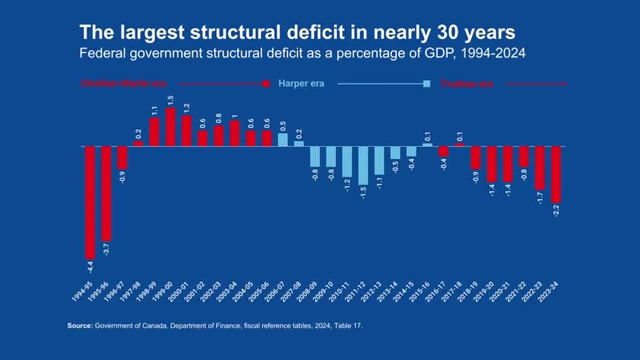
Chart showing "The largest structural deficit in nearly 30 years" from 19 [ 00:29:37 ] - ![Financial Times opinion piece headline "Unlocking Canada’s superpower potential" [30:20]](sc0129_t00.30.13.webp)
-
Board, Caisse de dépôt et placement du Québec, Ontario Teachers' Pension Plan, etc.) [30:20]

Logos of several Canadian pension funds (CPP Investment [ 00:30:53 ] - ![Exterior shot of McGill University [30:20]](sc0133_t00.31.13.webp)
- ![Medium article headline "How Canada Quietly Built the AI Revolution (And Why Silicon Valley Owes Them Big Time)" [30:20]](sc0135_t00.31.42.webp)
-
chart showing "Canada's national debt is one of the lowest in the G7" [30:20]
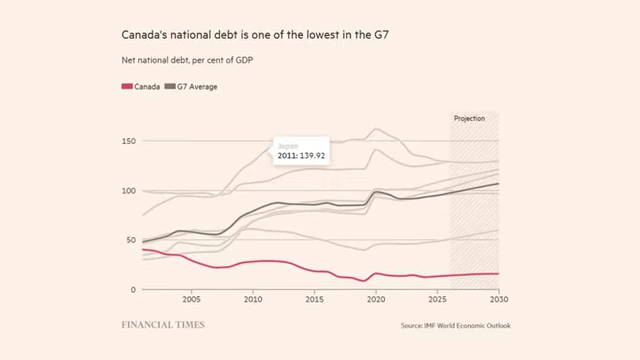
Financial Times [ 00:32:01 ] -
at a crossroads and has a unique chance to reach its potential [33:21]
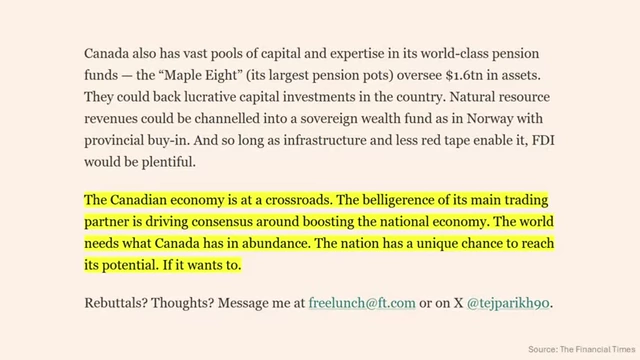
Text excerpt from Financial Times article, concluding that the Canadian economy is [ 00:33:12 ]
-