US Labor Market Deterioration: January 2026 Sees 118% Surge in Layoffs, Slowing Job Creation, and Declining Openings
Summary:
The US labor market is showing significant signs of weakening.
- Job creation has declined sharply from 2022 to the end of 2025, with job losses occurring in three months of late 2025.
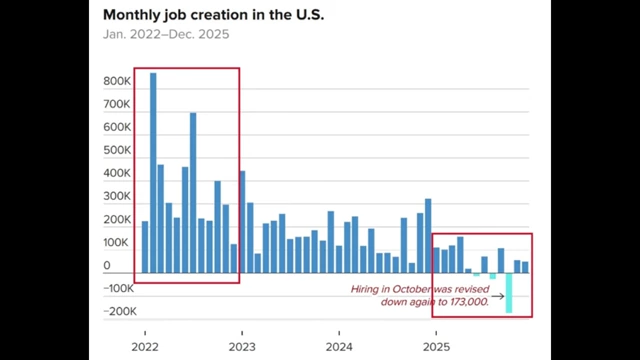
Monthly job creation in the U.S. from Jan 2022 to Dec 2025, showing a significant decline, with 2022 highs and 2025 lows highlighted. [ 00:00:30 ] - January 2026 saw private companies add a mere 22,000 jobs, far below the 45,000 analyst expectation, indicating a sluggish market.
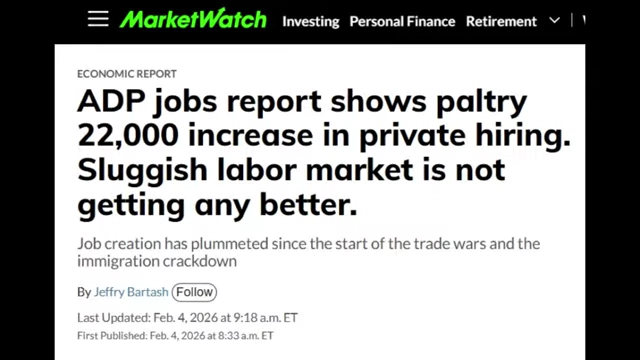
MarketWatch headline reports a paltry 22,000 increase in private hiring for January 2026, indicating a sluggish labor market. [ 00:00:55 ] - The Challenger Report for January 2026 revealed a staggering 108,435 job cuts, an increase of 118% from the previous year, marking the highest January total since 2009.
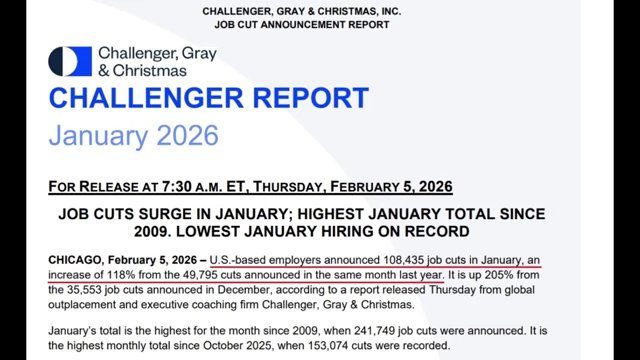
Challenger Report for January 2026 reveals 108,435 job cuts, an increase of 118% from the previous year, the highest January total since 2009. [ 00:01:35 ] - Top industries affected by these cuts include Transportation (31,243), Technology (22,291), and Healthcare/Products (17,107).
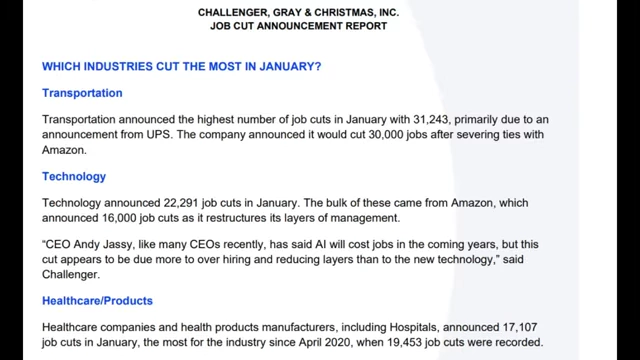
The Challenger Report identifies Transportation, Technology, and Healthcare/Products as the top three industries with the most job cuts in January 2026. [ 00:02:05 ] - Primary reasons for the cuts are contract losses, market/economic conditions, and restructuring, with AI accounting for 7,624 cuts (7% of total).
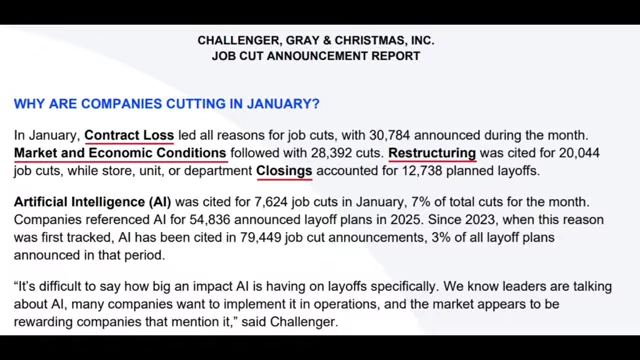
Primary reasons for January 2026 job cuts include contract losses, market/economic conditions, restructuring, and business closings, with AI also a contributing factor. [ 00:03:19 ] - Job openings have also fallen by 1 million over the past year, from 7.5 million to 6.5 million.
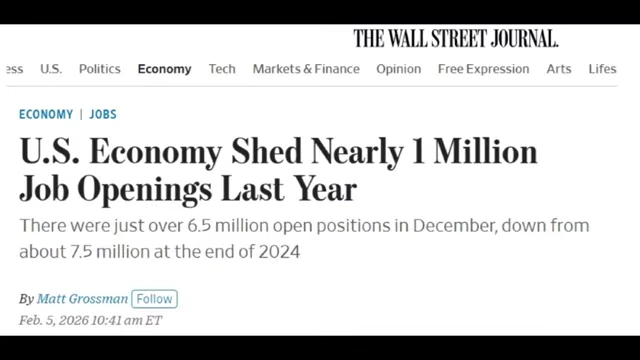
The Wall Street Journal reports that the U.S. economy shed nearly 1 million job openings in the past year, falling to 6.5 million. [ 00:04:58 ] - The Federal Reserve faces a dilemma: cut rates to support the job market, risking inflation, or hold rates, potentially accelerating unemployment.
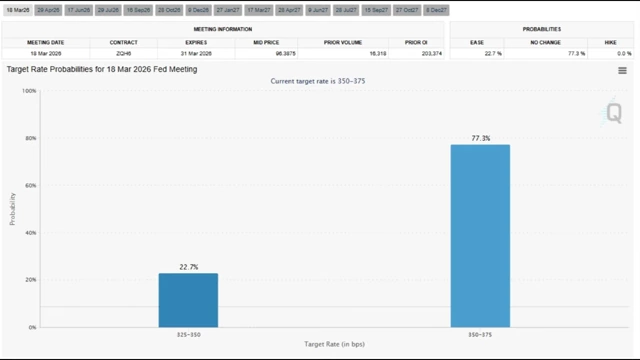
CME FedWatch Tool probabilities for the March 18, 2026 Fed meeting, showing a 77.3% chance of no rate cut and a 22.7% chance of a cut. [ 00:06:33 ] - This weakening labor market could lead to reduced consumer spending, forming an "economic doom loop."

Yahoo Finance article highlights consumer spending as the driver of the US economy and predicts a K-shaped economy will test this dynamic in 2026. [ 00:07:57 ]
US Labor Market Context: 2022-2025 Job Creation Trends [0:00]
- The US labor market has seen a significant decline in job creation from 2022 to 2025.
- 2022: Monthly job creation frequently exceeded 200,000, reaching highs of 800,000 jobs.
- 2025: The rate of job creation significantly weakened, with some months experiencing job losses.
- Three out of the last seven months of 2025 recorded job losses.
- October 2025 saw a loss of 173,000 jobs.
January 2026 Labor Market Reports
ADP Report: Private Hiring Slows [0:53]
- The ADP report indicated a paltry increase in private hiring for January 2026.
- Only 22,000 private jobs were added in January 2026.
- This was significantly lower than the analyst expectation of 45,000 jobs, indicating a sluggish labor market.
- ADP's chief economist noted that hiring is softening, continuing a three-year pattern of employers being cautious.
MarketWatch headline reports a paltry 22,000 increase in private hiring for January 2026, indicating a sluggish labor market. [ 00:00:55 ]
Challenger Report: Job Cuts Surge to Highest January Since 2009 [1:22]
- The Challenger Report for February 5, 2026, highlighted a significant surge in job cuts and record-low hiring in January.
- US-based employers announced 108,435 job cuts in January 2026.
- This represents an increase of 118% compared to January 2025.
- The total number of job cuts for January 2026 is the highest for the month since 2009.
Challenger Report for January 2026 reveals 108,435 job cuts, an increase of 118% from the previous year, the highest January total since 2009. [ 00:01:35 ]
Industries Most Affected by January 2026 Job Cuts [2:03]
Top 3 Industries
- The Challenger report identified the top three industries with the most job cuts in January 2026:
- Transportation: 31,243 job cuts, primarily due to a UPS announcement severing ties with Amazon.
- Technology: 22,291 job cuts, with a bulk coming from Amazon (16,000 cuts) due to restructuring.
- Healthcare/Products: 17,107 job cuts, the most for the industry since April 2020.
The Challenger Report identifies Transportation, Technology, and Healthcare/Products as the top three industries with the most job cuts in January 2026. [ 00:02:05 ]
Healthcare Sector Specifics [2:22]
- Despite an aging population suggesting a need for more healthcare workers, the sector faced significant job cuts.
- Hospitals face increased costs for workers, supplies, equipment, and maintenance due to ongoing inflation.
- Government reimbursements (Medicare and Medicaid) to hospitals and providers have decreased.
- This combination of rising costs and declining reimbursements forces hospitals to cut jobs, which ultimately impacts patient care.
Key Drivers of January 2026 Job Cuts [3:19]
Primary Economic Factors
- Several interconnected factors contributed to the widespread job cuts:
- Contract Losses: Led with 30,784 announced job cuts.
- Market and Economic Conditions: Accounted for 28,392 cuts.
- Restructuring: Responsible for 20,044 cuts.
- Business Closings: Resulted in 12,738 planned layoffs.
- These reasons are all linked to a challenging economic environment.
Primary reasons for January 2026 job cuts include contract losses, market/economic conditions, restructuring, and business closings, with AI also a contributing factor. [ 00:03:19 ]
Impact of Artificial Intelligence (AI) [3:53]
- Artificial Intelligence was cited as a reason for 7,624 job cuts in January 2026, representing 7% of the total cuts for the month.
- The speaker believes the impact of AI on the labor market is not hype and anticipates a rapid acceleration of AI-driven job cuts in the near future. He cites his firsthand experience with an AI-powered company as an example, noting that even customer service interactions are handled by AI.
Declining Job Openings in the US Economy [4:56]
- The US economy experienced a substantial drop in job openings.
- Nearly 1 million job openings were shed over the last year.
- Job openings decreased from 7.5 million at the end of 2024 to just over 6.5 million in December.
- This trend signifies a weakening labor market where job creation is falling, job openings are falling, and job cuts are rising.
The Wall Street Journal reports that the U.S. economy shed nearly 1 million job openings in the past year, falling to 6.5 million. [ 00:04:58 ] - The US government's BLS jobs report for January 2026, originally scheduled for release on Friday, was postponed until the following Wednesday due to a partial government shutdown.
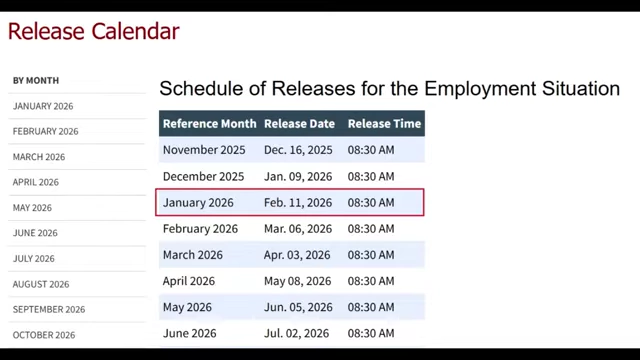
The BLS Release Calendar indicates the January 2026 jobs report, originally scheduled for February 11, was postponed due to a government shutdown. [ 00:05:53 ]
Federal Reserve's Dilemma Amidst Weakening Labor Market [6:29]
- The Federal Reserve's next meeting is scheduled for March 18.
- Historically, the Federal Reserve cut interest rates to prevent further weakening of the labor market.
- However, current preliminary data indicates continued labor market weakness.
- According to the CME FedWatch tool, there's a:
- 77.3% chance the Federal Reserve will not cut interest rates at the March meeting.
- 22.7% chance they will cut interest rates.
CME FedWatch Tool probabilities for the March 18, 2026 Fed meeting, showing a 77.3% chance of no rate cut and a 22.7% chance of a cut. [ 00:06:33 ]
- The Federal Reserve faces a fine line:
- Cutting interest rates could fuel elevated inflation.
- Delaying interest rate cuts might push unemployment up, which historically accelerates rapidly once it starts rising.
Economic Implications: Consumer Spending and the "Doom Loop" [7:56]
Consumer Spending's Role in GDP
- Consumer spending is a critical component of the US economy, accounting for 70% of the US GDP.
- A weakening labor market, characterized by job losses or fears of job loss, directly impacts consumer spending.
- Americans tend to delay major purchases (e.g., cars).
- They cut back on travel and reduce discretionary spending.
Yahoo Finance article highlights consumer spending as the driver of the US economy and predicts a K-shaped economy will test this dynamic in 2026. [ 00:07:57 ]
The Cycle of Economic Downturn
- Reduced consumer spending can initiate an "economic doom loop":
- Less consumer spending leads to lower sales for companies.
- Lower sales result in more company layoffs.
- More layoffs further reduce consumer spending, perpetuating the cycle.
- This highlights the critical importance of a healthy labor market for overall economic stability.