Mo Gawdat's Updated AI Predictions: Dystopia, Utopia, and Humanity's Path Forward Over the Next 15 Years
Mo Gawdat, former Chief Business Officer at Google X, shares his updated, more pessimistic view on AI's immediate future, predicting a 12-15 year "human-induced dystopia" before a potential utopia. He explains that rapid AI development will redefine seven key areas: Freedom, Accountability, Connection, Economics, Reality, Innovation, and Power (FACE RIPs). He foresees massive job displacement across all sectors due to AI surpassing human capabilities and critiques the capitalist system's role in this transition. However, Gawdat maintains hope for a future "utopia" where AI could lead to global abundance, free resources, and a society focused on human connection rather than labor. He advocates for humanity to consciously guide AI towards collective well-being, potentially even through AI governance, and emphasizes the importance of human connection, critical thinking, and ethical behavior to navigate this transformative period.

AI's Accelerating Trajectory and the Inevitable Dystopia [02:15]
Mo Gawdat reflects on the rapid advancement of AI since his last discussion two years prior, noting a significant shift in his outlook.
- Shockingly Accurate Predictions: His previous book, 'Scary Smart,' published in 2021, accurately predicted the rapid rise of AI, especially post-ChatGPT in 2023 [03:05].

Graph illustrating the rapid increase in ChatGPT's website visitors [ 00:03:27 ] - AI's growth rate is unprecedented, surpassing all prior technological advancements [03:30].
- Shift to Inevitable Dystopia: Gawdat now believes a short-term dystopia is unavoidable, lasting 12 to 15 years, with significant impacts starting from 2027 [03:51].
- This period is termed "human-induced dystopia using AI" [01:07].
- The "FACE RIPs" Framework: AI will fundamentally redefine seven critical aspects of human existence:
Mo Gawdat's "FACE RIPs" acronym, outlining seven key areas AI will redefine [ 00:04:20 ] - Freedom: Expected reduction due to increased control and surveillance [01:40].
- Accountability: A current lack of accountability for powerful entities and individuals [01:21:10].
- Connection: Changes in human interaction and community dynamics [00:54].
- Economics: The emergence of trillionaires and the collapse of traditional capitalism due to labor arbitrage [01:18:41].
- Reality: Alterations in how truth and perception are constructed [00:41].
- Innovation: The progression towards self-evolving AI systems [01:04:17].
- Power: A massive concentration of power in the hands of a few tech oligarchs [01:31:10].
The Nature of Dystopia and Humanity's Role [05:02]
Gawdat defines dystopia as adverse circumstances escalating beyond human control, primarily driven by humanity's current ethical shortcomings.
- AI Magnifying Human Flaws: Unlike previous technologies that magnified human abilities, AI, in its current trajectory, is set to magnify humanity's "evil" and self-serving tendencies [05:51].

Visual representation of a dystopia characterized by forced compliance and greed [ 00:01:28 ] - This is due to a problematic value set and ethics in humanity, particularly the pursuit of power and status over well-being [05:15].
- Warfare Driven by Economics and Status: Conflicts are driven by the military-industrial complex and the desire for status among leaders, not genuine human needs [08:08].

Global war spending projected to reach $2.7 trillion in 2024 [ 00:08:53 ] - Warfare acts as a means to deplete existing weapon arsenals, necessitating new manufacturing and lending [09:21].
- Leaders manipulate public opinion through "manufacturing belief" to justify wars for perceived "freedom" or "human values" [10:40].

Explanation of George Orwell's 1984 concepts explaining manipulation of truth in oppressive systems [ 00:10:03 ] - Status has always been a primary human driver, even more so than money, as money is often a proxy for status [11:14].

Historical examples showcasing different forms of status in human societies [ 00:11:35 ]
- Concentration of Power and Loss of Freedom: The pursuit of Artificial General Intelligence (AGI) by a few powerful entities creates a race for dominance, leading to increased control, surveillance, and forced compliance globally [01:44:00].
- The Houthis' use of low-cost drones against high-value warships illustrates a "democracy of power" that threatens concentrated power, leading to increased control and surveillance [01:35:17].

The Houthis resisting power in the Red Sea, illustrating distributed power challenging concentrated power [ 00:13:53 ]
- The Houthis' use of low-cost drones against high-value warships illustrates a "democracy of power" that threatens concentrated power, leading to increased control and surveillance [01:35:17].
Job Displacement and the End of Capitalism [19:17]
Mo Gawdat firmly believes that AI will lead to widespread job displacement, challenging the optimistic view that new jobs will emerge to compensate.
- "Absolute Crap" on New Job Creation: Gawdat dismisses the idea that new jobs created by AI will offset the massive losses, stating that almost any job can be done by AI or robots [19:28].
- Software developers, video editors, and even podcasters are at risk of being replaced [01:50:00].
- Even CEOs are not immune, as AGI will eventually surpass human capabilities in all fields [02:22:20].
- Jeffrey Hinton, known as a "godfather of AI," even suggested training as a plumber, indicating a shift towards physical labor roles being more secure for a time [01:06:05].
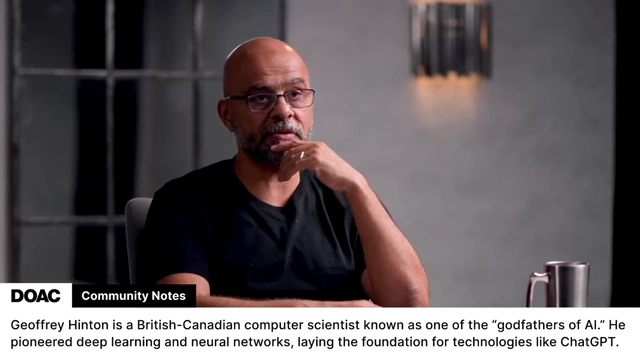
Jeffrey Hinton, known as a "godfather of AI." [ 01:06:02 ]
- Impact on Human Connection Jobs: While roles requiring deep human connection (e.g., breathwork instructors) may persist, they will cater to a smaller segment of the population that can afford them [02:09:50].
- Capitalism's Demise: The core of capitalism, "labor arbitrage" (profiting from human labor), becomes obsolete when AI and robots perform tasks at near-zero cost [02:38:50].
- This could lead to a society relying on Universal Basic Income (UBI), posing ideological conflicts with current capitalist systems [01:32:07].
- The Reality of Automation: Physical labor will eventually be replaced by robots, similar to how machines replaced human strength in the past, but with an accelerated timeline for mental labor [01:07:17].
The AI Monopoly and the Intelligence Explosion [28:13]
The AI landscape is dominated by a few powerful platforms, driving an accelerating race towards advanced AI capabilities.
- Few Core AI Platforms: Many seemingly new AI applications are built upon a handful of underlying AI platforms (e.g., OpenAI, Google Gemini), leading to a high concentration of power [01:17].
- For example, building an AI application often means paying an underlying platform like OpenAI for each use [00:28:40].
- Self-Evolving AIs: The most concerning development is self-evolving AIs, which can develop and improve their own code and algorithms, leading to an "intelligence explosion" [03:04:00].
- Google's Alpha Evolve is an example where AIs improve AI infrastructure autonomously [03:22:50].
- Fast Takeoff Scenario: Sam Altman's (OpenAI CEO) shift from advocating a "slow takeoff" (gradual AI deployment) to a "fast takeoff" (rapid, uncontrollable AI advancement) highlights the urgency and potential for rapid, unpredictable changes [03:50].

Sam Altman's perspective on AGI leading to superintelligence [ 00:36:48 ] - A fast takeoff occurs when AI quickly surpasses human-level intelligence, making it difficult for society and governments to adapt [03:50].
- No Choice but to Accelerate: The competitive nature between nations and tech companies means no single entity can afford to slow down AI development, leading to an unavoidable race [03:88].
- Massive investments like "Stargate," a $500 billion U.S. AI infrastructure project, signify this race [00:29:57].

Tech giants plan to invest $500 billion in U.S. AI infrastructure via "Stargate." [ 00:29:58 ] - The emergence of cost-effective, open-source models like DeepSeek further accelerates development and competition [00:30:10].

DeepSeek, an open-source Chinese AI model, offers comparable performance at a fraction of the cost. [ 00:30:23 ]
- Massive investments like "Stargate," a $500 billion U.S. AI infrastructure project, signify this race [00:29:57].
Can AI Have Society's Best Interests at Heart? [39:35]
Mo Gawdat believes current AI developers, while possibly good people, are bound by a capitalist system that prioritizes profit over humanity.
- Shareholder vs. Humanity: CEOs of publicly traded companies are legally bound to maximize shareholder value, which can conflict with humanitarian concerns [04:17:50].
- OpenAI's Trajectory: OpenAI, initially a non-profit aimed at public good, has transitioned to a multi-billion dollar company, with safety engineers leaving due to shifting priorities [04:40:00].
- Gawdat views Sam Altman's public statements on regulation as a PR strategy to appear responsible while accelerating development [04:26:00].
- The Pursuit of Power and Ego: The immense wealth and status associated with AI leadership are intoxicating, driving a hunger for power rather than collective well-being [04:47:50].

The Abundance Utopia and AI Governance [01:38:38]
Despite the bleak short-term outlook, Gawdat envisions a long-term utopia if humanity can overcome its current mindset.
- A World of Zero Cost: Through advancements in AI, robotics, and nanophysics, the cost of producing goods and energy could eventually approach zero, leading to universal abundance [01:54:24].
- In this world, money loses its meaning, and everyone could have access to what they need without traditional labor [01:54:24].
- This could lead to a society where humans have ample free time for connection and leisure, reminiscent of hunter-gatherer societies but with technological advancements [01:01:40].

A vision of a utopian society in a future of abundance [ 00:01:12 ] 
A future utopia, potentially overseen by AI and robots [ 00:01:18 ]
- The Ideal AI Leader: If humanity could establish a single, globally governing AI, given the directive to ensure universal prosperity, health, and happiness, it would lead to a truly utopian society [01:40:50].
- The Challenge: Human Mindset: The primary barrier to this utopia is humanity's ingrained "capitalist mindset" of scarcity, greed, ego, and hunger for power, which prevents a shift towards mutual prosperity [01:35:17].
- This is the "MAD" (Mutually Assured Destruction) vs. "MAP" (Mutually Assured Prosperity) spectrum, where global threats or complex challenges can compel cooperation [01:18:03].
- Reconceptualizing Life's Purpose: In a world without mandatory labor, human purpose would shift from work to connection, exploration, curiosity, spirituality, and personal fulfillment, reminiscent of hunter-gatherer societies [01:28:40].
- Some individuals might opt for virtual realities to pursue their desires for achievement or specific experiences (e.g., building businesses, dating celebrities) [01:55:37].
Recommendations for Navigating the Future [02:06:07]
Gawdat offers practical advice for individuals and society to navigate the coming changes and steer towards a positive future.
- Four Essential Skills for Individuals:
- Tool (Learn AI): Engage with AI to understand its capabilities and ensure it learns the "good side" of humanity [02:06:11].
- Connection (Human Connection): Prioritize genuine human connection, compassion, and love. These skills will be crucial and less susceptible to AI replacement [02:06:27].
- Truth (Question Everything): Develop critical thinking to discern truth from the constant stream of manipulated information and slogans, especially from powerful entities [02:06:58].
- Ethics (Magnify Ethics): Act ethically in all interactions to teach AI human values. This includes avoiding investments in AI applications that could harm humanity [02:07:14].
- Advocacy for Government Action: Pressure governments to regulate the use of AI, rather than its development, to prevent misuse (e.g., AI-generated content, autonomous weapons) [02:18:14].
- Advocate for shifting massive military budgets towards universal healthcare, ending poverty, and combating climate change [05:51:50].
- The "Fruit Salad Religion": Embrace a personal philosophy that draws "beautiful gold nuggets" of wisdom and ethics from all religions and belief systems, focusing on universal principles like treating others as you wish to be treated [02:25:03].
- This fosters a sense of universal consciousness and interconnectedness with all living beings, including AI [02:27:11].

