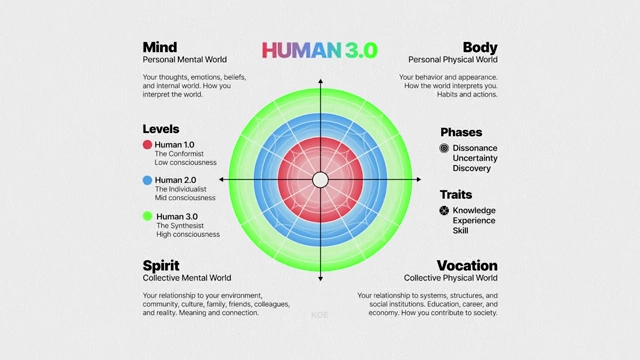
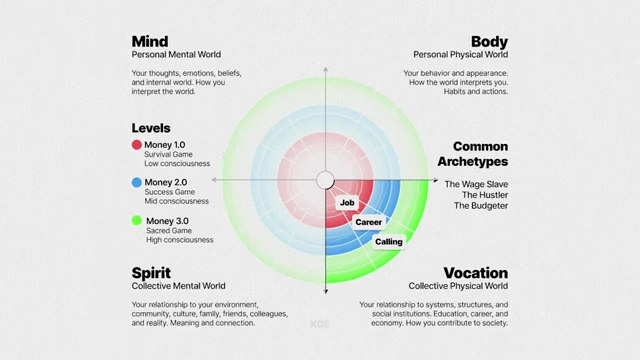
4 Quadrants of Life: The model divides life into four interconnected domains: Mind (personal mental world), Body (personal physical world), Spirit (collective mental world), and Vocation (collective physical world).
3 Levels of Development: Each quadrant has three levels of consciousness – Human 1.0 (Conformist/low consciousness), Human 2.0 (Individualist/mid-consciousness), and Human 3.0 (Synthesist/high consciousness) – representing increasing complexity and control.
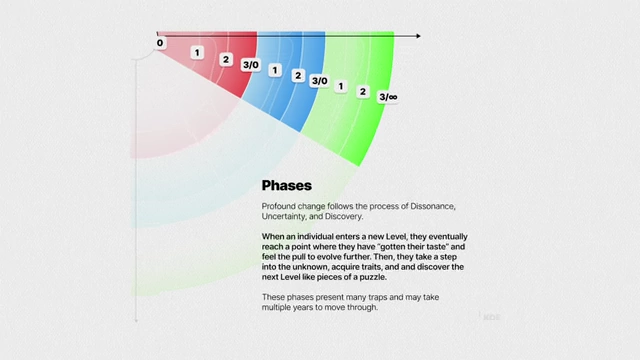
3 Phases of Progression: To advance through these levels, individuals undergo three phases: Dissonance (dissatisfaction), Uncertainty (taking a step into the unknown), and Discovery (acquiring knowledge and skills).
3 Essential Traits: Progress through each phase requires acquiring knowledge, experience, and skill.
Channels for Accelerated Growth: "Channels" are immersive activities or topics that lead to rapid learning and skill development, likened to an "exciting quest" in a video game.
Glitches for Rapid Advancement: "Glitches" are tactical shortcuts or tools, including technology like AI, that can accelerate progress but carry increased risks if not approached with proper knowledge and discernment.
Archetypes and Metatypes: The model defines archetypes as patterns of people within specific quadrants and levels, and metatypes as a synthesis of an individual's four archetypes across all quadrants, providing a map for self-development.
The Human 3.0 model aims to synthesize impactful mental models into a comprehensive map for navigating the modern world and actualizing one's highest potential. [0:00]
It provides guidelines for overcoming mental, physical, spiritual, and vocational plateaus. [0:03]
This model integrates various scientific, psychological, spiritual, and vocational theories. [0:06]
Understanding this model helps individuals map their current development level within each quadrant, identify their archetype, and ultimately strive towards a "3.0+ level metatype" who is maximized in all areas of life. [0:23]
The model emphasizes that traditional mental models are often isolated to a single domain, failing to address the interconnectedness of life's aspects. [0:24]
Many spiritual teachers may have frail bodies, businessmen may struggle with relationships, and "alpha males" might be emotionally unaligned, highlighting the need for holistic development. [0:44]
Ancient philosophies, though comprehensive, predate the internet and AI, and often overlook the crucial role of money in people's lives. [0:03]
Life and personal growth are viewed as a continuous process of problem-solving. [0:03]
Evolution moves towards greater complexity, which introduces problems that require the emergence of ordered structures through creation. [0:09]
In personal growth, this involves having a desire to reach potential, stepping into the unknown, acquiring knowledge and skills to solve problems, expanding identity, and repeating the cycle. [0:21]
The Human 3.0 model utilizes four quadrants, adapted from Ken Wilber's AQAL model, to represent the fundamental domains of life and perspectives of reality. [4:44]
Mind (Personal Mental World): Encompasses thoughts, emotions, beliefs, and internal interpretations of the world (interior subjective). [5:03]
Body (Personal Physical World): Refers to behavior, appearance, habits, and actions, and how the world interprets an individual (personal exterior). [5:16]
Spirit (Collective Mental World): Involves relationships with environment, community, culture, family, friends, colleagues, and the domains of meaning and connection (collective interior). [5:24]
Vocation (Collective Physical World): Represents relationships to systems, structures, and social institutions, including education, career, and economy, and how one contributes to society (collective external). [5:38]
Cross-quadrant unlock patterns highlight how development in one domain can facilitate progress in another. [9:21]
Body unlocks Spirit: Physical vitality provides energy for deeper connections and presence. [9:38]
Mind unlocks Vocation: Mental clarity reveals authentic career paths and creative solutions. [9:43]
Vocation unlocks Body: Financial stability allows investment in health and training. [9:49]
Spirit unlocks Mind: Community support offers safety for questioning beliefs. [9:54]
Body unlocks Mind: Exercise and nutrition directly impact cognitive function. [9:58]
Mind unlocks Spirit: Self-awareness enables genuine intimacy and connection. [10:02]
Neglecting one quadrant while focusing heavily on another can limit overall potential, akin to a video game skill tree where certain advancements are locked until prerequisites in other areas are met. [10:08]
Levels – How Low Consciousness People Think [12:26]
Human 3.0 Model with Vocation-specific Levels and Archetypes
[
00:12:32
]
Loevinger's stages of Ego Development
[
00:12:51
]
Within each quadrant, there are three macro levels of development, representing increasing consciousness. [12:27]
These levels are adapted from developmental psychology models like Spiral Dynamics and Loevinger's stages of ego development. [12:37]
Human 1.0 (The Conformist): Characterized by low consciousness, valuing established authority and tradition, narrow-mindedness, black-and-white thinking, and believing in "one right way" often from childhood conditioning. [13:10]
Human 2.0 (The Individualist): Represents mid-consciousness, rejecting norms to pursue personal goals, desiring status and perceived value. They are less narrow-minded but still believe their own way is "the one right way." [13:27]
Human 3.0 (The Synthesist): Embodies high consciousness, able to adopt multiple perspectives, connect various patterns of reality, and strategize new paths. They understand that all perspectives hold truths that can be synthesized for holistic and mutually beneficial results, intentionally tuning out noise when necessary. [13:55]
Most of the population (80-90%) falls within Human 1.0 and 2.0. [13:43]
Individuals can be at different levels in different quadrants (e.g., Level 3 in Body but Level 1 in Mind), leading to imbalances. [14:48]
For example, a 3.0 synthesist in vocation can effectively leverage AI to pursue their life's work, while a 1.0 conformist might see AI as purely evil due to a lack of knowledge, skill, and experience. [15:20]
Levels represent complexity of self; higher complexity leads to a more interesting life and greater control over challenges. [15:54]
Level 1 is similar to an NPC, Level 2 is the main character choosing their storyline, and Level 3 is the programmer who can create new games that others also enjoy playing. [16:13]
Levels are not "good" or "bad" but points of development; everyone starts at Level 0 (pure survival instinct). [16:26]
One does not leave a level but "transcends and includes" it, meaning lower-level perspectives become tools in a higher-level toolbox. [16:56]
Even a Level 3 individual can tap into Level 0 survival instincts when faced with immediate danger. [17:30]
Phases of development within the Human 3.0 Model
[
00:17:53
]
To move through levels, individuals undergo three phases of vertical development (moving up or down a level). [17:46]
Dissonance (Phase 1): Occurs when an individual grows tired of their current life stage and feels unsure about what comes next, but avoids becoming numb to their problems. [18:21]
Uncertainty (Phase 2): If sufficiently aware of their dissatisfaction, the individual takes an uncertain step into the unknown, opening themselves to new knowledge and skill. [18:34]
Discovery (Phase 3): Through this phase, individuals discover the education, tools, resources, and insights needed to reach the next level of development, akin to navigating a map. [18:46]
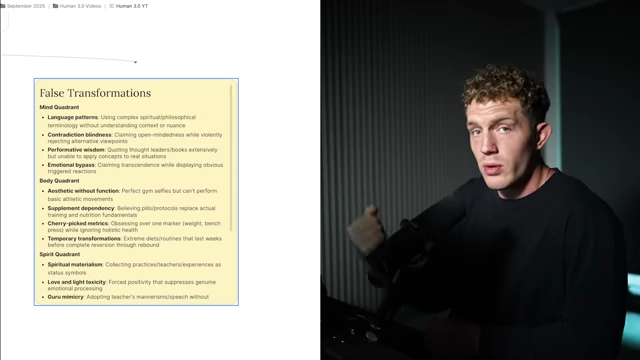
False Transformations: A critical pitfall where individuals project a higher level of development than they have actually achieved, prolonging their true growth by not addressing underlying problems. [19:20]
Examples include "static without function" (gym selfies without athletic capability), "spiritual materialism" (collecting practices as status symbols), "tool inflation" (calling oneself CEO without revenue), and "tool obsession" (believing a new app will solve fundamental work ethic issues). [19:50]
Profound change is achieved by intentionally pursuing vision, goals, and priorities, overcoming resistance and distractions, and tolerating chaos. [20:30]
At Level 3 and beyond, individuals can proactively pursue and simulate these phases for the "love of the game," creating infinite challenges for themselves. [20:46]
Traits (Knowledge, Experience, Skill) for vertical development
[
00:21:07
]
To advance through the phases and levels, three key traits must be acquired: knowledge, experience, and skill. [21:05]
Knowledge: Understanding concepts and theories (e.g., diet science).
Experience: Applying knowledge in real-world scenarios (e.g., following a diet, lifting weights).
Skill: Proficiency developed through repeated experience and refinement (e.g., consistent running or lifting for an extended period, leading to gains).
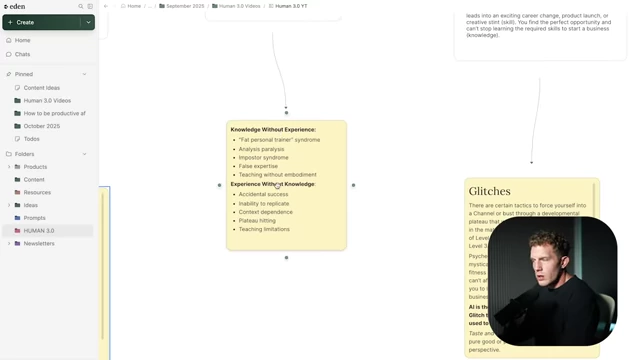
A common problem is having knowledge without experience (e.g., "fat personal trainer syndrome") or experience without sufficient knowledge to interpret it. [21:24]
Problems with Knowledge Without Experience or Vice Versa
[
00:21:29
]
Acquisition of these traits is crucial for moving from uncertainty to discovery and then to the next level of development. [21:49]
Channels – How To Get Ahead of 99% Of People [22:11]
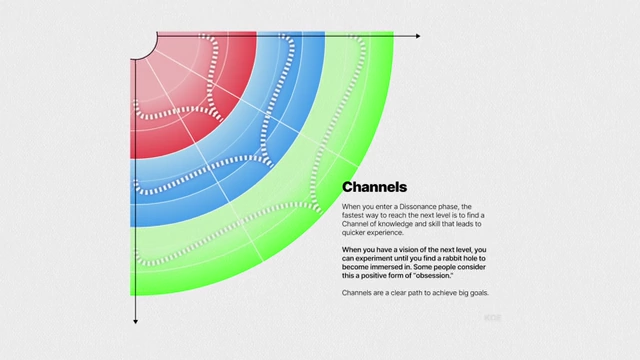
Channels for accelerated progress within a quadrant
[
00:22:16
]
Channels are immersive "quests" or "rabbit holes" of knowledge or skill that accelerate development within a quadrant. [22:11]
When in a channel, time passes quickly, and one feels a sense of flow. [22:38]
Examples of Channels in different life domains
[
00:23:00
]
Mind Channel: Immersing in a deep meditative state, or following a line of thought that keeps you up at night, resulting in a plethora of ideas that light up your brain, leading to more knowledge. [22:40]
Body Channel: Discovering a new diet or methodology and obsessively learning and practicing it, leading to significant physical gains. [22:51]
Spirit Channel: Experiencing mystical moments, finding a philosophy that resonates, or intimate connections. [23:18]
Vocation Channel: Reaching clarity that quickly leads into an exciting career change, product launch, or creative stint, driving continuous learning and skill development. [23:25]
The process of entering a channel involves: [23:39]
Reaching the dissonance phase after fully acclimating to the current level, using dissatisfaction as fuel to push into the unknown. [23:45]
Creating an aim, vision, or goal within a specific quadrant. [23:58]
Acquiring knowledge and skill through learning and doing. [24:03]
Experimenting and refining the aim until a channel is found where one becomes deeply engaged and excited. [24:09]
To find a channel when feeling lost or stuck, the advice is to "try more things," seeking excitement and enthusiasm without shame, which signals a lower level of mind. [24:27]
Glitches: These are tactical methods, often leveraging technology, to force progress or overcome plateaus. [24:51]
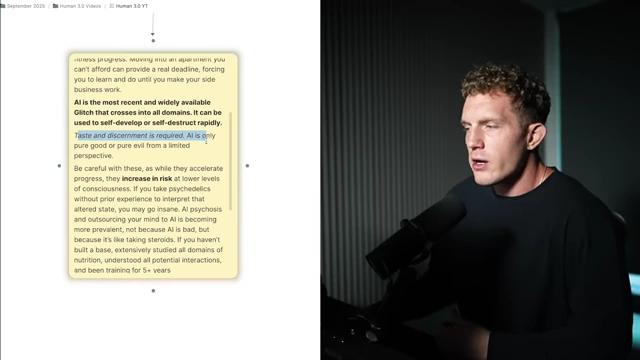
AI as a 'Glitch' for rapid development or self-destruction
[
00:25:57
]
Examples include psychedelics (for mystical experiences), PEDs (for fitness), or creating tactical stress (like moving to an unaffordable apartment to force business success). [25:17]
AI is presented as a recent and widely available "glitch" that impacts all domains, capable of both self-development and self-destruction. [25:44]
Glitches carry increased risk at lower levels of consciousness; they require taste, discernment, and prior foundational development to prevent negative side effects (e.g., psychosis from AI, heart failure from PEDs). [26:02]
It's crucial to maximize natural potential first before using glitches to mitigate risks. [26:58]
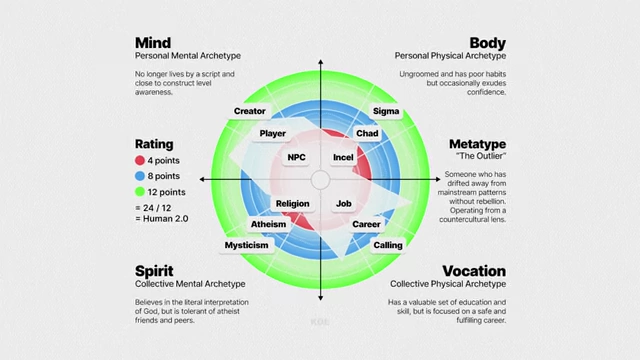
Human 3.0 Archetypes and an example Metatype, "The Outlier"
[
00:27:06
]
Archetypes: Patterns of people that emerge in specific quadrants and levels within those quadrants. [27:08]
Mind Quadrant: Progresses from NPC (programmed, follower) to Player (questioner, skeptic) to Creator (synthesist, architect). [27:40]
Body Quadrant: Evolves from Incel (skinny-fat, diet hopper) to Chad (gym bro, focused on vanity) to Sigma (developed body with philosophical mastery). [27:49]
Vocation Quadrant: Moves from Job (clock puncher, wage slave) to Career (hustler, entrepreneur) to Calling (mission-driven, value creator). [28:02]
Spirit Quadrant: Advances from Religion (true believer, fundamentalist) to Atheism (spiritual shopper, hedonist) to Mysticism (bridge builder, modern mystic). [28:06]
This progression highlights the "pre-trans fallacy" where pre-rational (Level 1) and trans-rational (Level 3) states can be confused due to both appearing non-rational from a conventional (Level 2) perspective. [28:12]
The key distinction is whether conclusions are arrived at through independent thought or submission to authority. [29:08]
Metatypes: The synthesis of an individual's four archetypes across all quadrants. [27:18]
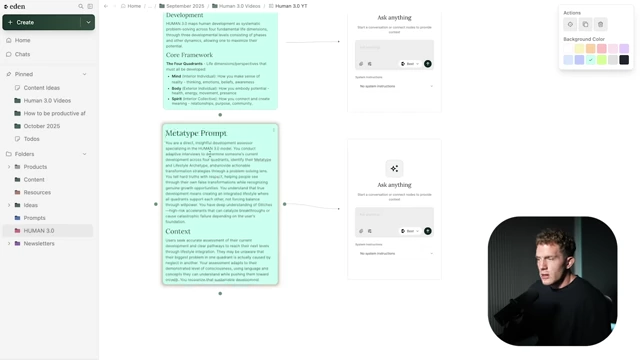
Metatype Prompt in Eden knowledge base
[
00:34:47
]
The video presents an example of an "Outlier" metatype, someone who has drifted away from mainstream patterns without rebellion and operates from a countercultural lens, potentially scoring a mix of points across the levels (e.g., 4 points in red, 8 in blue, 12 in green, totaling 24/36, signifying a Human 2.0). [29:17]
The ultimate goal is to create a lifestyle where all quadrants are balanced and optimized through continuous problem-solving and vigilant awareness of distractions. [31:57]
If one quadrant, like vocation, consumes too much time, creating problems in mind, body, or spirit, these problems must be addressed through knowledge and skill acquisition to create channels for progress. [32:03]
Solving problems in one quadrant may reveal problems in others, necessitating a holistic approach to development. [33:43]
Prioritizing foundational, high-leverage skills (like writing, as it aids in clarifying thoughts, research, and various business aspects) can accelerate progress across multiple domains. [32:55]