Navigating Early Menstruation and Reproductive Health: A Personal Story of Pain, Misinformation, and Effective Birth Control Options
The speaker recounts her challenging experience starting her period at a young age [10], characterized by severe pain, migraines, and nausea, and criticizes the inadequate sex education received. At 15, she began birth control pills to manage her symptoms and ovarian cysts but initially misunderstood how to take them correctly, causing further hormonal issues. Through consulting an OB/GYN, she explored long-term options like the arm implant and IUD, critiquing the painful and under-medicated IUD insertion process. Ultimately, she found the arm implant to be the most suitable method for her, advocating for accessible and informed reproductive healthcare choices.

The Onset of Menstruation and Early Struggles [0:00]
The speaker describes her first experience with menstruation at 10 years old, feeling intense stomach pain and thinking she was dying.
- Initial reaction and parental response (0:00-0:07)
- Her mother initially dismissed her pain, thinking it was related to something she ate.
- The speaker felt like her stomach was being "grabbed and twisted."
- Understanding menstruation as a process [0:29]
- Her mother explained it as the uterus shedding its lining, comparing it to "leaking fruit punch" for seven days straight.
- She felt she became a "woman" at a very young age (fifth grade).
Navigating Period Pain and Misinformation [0:59]
The video details the everyday challenges and embarrassment faced due to periods and a lack of proper education.
- Daily struggles (0:59-1:10)
- Dealing with loud pads and taking Advil "like candy" for pain at the bus stop.
- Experiencing sudden, severe cramps likened to a "swift punch to the gut."
- Embarrassment and lack of education [1:17]
- The speaker accidentally bled on her chair in class, leading to an awkward cover-up.
- In fifth grade, she was among the first to get her period, and no one else understood it.
- Her small town's "abstinence-only" sex education [0:02:16] was inadequate, failing to prepare students.
A chalkboard showing "Bird + Bee = Death," highlighting the inadequacy of abstinence-only sex education. [ 00:02:15 ]
- Misconceptions about periods [2:43]
- A male peer incorrectly stated that periods could be "held" like going to the bathroom.
- The speaker clarifies that menstruation is blood and cannot be held.

The speaker presents a "Periods 101" lesson on a chalkboard, preparing to correct misconceptions. [ 00:02:49 ]
- The severity of symptoms [3:37]
- "Shark week" (period) brought horrible, bedridden cramps, days-long migraines, intense nausea, and a highly attuned sense of smell.
- Described as "the worst flu ever, every month for a week."
The Journey with Birth Control Pills [4:00]
As her period symptoms worsened, the speaker sought medical intervention and started birth control.
- Seeking medical help [4:00]
- At 15, her mom took her to a doctor due to her worsening symptoms and missing too much school.
- She was prescribed birth control pills.
- How the pill works [4:41]
- The doctor explained that green pills for three weeks "trick" Mother Nature (the uterus) into thinking there's a "guest over," reducing period preparation.
- White placebo pills are fake, causing Mother Nature to realize she's been "tricked" and "throw everything out" (a period), but with less intensity.

A cartoon doctor explaining how birth control pills work to a patient, holding up a pill pack. [ 00:05:00 ]
- Initial positive effects [5:37]
- The pill balanced her hormones, cleared her skin, improved focus, and led to thriving crops (a metaphor for overall well-being).
- Her sugar pill week resulted in no cramps, no migraines, no nausea, and the lightest flow she'd ever experienced.
- Misunderstanding pill instructions [6:04]
- The speaker was told to start each pack on the Sunday after her period.
- She interpreted this as waiting until her period was completely gone before starting the next pack on the nearest Sunday, leading to irregular hormone delivery.
- This caused unexpected side effects like hot flashes and mood swings due to inconsistent hormone levels.
- A later doctor visit clarified that she was supposed to start the pack to interrupt her period, not wait for it to finish [7:20].
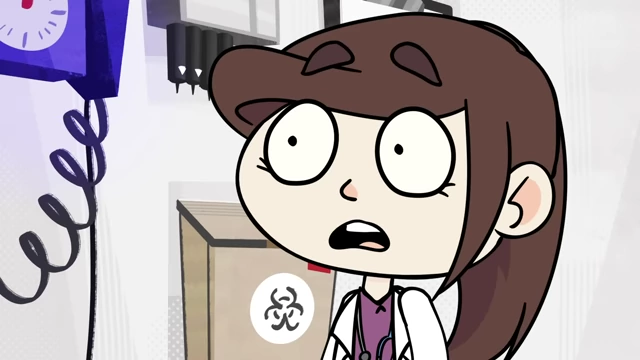
A cartoon doctor shows a surprised expression after the patient explains their incorrect birth control pill routine. [ 00:07:30 ]
Exploring Long-Term Reproductive Health Options with an OB/GYN [8:06]
After challenges with the pill, the speaker sought out an OB/GYN for more stable solutions.
- Importance of OB/GYN [8:12]
- An OB/GYN specializes in reproductive health, offering services beyond pregnancy, like testing and cancer screenings.
- It's recommended for everyone with a uterus to see an OB/GYN annually after turning 21.
- Personal difficulties with OB/GYN appointments [8:40]
- The speaker finds these appointments highly uncomfortable and invasive, comparing them to getting teeth pulled without painkillers.
- Her history of trauma sometimes triggers a "fight mode" response during these exams.
- She emphasizes the importance of open communication with the nurse (through questionnaires) and self-care before/after appointments.
- Bringing a trusted friend for support is also helpful.
- Alternative birth control options [9:49]
- The OB/GYN presented two long-term solutions:
- Arm Implant [9:53]: Popular, effective, quick to insert, lasts years, and can eliminate periods entirely.

A cartoon brochure illustrating the benefits of an arm implant for birth control, highlighting its effectiveness, longevity, and ability to stop periods. [ 00:10:00 ] - IUD (Intrauterine Device) [10:14]: A small T-shaped device inserted into the uterus, making the environment "uncomfortable" for menstruation, potentially stopping periods for years.

A cartoon brochure illustrating the IUD (Intrauterine Device) as a T-shaped device that makes the uterus "uncomfortable" to prevent periods. [ 00:10:20 ]
- Arm Implant [9:53]: Popular, effective, quick to insert, lasts years, and can eliminate periods entirely.
- The OB/GYN presented two long-term solutions:
- The painful reality of IUD insertion [10:44]
- The procedure is described as extremely painful, akin to "going into labor," and is typically done without anesthesia, with only Advil advised beforehand.
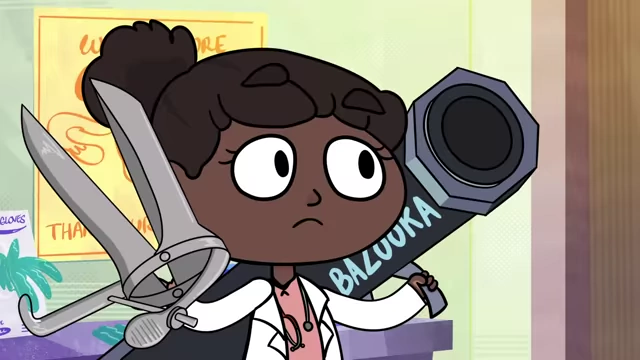
A cartoon doctor holding a speculum and a large "IUD Bazooka" tool, representing the invasive nature of IUD insertion. [ 00:10:48 ] - The speaker questions the lack of advanced pain relief for such an invasive procedure, highlighting a perceived societal de-prioritization of women's health concerning contraceptives.

The speaker, depicted in a cave with stick figures, criticizes the lack of advanced pain relief for IUD insertion, comparing the medical approach to the Stone Age. [ 00:11:22 ] 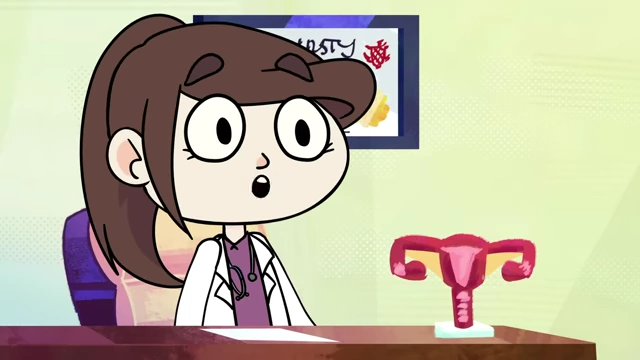
A cartoon doctor points to a uterus model on her desk while explaining the IUD insertion procedure to the patient. [ 00:13:02 ] - During her attempt, the pain was so severe it triggered her "childbirth alarm" in her brain, leading the doctor to suggest trying again with ultrasound guidance next month due to difficulty with insertion (13:30-14:22).

A "Childbirth Alarm" button in a brain, symbolizing the extreme pain experienced during the IUD insertion procedure. [ 00:13:39 ]
- The procedure is described as extremely painful, akin to "going into labor," and is typically done without anesthesia, with only Advil advised beforehand.
Choosing the Right Management Method and Advocating for Women's Health [14:35]
Following her difficult experience with the IUD, the speaker opted for another method and reflects on the overall "perks" of her period journey.
- Final choice and effectiveness [14:40]
- She ultimately chose the arm implant, which after about a year, proved to be the most effective method for her, resulting in only a couple of light periods.
- The true "perks" of a period [14:51]
- The only "perks" are having complete access to the right doctors, options, and healthcare choices tailored to one's body.
- Call to action [15:18]
- The speaker encourages viewers to talk to their doctors to find what is right for them.