Sam Altman Discusses GPT-5 Capabilities, AI's Societal Impact, and Career Opportunities in the AI Era
This interview with Sam Altman of OpenAI covers several key areas:
- GPT-5 Advancements: Altman highlights GPT-5's enhanced fluency, adaptive intelligence, and agentic capabilities, likening it to having PhD-level experts available 24/7 for complex tasks like software development and research.
- Career & Entrepreneurship in AI: He advises young people to master AI tools, develop adaptability, and focus on creating products people truly want. AI significantly boosts the efficiency of startups.
- Societal Impact of AGI: Altman envisions a post-AGI world where family and community become more important. He expects increased social support, potentially through universal basic income or sovereign wealth funds, and sees AGI as fundamentally deflationary in the long run, while admitting short-term economic effects are complex.
- Business Strategy with AI: Building a business solely on AI without a defensible layer is insufficient. Companies need to integrate AI to create unique value and strong customer relationships, similar to how successful apps leveraged the iPhone platform.
- Human vs. AI Intelligence: While AI excels at short-term, knowledge-based tasks, human intelligence remains superior in long-term problem-solving and generating truly contrarian, "right" ideas. Human connection will also increase in value.
- Future of Robotics & Form Factors: Humanoid robots are likely due to a human-designed world. AI's ideal form factor will move beyond "on/off" devices to ambient, proactive companions like wearables.
- India's AI Opportunity: India is projected to be OpenAI's largest market, with remarkable enthusiasm and entrepreneurial drive to become a global producer of AI solutions.
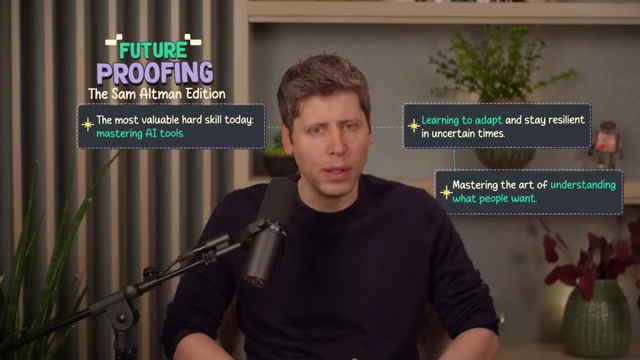
Sam Altman outlines key skills for future-proofing: mastering AI tools, adaptability, and understanding user needs. [ 00:09:45 ]
What’s New in GPT-5? [01:13]

- Enhanced Fluency and Adaptive Intelligence: GPT-5 exhibits a fluency and adaptive intelligence that makes reverting to previous models feel "painful."
- Integrated Model: Unlike earlier versions, GPT-5 is an integrated model, eliminating the need for users to choose between different model types (e.g., GPT-4, GPT-4 mini) for specific tasks.
- PhD-Level Expertise: It provides access to "PhD-level experts in every field, available to you 24/7," capable of answering questions and performing diverse tasks.
- Diverse Applications: These tasks include creating software from scratch, generating research reports on complex topics, and planning events.
- Agentic Nature: GPT-5 is more agentic, meaning it's better at sequential tasking, showing increased robustness and reliability for carrying out long and complex workflows.
Sam on First Principles, Careers & Future Industries [02:54]
Altman views the current era as an exceptionally exciting time for career development and entrepreneurship.
- Unprecedented Potential: A 25-year-old in a city like Mumbai or Bangalore today has more potential than any previous generation, thanks to powerful new tools.
- Impact on Industries:
- Science: AI will transform scientific discovery, accelerating the rate at which individuals can make breakthroughs.
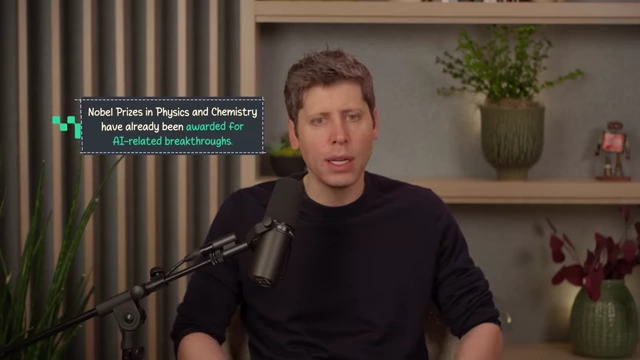
Nobel Prizes have already been awarded for AI-related breakthroughs in Physics and Chemistry. [ 00:05:09 ] - Programming: It's fundamentally changing how computers are programmed, enabling the creation of entirely new types of software.
- Startups: AI allows tiny teams to accomplish a vast amount of work, making it easier to launch new businesses efficiently.
- Science: AI will transform scientific discovery, accelerating the rate at which individuals can make breakthroughs.
- Open Canvas: The limitations for individuals are now primarily creativity and the quality of their ideas, rather than technical barriers or extensive experience.
What’s Possible with GPT-5 [05:47]
GPT-5 represents a "pretty significant step forward" in how people interact with AI systems.
- Increased Capability, Robustness, and Reliability: These improvements make it highly suitable for a wide range of daily tasks, from creating software and answering questions to learning and improving work efficiency.
- Unlocking Human Potential: Each major AI advancement has revealed new human potential, with users leveraging these tools for new companies, better learning, and improved services.
- India's Importance: India is currently OpenAI's second-largest market and could soon become its largest. Feedback from Indian users has influenced model improvements, including better language support and more affordable access to ChatGPT.

Sam Altman's tweet noting India's amazing AI adoption and creativity. [ 00:06:29 ]
Building on GPT-5: Skills & Science Applications [07:09]
Altman details practical applications of GPT-5 and essential skills for navigating the AI-driven future.
- Efficient Startup Building: A 25-year-old can leverage GPT-5 to build a startup much more efficiently, handling various operational aspects:
- Software development for products.
- Customer support.
- Marketing and communications plans.
- Reviewing legal documents.
- Key Skills for the AI Era:
- Mastering AI Tools: The most important specific "hard skill" is becoming highly proficient at using new AI tools and thinking in an "AI-native" way.
Sam Altman outlines key skills for future-proofing: mastering AI tools, adaptability, and understanding user needs. [ 00:09:45 ] - Learning to Learn: Developing the meta-skill of learning rapidly is crucial in a fast-changing world.
- Adaptability and Resilience: These general skills are highly valuable as the landscape evolves.
- Understanding User Needs: Figuring out what people want ("make something people want," a motto from Y Combinator's Paul Graham) remains paramount for success.

Paul Graham, co-founder of Y-Combinator, whose advice "make something people want" influenced Sam Altman. [ 00:10:00 ]
- Mastering AI Tools: The most important specific "hard skill" is becoming highly proficient at using new AI tools and thinking in an "AI-native" way.
Mastering Today’s AI Tools [10:28]
Altman shares how he personally utilizes AI tools and advises others to do the same.
- Creating Small Software Pieces: GPT-5 is exceptionally good at helping to create small software solutions for everyday problems.
- Iterative Creative Process: His approach involves asking the AI for a first draft, using it, and then iteratively requesting improvements and new features based on workflow needs and discoveries.
Sam’s Self-Perception & Edge at 19 [11:37]
Nikhil Kamath brings up Paul Graham's 2009 list of founders to watch, which included a 19-year-old Sam Altman alongside figures like Steve Jobs.
- Undeserved Recognition: Altman recalls feeling the mention was "deeply undeserved" at the time, seeing himself as naive and unsure.
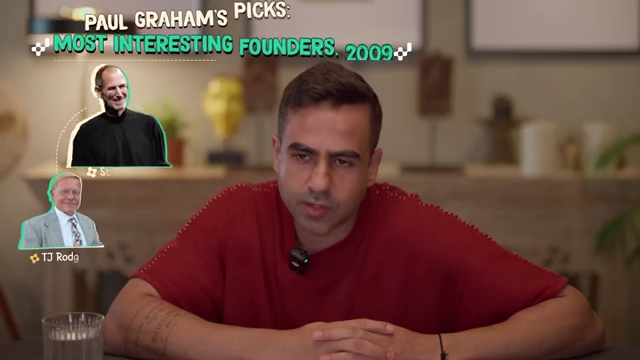
Paul Graham's 2009 list of "most interesting founders" included Sam Altman at age 19. [ 00:12:04 ] - OpenAI's Edge: The company's strength lies in:
- Long Time Horizon: Taking a very long view, like the 4.5 years of research before OpenAI's first product.
- Independent Thinking: Trusting internal conviction and pursuing different ideas than the mainstream, even without immediate external validation.
Is Humility Still an Advantage? [13:42]
Kamath asks if projecting humility, as Altman often does, is an effective strategy in today's world.
- Reality of Leadership: Altman asserts that "no one has a plan," and everyone, including himself, is "figuring it out as they go."
- He describes the process as constantly adapting to problems, making bets on people, and reacting to market changes.

Sam Altman explains that no one has it all figured out, and intellectual openness is crucial for good decisions. [ 00:15:57 ]
- He describes the process as constantly adapting to problems, making bets on people, and reacting to market changes.
- Value of Openness: Projecting false certainty is counterproductive, as it hinders intellectual openness, the ability to listen to diverse viewpoints, and ultimately, making good decisions.
- Adaptability is Key: Curiosity, a willingness to adapt to new data, and changing one's mind are crucial strengths. The best founders are quick learners and adapters rather than those projecting bravado.
Parenthood & Why He Chose It [18:51]
Altman, who recently became a parent, shares his perspective on the experience.
- Profound Experience: Parenthood is his "favourite thing ever," describing it as the "coolest, most amazing, most emotionally overwhelming" experience.

Sam Altman's personal tweet welcoming his son to the world and sharing his profound love. [ 00:19:07 ] - Exceeding Expectations: He took a "leap of faith" based on others' recommendations and found that it has "exceeded all expectations," offering a type of love previously unknown.
How Marriage, Religion & Kids Will Evolve [21:19]
Altman expresses his hopes for the future of social structures in a post-AGI world.
- Importance of Family and Community: He hopes that creating family and community will become "far more important" as society evolves.
- Reversing Negative Trends: The decline of these structures is a "real problem for society," and he hopes for a reversal.
- Happiness through Connection: With increased abundance, time, resources, and potential from AI, people will likely return to family and community as primary sources of happiness.
Capitalism, Democracy & The Odds of Socialism [22:20]
Kamath asks about the future of economic and political systems.
- Limitless Human Desire: Altman believes human demand, desire, and ability to engage in "status games" are "pretty limitless." People will always find new things to want and compete over.
- AI Distribution: It's unlikely that one company (like OpenAI) would control half of global GDP. AI is more akin to the transistor, a fundamental scientific discovery that becomes embedded in countless products and services in a distributed manner.

Sam Altman states his belief that AI will be a distributed technology like the transistor. [ 00:23:46 ] - Increased Social Support: He expects an increase in social support, redistribution, or similar mechanisms as society becomes wealthier and the technological landscape shifts.
- Experimentation: This could manifest through new sovereign wealth funds, universal basic income (UBI) ideas, or redistribution of AI compute, varying by country.
- Worldcoin Experiment: Altman discusses Worldcoin as an experiment to identify unique humans in a privacy-preserving way and build a new network/currency around that, potentially for UBI distribution.
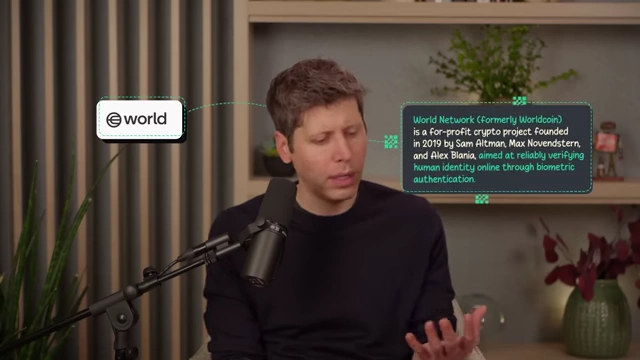
An overview of World Network (formerly Worldcoin), a crypto project for human identity verification and potential UBI. [ 00:25:27 ]
Does AGI Make Capital Obsolete? [25:44]
The discussion turns to the economic impact of AGI, particularly on capital.
- Deflationary Potential: From basic economic principles, AGI is "supposed to be hugely deflationary" by eliminating scarcity and increasing productivity.
- Short-Term Ambiguity: However, in the short term, capital might become even more important if building AI compute is deemed critical, making every piece of compute highly valuable.
- Uncertain Interest Rates: Altman gives an example of someone questioning if future interest rates would be -2% or 25%, highlighting the economic uncertainty.
- Capital Sinks: In a deflationary world, while some things face deflationary pressure, other categories (like "gateway luxury brands" discussed earlier) could become "sinks for all of the extra capital," potentially seeing their value increase.
Marginal Utility & the Fate of Wrappers [28:25]
Kamath probes the concept of marginal utility and the longevity of "wrapper" businesses built on top of large AI models.
- Quality Over Quantity: While 20 kettles might have no additional utility, people will seek "much better stuff" even if they don't get more of it (e.g., endlessly improving video games).
- Defensible Businesses: Using AI itself does not create a defensible business. Companies must parlay the advantage from new technology into a durable business with real value.
- Race Against the Clock: It's a race to build a defensible layer around the core AI.
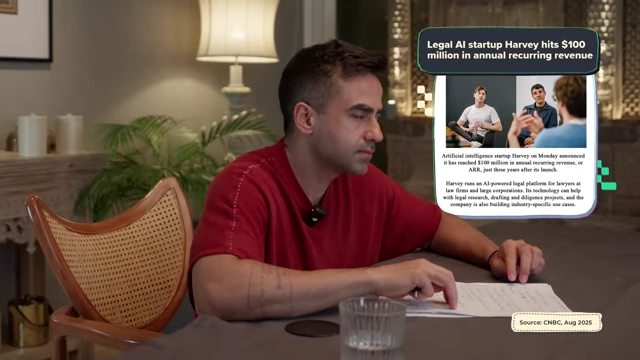
A news report on legal AI startup Harvey reaching $100 million in annual recurring revenue. [ 00:29:47 ] 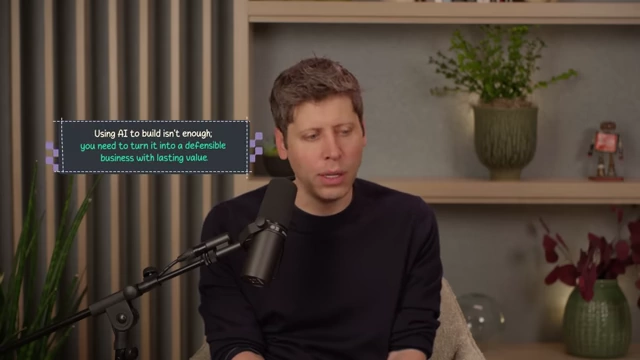
Sam Altman emphasizes that using AI is not enough; businesses need to build a defensible layer with lasting value. [ 00:30:44 ] 
Sam Altman describes a Moore's Law-like trend in AI, leading to faster, cheaper, and more accessible technology. [ 00:31:45 ] - Lessons from the iPhone App Store: Early "toy applications" (like a flashlight app) were eventually integrated into the core OS. Successful, durable businesses (like Uber) used the new technology as an enabler for more complex, sticky services.
- Race Against the Clock: It's a race to build a defensible layer around the core AI.
- Customer Ownership: Building a deeper relationship with the customer, particularly through services rather than one-off products, is crucial for durability.
Is Contrarian Thinking an Edge? [34:15]
Kamath suggests that in a world where AI can predict human behavior, being contrarian might become more valuable.
- Contrarian and Right: Altman agrees that the ability to generate "contrarian and right" ideas (which current models struggle with) will increase in value. Most contrarian ideas, however, are simply wrong.
- Value of Human Connection: Despite AI's intelligence, people will continue to value other humans.
- Human Uniqueness: An AI podcast host, no matter how smart, is unlikely to be more popular than a real human host because people care deeply about other humans, their life stories, and shared cultural/social value.
- "Real Person" Value: Being a "real person" in a world of unlimited AI content will increase in value, even if that includes human imperfections or "screwing up."
AGI vs. Human Intelligence [37:33]
Altman differentiates current AI capabilities from human intelligence.
- AI's Strengths: GPT-5 is "incredibly smart" at short-term tasks (seconds to a few minutes), demonstrating superhuman abilities in knowledge, pattern recognition, and recall.
- Human Strengths (Currently): AI is "definitely not close to human performance" in:
- Figuring out what questions to ask.
- Working on something over very long periods.
- Math Example: AI has progressed from solving math problems in minutes to achieving gold-level performance on Math Olympiad problems (90-minute tasks). However, proving a new mathematical theorem can take "a thousand hours," a capability AI cannot yet achieve.

A tweet highlights AI's achievement of gold-level performance on International Math Olympiad problems. [ 00:38:29 ]
The Future of Robotics [38:56]
Altman discusses the growing importance of robotics.
- AGI-like Robots: Seeing robots perform normal day-to-day tasks on the street will be a strong indicator of AGI's presence.
- Humanoid Form Factor: Humanoid forms are beneficial because the world is largely "built for humans" (e.g., door handles, steering wheels). While specialized robots will exist, human-like forms allow interaction with existing infrastructure.

Nikhil Kamath discusses China's potential leadership in robotics development. [ 00:39:26 ] - Manufacturing Scale: Building a robotics company requires significant manufacturing scale, which necessitates finding strong partners.
Where the Form Factor is Headed [40:55]
The conversation explores how the physical interface with AI will evolve.
- Context, Proactivity, Companion: AI needs to have as much context as possible, be proactive, and act as a constant companion throughout the day.
- Limitations of Current Devices: Current computers and phones have an "on or off binary" and are not ideal for this ambient, proactive AI companion model.
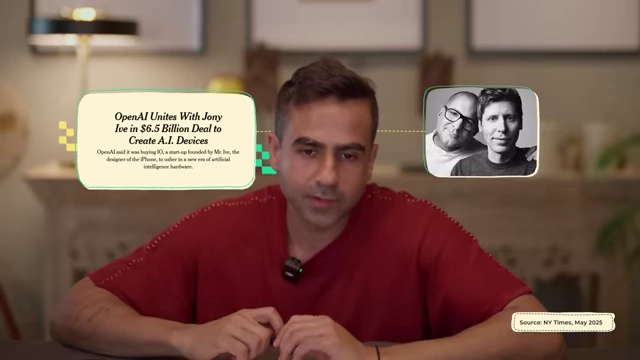
A news article reports on OpenAI's $6.5 billion deal with Jony Ive to create new AI devices. [ 00:41:08 ] 
Sam Altman explains why current devices like phones are not ideal for an ambient, proactive AI companion. [ 00:42:02 ] - Future Hardware: New form factors are needed, such as glasses, wearables, or small devices that sit on tables, enabling "ambiently aware physical hardware" that an AI companion can "embody itself in."
Climate Change & AI in India [42:54]
Altman shares his views on critical global issues.
- Fusion Energy for Climate: His investment in Helion (fusion energy) is a significant step forward for climate change, though he suspects current damage will require additional efforts to undo.
- India's AI Opportunity:
- Largest Market: India is expected to become OpenAI's largest market soon, driven by immense excitement and adoption of AI.
- Leapfrogging into the Future: Indian people are uniquely positioned to use AI to "leapfrog into the future" and invent new, better ways of doing things, leading to significant economic and societal benefits.
- Producer Nation: There is incredible entrepreneurial energy in India focused on building AI solutions, transitioning from being consumers to producers for the global market.

Sam Altman discusses India's incredible entrepreneurial energy in building AI solutions for the global market. [ 00:44:12 ]