How to Transform Your Life in the Last Month of the Year
This video emphasizes that the final month of the year is crucial for achieving goals and setting up the next year for success. The speaker outlines a four-part system for personal transformation:
- Part 1: The End of the Old Operating System - Focuses on "identity shifting," which involves reprogramming your mind and beliefs to assume the identity of the person you aspire to be. Habits follow identity, so changing your core self is key to changing your actions and results.
- Part 2: The Art of Productive Isolation - This section explains how to pull away from noise and distractions by detoxing from social media for the first three hours of the day, optimizing your physical work environment for focus, and eliminating drama and low-value inputs.
- Part 3: Emotional Control as a Performance Tool - Highlights the importance of managing your emotional state by identifying your patterns, controlling your reactions, and aligning all your consumed content with your goals. Meditation and affirmations are suggested as actionable steps.
- Part 4: The 30-Day Identity Audit - A protocol for self-evaluation to identify old identity parts that no longer serve you, traits that stuck, and areas needing further development. This includes creating a "bad-day protocol" to maintain consistency even when motivation is low.
Introduction [0:00]
The speaker highlights that the end of the year (specifically, the last month) is a critical time for reflection and change, especially if the current year didn't meet expectations. It's an opportunity to rewrite the ending of the current year and set the foundation for the next. This month is crucial for changing habits and achieving goals, as a lack of consistency and discipline can spill over into the new year.
The End of the Old Operating System [1:27]
This section focuses on the concept of updating one's "mental operating system" to shed outdated beliefs and identities that no longer serve personal growth.
- The speaker compares this to an old device with a slow operating system, emphasizing that an un-optimized mental system will hold you back.
- The core idea is not just to improve life but to reprogram the mind, beliefs, and identity.
- This involves identity shifting, belief challenging, and pattern interruption.
- Identity Shifting [2:40]
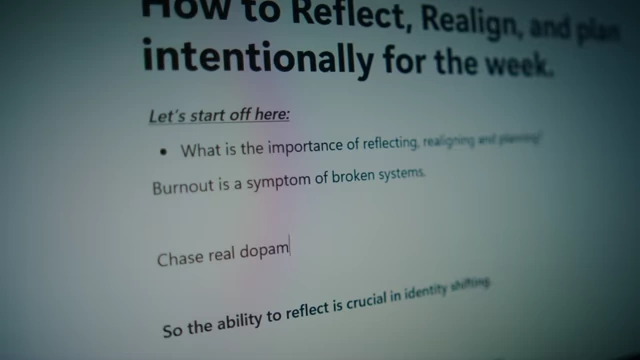
A prompt for reflecting and planning intentionally for the week, highlighting that burnout is a symptom of broken systems and that reflection is crucial for identity shifting. [ 00:00:26 ] - Identity shifting means assuming the identity of the person you want to become by making a promise to that future self and consistently abiding by it.
- Every small win and consistent action builds self-trust and self-confidence, reinforcing the new identity.
- Habits naturally follow identity; the identity comes first, then the habits.
- For example, a swimmer will always swim because that's their identity. To quit a bad habit, one must change the underlying identity associated with it.
- To fundamentally change your life, you must change your identity, not wait for results.
- Ask yourself: "How does the person who consistently achieves my goals think, act, and move?" Then embody that persona.
The Art of Productive Isolation [4:55]
Productive isolation is defined as a strategic withdrawal from noise and distractions, not loneliness. It's about eliminating low-value inputs to make space for high-value ones.
- Inputs directly influence outputs; low-quality inputs lead to low-quality outputs.
- Focus on controlling inputs rather than outputs, as inputs are within your active control.
- 3 Ways to Pull Away From the Noise [6:00]
- Social Media Detox [6:02]
- A crucial tip is to avoid opening your phone for at least three hours after waking up.
- The speaker's personal experiment showed that delaying phone use led to increased focus and productivity throughout the day, while early phone use resulted in dopamine cravings and distractions.
- Detoxing from social media means not being distracted by external digital noise to focus on personal growth and goals (e.g., physique, financial status).
- Physical Environment Optimization [7:40]
- This involves optimizing your work environment for maximum focus.
- Examples include:
- Cleaning your desk and only keeping essentials.
- Optimizing your web browser for accessibility of needed tools and removal of distractions.
- Changing your work environment (e.g., working from a cafe or hotel) if your default home environment conflicts with your energy and focus.
- Environments carry energies, and some may not be conducive to productive work. Experiment to find what works best.
- Eliminating Drama [8:47]
- Pull away from noise and drama like talking about other people's lives or celebrity gossip.
- Realize that your own goals and life are paramount. Spending time on external drama distracts from achieving personal objectives.
- Social Media Detox [6:02]
- 2 Ways to Reach Your Goals [9:30]
- Increase your sacrifice: Dedicate more time and effort to your goals by cutting out non-essential activities.
- Reduce your desire for distractions: Lower the allure of things that pull you away from your objectives.
Emotional Control as a Performance Tool [9:46]
This section emphasizes learning to manage your emotional state rather than being controlled by it.
- Conduct a "self-audit" to understand your emotional patterns and states throughout the week.
- Identify days or situations where you tend to fall into ruts or seek dopamine.
- Once patterns are identified, you can adapt and adjust to strive for optimal performance, even if perfection is an illusion.
- Control your emotions, reactions, and what you allow into your life (inputs).
- Align Your Content Consumption with Your Goals:
- If you want to be a successful business owner, your YouTube and social media feeds should reflect content related to business, sales, and personal development, not random entertainment.
- Controlling your inputs (content, conversations, diet) shapes your identity and helps you achieve your goals.
- Actionable Steps [11:47]
- Meditation [12:00]
- Meditating for 10-15 minutes daily helps silence distractions and practice controlling your thoughts and brain waves.
- This improved thought control makes you better at resisting distractions and actively achieving goals without self-sabotage.
- Affirmations [12:36]
- Affirmations are effective for reaffirming a new identity or way of being.
- Meditation [12:00]
The 30-Day Identity Audit [12:53]
This involves a raw self-evaluation to understand your evolving identity and areas for growth.
- Self-Revision Protocol [13:12]
- For 30 days, monitor yourself to answer three key questions:
- What parts of your old identity are no longer present?
- What new traits have successfully stuck?
- What areas still need work, evolving, or change?
- Identify your "emotional crutches" – the bad habits or "dirty pleasures" you turn to when life gets hard, stressful, or you fall into a rut.

A question displayed on screen: "What are the habits I turn to, when life gets hard?" [ 00:13:19 ]
- For 30 days, monitor yourself to answer three key questions:
- Bad-Day Protocol [13:49]
- Once you understand your emotional crutches and typical bad-day behaviors, you can adjust and optimize.
- Create a minimum viable system that you can adhere to even when you don't feel like it. This helps shift bad habits and create space for good ones.