US Government Shutdown Update: Impact on SNAP Benefits, Unpaid Federal Workers, and Federal Reserve Data Leading to Economic Uncertainty
The video provides a status update on the US government shutdown, detailing its critical impacts:
- SNAP Benefits at Risk: 42 million Americans relying on SNAP (formerly food stamps) face funding cuts starting November 1st, as the USDA refuses to use contingency funds, claiming they are for disasters. Some states are partially funding benefits, while others suspend them, with no federal reimbursement.
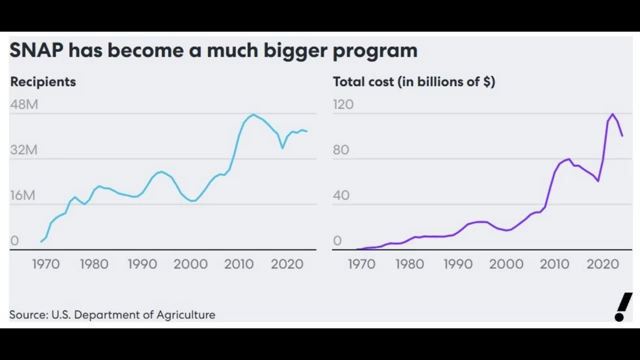
Chart showing the growth in SNAP recipients and total cost over decades. [ 00:02:20 ] - Aviation Disruptions: Air traffic controllers and TSA agents are working without pay, causing thousands of flight delays and potential holiday travel chaos. Federal law prohibits these essential employees from striking, despite delayed paychecks.
- Federal Reserve Data Crisis: The shutdown prevents the release of crucial economic data, including jobs and inflation reports, which the Federal Reserve relies on for monetary policy decisions. This data void has led to uncertainty regarding December interest rate cuts, scaring the stock market.
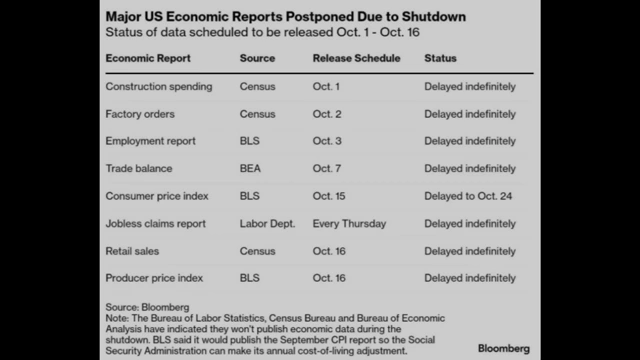
Table showing major US economic reports postponed due to the shutdown. [ 00:06:23 ] - Significant Economic Cost: The Congressional Budget Office estimates the shutdown has already cost the US economy $18 billion due to lost productivity from non-working federal employees and reduced consumer spending.

Bloomberg headline reporting the government shutdown has already cost the US economy $18 billion. [ 00:06:38 ] - Political Standoff: The Senate has repeatedly failed to pass funding bills (13 times) due to a lack of negotiation, but increasing pressure from these escalating problems is forcing renewed talks. The speaker predicts a resolution before November 7th, when Congress is scheduled for vacation.
Government Shutdown Status Update [0:00]
The video provides an update on the ongoing government shutdown, describing it as a "fiasco," "circus," or "catastrophe." The speaker highlights several critical problems stemming from the shutdown.
1. Impact on SNAP Benefits [0:12]
The shutdown's most significant problem is the funding for SNAP benefits, previously known as food stamps.
- November Funding Cuts: Funding for November SNAP benefits is set to dry up.
- 42 million Americans, representing 12% of the US population, receive monthly SNAP benefits for food assistance.

Yahoo News headline stating that SNAP benefits won't go out on Nov. 1 due to the government shutdown, affecting 42 million Americans. [ 00:00:25 ] - Some states will partially fund these payments, while others will completely suspend them, depending on the state.
- 42 million Americans, representing 12% of the US population, receive monthly SNAP benefits for food assistance.
- USDA's Stance on Contingency Funds: The USDA has refused to tap into contingency funds to cover November benefits.
- The USDA memo states that these funds are not legally available for regular benefits [0:53] and are intended for natural disasters like hurricanes, tornadoes, and floods, which "come on quickly and without notice" [1:16].
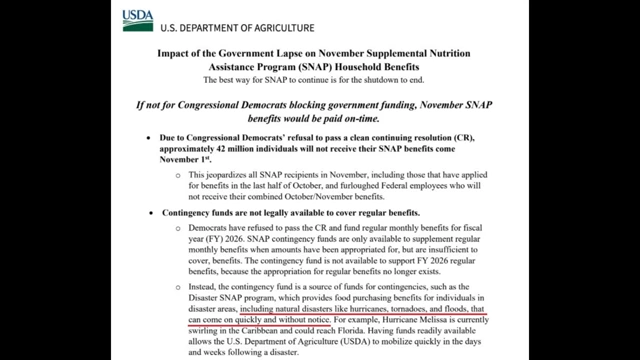
An excerpt from a USDA memo explaining that contingency funds are not legally available for regular SNAP benefits, but rather for disasters. [ 00:01:13 ] - Using funds from other sources would impact Child Nutrition Programs (school meals, infant formula) [1:34].

An excerpt from a USDA memo stating that transfers from other sources would pull away funding for school meals and infant formula. [ 00:01:43 ]
- The USDA memo states that these funds are not legally available for regular benefits [0:53] and are intended for natural disasters like hurricanes, tornadoes, and floods, which "come on quickly and without notice" [1:16].
- States Cannot Be Reimbursed: The federal government will not reimburse states if they cover the cost of SNAP benefits [1:53].
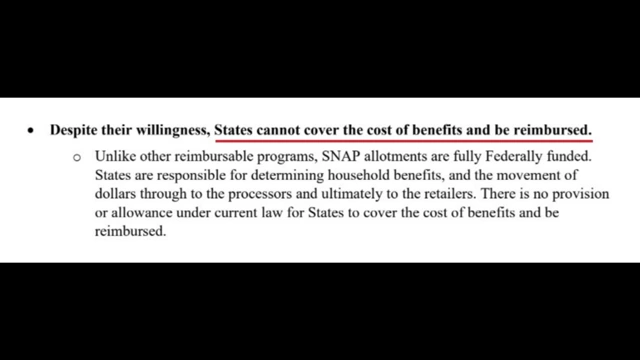
An excerpt from a USDA memo stating that states cannot cover the cost of SNAP benefits and be reimbursed. [ 00:02:06 ] - Despite this, some states are choosing to partially fund benefits, while others are waiting for the shutdown to resolve.
- SNAP Program Growth: The number of Americans receiving SNAP benefits has grown substantially over decades, with 42 million recipients in 2024.
Chart showing the growth in SNAP recipients and total cost over decades, indicating a significant increase in program scale. [ 00:02:20 ] 
A heat map of the US indicating which states rely on SNAP the most, with darker shades showing higher reliance. [ 00:02:34 ]
2. Aviation Disruptions and Unpaid Federal Workers [2:48]
The government shutdown is causing significant issues in the aviation sector due to unpaid federal employees.
- Unpaid Air Traffic Controllers: Air traffic controllers are not receiving their pay, leading to flight delays.
- Over 3,300 flight delays across the US were reported as of Monday afternoon [2:50].
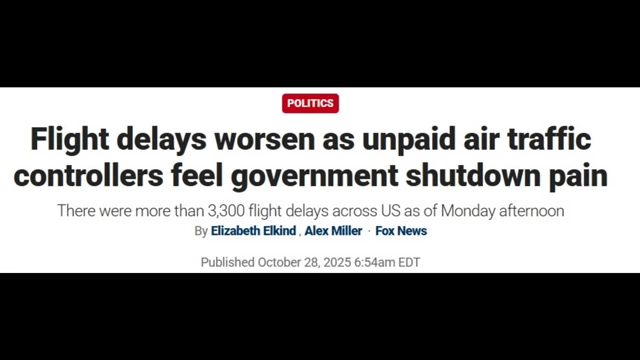
Fox News headline stating that flight delays are worsening as unpaid air traffic controllers feel the pain of the government shutdown. [ 00:02:49 ] - This issue is anticipated to become a major pain point for politicians, especially with holiday travel approaching [3:36].
- Over 3,300 flight delays across the US were reported as of Monday afternoon [2:50].
- TSA Agents Working Without Pay: TSA agents are legally required to work but are not getting paid.
- It is illegal for federal employees, including TSA agents, to strike, as it would jeopardize national security [4:25].
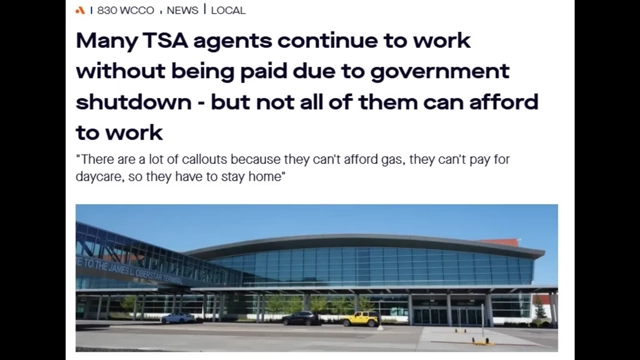
WCCO News headline reporting that many TSA agents continue to work without pay, but some cannot afford to. [ 00:03:44 ] - The government requiring essential personnel to work without timely pay is criticized as unfair [4:50].
- It is illegal for federal employees, including TSA agents, to strike, as it would jeopardize national security [4:25].
3. Federal Reserve Data Dependency and Market Impact [5:02]
The shutdown is hindering the Federal Reserve's ability to make informed decisions due to a lack of economic data.
- Missing Economic Reports: Key government reports are being delayed or unreleased.
- The jobs report for October was not released, and November reports are expected to be missed [5:19].
- Inflation reports (CPI) for November may also be delayed [5:25].
- Other affected reports include construction spending, factory orders, trade balance, jobless claims, retail sales, and producer price index [6:24].
A table titled "Major US Economic Reports Postponed Due to Shutdown" showing various reports, their sources, original release schedules, and their current delayed status. [ 00:06:23 ]
- Impact on Interest Rate Decisions: The lack of data creates uncertainty for the Federal Reserve.
- In September, there was a 93% chance of an interest rate cut in December, but this has fallen to 70% due to the data void [6:04].
- Federal Reserve Chair Jerome Powell noted "strong disagreement" among committee members on December's rate decision due to being on a "foggy path" without reports [5:50].
- Stock Market Reaction: This uncertainty has caused a scare in the stock market, which anticipated more rate cuts and an easier monetary policy [6:15].
4. Economic Costs and Productivity Loss [6:37]
The shutdown has tangible financial costs and widespread economic ripple effects.
- $18 Billion Economic Cost: The Congressional Budget Office (CBO) reports the shutdown has already cost the US economy $18 billion this year [6:40].
Bloomberg headline stating that the government shutdown has already cost the US economy $18 billion this year, according to the CBO. [ 00:06:38 ] - Lost Productivity: The majority of federal employees are not working but will receive back pay, leading to a massive loss of productivity [6:49].
- This is highlighted as a waste of taxpayer money, as people are paid for no work done.
- Reduced Consumer Spending: Unpaid federal employees naturally cut back on spending, creating a chain reaction that harms local businesses [7:23].
- An example given is a donut shop owner whose sales plummeted because federal employees, his main customers, were not working [7:31].
5. Political Standoff and Prospects for Resolution [7:47]
The political situation in Washington D.C. has been characterized by deadlock.
- Repeated Failures to Pass Funding Bill: The Senate has voted on the same government funding bill 13 times, consistently failing to reach the necessary 60 votes (receiving 54 instead) because of a lack of negotiation between Republicans and Democrats [8:30].
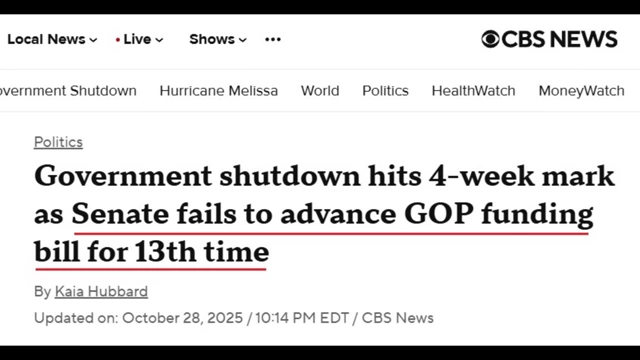
CBS News headline reporting that the government shutdown has hit the 4-week mark as the Senate failed to advance a GOP funding bill for the 13th time. [ 00:08:27 ] - Mounting Pressure for Resolution: The escalating problems, including SNAP cuts, Obamacare enrollment openings on November 1st, and aviation troubles, are creating immense pressure for a resolution.
- Senators have started talking again due to this pressure [8:27].
- Prediction of Resolution: The speaker predicts the shutdown will be resolved very soon, likely well before the end of November [9:24].
- A significant motivator is that Congress is scheduled for vacation on November 7th, providing an incentive to resolve the issue beforehand [9:36].