How to Legally Profit from Inside Information in Prediction Markets
This video explains how to legally profit from inside information using emerging prediction markets like Polymarket and Kalshi, which actively encourage such activity to improve market accuracy for their data sales.
- Traditional insider trading is illegal and risky, but it exists in gray areas (e.g., real estate, 9/11 puts, COVID-19 stock shorts).
- Prediction markets operate in a currently unregulated legal gray area, allowing participants to leverage non-public information without legal repercussions (at worst, a fine).
- Notable examples include a Super Bowl streaker profiting from his own stunt, early bets on Taylor Swift's engagement, and bets on an HBO documentary's conclusion by those with advanced knowledge.
- These platforms deliberately encourage "insider trading" because it enhances market accuracy, making their predictive data more valuable. Their true business model is selling this accurate, real-time data to institutional clients (e.g., automated trading algorithms, government agencies) as a superior forecasting tool, much like a Bloomberg Terminal.
- Individuals can profit by creating markets based on their proprietary knowledge, collaborating with friends who have inside information, or developing tools to track large, confident "insider betting whales" in illiquid markets and piggybacking on their trades.
- This "ask for forgiveness, not permission" strategy, akin to the early days of futures trading or Uber, presents a unique, time-limited opportunity while these markets remain largely unregulated.

Prediction Markets Invite Insider Trading—And That's a Good Thing [ 00:03:49 ]
The Context of Insider Trading [0:08]
Insider trading often operates in a gray area, where individuals exploit non-public information for financial gain.
- Traditional Illegality and Risks
- Insider trading is explicitly deemed illegal by regulatory bodies like the SEC, carrying risks of prison time and substantial fines.
- Despite clear laws, detecting and prosecuting insider trading remains challenging due to its covert nature.

Summary of characteristics of traditional 'inside information' [ 00:01:40 ]
- Historical Examples Highlighting the Gray Area
- Real Estate: Homebuyers/sellers might use advance knowledge about local development (e.g., Section 8 housing coming to town) to inform their transactions, selling before others become aware.
- COVID-19 Pandemic: Individuals with early knowledge from contacts in Wuhan allegedly shorted markets in the U.S., profiting from the impending economic downturn.
- September 11th Attacks: An academic paper notes unusual trading volumes (10 times more puts than calls) on American Airlines and United Airlines just days before 9/11, suggesting informed trading.

Academic journal article discussing unusual option market activity before 9/11 [ 00:00:45 ] - The abstract highlights the unusually high level of put buying on airlines before September 11, 2001.

Abstract highlighting the unusually high level of put buying on airlines before September 11, 2001 [ 00:01:02 ] - Firms like Morgan Stanley, with significant presence in the World Trade Center, also saw abnormal trading volumes.
- The abstract highlights the unusually high level of put buying on airlines before September 11, 2001.
- These historical instances illustrate how difficult it is to catch those with non-public information, especially when their identities are obscured.

Notable individuals convicted of traditional insider trading [ 00:00:09 ] 
Big-name convictions for insider trading, detailing sentences and fines [ 00:00:12 ]
Introduction to Legal "Insider Trading" in Prediction Markets [1:42]
A new class of financial markets, called prediction markets, offers a unique environment where leveraging non-public information is currently legal and carries minimal risk.
- Emergence of Prediction Markets
- Platforms like Polymarket and Kalshi allow users to bet on the outcomes of future events.

Logos of prominent prediction market platforms, Polymarket and Kalshi [ 00:01:55 ] - Unlike traditional stock markets, these markets are not yet fully regulated by bodies like the SEC or CFTC, creating a legal gray area.

Article discussing Bill Ackman's suggestion of a 'legal insider trade' on Polymarket and the lack of SEC regulation [ 00:02:24 ] 
Text from an article explaining the legal ambiguity of insider trading on prediction markets due to evolving regulations [ 00:02:56 ]
- Platforms like Polymarket and Kalshi allow users to bet on the outcomes of future events.
- Cases of Legal Insider Betting
- Super Bowl Streaker: A bettor successfully wagered $50,000 on there being a Super Bowl streaker, making over $300,000. He was only identified because he publicly bragged about his plan, but his associates likely profited undetected.

News report on a Super Bowl streaker who bet $50,000 on his own stunt and won [ 00:02:00 ] - Taylor Swift's Engagement: A significant bet was placed on Polymarket regarding Taylor Swift's engagement, days before public announcement, causing a price spike. The anonymous nature of Polygon wallets (used on Polymarket) made it impossible to trace the "insider."

News story reporting how Polymarket activity 'foretold' Taylor Swift's engagement due to insider betting [ 00:02:39 ] 
Detail from the article showing the price spike from a single user's bet on Taylor Swift's engagement [ 00:02:47 ] - HBO Documentary on Bitcoin: Ahead of an HBO documentary's release, people involved in the production allegedly placed bets on Polymarket regarding the film's conclusion, demonstrating market movements consistent with foreknowledge.

Poster for the HBO documentary 'Money Electric: The Bitcoin Mystery,' which was subject to insider betting [ 00:03:03 ]
- Super Bowl Streaker: A bettor successfully wagered $50,000 on there being a Super Bowl streaker, making over $300,000. He was only identified because he publicly bragged about his plan, but his associates likely profited undetected.
The Business Model: Why Prediction Markets Encourage Insider Information [3:33]
Prediction markets actively encourage, or at least tacitly allow, insider trading because it is fundamental to their core business objective: accurate forecasting.
- Beyond Transaction Fees
- While fees might become a revenue source later, current platforms like Polymarket often waive them to attract users and build liquidity.
- The real value lies in the accuracy and predictive power of the market data generated.
Article highlighting that prediction markets 'invite' insider trading as a feature, not a flaw [ 00:03:49 ] 
Text explaining that prediction markets prioritize accuracy over fairness, encouraging insider trades for better forecasting [ 00:04:14 ]
- Competition with Traditional Data Providers
- Prediction markets aim to compete with established data services like Bloomberg Terminal by offering superior, real-time forecasts.

A Bloomberg Terminal workstation, representing a competitor in the financial data industry [ 00:04:59 ] - Their ability to predict future events (e.g., political elections, corporate earnings) more accurately than traditional polls or analyses is highly profitable.
- For instance, prediction markets were more accurate in forecasting Donald Trump's potential 2024 presidential win than many traditional polls.

CNN Business article crediting prediction markets for more accurately forecasting political outcomes than traditional polls [ 00:04:34 ]
- For instance, prediction markets were more accurate in forecasting Donald Trump's potential 2024 presidential win than many traditional polls.
- Prediction markets aim to compete with established data services like Bloomberg Terminal by offering superior, real-time forecasts.
- Monetizing Predictive Data
- These platforms intend to sell access to their live market data through subscription models and high-speed API feeds to institutional clients (e.g., hedge funds, quantitative trading firms).
- This data allows institutional clients to create automated trading algorithms and exploit arbitrage opportunities between prediction markets and traditional financial markets (e.g., betting on company earnings outcomes).

News article discussing Polymarket's rollout of markets for quarterly earnings, creating arbitrage opportunities [ 00:05:34 ] - Governments could also be clients, using these markets for national security insights, such as predicting geopolitical events like an invasion.
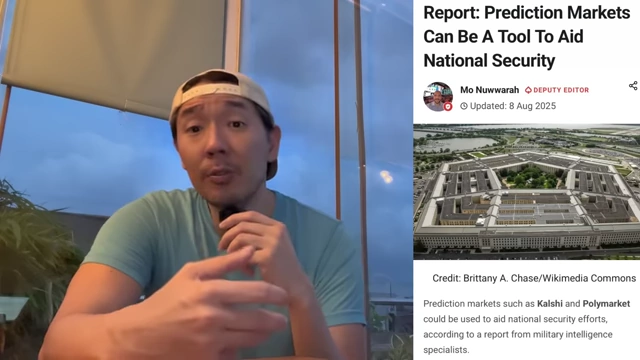
Report suggesting prediction markets can serve as a valuable tool for national security intelligence [ 00:06:04 ] 
Excerpt from a report detailing how prediction market contract prices could provide early warnings for national security threats [ 00:06:11 ]
Key Market Participants [6:43]
Understanding the different types of participants helps clarify how insider information impacts these markets.
- Market Makers:
- These participants place both bid and ask orders, providing liquidity to the market.

Definition of a 'Market Maker' in financial markets, explaining their role in providing liquidity [ 00:06:49 ] - Their goal is to profit from small price discrepancies (scalping) throughout the day.
- These participants place both bid and ask orders, providing liquidity to the market.
- Speculators:
- Speculators bet on the direction of market outcomes.
- Crucially, some speculators possess inside information and are willing to place large, confident bets that can significantly move the market.
- This creates a dynamic where "insiders" can profit at the expense of less informed market makers, pushing the market toward a more accurate price.
Practical Strategies for Profiting from Prediction Markets [7:56]
Given the current unregulated environment, individuals can employ several strategies to legally leverage inside information for profit.
- 1. Utilize Personal Inside Information:
- If you have non-public information about an event (e.g., a celebrity engagement, a product launch at your company, or the outcome of a film you worked on), check if a prediction market exists or can be created for it.
- Place bets based on your privileged knowledge.
- 2. Create Your Own Prediction Market:
- You can initiate a new market on platforms like Polymarket concerning an event you have inside knowledge about (e.g., a Tesla Model X redesign).
- Once market makers establish liquidity, you can trade against them with your superior information.
- 3. Collaborate for Information:
- If you lack direct inside information, partner with friends or acquaintances who might have access to such knowledge through their work or personal lives.
- Facilitate the trade on their behalf and agree on a profit split.
- 4. Track "Insider Betting Whales":
- Develop or use existing tools to monitor trading patterns in illiquid prediction markets.
- Look for "new accounts" that confidently place large, market-moving bets, as these often indicate insider knowledge.
- Piggyback on these "whale" trades, as they statistically have a higher probability of success (over 50%).
The Unregulated Opportunity [10:08]
The current phase of prediction markets offers a unique, albeit temporary, opportunity due to their unregulated status.
- Historical Precedent:
- This situation is analogous to the early days of financial instruments like futures contracts, where practices like "spoofing" were unregulated for years, allowing early adopters to amass significant wealth.

Definition of 'Spoofing,' an early unregulated practice in futures trading, as a historical parallel [ 00:10:38 ] - Similarly, companies like Uber capitalized on operating in a legal gray area before regulations caught up ("ask for forgiveness, not permission").
- This situation is analogous to the early days of financial instruments like futures contracts, where practices like "spoofing" were unregulated for years, allowing early adopters to amass significant wealth.
- Time-Limited Advantage:
- This opportunity to exploit legal insider information is expected to last for a few years until regulators establish clear rules and oversight.
- Early engagement allows for substantial profits before market efficiencies and regulations close these loopholes.