How to Build Intimacy Gradually with the "Match Plus One" Technique from Radically Open DBT
Summary:
This video introduces the "Match Plus One" technique, derived from Radically Open Dialectical Behavioral Therapy (RODBT), as a low-risk method for building intimacy in relationships.
- The technique involves disclosing personal information in incremental steps, starting with low vulnerability.
- You assess whether the other person reciprocates your level of disclosure.
- If they reciprocate, you can increase your vulnerability by "plus one" degree.
- If reciprocation is absent, you maintain or decrease your level of disclosure to avoid over-investing or facing rejection.
- The video outlines 10 levels of intimacy, ranging from discussing non-emotional everyday events (Levels 1-2) to expressing deep love and making sacrifices (Level 10).
- An example demonstrates progressing through these levels in an acquaintance relationship.
- A self-assessment exercise is provided, encouraging viewers to map their existing relationships on the intimacy spectrum and identify patterns or gaps.
- The video concludes with a "homework assignment" to challenge oneself to practice a disclosure slightly outside one's comfort zone, fostering gradual growth in intimacy.
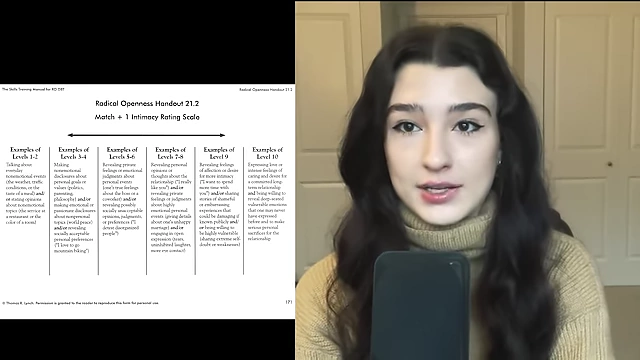
The 10-level Match Plus One Intimacy Rating Scale from Radically Open DBT [ 00:02:10 ]
Understanding the Match Plus One Technique [00:00:19]
The video introduces the "Match Plus One" technique, a strategy from Radically Open Dialectical Behavioral Therapy (RODBT) designed for building intimacy in a low-risk manner.
- Origin of the Technique [00:00:19]
- The technique originates from Radically Open Dialectical Behavioral Therapy (RODBT), a variation of Dialectical Behavioral Therapy (DBT).
- Core Principle [00:00:46]
- It involves starting with less personal disclosures and then assessing if the other person reciprocates.
- If reciprocation occurs, you elevate your disclosure by one "plus one" degree of vulnerability.
- If not, you maintain the current level or reduce vulnerability.
- Benefits of the Approach [00:01:41]
- It allows for gradual intimacy building, fostering trust over time without taking excessive risks.
- It helps prevent rejection or feeling abandoned by gauging the other person's engagement before revealing highly personal information.
The 10 Levels of Intimacy Explained with Examples [00:02:06]
The video details a 10-level scale of intimacy, providing examples for each stage using a hypothetical interaction with a classmate.
- Levels 1-2: Everyday, Non-Emotional Events [00:02:10]
- Characteristics [00:02:12]
- Discussing neutral, non-emotional topics.
- Examples: Weather, traffic, the taste of a meal, opinions on non-emotional subjects (e.g., restaurant service, room color).
- Example Scenario [00:02:25]
- Initiating with a classmate: "The readings took me a really long time to complete this week."
- Assessing reciprocation: Do they agree, or do they dismiss the comment?
- Characteristics [00:02:12]
- Levels 3-4: Non-Emotional Personal Disclosures or Emotional Non-Personal Disclosures [00:02:48]
- Characteristics [00:02:50]
- Revealing personal goals or values (e.g., politics, parenting, philosophy).
- Expressing emotional or passionate views on non-personal topics (e.g., world peace).
- Sharing socially acceptable personal preferences (e.g., hobbies like mountain biking).
- Example Scenario [00:03:08]
- Building on reciprocation from Levels 1-2: Discussing weekend plans (e.g., a trip) or sharing an opinion on a political topic from class.
- Characteristics [00:02:50]
- Levels 5-6: Private Feelings/Emotional Judgments on Personal Events or Socially Unacceptable Opinions [00:03:38]
- Characteristics [00:03:41]
- Disclosing true feelings about personal events (e.g., about a boss or co-worker).
- Revealing socially less acceptable opinions, judgments, or preferences (e.g., "I detest disorganized people").
- Example Scenario [00:03:57]
- Following reciprocation from Levels 3-4: Sharing a critical opinion about a popular professor.
- Characteristics [00:03:41]
- Levels 7-8: Personal Opinions/Thoughts about Relationships or Highly Emotional Personal Events [00:04:24]
- Characteristics [00:04:25]
- Expressing personal thoughts or opinions about the relationship itself (e.g., "I really like you").
- Giving details about highly emotional personal events (e.g., an unhappy marriage).
- Engaging in open emotional expressions (e.g., tears, uninhibited laughter, increased eye contact).
- Example Scenario [00:04:45]
- After prior reciprocation: Suggesting to study together because you "vibe" or like them as a person.
- Revealing a personal setback: "Actually, my weekend was terrible, I broke up with my boyfriend."
- Key Observation [00:05:06]
- Many relationships often falter at this stage due to a lack of reciprocation, causing individuals to reduce their level of disclosure.
- Characteristics [00:04:25]
- Level 9: Affection/Desire for More Intimacy, Shameful/Embarrassing Experiences, Extreme Self-Doubt [00:05:27]
- Characteristics [00:05:29]
- Expressing affection or a desire for deeper intimacy (e.g., "I want to spend more time with you").
- Sharing shameful or embarrassing experiences that could be damaging if widely known.
- Being highly vulnerable by sharing extreme self-doubt or weaknesses.
- Example Scenario [00:05:43]
- After established trust: Discussing the specific reasons for a breakup.
- Explicitly stating positive feelings and inviting them to an event: "I think you're a really cool person, I really like spending time with you. How would you feel about going to this event with me?"
- Characteristics [00:05:29]
- Level 10: Expressing Love/Intense Caring, Desire for Committed Relationship, Deep-Seated Vulnerable Emotions, Serious Sacrifices [00:06:04]
- Characteristics [00:06:06]
- Expressing love and intense feelings of caring.
- Desiring a committed, long-term relationship.
- Revealing deep-seated vulnerable emotions never expressed before.
- Willingness to make serious personal sacrifices for the relationship.
- Example Scenario [00:06:20]
- Asking someone to be your partner.
- Telling a close friend "I love you."
The 10-level Match Plus One Intimacy Rating Scale from Radically Open DBT [ 00:02:10 ]
- Characteristics [00:06:06]
Self-Assessment and Personal Growth [00:06:30]
The video concludes with an exercise and homework assignment to help viewers apply the "Match Plus One" technique to their own relationships.
- Relationship Mapping Exercise [00:06:35]
- Viewers are encouraged to use a provided worksheet to map out where their current relationships (friends, family, partner, co-workers) fall on the 10-level intimacy spectrum.
- Reflection Questions [00:06:41]
- Patterns in Relationships: Identify noticeable patterns in intimacy levels across different relationships.
- Gaps in the Spectrum: Recognize if there are certain levels of closeness that are difficult to achieve or maintain.
- The speaker shares her own experience of a gap between levels 6-9, stemming from black-and-white thinking about trust.
- Relationship Clusters: Observe if certain types of relationships (e.g., family, friends) tend to cluster at specific intimacy levels.
- Perception vs. Reality: Consider how others might rate your intimacy with them and explore reasons for any discrepancies.
- Personal Challenge Homework [00:08:05]
- Viewers are challenged to select a step slightly outside their comfort zone based on their self-assessment.
- Examples [00:08:14]
- For difficulty showing affection professionally: Give a holiday card to a co-worker.
- For struggling with high intimacy in friendships: Tell a friend, "I care about you," or "I love you."