How to Achieve Career Growth by Aligning Your Skills with High-Value Company Problems
This video explains why hard work doesn't always lead to career growth and what strategies actually do, emphasizing the concept of "product-market fit" for your skills.
- Many dedicated professionals find their efforts invisible because they're solving problems they care about, not those critical to the company.

Illustration of darts consistently missing the bullseye [ 00:00:44 ] - Your "product" consists of your skills and strengths, while your "market" is the expensive, painful problems your company desperately needs solved.
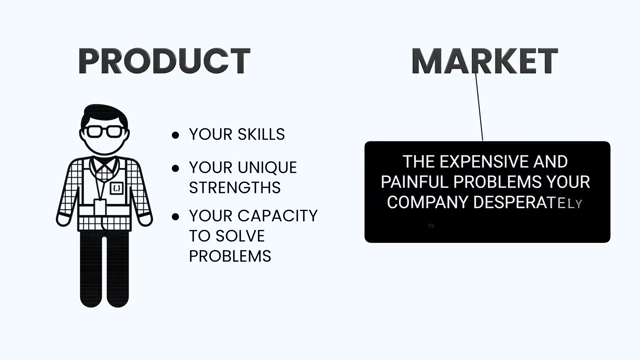
Product and Market definition for your career [ 00:04:35 ] - To find your "market," ask your manager specific questions about their frustrations and team blockers, moving beyond generic performance reviews.

Effective questions to ask your manager [ 00:07:49 ] - Identify your unique skills by recognizing problems you're naturally drawn to, activities that energize you but drain others, and compliments you tend to brush off as easy.

Questions to find your unique skill [ 00:11:03 ] - Implement the "Value Loop": 1) Solve one impactful problem for a specific person, 2) Generalize that solution into a reusable system (tool, template, process), and 3) Proactively announce this "product" to the wider team or organization.
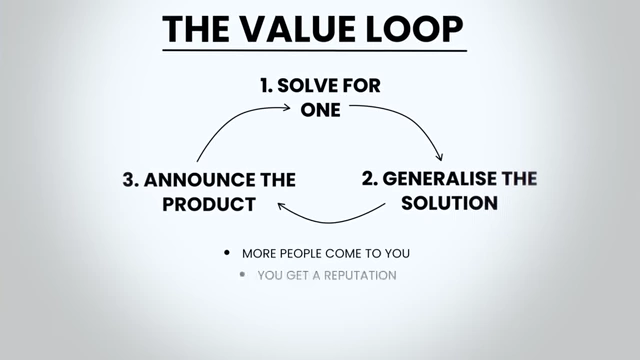
The Value Loop process [ 00:13:35 ] - By focusing on solving "expensive pain" and turning individual solutions into repeatable systems, you become an indispensable asset, making your work visible and leading to promotions and greater opportunities.
The Disconnect Between Hard Work and Career Growth [0:00:00]
Hard work often goes unrecognized if it's focused on the wrong things. [0:00:03]
- Common Scenarios Illustrating the Problem:
- An individual consistently shows up, does what is asked, is responsive, reliable, and hits deadlines, but remains stuck in place. [0:00:18]

Checklist of common hardworking traits that might not lead to promotion [ 00:00:18 ] - An individual spending days refactoring complex legacy code receives minimal recognition (e.g., "looks good to me" comment). [0:01:37]

Illustration of a person refactoring complex legacy code [ 00:01:41 ] 
Depiction of minimal recognition for complex code refactoring [ 00:11:48 ] - Meanwhile, a coworker who spent an hour writing a simple bash script to automate a manual task becomes a "hero," receiving thanks and requests from managers. [0:01:59]

Illustration of a person writing a simple bash script [ 00:02:03 ] 
Depiction of significant recognition for a simple automation script [ 00:12:05 ] - A consistently responsive, reliable, and on-time worker receives "meets expectations" during performance reviews. [0:02:13]
- Another person working normal hours and taking vacations receives "exceeds expectations" and is considered for promotion. [0:02:24]
- An individual consistently shows up, does what is asked, is responsive, reliable, and hits deadlines, but remains stuck in place. [0:00:18]
- The Core Issue:
- The problem lies in solving issues you care about, rather than the "expensive pain" that others, especially leadership, deeply care about. [0:02:37]
- This is analogous to consistently hitting the same spot on a dartboard but completely missing the bullseye. [0:02:41]
Illustration of darts consistently missing the bullseye [ 00:00:44 ] - Often, people mistakenly believe that career growth is due to politics, luck, or who you know. [0:01:14]

Emojis representing politics, luck, and connections [ 00:01:18 ]
Applying Product-Market Fit to Your Career [0:02:47]
The concept of "product-market fit" from the startup world is applicable to career growth. [0:02:50]
- Understanding Product-Market Fit:
- In startups, killer technology and genius teams are irrelevant if there's no market that values what's being built. [0:02:53]
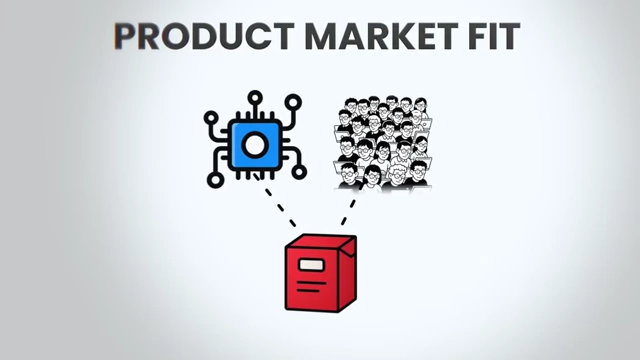
Diagram explaining the concept of Product-Market Fit [ 00:02:57 ] - Your career functions similarly: you can be skilled and hardworking, but your work remains invisible if it doesn't solve problems people care about. [0:03:04]
- Analogy: A talented, charismatic, and hardworking polymath YouTuber created over 5,000 videos in eight years but had only a few hundred subscribers and single-digit views on many videos because his content (product) didn't fit a market need. [0:03:16]

Definition of a Polymath [ 00:03:26 ] 
Mock-up of a YouTube channel with low view counts, illustrating poor product-market fit [ 00:03:49 ] 
Illustration showing audience perceiving content as useless [ 00:04:13 ]
- In startups, killer technology and genius teams are irrelevant if there's no market that values what's being built. [0:02:53]
- Your Career as a "Company of One":
- Your "product" consists of your skills, unique strengths, and capacity to solve problems. [0:04:28]
- Your "market" represents the expensive, painful problems your company desperately needs to be solved. [0:04:32]
Diagram defining 'Product' as your skills and 'Market' as expensive problems your company needs solved [ 00:04:35 ] - The Pitfall: Most people focus on perfecting their "product" (learning new frameworks, improving code quality) without finding the right "market" for those skills, leading to invisible effort. [0:04:40]
- Shift in Perspective:
- Instead of asking, "What should I learn next?" or "How can I improve my skills?", start asking, "What expensive pain can I solve?" [0:05:07]

Visual contrasting ineffective career questions with the effective question: "What expensive pain can I solve?" [ 00:05:11 ] - Connecting your unique abilities to real problems makes your hard work visible and valuable. [0:05:17]
- Instead of asking, "What should I learn next?" or "How can I improve my skills?", start asking, "What expensive pain can I solve?" [0:05:07]
Finding Your Market: The "Mom Test" for Managers [0:06:57]
Your manager is your most important customer, and effective market research starts with them. [0:07:02]
- Ineffective Questions to Avoid:
- Asking "Am I doing a good job?" or "How's my performance?" typically elicits polite but useless answers like, "You're doing great, keep it up." [0:07:10]

Illustration showing ineffective questions to ask your manager [ 00:07:15 ] - This is like asking your mom for an opinion on your business idea; she'll say it's good because she loves you. [0:07:20]
- Asking "Am I doing a good job?" or "How's my performance?" typically elicits polite but useless answers like, "You're doing great, keep it up." [0:07:10]
- Applying "The Mom Test" Principle:
- Effective Questions for Your Manager:
- "What's the most frustrating part of your week?" [0:07:41]
- "What's the biggest thing slowing our team down right now?" [0:07:43]
- "If you could wave a magic wand and solve one problem, what would it be?" [0:07:48]
Illustration of effective questions to ask your manager to uncover real problems [ 00:07:49 ] - Listen for their frustration; the answers define your "market." [0:07:52]
- Example from Amazon:
- A team was known for buggy code and slow delivery, initially diagnosed as a "skills gap" requiring training. [0:07:59]
- Observation revealed a "pain gap": their software release process was a nightmare, taking days and involving dozens of manual steps and approvals. [0:08:22]
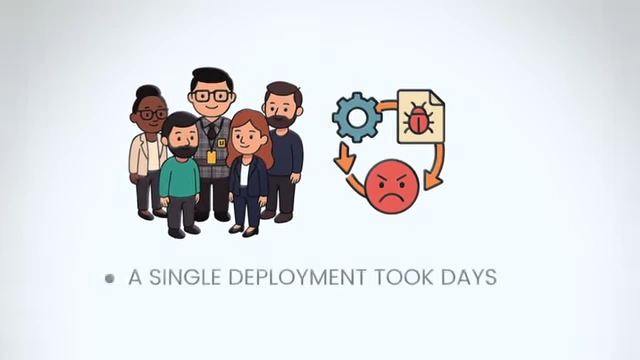
Visualizing the 'pain gap' of a slow and buggy software deployment process [ 00:08:28 ] - This broken deployment process was costing the team two developer-weeks of productivity monthly, a significant "expensive pain." [0:08:51]

Illustration depicting good engineers trapped within a terrible system [ 00:08:45 ] - Instead of asking "How do I solve this once?", the focus shifted to "What skill, if mastered, would solve this class of problem forever?" [0:09:08]

Shift in mindset from one-off fixes to mastering skills for systemic solutions [ 00:09:11 ] - By reframing the technical problem (complex deployment pipeline) into business impact (losing developer weeks, delaying feature launches), leadership understood the urgency and provided necessary bandwidth. [0:09:35]
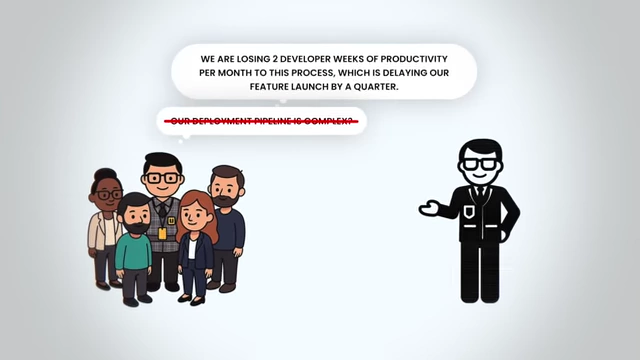
Diagram showing how to translate technical pain into business impact for leadership [ 00:09:47 ]

Identifying Your Unique Skill [0:10:13]
The most powerful skills are extensions of your authentic personality.
- Questions to Discover Your Unique Skill:
- What problems are you naturally drawn to? [0:10:18]
- What activity gives you energy while draining others? [0:10:33]
- What compliment do you brush off because it felt too easy? [0:10:47]
- When someone thanks you for explaining something clearly or staying calm during an outage, and you instinctively say, "It was nothing." [0:10:52]
- This often highlights a core skill that feels natural to you but is highly valued by others. [0:11:01]
Three key questions to help identify your unique skills [ 00:11:03 ]
- The Outcome: The patterns in your answers will point to your most authentic "product" – the core of your product-market fit. [0:11:08]
The Value Loop: Turning Solutions into Systems [0:11:13]
Execution involves transforming individual acts of helpfulness into essential, repeatable systems.
- An Example of the Impact of Solving the Right Problem:
- Weeks were spent refactoring complex code, resulting in an objectively better codebase, but "nobody cared." [0:11:30]
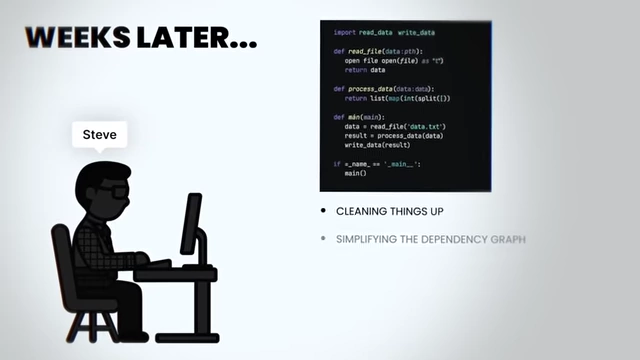
Illustration of a person spending weeks refactoring code [ 00:11:35 ] - A simple Python script written in 2 hours to automate a tedious manual task for program management saved them hours every week and made the developer a "hero." [0:11:53]

Illustration of a person spending 2 hours writing a simple Python script [ 00:11:55 ] - The key difference was solving a problem they cared about versus a problem you cared about. [0:12:10]

Comparison of solving problems you care about versus problems others care about [ 00:12:14 ]
- Weeks were spent refactoring complex code, resulting in an objectively better codebase, but "nobody cared." [0:11:30]
- The Value Loop Framework:
- Solve for One [0:12:19]
- Generalize the Solution [0:12:44]
- Take your one-off solution and convert it into a reusable tool, template, or documented process. [0:12:46]
- Example: The Python script that automated a task was packaged into an internal, configurable website with documentation and placed in a shared repository, becoming a "support automation tool." [0:12:50]
- Announce the Product [0:13:07]
- This is where many fail by not communicating their solution. [0:13:09]
- Share it widely: post in team channels, mention it in meetings, write a quick wiki page. [0:13:13]
- Frame it simply: "Here's a common pain. Here's the tool that solves it. Here's how to use it." [0:13:20]
Complete diagram of the Value Loop, including its benefits [ 00:13:35 ]
- Benefits of the Value Loop:
- This process establishes you as the person who solves a class of problems, not just a single instance. [0:13:27]
- It builds your reputation, attracts more opportunities, and leads to promotions. [0:13:33]
- The support script that became an internal tool was eventually adopted and forked by other teams, making it part of the operational fabric. [0:13:39]
- One-time fixes make you helpful; repeatable systems make you essential. [0:13:50]

Key takeaway: One-time fixes make you helpful, repeatable systems make you essential [ 00:13:51 ]
Conclusion: Focus on Impact and Repeatable Value [0:13:53]
Career success comes not from merely working hard or possessing great skills, but from finding product-market fit for your unique abilities. [0:13:53]
- Connect what you uniquely do with problems that people desperately need solving. [0:14:00]
- Stop perfecting your skills in isolation; actively seek your market. [0:14:07]
- Ask about pain, not performance. [0:14:10]
- Develop skills that address expensive problems. [0:14:12]
- Deliver quality solutions and transform them into sustainable systems. [0:14:15]
- This approach ensures that all your hard work finally translates into visible impact and career advancement. [0:14:20]