This video demonstrates advanced techniques for using the MatchSrf command in CAD software, specifically focusing on how to successfully "break" its conventional rules for more efficient surface modeling.
Matching Lower to Higher Degree Surfaces: It's possible to match a lower-degree surface to a higher-degree surface perfectly (position and tangent) if the higher-degree surface's shape hasn't been altered from its original lower-degree form.
Practical Application for Simplification: This technique is useful in complex models, like a fuselage, allowing for simpler, lower-degree surfaces where possible, making them easier to edit without compromising continuity.
Maintaining Editability: By keeping parts of a surface at a lower degree while matching to a higher-degree section, the overall model remains more editable and manageable.
Partial Edge Matching within Tolerance: Even when direct perfect matching isn't possible (e.g., after a higher-degree surface has been edited), specific portions of an edge can be matched to a higher-degree edge within the file's tolerance. This is typically effective for smaller segments, often less than 25% of the edge.
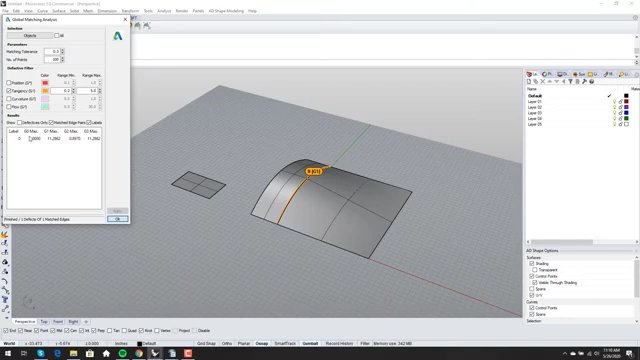
Global Matching Analysis confirming a perfect (zero difference) position and tangency match between a degree 3 and a degree 5 surface.
[
00:02:30
]
The first method involves matching a lower-degree surface to a higher-degree surface when the higher-degree surface's shape has not been changed from its original lower-degree form.
Demonstration:
A degree three curve and two degree three surfaces are set up. [0:39]
One surface is extruded and its degree is increased from three to five without altering its shape. [1:15]
The presenter successfully matches the degree three edge to the degree five edge by position, achieving a watertight join. [2:08]
The matching analysis confirms a perfect match down to zero difference. [2:25]
Global Matching Analysis confirming a perfect (zero difference) position and tangency match between a degree 3 and a degree 5 surface.
[
00:02:30
]
This can also be achieved with tangent matching, resulting in a perfect match despite the differing degrees. [2:35]
When to use this method:
This technique is beneficial in complex designs, such as a fuselage, where different sections might require varying degrees of complexity. [3:21]
If a simpler section (lower degree) needs to connect to a more complex section (higher degree), but the shape of the complex section at the join point is still geometrically simple (i.e., it can be represented by the lower degree), this method allows for simpler geometry without penalty. [3:40]
This maintains the editability of the simpler surface without affecting the complex surface. [3:50]
Limitation:
If the higher-degree surface is edited to truly express its higher-degree nature (i.e., its shape is no longer representable by the lower degree), then the lower-degree surface will no longer match perfectly. [4:02]
The matching will fail, resulting in naked edges and a non-watertight join. [4:21]
This method demonstrates how to match a lower-degree surface to a portion of a higher-degree edge, even if the higher-degree surface has been altered, by matching within the file's tolerance.
Setup:
The degree five surface is returned to its original, unedited degree three shape. [4:40]
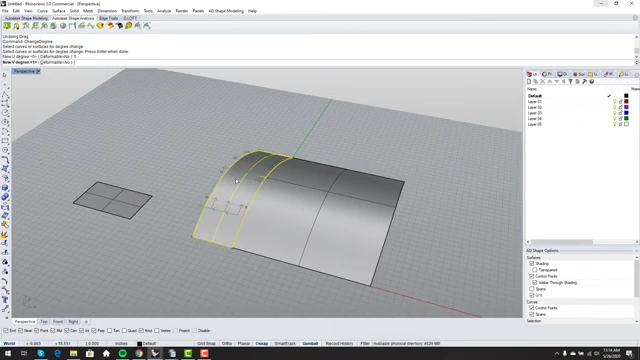
The degree five surface is then modified in one direction to degree two (still keeping degree five in the other direction), and control points are added, truly expressing its higher-degree nature. [4:53]
A degree 5 surface with control points added, demonstrating how its higher-degree nature is expressed in one direction while still maintaining simpler geometry in another.
[
00:05:00
]
Even with this modification, if the higher-degree surface retains a segment that could be represented by a lower degree, tangency matching can still work. [5:44]
Curvature Matching Implications:
To match by curvature, the surface would need to be degree three across the matching edge and the first three rows of control points would need to remain untouched, essentially extending the tangency requirement one layer further. [6:02]
This highlights the advantage of simplifying surfaces where possible to maintain editability. [6:42]
Matching to File Tolerance:
When an exact match is impossible due to true degree differences, matching within file tolerance can be employed. [7:05]
Demonstration:
The degree three surface is matched to a portion of the degree five edge (which has been edited). [7:35]
The degree five edge is split to create a smaller segment for matching. [7:53]
The lower-degree surface is matched to this smaller segment by position. [9:00]
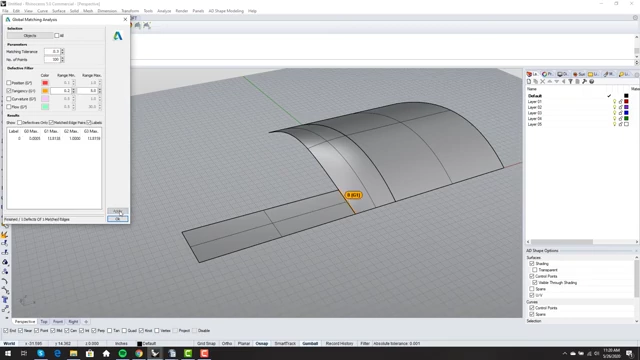
While not a perfect match, it achieves a watertight join and matches within the file tolerance. [9:07]
Global Matching Analysis showing a watertight match within file tolerance for a partial edge match between a lower and higher degree surface.
[
00:09:12
]