The Mathematical Flaws of the ISO A-Series Paper Scale: Why Rounding Errors Lead to Unexpected Packing Densities
The video investigates the mathematical properties of the A-series paper scale, which is ideally based on a square root of two aspect ratio, allowing paper to be split into two equal, similar, smaller pieces. The presenter demonstrates this ideal system and contrasts it with other mathematical ratios like the golden ratio (split, similar, but unequal pieces) and a square (split, equal, but dissimilar pieces that alternate aspect ratios). The core revelation is that the ISO A-series standard is "broken" because its dimensions are rounded to the nearest millimeter. This rounding causes the aspect ratio to deviate from the ideal root two, especially for smaller paper sizes. This cumulative error means that more small pieces, such as 514 A9s or 1038 A10s, can physically fit onto a larger A0 sheet than the theoretically expected power of two (512 or 1024). The video also explores other paper scales like the B and C series (also based on root two with different starting points), and the "P-scale" of Post-it notes, which splits equally but not similarly, alternating between 1.5 and 1.34 aspect ratios. Extreme rounding effects are shown with A17 (2mm x 3mm) and A18 (1mm x 2mm) papers, where three A18s fit into one A17, completely abandoning the root two ratio and two-piece split.
Introduction to the A-Series Paper System and its Ideal Properties [00:00:00]
- The A-series paper scale is lauded for its inherent mathematical elegance. [00:00:00]
- Each successive size (e.g., A5 from A4) is exactly half the area of the previous one. [00:00:08]
- This allows pieces to fit perfectly into a spiral arrangement, demonstrating proportional scaling. [00:00:16]
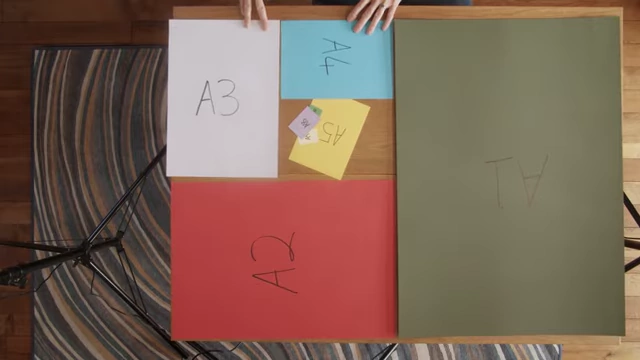
A-series paper sizes from A1 to A10 arranged in a golden spiral, illustrating their proportional scaling. [ 00:00:20 ] - The largest standard size, A0, has an area of exactly 1 square meter. [00:00:37]
- A key property is that a larger sheet can be perfectly covered by a power of two of a smaller sheet (e.g., 2^9 = 512 A9 sheets fit onto one A0). [00:00:51]
The Fundamental Mathematical Property of the A-Series Ratio [00:02:06]
The ideal A-series paper maintains its aspect ratio when halved. [00:02:06]
- If a rectangle has sides 1 and X, when cut in half along its long side, the new rectangles will have sides 1 and X/2. [00:02:12]
- To maintain the same aspect ratio, the new ratio (X/2 : 1, or 1 : 2/X if rotated) must be equal to the original ratio (1 : X). [00:02:21]
- This leads to the equation X = 2/X, which simplifies to X^2 = 2, meaning X = √2. [00:03:07]
- Therefore, the aspect ratio of A-series paper is 1:√2. [00:03:29]
Three Desired Properties for a Paper Scale: [00:03:41]
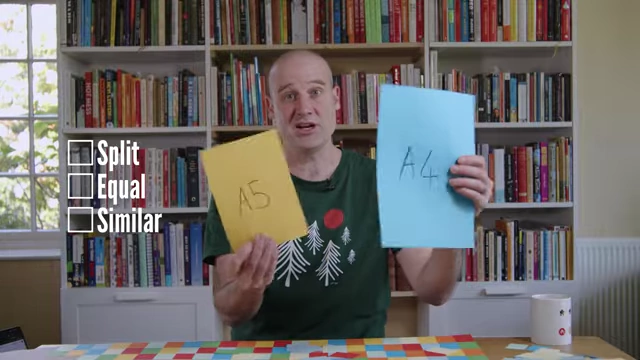
- Split: A larger piece can be cut to produce smaller pieces (e.g., A4 splits into two A5s). [00:03:52]
- Equal: The resulting split pieces are identical in size and shape. [00:04:08]
- Similar: The resulting split pieces have the same aspect ratio as the original piece. [00:04:14]
A presenter holding A4 and A5 paper, with checkboxes for "Split," "Equal," and "Similar" properties. [ 00:04:19 ]
Examples of other ratios illustrating these properties: [00:04:32]
- Golden Ratio (Φ): Possesses "Split" and "Similar" properties but not "Equal," as splitting results in a square and a smaller rectangle, both maintaining the golden ratio. [00:04:43]
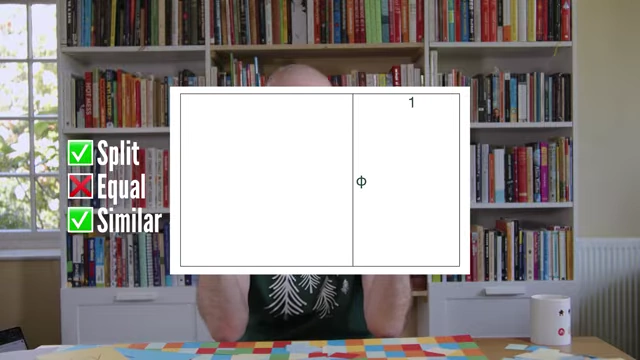
Diagram of a Golden Ratio rectangle being split into a square and a smaller, similar Golden Ratio rectangle. [ 00:05:00 ] - Square (1:1 ratio): Possesses "Split" and "Equal" properties but not "Similar." Halving a square creates two equal rectangles, but they are not squares, thus not similar to the original. Subsequent cuts may or may not return to the original ratio. [00:05:12]
- Plot of Aspect Ratios: A graph showing y=x and y=2/x illustrates that only at their intersection (x=√2) does halving a paper maintain a single aspect ratio. Any other starting ratio will alternate between two different aspect ratios when repeatedly halved equally. [00:05:52]
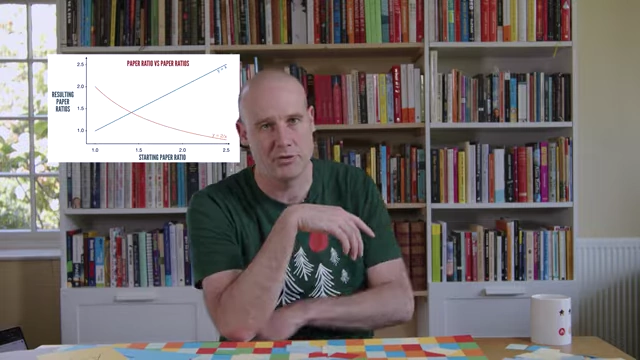
A graph illustrating how only the square root of 2 aspect ratio maintains a single ratio when halved, unlike other ratios that alternate between two. [ 00:05:59 ]
- Golden Ratio (Φ): Possesses "Split" and "Similar" properties but not "Equal," as splitting results in a square and a smaller rectangle, both maintaining the golden ratio. [00:04:43]
Other International Paper Scales and the "P-Scale" [00:07:51]
- B-series and C-series paper scales: [00:07:59]
- Both are also based on the √2 aspect ratio, like the A-series. [00:08:05]
- The B-series uses a starting sheet (B0) where one side is exactly 1 meter. [00:08:12]
- B-series sizes are the geometric mean of adjacent A-series sizes (e.g., B1 is between A0 and A1). [00:08:27]
- The C-series is the geometric mean of an A-size and the B-size above it, designed for envelopes to fit A-series papers. [00:08:41]
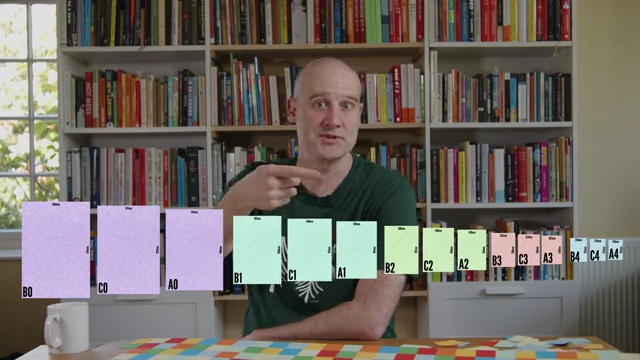
A visual comparison of A, B, and C series paper sizes, showing their relative scales and how B and C fit between A sizes. [ 00:08:51 ]
- The "P-scale" (Post-it notes): [00:10:06]
- Post-it notes, initially based on imperial measurements, are now defined in millimeters. [00:10:28]
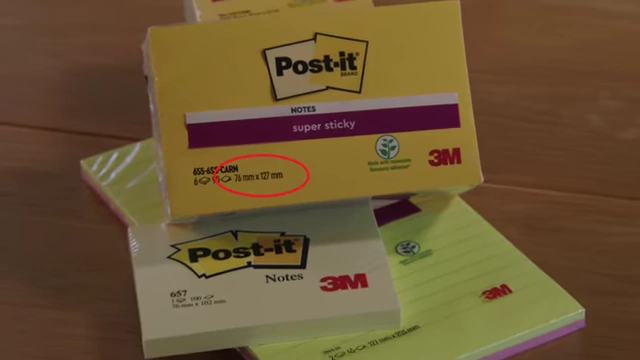
Post-it Note packaging displaying its dimensions in millimeters, defining the "P-scale". [ 00:10:36 ] - They follow the "Split" and "Equal" properties but not the "Similar" property. [00:11:09]
- This means repeatedly halving Post-it sizes causes their aspect ratios to alternate between two different families of similar shapes, approximately 1.5 and 1.34. [00:11:21]
- Post-it notes, initially based on imperial measurements, are now defined in millimeters. [00:10:28]
The Breakdown: ISO Rounding Errors [00:11:15]
- The ideal 1:√2 ratio is not perfectly maintained in the official ISO standard. [00:01:12]
- Official A-series dimensions are rounded to the nearest millimeter. [00:13:40]
- For larger sheets, this rounding has a minimal impact on the aspect ratio. [00:14:04]
- However, for smaller sheets like A9 and A10, rounding causes a significant cumulative deviation from the ideal √2 ratio, making them slightly smaller than they theoretically should be. [00:14:14]

A table detailing the calculated ideal dimensions, the ISO rounded dimensions, the actual aspect ratio, and the percentage error for A0 through A10 paper sizes. [ 00:14:16 ]
- Demonstration: Fitting more than the theoretical number of pieces. [00:12:10]
- Theoretically, 512 A9s should perfectly cover an A0 sheet. [00:01:04]
- Due to the slight size reduction from rounding, 514 A9s can be fitted onto an A0 sheet, with space for more if optimally arranged. [00:12:52]
- The speaker experimented with different orientations of A9s on an A0, demonstrating how the "extra" space accumulates due to rounding, allowing for an increased packing density. [00:12:18]
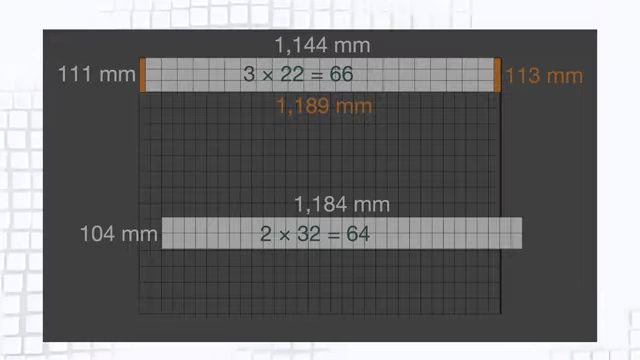
A diagram comparing the packing of A9 sheets in two different orientations onto an A0 area, highlighting how rounding errors allow more pieces to fit. [ 00:15:56 ] - Noel Friedrich's Research: Noel Friedrich discovered that 1038 A10s (instead of the theoretical 1024) could be orthogonally packed onto an A0. [00:17:08]
- Matthew Scroggs's Contribution: Collaborated on coding an orthogonal solver to find packing solutions, confirming that more pieces than theoretically expected can be fitted. [00:17:58]
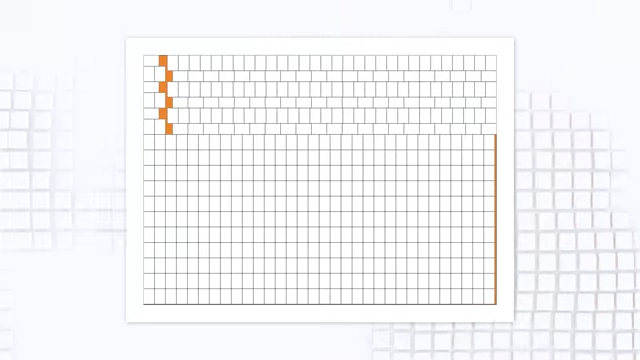
A grid-based diagram illustrating an orthogonal packing solution for A10s onto an A0 sheet, showcasing how extra pieces can be fitted due to rounding. [ 00:19:48 ] - Scroggs and the presenter's solution for A10s yielded 1031 pieces, seven more than the theoretical 1024. [00:18:29]
Extreme Cases: Very Small A-Series Papers [00:21:59]
- Exaggerated rounding effects at extremely small scales: [00:22:08]
- As paper sizes continue to shrink beyond A10, the 1mm rounding becomes a dominant factor, drastically altering aspect ratios and the splitting principle. [00:22:08]
- A17 and A18 example: [00:22:15]
- A17 is approximately 2mm x 3mm (ratio 1.5). [00:23:31]
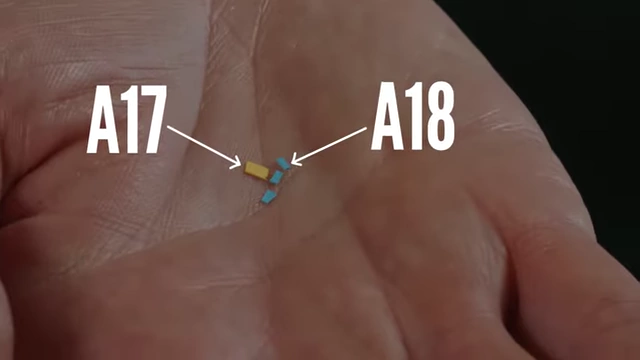
A close-up of tiny A17 (yellow) and A18 (blue) paper pieces held in a hand. [ 00:22:22 ] - A18 is approximately 1mm x 2mm (ratio 2). [00:23:31]
- Instead of two A18s fitting into an A17 (as per the ideal A-series split), three A18s are needed to cover an A17. This completely breaks the root two ratio and the halving principle. [00:22:59]
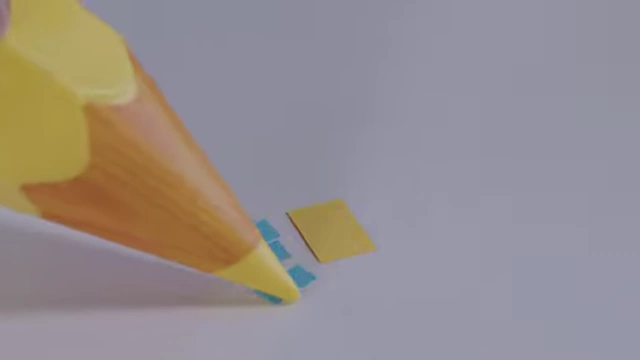
A close-up of a pencil arranging tiny A18 paper pieces next to an A17 piece, demonstrating their fit. [ 00:23:03 ] 
A diagram showing an A17 sheet (2mm x 3mm) being perfectly covered by three A18 sheets (1mm x 2mm), illustrating the breakdown of the A-series principles at extreme small sizes. [ 00:23:34 ]
- A17 is approximately 2mm x 3mm (ratio 1.5). [00:23:31]
- A19 and A20: A19 is 1mm x 1mm. Theoretically, A20 would be 0mm x 0mm, allowing for an infinite number to fit. [00:24:23]
Future Research and Tolerances [00:26:02]
- ISO standards include manufacturing tolerances. [00:26:15]
- For paper sizes under 150mm, there's a tolerance of ±1.5mm. [00:26:21]
- For larger sizes like A0, the tolerance is ±3mm. [00:26:35]
- Exploiting these tolerances (e.g., using A-series papers that are manufactured at the smaller end of their tolerance range) could potentially allow even more pieces to be packed onto a larger sheet. [00:26:54]