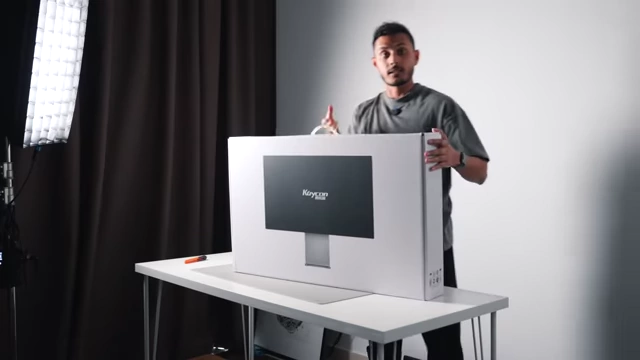
The video reviews the Kuycon G32P, a 32-inch 6K IPS monitor, positioning it as a significant competitor to Apple's Pro Display XDR, despite its notably lower price.
Side-by-side comparison of the Apple Pro Display XDR (left) and Kuycon G32P (right), highlighting their respective resolutions and displaying a color palette.
[
00:12:07
]
Introduction to 6K Monitors and Apple's Dominance [0:00]
Apple's Pro Display XDR has been the sole 6K display on the market since 2020/2021.
No other companies offered a 6K display until recently.
Apple's Pro Display XDR product page highlighting its high cost and the separate purchase of a stand.
[
00:00:18
]
The reviewer has been anticipating a 6K competitor due to the utility of 6K resolution.
6K resolution provides immense screen estate, allowing more content to be displayed clearly, unlike lower-resolution or multi-monitor setups that sacrifice sharpness.
The Kuycon G32P attempts to imitate the Pro Display XDR's back panel design.
While similar, the perforated holes lack the depth and curvature of Apple's design, appearing flatter.
Despite the imitation, the aluminum build feels high-quality and premium.
Connectivity ports include:
Two HDMI ports.
One DisplayPort.
Three USB-C ports, with one designed for Mac connectivity and 100W charging passthrough.
A 3-pin power connection, easily replaceable if damaged.
A 3.5mm audio jack.
A close-up of the Kuycon G32P's back panel, featuring its perforated design and various ports including HDMI, DisplayPort, and USB-C.
[
00:03:00
]
The included stand offers significant adjustability.
It allows for rotation to portrait orientation.
The Kuycon G32P monitor rotating into a portrait orientation, demonstrating its adjustable stand.
[
00:04:59
]
Features extensive tilt and height adjustment for optimal viewing angles.
Minor manufacturing flaws were observed.
Residue (likely glue) was found along the top edge of the monitor, indicating a less refined assembly process compared to Apple's products.
Close-up of residue along the top edge of the Kuycon G32P, indicating a minor manufacturing flaw.
[
00:05:52
]
Display Performance and Comparison with Apple Pro Display XDR [7:29]
Initial impressions of the Kuycon G32P are positive.
It defaults to a perfectly scaled resolution (half of native 6K) for clear text and UI elements.
Colors appear good at first glance, though slightly blueish, which can be adjusted.
The remote control is crucial for adjusting brightness and color temperature as macOS cannot control these settings directly.
The Kuycon G32P's On-Screen Display menu, accessible via remote, showing options for brightness and color adjustment.
[
00:08:17
]
Resolution comparison:
Kuycon G32P: 6144x3456.
Apple Pro Display XDR: 6016x3384.
The Kuycon actually has a slightly higher resolution.
Image and text sharpness are exceptional due to the true Retina quality of the 6K resolution on a 32-inch screen.
Side-by-side comparison with the Pro Display XDR reveals striking similarities from the front.
Bezels on the Pro Display XDR are slightly thinner, but the difference is minimal to most observers.
The stands look nearly identical.
Side-by-side comparison of the Apple Pro Display XDR (left) and Kuycon G32P (right), highlighting their respective resolutions and displaying a color palette.
[
00:12:07
]
Key differences in display technology and quality:
The Kuycon is an IPS panel, while the Pro Display XDR is Mini-LED.
Blacks on the Kuycon are "raised" (not as deep) compared to the Pro Display XDR's Mini-LED, especially noticeable with dark content.
The Kuycon sometimes exhibits a slight purple/blue tinge, affecting the accuracy of whites and grays compared to the XDR's more true and realistic tones.
Display edges on both monitors can be slightly dark, but it's less noticeable on the Pro Display XDR due to its Mini-LED backlighting.
The design of the back panel also differs.
The Apple Pro Display XDR (left) and Kuycon G32P (right) viewed from the back, showing the differences in their perforated designs and stands.
[
00:16:25
]
A close-up comparison of the back panel perforations, showing the deeper, more sculpted design of the Apple Pro Display XDR (left) versus the flatter design of the Kuycon G32P (right).
[
00:16:36
]
Their thickness is nearly identical.
A side profile view comparing the thickness of the Apple Pro Display XDR (front) and the Kuycon G32P (back).
[
00:16:55
]
Brightness difference is significant:
Kuycon: 500 nits.
Pro Display XDR: Up to 1600 nits.
The Pro Display XDR offers an "unreal" HDR content viewing experience due to its extreme brightness.
The Kuycon G32P is recommended for users interested in the Pro Display XDR's 6K resolution and large screen estate but unwilling to pay the premium price or who don't require its high-end professional color accuracy and HDR functionality.
It's an excellent choice for creative work like YouTube video editing, photo editing for social media, and general productivity.
A key advantage of the Kuycon is its broad compatibility, allowing connection to PCs and game consoles, and the ability to adjust settings via its remote regardless of the connected device. The Pro Display XDR is primarily limited to Macs for full functionality.
The reviewer was surprised to recommend the monitor, expecting more flaws, but found its minor issues (e.g., residue, no auto-brightness, needing calibration) easily overlooked given the substantial cost savings.
Both monitors are 60Hz; therefore, neither is suitable for users prioritizing high refresh rates.
The reviewer states that if they didn't already own the Pro Display XDR, they would purchase the Kuycon G32P due to its value, despite the XDR's slightly superior color accuracy and professional features that aren't critical for the reviewer's use case.