Analyzing Trump's Efforts to Influence the Federal Reserve's Independence and the Economic Forecast for 2026, Alongside an Argument for the Fed's Unconstitutionality
Summary:
- The video highlights concerns about former President Trump potentially taking control of the Federal Reserve (Fed), leading to a loss of its independence.
- It clarifies that the Fed is a private entity, akin to a "cartel of bankers," owned by its member banks, not the government.
- Trump advocates for drastic interest rate cuts (from 4.5% to 1.5%) to stimulate the economy, reduce borrowing costs, and lower government debt payments, a stance that conflicts with the Fed's current projection of slow rate reductions by 2028.
- Trump is actively attempting to replace Federal Reserve voting members with loyalists, as evidenced by Adriana Kugler's resignation and the controversial appointment of Stephen Miran, who pushed for more aggressive rate cuts.
- With Fed Chair J. Powell's term expiring in May 2026, there's an expectation that Trump will appoint a compliant successor, significantly enhancing his control over monetary policy.
- The speaker posits that the Federal Reserve itself is unconstitutional, citing that the U.S. Constitution grants monetary power to Congress, not private entities, and lacks provisions for a central bank.
- The projected economic outlook for 2026, under a Trump-influenced Fed, includes accelerated interest rate cuts, increased quantitative easing (money printing), leading to higher inflation, boosted asset prices, and a faster pace of dedollarization.
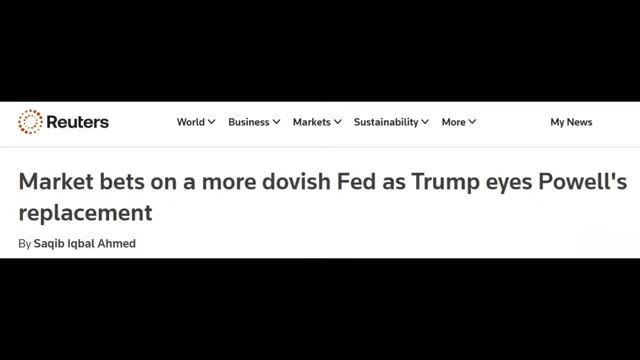
A Reuters headline states, "Market bets on a more dovish Fed as Trump eyes Powell's replacement," highlighting expectations of a shift in monetary policy. [ 00:08:02 ]
Introduction to the Federal Reserve Independence Debate [0:00:00]
- There is current concern regarding President Trump's potential takeover of the Federal Reserve (Fed) and the associated risk of the Fed losing its independence.
- Media headlines reflect this growing apprehension:
- "US Fed loss of independence a serious danger, says Lagarde" [0:00:13]
- "Independence Of Central Banks Tested By Trump Attacks On US Fed" [0:00:18]

A BBC News headline states "US Fed loss of independence a serious danger, says Lagarde," reflecting concerns over the Federal Reserve's autonomy. [ 00:00:15 ]
Understanding the Federal Reserve's Structure and Ownership [0:00:22]
- The Federal Reserve is fundamentally a private organization, despite its name being a misnomer, meaning it is neither "federal" nor truly holding "reserves" in the conventional sense.
- The speaker personally describes it as a "private cartel of bankers" [0:01:02].
- The Fed comprises 12 regional Federal Reserve banks.
- These reserve banks are structured similarly to private corporations [0:01:06].
- Member banks own the reserve banks and receive legally mandated dividends from them [0:01:17].

A screenshot from the Federal Reserve Bank of Atlanta's website clarifies that the Reserve Banks are "organized similarly to private corporations," emphasizing their non-governmental ownership structure. [ 00:01:10 ]
- This private organizational structure underpins the Fed's claim of independence from direct government control.
Trump's Pressure for Lower Interest Rates [0:01:37]
- President Trump has previously attempted to remove Jerome Powell, the current Chair of the Federal Reserve, from his position.
- Trump has consistently advocated for a dramatic reduction in interest rates.
- A tweet from Donald J. Trump stated, "Our Fed Rate is AT LEAST 3 Points too high. 'Too Late' is costing the U.S. 360 Billion Dollars a Point, PER YEAR, in refinancing costs. No Inflation, COMPANIES POURING INTO AMERICA. 'The hottest Country in the World!' LOWER THE RATE!!!" [0:01:43].
- At the time of the tweet, the Fed funds interest rate was 4.5%, and Trump urged a cut of 3% to bring it down to 1.5% [0:01:57].

A tweet from Donald J. Trump states, "Our Fed Rate is AT LEAST 3 Points too high. 'Too Late' is costing the U.S. 360 Billion Dollars a Point, PER YEAR, in refinancing costs. No Inflation, COMPANIES POURING INTO AMERICA. 'The hottest Country in the World!' LOWER THE RATE!!!" [ 00:01:45 ]
- Trump's rationale for lower rates includes boosting the economy, reducing borrowing costs, and decreasing the U.S. government's interest payments on loans [0:02:02].
- However, cutting interest rates carries the risk of reaccelerating inflation [0:02:13].
- The Federal Reserve's current projections diverge significantly from Trump's demands:
- After their September 17th meeting, the Fed implemented a minor rate cut of 0.25%, moving the rate from 4.5% to 4.25% [0:02:26].
- Their updated projections show a slow, gradual reduction, aiming for a federal funds rate of 3% to 3.25% by the end of 2028 [0:02:42].

A table titled "Memo: Projected appropriate policy path" shows the Federal Funds Rate projections decreasing slowly from 3.6% in 2025 to 3.0% in the longer run, highlighting a gradual approach. [ 00:02:39 ]
Trump's Strategy to Influence the Fed's Board [0:02:54]
- President Trump is actively working to replace Federal Reserve voting members to align the institution's policies with his economic agenda.
- The Federal Reserve's decision-making body consists of 12 voting members, requiring seven votes to pass policy changes, such as interest rate adjustments [0:03:30].
- Several key events illustrate this strategy:
- Adriana Kugler's Resignation: Voting member Adriana Kugler, nominated by President Biden, resigned effective August 8, 2025 [0:03:22].

A press release from the Federal Reserve Board announces Adriana D. Kugler's resignation as a member, effective August 8, 2025. [ 00:03:17 ] - Allegations Against Lisa Cook: President Trump targeted Lisa Cook, another Board of Governors member nominated by President Biden, accusing her of mortgage fraud [0:03:41].

A list of 2025 Federal Reserve Committee Members highlights Lisa D. Cook, a Board of Governors member targeted by President Trump. [ 00:03:43 ] 
An Axios headline reports, "Trump housing regulator accuses Fed governor Cook of mortgage fraud," detailing allegations against a Fed official. [ 00:03:51 ] - Although a federal court blocked Trump's attempt to remove Cook, the issue is currently awaiting review by the Supreme Court [0:03:50].

An "Emergency Docket" headline from SCOTUSblog states, "Trump administration asks Supreme Court to allow for firing of Fed governor," showing the ongoing legal challenge. [ 00:03:57 ]
- Although a federal court blocked Trump's attempt to remove Cook, the issue is currently awaiting review by the Supreme Court [0:03:50].
- Appointment of Stephen Miran: Trump nominated his economic advisor, Stephen Miran, to the Federal Reserve Board to fill a vacancy [0:04:01].

A list of 2025 Federal Reserve Committee Members highlights Stephen I. Miran, a Board of Governors member nominated by President Trump. [ 00:04:04 ] - Miran was confirmed by the Senate on September 15th and sworn in on September 16th, just before the September 17th Fed meeting [0:04:09].
- At this meeting, Miran dissented from the majority, advocating for a deeper rate cut of 0.5% instead of the approved 0.25% [0:04:22].
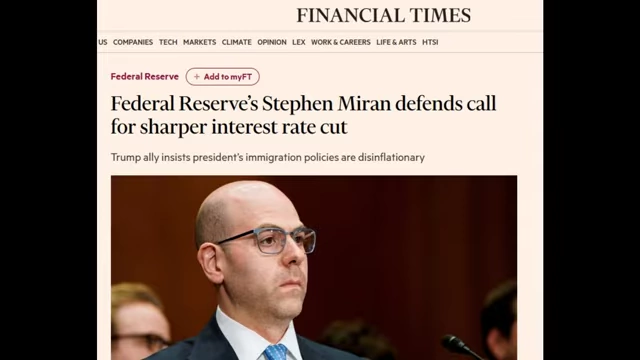
A Financial Times headline reads, "Federal Reserve's Stephen Miran defends call for sharper interest rate cut," indicating his preference for more aggressive monetary policy. [ 00:04:09 ]
- Adriana Kugler's Resignation: Voting member Adriana Kugler, nominated by President Biden, resigned effective August 8, 2025 [0:03:22].
- Impending Change in Fed Chairmanship: Jerome Powell's term as Fed Chair is set to expire in May 2026 [0:04:34].

A list of 2025 Federal Reserve Committee Members highlights Jerome H. Powell, the current Board of Governors Chair, whose term expires in May 2026. [ 00:04:34 ] - It is anticipated that President Trump will select a loyalist to replace Powell, ensuring alignment with his desired monetary policies [0:04:40].

A Barron's headline states, "Trump's Fed Chair Search Expands. Meet the New Contenders," indicating ongoing efforts to find a suitable replacement. [ 00:04:38 ] 
A news analysis headline from the Wall Street Journal describes "Trump's Plan to Pack the Fed With Loyalists," highlighting his strategy to influence monetary policy. [ 00:05:02 ] - The position of Fed Chair holds immense influence over other voting members, often leading to a "herd mentality" where dissent is rare, reinforcing the idea that a loyalist Chair would effectively control policy direction [0:05:07].
- It is anticipated that President Trump will select a loyalist to replace Powell, ensuring alignment with his desired monetary policies [0:04:40].
The Speaker's Opinion: The Federal Reserve is Unconstitutional [0:05:26]
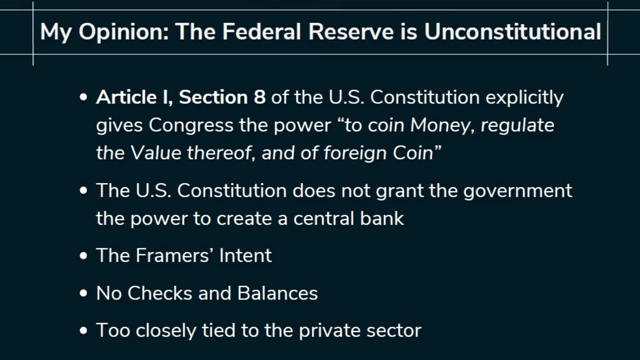
- The speaker presents five arguments supporting the view that the Federal Reserve is unconstitutional:
- Congressional Power Over Money: Article I, Section 8 of the U.S. Constitution explicitly grants Congress the power "to coin Money, regulate the Value thereof, and of foreign Coin," not a private organization [0:05:51].
- No Constitutional Grant for a Central Bank: The U.S. Constitution does not explicitly grant the government the power to establish a central bank [0:06:04].
- Framer's Intent: The Founding Fathers, including Thomas Jefferson and James Madison, were deeply skeptical of central banks [0:06:10].
- Lack of Checks and Balances: The Federal Reserve can significantly impact the economy through interest rate changes, money supply adjustments, and lending programs without direct congressional approval [0:06:38].
- It is not accountable to voters or any other direct government oversight [0:06:57].
- Ties to the Private Sector: Each Federal Reserve bank is structured as a corporation with shares held by commercial banks [0:07:03].
- This structure gives private banks a high degree of influence within the Federal Reserve, which the speaker views as "masquerading to be an independent quasi government agency" [0:07:15].
- Broader Societal Impact: The speaker believes the Federal Reserve's actions suppress the middle class and low-income Americans, contributing to a widening wealth gap [0:07:29].
- This ultimately creates a society of "haves and have-nots" and could lead to system collapse, civil unrest, and chaos [0:07:50].
Economic Projections for 2026 under Trump's Influence [0:08:00]
- The market is increasingly betting on a more dovish Federal Reserve if President Trump succeeds in replacing Powell [0:08:07].
- Likely Outcomes for 2026:
- Accelerated Pace: While the Fed had pre-existing plans for rate cuts and money printing in 2026, Trump's influence is anticipated to intensify these actions ("kick it up a few notches") [0:08:33].
- Economic Consequences: These actions are predicted to lead to several significant economic shifts: