Max's Comprehensive Guide to Selecting, Seasoning, and Cooking the Perfect Steak
This video offers a comprehensive guide to mastering steak, covering everything from selecting cuts to advanced cooking techniques, aiming to transform viewers into "steak masters." It categorizes cuts, identifies overrated and underrated options, provides essential purchasing and seasoning tips, and details direct and indirect cooking methods for perfect results. The guide concludes with a blind taste test to assess the host's expertise.

Introduction [00:00]
The video aims to transform viewers into "steak masters" by covering all essential aspects of steak, from selection to cooking. The host defines steak for the video's context as any relatively tender cut of beef, excluding tougher options like brisket or beef ribs.

Steak Categories [00:40]
The video categorizes steak cuts into three main types based on their characteristics and typical use.
The Primary Cuts [00:43]
These are considered premium, expensive cuts often found in steakhouses.

- Ribeye: A classic, highly marbled, and flavorful cut.
- Tenderloin (Filet Mignon): Known for its extreme tenderness.
- New York Strip: Offers a good balance of tenderness and flavor.
- T-Bone / Porterhouse: A cut that includes both the tenderloin and strip loin.
The Secondary Cuts [01:04]
These cuts are generally less premium but offer excellent value and flavor.

- Examples include Picanha, Hanger, Denver, and Skirt steak.
The Tough Cuts [01:16]
These are generally not ideal for direct steak preparation due to their inherent toughness.

- Examples: Top Round, Bottom Round, Eye of Round, and Chuck Tender.
Overrated Cuts [01:36]
The host shares personal opinions on cuts that, despite popularity, might be overrated in terms of value or cooking experience.
1. Ribeye (Tomahawk Ribeye) [01:40]
- Qualities: Incredible taste and super tender.
- Overrated Aspect: Very expensive ($38/lb), with a significant portion being bone. Better value steaks exist for a fraction of the cost.
- Note: A great crowd-pleaser if budget is not an issue.

A Tomahawk Ribeye steak with its long bone, priced at $38/lb, indicating its high cost. [ 00:01:59 ] 
A thick slice of cooked Tomahawk Ribeye steak, showing its medium-rare doneness and texture. [ 00:02:05 ]
2. Tenderloin (Filet Mignon) [02:11]
- Qualities: The most tender cut on the animal.
- Overrated Aspect: Extremely expensive and lacks marbling, fat, and strong flavor compared to other cuts.
- Recommendation: Great as an entry-level steak for those new to steak, especially when cooked rare to medium-rare.
- Tip on Oxidation: Discoloration on the outside of the steak (turning gray) is due to air exposure and does not affect quality. Oxidized steaks can often be found on sale, offering a great deal.

A close-up of a raw tenderloin (filet mignon) steak, showcasing its very lean nature and minimal marbling, characteristic of an overrated cut. [ 00:02:20 ] 
A perfectly cooked Filet Mignon steak, sliced in half to reveal a consistent medium-rare doneness. [ 00:02:25 ] 
A cross-section of a tenderloin steak, highlighting how discoloration from air exposure does not affect quality and can lead to sales opportunities. [ 00:02:58 ]
3. Striploin / New York Strip [03:01]
- Qualities: Offers a good balance between the lean tenderloin and fatty ribeye, being tender and juicy.
- Overrated Aspect: Its premium price point makes it less appealing when considering value.

A raw Striploin/NY Strip steak with a visible fat cap, labeled as an "Overrated: Striploin/NY Strip" cut. [ 00:03:10 ] 
A cross-section of a cooked Striploin/NY Strip steak, revealing a medium-rare interior and thick fat cap. [ 00:03:22 ]
4. Porterhouse [03:31]
- Composition: Essentially a filet and a strip loin attached by a T-bone.
- Overrated Aspects:
- High cost for a significant amount of bone.
- The filet section is much smaller than the strip, leading to uneven cooking where the filet cooks faster.
- Tip: Minimize heat on the filet section when cooking.
- Note: It makes for a stunning centerpiece and offers two cuts in one, sometimes justifying the premium price.

A raw Porterhouse steak with a separate filet cut, illustrating that it comprises both a filet and a strip loin attached by a bone. [ 00:03:36 ] 
A cooked Porterhouse steak being checked, with a tip to minimize heat on the filet section during cooking to prevent overcooking. [ 00:03:49 ] 
Sliced cooked Porterhouse steak, showing the different textures of the filet and strip sections. [ 00:03:58 ]
5. Flank Steak [04:11]
- Qualities: Historically a great value steak.
- Overrated Aspect: Has gained significant popularity, leading to increased prices in grocery stores.
- Alternatives: Flat Iron or Hanger steak are suggested as better-tasting alternatives.
- Key: Always slice against the grain for maximum tenderness.

A raw flank steak, showing its distinct grain pattern, labeled as an "Overrated: Flank" cut. [ 00:04:23 ] 
A perfectly cooked flank steak being sliced against the grain to enhance its tenderness, revealing a medium-rare interior. [ 00:04:39 ]
Underrated Cuts [04:45]
These are the host's favorite cuts, offering great flavor and tenderness at a more accessible price point. Slicing against the grain is crucial for all of them.
1. Flat Iron [04:45]
- Qualities: The second most tender steak on the entire animal, coming from the shoulder, which provides incredible flavor from consistent use.
- Versatility: Can be cooked from rare to well-done and remain extremely tender.
- Preparation: Always slice against the grain.

A raw flat iron steak, labeled as an "Underrated: Flat Iron" cut. [ 00:04:49 ] 
A slice of cooked flat iron steak, showcasing its tender, medium-rare doneness. [ 00:04:59 ]
2. Tri-Tip [05:04]
- Popularity: More common on the West Coast.
- Preparation: Best when smoked whole and then sliced against the grain.

A raw tri-tip steak, showing its triangular shape and marbling, labeled as "Underrated: Tri-Tip." [ 00:05:09 ] 
A slice of cooked tri-tip steak, revealing its medium-rare interior and texture. [ 00:05:14 ]
3. Denver [05:17]
- Origin: Also from the shoulder.
- Qualities: A bit less tender than flat iron but exceptionally beefy.
- Preparation: Slicing against the grain is critical for tenderness, making it almost as tender as a ribeye.

A raw Denver steak, showcasing its beefy texture, labeled as an "Underrated: Denver" cut. [ 00:05:23 ] 
A cooked Denver steak being sliced against the grain, with a tip highlighting this technique for tenderness. [ 00:05:29 ]
4. Picanha [05:35]
- Popularity: Popularized in South America.
- Features: Characterized by a huge, delicious fat cap and super tender meat.
- Preparation: Can be cooked whole. If cutting into steaks, slice with the grain first, then slice against the grain after cooking for tender bites.

A raw Picanha steak with a thick fat cap, labeled as "Underrated: Picanha." [ 00:05:45 ] 
The host demonstrates slicing raw Picanha along the grain, with a tip explaining this method for tender steaks after cooking. [ 00:05:53 ] 
Slices of cooked Picanha, showcasing its tender texture and delicious fat cap. [ 00:06:00 ]
5. Skirt Steak [06:01]
- Type: Inside skirt steak, known for its loose muscle fibers.
- Preparation: Phenomenal with marinades, ideal for grilling to get a nice char, and must be sliced against the grain.

A raw skirt steak, characterized by its loose muscle fibers, labeled as "Underrated: Skirt." [ 00:06:09 ] 
Slices of cooked skirt steak, revealing its tender texture. [ 00:06:18 ]
6. Top Sirloin [06:19]
- Description: A solid weeknight steak, often lean.
- Tip: Sometimes includes a piece of the Picanha still attached.
- Cooking: Best cooked to medium rare.

A raw top sirloin steak, showcasing its lean profile, labeled as "Underrated: Top Sirloin." [ 00:06:25 ] 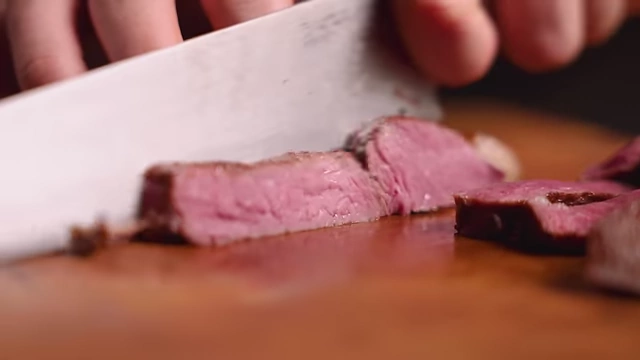
Slices of cooked top sirloin steak, displaying a consistent medium-rare doneness. [ 00:06:32 ]
7. Bavette [06:33]
- Availability: Can be tough to find.
- Comparison: Very similar to flank steak but generally slightly better due to being thicker and having better marbling.
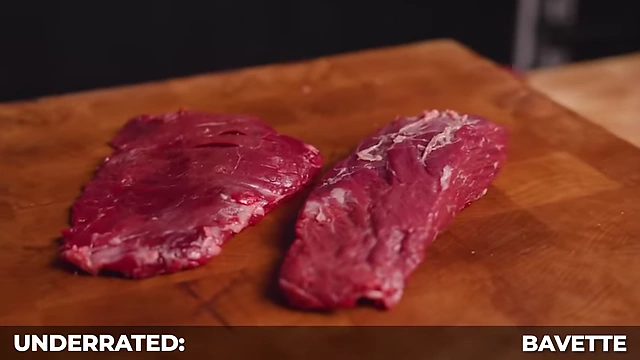
A raw bavette steak, similar to flank steak but often thicker with better marbling, labeled as "Underrated: Bavette." [ 00:06:37 ] 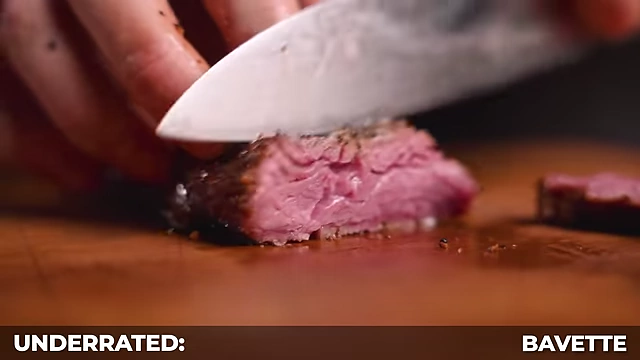
Slices of cooked bavette steak, showing its internal doneness. [ 00:06:45 ]
8. Hanger Steak [06:47]
- Nickname: Often called the "butcher's cut" because butchers would keep it for themselves due to its quality.
- Qualities: Insanely tender and juicy, offering incredible value (e.g., $5 for a whole steak in NYC).

A raw hanger steak, known for its tenderness and value, labeled as "Underrated: Hanger." [ 00:06:56 ] 
Slices of cooked hanger steak, highlighting its tender interior and noting its incredible value ($5 Steak!). [ 00:07:04 ]
Do Not Buy [07:14]
These cuts are generally not recommended for steak preparation due to their tough texture and lack of flavor.
1. Top Round / Bottom Round [07:16]
- Qualities: Extremely tough.
- Alternative Uses: Can be pounded out for chicken-fried steak.
- Recommendation: Better to spend a little extra money on a more tender cut.

Raw cuts of Top Round and Bottom Round steaks, labeled "DO NOT BUY." [ 00:07:21 ] 
Cooked slices of Top Round or Bottom Round steak being torn, demonstrating their tough, stringy texture. [ 00:07:34 ]
2. Eye of Round [07:40]
- Qualities: Extremely tough and virtually flavorless.
- Recommended Uses: Belongs in the trash or for beef jerky. If cooked, keep it whole like a roast and slice very thinly.

A raw eye of round roast, described as extremely tough and flavorless, labeled "DO NOT BUY." [ 00:07:44 ] 
Thin slices of a cooked eye of round roast, illustrating the recommended thin slicing for this tough cut. [ 00:07:55 ]
3. Chuck Tender [07:58]
- Misconception: Often confused with tenderloin due to its similar shape and the word "tender" in its name.
- Reality: Not tender at all; it is frequently marketed misleadingly.

A raw Chuck Tender cut, often confused with tenderloin due to its shape, labeled "DO NOT BUY." [ 00:08:07 ] 
Slices of cooked Chuck Tender, showing its less tender internal structure. [ 00:08:21 ]
5 Additional Tips [08:30]
Important considerations when purchasing steak.
1. Marbling [08:31]
- Grades: In America, primary grades are Select (least marbling, avoid), Choice, and Prime (highest marbling, most intramuscular fat). Wagyu is even higher.
- Visual Inspection: Price and grade don't always reflect actual marbling. Always use your eyes to choose the steak that looks best to you, regardless of its label.

A graphic scale illustrating steak marbling grades from Select to Prime and Wagyu. [ 00:08:38 ] 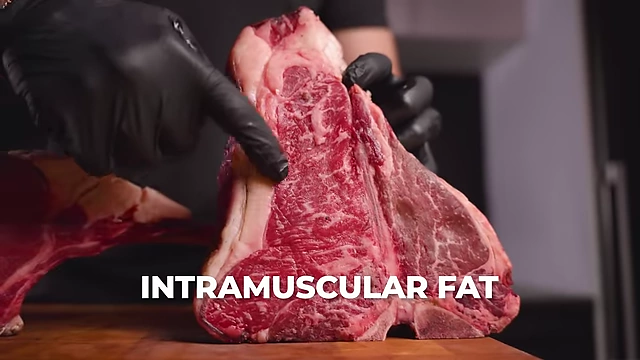
A close-up of a marbled steak, with "INTRAMUSCULAR FAT" pointing to the marbling within the meat. [ 00:08:48 ] 
A side-by-side comparison of two raw steaks (a Tomahawk Ribeye and a Porterhouse), with a tip to prioritize visual marbling over official grades when buying. [ 00:09:17 ]
2. Speak with Your Butcher [09:22]
- Butchers as a Resource: Butchers are usually knowledgeable and helpful.
- Advocacy: Don't hesitate to ask for a specific cut, better marbling, or to see other options if you're not satisfied with what's on display. It's your money, so ensure you're happy with your purchase.

The host explaining the importance of confidently speaking with your butcher, with a tip to not pay for meat you're unhappy with. [ 00:09:38 ]
3. Sales [09:52]
- Opportunities: Look for discounted cuts, especially around holidays (e.g., rib roasts 50% off during Christmas).
- Flexibility: Don't go into the store fixated on one specific cut. Be open to buying what looks best and is on sale.

The host gesturing while discussing the strategy of looking for sales when buying steak. [ 00:09:58 ]
4. Fresh vs. Frozen Steaks [10:23]
- Quality: There is virtually no difference in flavor, texture, or quality for steaks that have only been frozen once. Don't be afraid to buy frozen.
5. Dry-Aged vs. Wet-Aged Steaks [10:34]
- Wet-Aged: 99% of supermarket steaks are wet-aged, meaning they are vacuum-sealed, which tenderizes them over time.
- Dry-Aged: Exposed to air for an extended period, leading to moisture evaporation and a more concentrated flavor.
- Recommendation: If paying a premium for dry-aged, ensure it has been aged for at least 30 days to fully realize its benefits.

A wet-aged steak, with text defining wet-aging as vacuum-sealing for preservation and tenderness. [ 00:10:45 ] 
A dry-aged steak, with text defining dry-aging as exposure to air to concentrate flavor. [ 00:10:53 ] 
A close-up of a sliced dry-aged steak, emphasizing that dry-aging for over 30 days yields the most flavor. [ 00:11:06 ]
How To Season Steak [11:13]
Proper seasoning is crucial for a flavorful steak.
Basic Seasoning [11:17]
- Core Ingredients: Salt, black pepper, and garlic powder.
- Caution: Garlic powder and black pepper can burn in a cast iron pan, so be mindful of cooking temperature.
- Avoid Sugar: Sugar in seasonings can cause burning, so opt for very low or sugar-free rubs.

The essential seasoning ingredients for steak: Kosher salt, a pepper mill, and garlic powder. [ 00:11:17 ] 
Basic seasoning ingredients for steak, with a caution that black pepper and garlic powder can burn in a cast iron pan. [ 00:11:30 ]
Kosher Salt vs. Table Salt [11:43]
- Kosher Salt Preference: Kosher salt is always recommended.
- Visibility: Its coarser particles make it easier to see how much you're applying, ensuring a consistent layer.
- Absorption: It absorbs more slowly than fine iodized table salt.
- Texture: Contributes better to developing a crust.

A raw steak being seasoned with Kosher salt, highlighting that it provides a consistent and easy-to-measure layer. [ 00:12:08 ] 
A comparison of two seasoned steaks, illustrating how Kosher salt contributes to a better crust texture compared to fine salt. [ 00:12:13 ]
Dry Brining [12:17]
Dry brining is a simple yet powerful technique for enhancing steak.
Process [12:17]
- Definition: Seasoning your steak with salt prior to cooking.
- Timing: At least an hour before cooking, ideally overnight.

A piece of steak being seasoned with salt, illustrating the concept of dry brining, defined as "Seasoning steaks prior to cooking." [ 00:12:17 ]
Benefits [12:23]
- Even Seasoning: As the salt absorbs, the steak becomes seasoned throughout, not just on the surface.
- Superior Crust: A fully dry-brined steak develops an extremely dry exterior, which is critical for forming a strong, flavorful crust during searing.

A side-by-side comparison of a dry-brined steak (left) with a significantly better crust and a normal steak (right) being seared in a pan. [ 00:12:47 ]
How To Cook Steak [12:57]
Mastering steak cooking involves balancing two key variables: developing a crust and achieving even doneness.
Two Key Variables [13:03]
- 1. Developing a nice crust: Requires super high heat.
- 2. Cooking evenly: Achieved by cooking slower for edge-to-edge doneness.
- The Conflict: High heat for crust can lead to uneven cooking, while slow cooking for evenness might compromise the crust.

The host explaining that achieving a nice crust on steak requires super high heat. [ 00:13:14 ] 
The host explaining that achieving an even cook on steak requires a longer cooking time. [ 00:13:18 ]
Steak Categories for Cooking [13:21]
Steaks are categorized by thickness to determine the best cooking method.
- Thin Steaks (under ~1 inch): Focus on developing the crust as quickly as possible using the Direct Heat Method.
- Thick Steaks: Focus on cooking them evenly using the Indirect Heat Method.

A thick steak (like a Tomahawk Ribeye) contrasted with thinner cuts, illustrating the two categories for cooking: Thin Steaks = Direct Heat Method, Thick Steaks = Indirect Heat Method. [ 00:13:37 ]
Indirect Heat Method (Reverse Searing / Sous Vide) [13:44]
This method is ideal for thick steaks to achieve even doneness before searing.
- Reverse Searing: Slowly brings up the steak's temperature in an oven, smoker, or offset grill to fully cook it before a final sear.
- Benefit: Achieves a beautiful edge-to-edge medium-rare.
- Example: Tomahawk steak cooked in a low-temperature oven (250°F) until it reaches ~125°F internal temperature.

Seasoned thick steaks (Tomahawk Ribeye) being prepared for reverse searing, illustrating the process of "Reverse Searing: fully cooking a steak before searing." [ 00:13:47 ] 
A thick Tomahawk steak cooking in a low-temperature oven, with a tip to cook thick steaks at a lower heat, like 250°F. [ 00:14:17 ]
- Sous Vide: Another form of indirect heat cooking.
- Example: Porterhouse steak cooked at 130°F in a sous vide bath.

A Porterhouse steak being placed into a sous vide bath, with text defining "Sous Vide: Vacuum seal and boil." [ 00:14:21 ]
- Example: Porterhouse steak cooked at 130°F in a sous vide bath.
- Searing Step: After indirect cooking, sear the steak using a pan, grill, or even a blow torch to develop the crust.
- Temperature Control: Use a thermometer. Pull the steak around 115°F internal temperature, accounting for up to 15°F of carryover cooking during a 5-10 minute rest.

A thick Tomahawk steak, cooked via reverse sear, with a tip to pull it from the heat at 125°F for a medium-rare finish. [ 00:14:28 ] 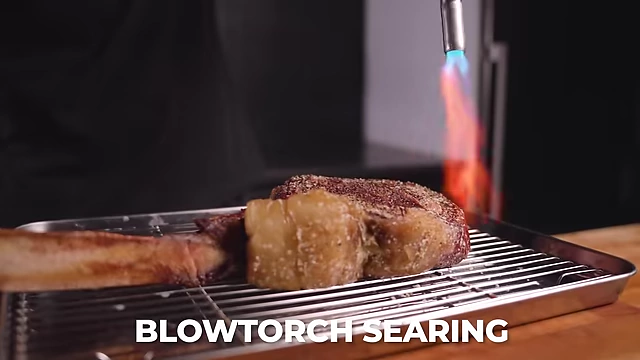
A Tomahawk steak being seared with a blowtorch, demonstrating an aggressive searing technique to develop a crust. [ 00:14:46 ] 
A thick slice of Porterhouse steak, perfectly cooked with an even edge-to-edge medium-rare doneness. [ 00:14:55 ]
Direct Heat Method (for Thin Steaks) [15:04]
This method focuses on quickly developing a crust on thinner steaks.
- Pan Searing:
- Use a cast iron pan and get it very hot (thinner steak = higher heat).
- Flip frequently for even cooking and crust development.
- Once a nice sear is formed, add butter and baste the steak.
- Monitor temperature; pull around 115°F, allowing for carryover cooking during the rest.

Two thin steaks on a cutting board, with a tip to "Use the Direct Heat Method on steaks under 1" thick." [ 00:15:11 ] 
A thin steak being seared in a cast iron pan, with a tip that "Thinner Steak = Higher Heat!". [ 00:15:28 ] 
A thin steak being flipped frequently in a pan, with a tip to "Flip often for even cooking." [ 00:15:34 ] 
A thin steak being basted with butter and herbs in a pan, with a tip to "Baste steaks in their cooking oils to keep juicy." [ 00:15:44 ] 
A perfectly cooked medium-rare thin steak, with a tip to "Pull at 115F internal for medium-rare steaks." [ 00:15:56 ]
- Grilling (Gas Grill):
- Understand your grill's hot spots.
- Sear quickly due to the steak's thinness.
- Dry brining is particularly helpful here to aid crust development, as gas grills might struggle to achieve a strong crust on thin steaks.

A thin skirt steak being grilled directly over high heat on a gas grill, with a tip to "Cook with the hottest part of your grill." [ 00:16:16 ] 
A cooked skirt steak being sliced, with a tip to "Dry Brine to give steaks a better crust" for grilling. [ 00:16:31 ]
Taste Test [16:43]
The host conducts a blindfolded taste test of 13 different cooked steak cuts to see how many he can correctly identify. He successfully identifies 5 out of 13.

