Analyzing Trump's Proposed 10% Credit Card Interest Rate Cap: Feasibility, Economic Impact, and Challenges
Summary:
- Donald Trump has proposed a one-year, 10% cap on credit card interest rates, effective January 20, 2026, aiming to alleviate the significant burden of consumer debt.
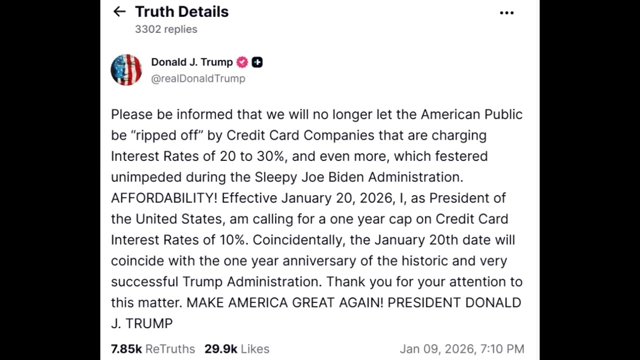
A post by Donald J. Trump on "Truth Details" states, "I, as President of the United States, am calling for a one year cap on Credit Card Interest Rates of 10%." [ 00:00:20 ] - Americans currently face record credit card debt, totaling $1.21 trillion, with an average Annual Percentage Rate (APR) of around 22%.
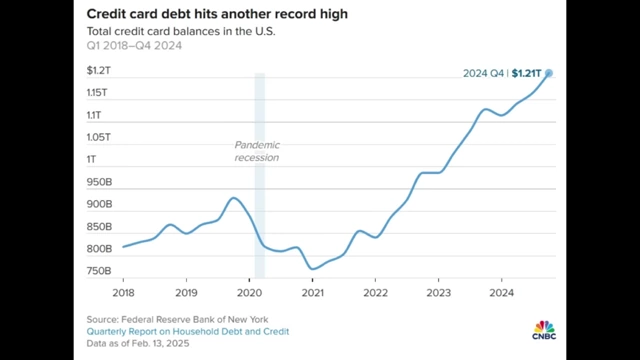
A chart illustrating the significant increase in total credit card balances in the U.S. from Q1 2018 to Q4 2024, reaching $1.21 trillion. [ 00:01:25 ] - Implementing this cap could potentially save Americans $144 billion annually in interest payments.
- However, a U.S. President cannot unilaterally impose such a cap via executive order; it requires legislation passed by Congress.
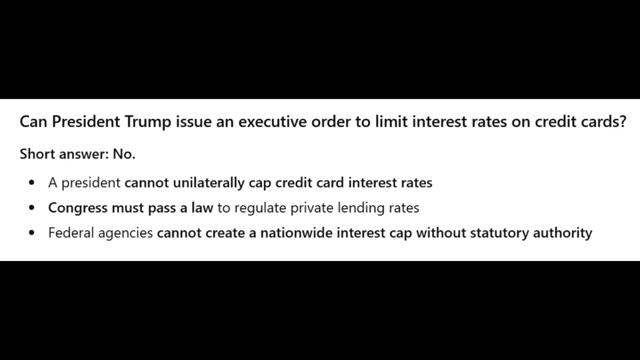
A slide explaining that a President cannot unilaterally cap credit card interest rates and that Congress must pass a law. [ 00:02:59 ] - Similar efforts by Senator Bernie Sanders and Congresswoman Alexandria Ocasio-Cortez in previous years failed to gain traction in Congress.

Images of Congresswoman Alexandria Ocasio-Cortez and Senator Bernie Sanders, who previously attempted to cap credit card interest rates. [ 00:03:54 ] - Banks, who are the primary recipients of credit card interest, strongly oppose the measure, arguing it would severely impact their profits and lead to reduced credit availability.
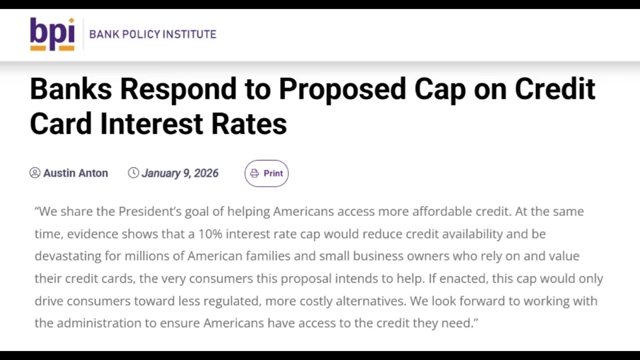
An article headline from the Bank Policy Institute expressing concerns that a 10% interest rate cap would reduce credit availability and be devastating for millions of families and small businesses. [ 00:04:54 ] - They warn that a cap would lead to tighter credit standards, including fewer approvals, reduced credit limits, and canceled accounts, especially for higher-risk borrowers, and predict an increase in various fees (annual, late, balance transfer) and a reduction or discontinuation of credit card rewards.

A table showing that rewards funding for credit cards comes from the issuing bank. [ 00:05:39 ] 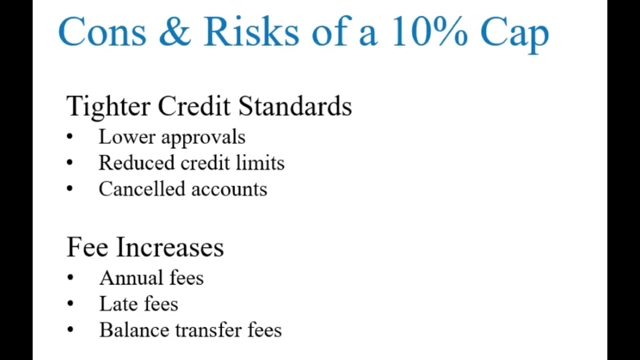
A slide outlining the cons and risks of a 10% cap, including tighter credit standards and fee increases. [ 00:06:48 ] - The proposal remains a concept, facing significant legislative and banking industry hurdles, with political motivations also being a subject of debate.
Trump's Proposal for a 10% Credit Card Interest Rate Cap [0:00]
Donald Trump announced a proposal to cap credit card interest rates at 10% for one year, starting January 20, 2026.
- The stated goal is to prevent the American public from being "ripped off" by credit card companies charging 20-30% interest rates.
- Trump's post on January 9th, 2026, explicitly states he is "calling for" this cap, not that he will unilaterally implement it [0:18].
A post by Donald J. Trump on "Truth Details" states, "I, as President of the United States, am calling for a one year cap on Credit Card Interest Rates of 10%." [ 00:00:20 ] - The speaker emphasizes that "calling for" something is a request, not a promise or an executive action [0:44].
- Trump's post on January 9th, 2026, explicitly states he is "calling for" this cap, not that he will unilaterally implement it [0:18].
The Current State of Credit Card Debt in the US [1:14]
The proposal comes amidst record-high credit card debt in the United States.
- Total credit card balances hit a record $1.21 trillion by Q4 2024 [1:25].
A chart illustrating the significant increase in total credit card balances in the U.S. from Q1 2018 to Q4 2024, reaching $1.21 trillion. [ 00:01:25 ] - A 10% interest rate cap could save Americans an estimated $144 billion in interest payments annually [1:56].
- This savings could be used for debt reduction, daily expenditures, or discretionary income [2:08].
- Credit card interest payments primarily go to the issuing banks (e.g., JP Morgan Chase, Citi Bank, Bank of America), not the card networks like Visa or Mastercard [2:24].
Feasibility of Implementing the Interest Rate Cap [2:56]
The implementation of a nationwide interest rate cap faces significant legal and political hurdles.
- A U.S. President cannot unilaterally cap credit card interest rates through an executive order [3:00].
- Any such executive order would likely be legally unenforceable and challenged in court by banks [3:11].
- To regulate private lending rates, Congress must pass a law [3:22].
A slide titled "Can President Trump issue an executive order to limit interest rates on credit cards? Short answer: No." lists that a president cannot unilaterally cap rates, Congress must pass a law, and federal agencies lack statutory authority for a nationwide cap. [ 00:02:59 ]
- Previous attempts to cap credit card interest rates in Congress have failed [3:37].
- Senator Bernie Sanders proposed a 10% cap for five years approximately 11 months prior to the video's recording, which did not materialize [3:49].
- Congresswoman Alexandria Ocasio-Cortez introduced a bill in March 2025 for a 10% cap, but it failed to gain traction [3:59].
Images of Congresswoman Alexandria Ocasio-Cortez and Senator Bernie Sanders, who previously attempted to cap credit card interest rates. [ 00:03:54 ]
- Current legislative discussions involve Senator Marshall and President Trump to potentially create legislation for a vote [4:12].
- Senator Marshall expressed that these efforts aim to lower costs for American families and curb "greedy credit card companies" [4:26].
- Overall, the speaker concludes that the proposal is currently a concept with uncertain prospects, similar to other political ideas that have not materialized [4:38].
Potential Impacts and Concerns of a 10% Cap [4:54]
The banking industry has expressed strong opposition, citing several negative consequences.
- Banks argue that a 10% cap would reduce credit availability and be "devastating" for millions of families and small businesses [4:54].
- The Bank Policy Institute claims such a cap would drive consumers towards less regulated, more costly alternatives [5:00].
An article headline from Bank Policy Institute reads "Banks Respond to Proposed Cap on Credit Card Interest Rates" with text claiming a 10% interest rate cap would reduce credit availability and be devastating for millions of American families and small business owners. [ 00:04:54 ] - The speaker suggests that the banks' primary concern is the loss of income and profits [5:18].
- The Bank Policy Institute claims such a cap would drive consumers towards less regulated, more costly alternatives [5:00].
- Impact on credit card rewards programs [6:05].
- Rewards such as cash back, miles, and points are funded by the issuing banks, not the credit card networks [6:05].
A table outlines "Fee type" and "Who gets it," showing "Rewards funding" goes to the "Issuing bank." [ 00:05:39 ] - If banks make less money due to an interest rate cap, credit card rewards would likely be significantly reduced or discontinued [6:35].
- Rewards such as cash back, miles, and points are funded by the issuing banks, not the credit card networks [6:05].
- Other cons and risks of a 10% cap, as argued by banks [6:47].
- Tighter credit standards:
- Fee increases:
- Banks would likely increase other fees to offset lost interest revenue [7:42].
- Potential increases in annual fees, late fees, and balance transfer fees [7:47].
A slide titled "Cons & Risks of a 10% Cap" lists "Tighter Credit Standards" (Lower approvals, Reduced credit limits, Cancelled accounts) and "Fee Increases" (Annual fees, Late fees, Balance transfer fees). [ 00:06:48 ]