The Financial Implications of the 2025 Government Shutdown: Impacts on Jobs, Social Security, and Markets
The 2025 federal government shutdown impacts various financial aspects, arising from politicians' failure to agree on a funding bill. Key takeaways include:
- Essential services like Social Security, Medicare, and VA benefits remain funded, while non-essential services such as certain national parks, the Small Business Administration (SBA), and economic data collection are closed or delayed.
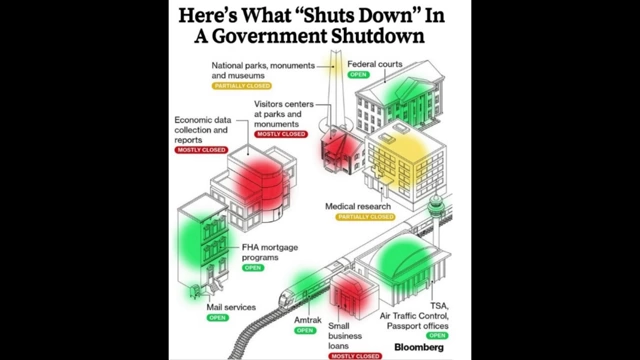
An infographic showing which government services are open (green), partially closed (yellow), or mostly closed (red) during a shutdown. [ 00:00:25 ] - Crucial economic reports, including the jobs report and CPI inflation data, face delays, which could hinder the Federal Reserve's data-dependent interest rate decisions, as confirmed by the Department of Labor's contingency plan.
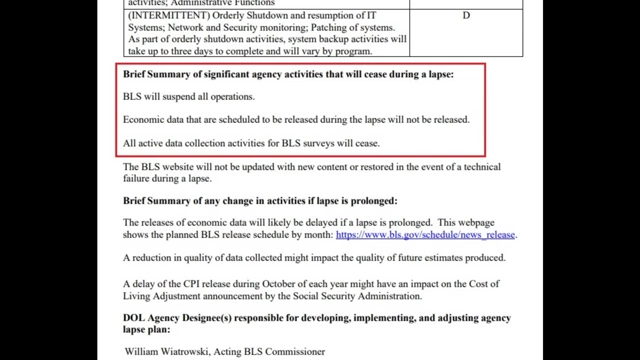
A summary from the U.S. Department of Labor's contingency plan, stating that the Bureau of Labor Statistics will suspend all operations and not release scheduled economic data during a lapse in appropriations. [ 00:01:29 ] - The announcement of the 2026 Social Security Cost of Living Adjustment (COLA) may be delayed, though beneficiaries will still receive their adjustments on time.
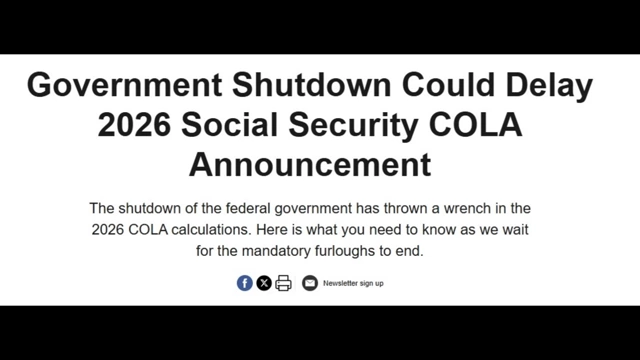
A news headline indicating that a government shutdown could delay the 2026 Social Security COLA announcement. [ 00:02:50 ] - Historically, government shutdowns have a minimal impact on the S&P 500 stock market, showing only fractional changes.
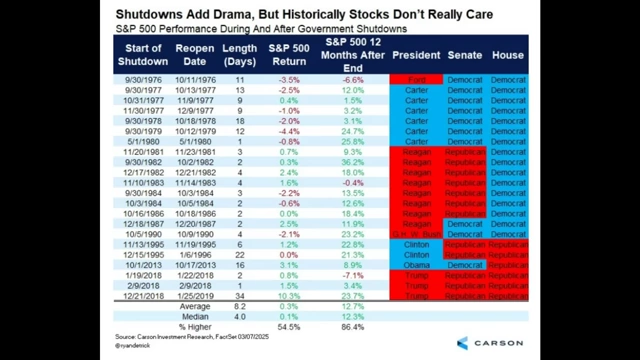
A table detailing S&P 500 performance during and 12 months after historical government shutdowns, showing minimal impact during the shutdown periods. [ 00:03:14 ] - A government shutdown commonly leads to a weaker US dollar, which can be favorable for commodities like gold and silver.
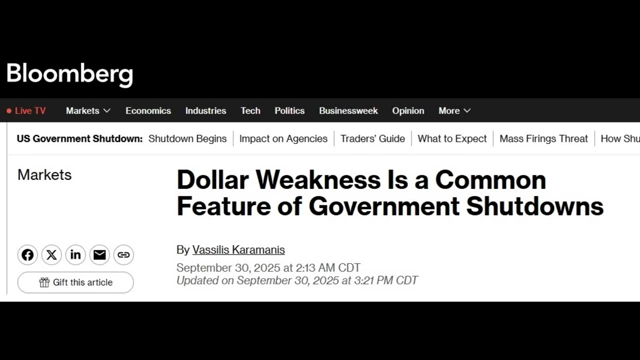
A Bloomberg headline noting that dollar weakness is a common feature of government shutdowns. [ 00:04:20 ] - Approximately 750,000 federal employees will be furloughed without pay but are statutorily entitled to retroactive back pay once the government reopens, while Members of Congress continue to receive their salaries.
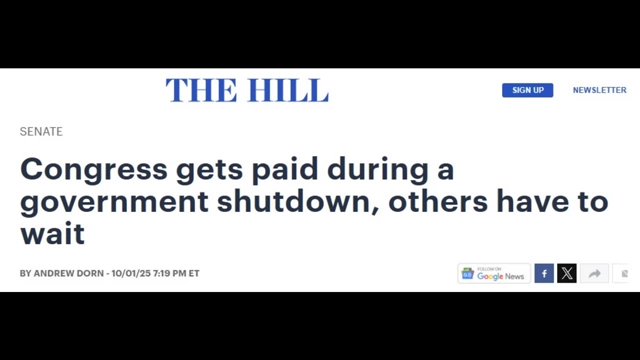
A news headline from The Hill stating that Congress members get paid during a government shutdown while other federal workers have to wait. [ 00:05:28 ] - The overall impact on the broader US economy is expected to be minimal due to back pay for federal employees.
- Historically, shutdowns average about 8 days, but duration is unpredictable and dependent on political stalemates, such as the current one over healthcare subsidies.
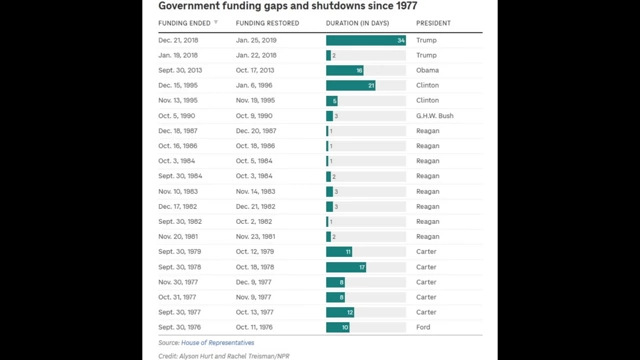
A table listing government funding gaps and shutdowns since 1977, showing their duration in days and the responsible political parties. [ 00:06:41 ] - Public opinion polls indicate Republicans are blamed most (38%), followed by both parties (31%), for a potential shutdown.
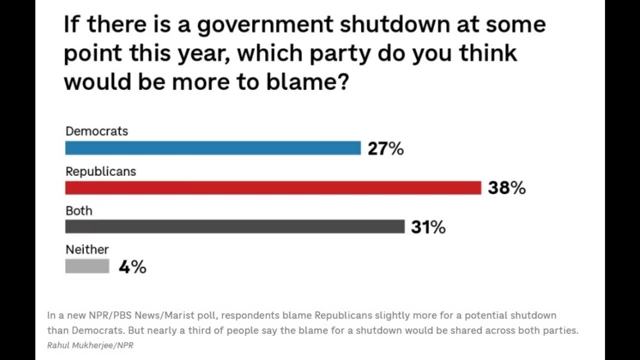
A bar chart showing poll results on which party is more to blame for a government shutdown, with Republicans (38%) being blamed most, followed by Both (31%) and Democrats (27%). [ 00:08:12 ]
Understanding the Government Shutdown [0:00]
The federal government has shut down due to a failure among politicians to agree upon and pass a funding bill. This video focuses specifically on the money-related consequences and the political dynamics influencing the shutdown's duration.
Services Affected by a Government Shutdown [0:25]
During a federal government shutdown, not all government functions cease.
- Services and Programs That Continue (Essential Services) [0:31]
- Social Security, Medicare, Medicaid, and VA benefits remain funded and operational.
- TSA operations continue without interruption.
- Federal courts largely remain open.
- Services and Programs That Close or Are Delayed [0:42]
- Certain national parks, monuments, and museums may close.
- Visitor centers at parks and monuments are affected.
- The Small Business Administration (SBA) ceases some operations.
- Economic data collection and reports are suspended.
- Medical research activities may be halted.
- FHA mortgage programs face disruptions.
- Passport offices might experience delays.
An infographic showing which government services are open (green), partially closed (yellow), or mostly closed (red) during a shutdown. [ 00:00:25 ]
Impact on Economic Data and Federal Reserve Decisions [0:52]
The suspension of economic data collection has significant financial ramifications.
- Jobs Reports [0:52]
- The monthly jobs report, typically released on the first Friday of each month, will be delayed.
- The U.S. Department of Labor's contingency plan explicitly states that the Bureau of Labor Statistics (BLS) will suspend all operations and not release scheduled economic data during a lapse in appropriations.
- CPI Inflation Report [1:42]
- The Consumer Price Index (CPI) inflation report, usually released around October 15th, is also in jeopardy of being delayed.
- Federal Reserve Implications [1:51]
- The Federal Reserve relies heavily on jobs and inflation data to make interest rate decisions.
- A prolonged delay in these reports could force the Fed to make critical policy decisions "in the dark" ahead of their next meeting, scheduled for October 29th.
A summary from the U.S. Department of Labor's contingency plan, stating that the Bureau of Labor Statistics will suspend all operations and not release scheduled economic data during a lapse in appropriations. [ 00:01:29 ]
Social Security COLA Announcement Delay [2:34]
The shutdown also affects announcements related to Social Security benefits.
- 2026 COLA Announcement [2:36]
- The announcement for the 2026 Social Security Cost of Living Adjustment (COLA), typically made around October 15th, could be delayed if the underlying inflation data is not released on time.
- Beneficiary Payments [2:52]
- It is crucial to note that beneficiaries will still receive their 2026 COLA on time; only the official announcement of the adjustment amount is delayed.
A news headline indicating that a government shutdown could delay the 2026 Social Security COLA announcement. [ 00:02:50 ]
- It is crucial to note that beneficiaries will still receive their 2026 COLA on time; only the official announcement of the adjustment amount is delayed.
Stock Market and US Dollar Impact [3:07]
Government shutdowns typically have specific effects on financial markets.
- Stock Market Performance (S&P 500) [3:13]
- Historical data indicates that government shutdowns generally have a minimal impact on the stock market.
- The S&P 500 has, on average, seen a modest return of 0.3% and a median return of 0.1% during past shutdown periods.
- This suggests that shutdowns do not typically cause a significant market "crash" or create substantial "buy the dip" opportunities.
- US Dollar Weakness [4:03]
- A government shutdown is often associated with political instability, which tends to weaken the US dollar.
- A weaker dollar can be beneficial for commodity prices, including gold and silver.
- The video speaker suggests that such shutdowns exacerbate the situation for the US dollar, aligning with a view of a broader "monetary reset."
A table detailing S&P 500 performance during and 12 months after historical government shutdowns, showing minimal impact during the shutdown periods. [ 00:03:14 ]
A Bloomberg headline noting that dollar weakness is a common feature of government shutdowns. [ 00:04:20 ]
Impact on Federal Employees [4:42]
The shutdown directly affects the employment and pay of federal workers.
- Furloughed Employees [4:44]
- Approximately 750,000 federal employees are expected to be furloughed, meaning they are placed on temporary leave without pay.
- Retroactive Back Pay [4:56]
- Under the Government Employee Fair Treatment Act, both furloughed employees and essential federal employees (who must work without pay during the shutdown) are legally entitled to receive retroactive pay once the government reopens.
- This back pay is mandated to be paid on the earliest possible date after the shutdown ends, regardless of regular payroll schedules.
- Exceptions to Pay Freeze [5:30]
- Members of Congress continue to receive their paychecks during a shutdown, as mandated by Article I, Section Six of the US Constitution.
- US Postal Service (USPS) employees also continue to be paid because the USPS is a self-funded, independent agency.
A news headline from The Hill stating that Congress members get paid during a government shutdown while other federal workers have to wait. [ 00:05:28 ]
General US Economy Impact [6:01]
The overall effect of a government shutdown on the broader US economy is typically limited.
- Minimal Impact Expected [6:10]
- Due to the provision for retroactive pay for federal employees and the eventual spending of appropriated funds, the economic impact is generally considered minimal. The government ultimately spends what it would have spent, simply delaying the timing.
Duration of Government Shutdowns and Political Blame [6:23]
The length of a shutdown and public perception of responsibility are key considerations.
- Historical Duration [6:27]
- Over the past 50 years, the average government shutdown has lasted approximately eight days.
- However, historical data shows significant variability, with shutdowns ranging from a few days to over a month.
- Current Political Stalemate [6:58]
- The current shutdown stems from the Senate's failure to pass a funding bill (CR), which required 60 votes but only received 55-45.
- The main point of contention between the parties is primarily over healthcare subsidies.
- A significant concern is that the proposed funding bill was only a temporary, 7-week extension, implying that the same political battle could re-emerge shortly after a resolution.
- Public Opinion on Blame [8:13]
- A Maris poll indicates public sentiment regarding responsibility for the shutdown:
- Republicans are blamed by 38% of respondents.
- Democrats are blamed by 27% of respondents.
- Both parties are blamed by 31% of respondents.
- 4% blame neither party.
- While Republicans hold majorities in both the House and Senate, passing legislation in the Senate requires a 60-vote supermajority, necessitating bipartisan cooperation.
- Democrats are pushing for changes, specifically to repeal certain healthcare cuts, arguing they are fighting for lower healthcare costs, while Republicans generally sought a temporary extension without changes.
A table listing government funding gaps and shutdowns since 1977, showing their duration in days and the responsible political parties. [ 00:06:41 ]
A bar chart showing poll results on which party is more to blame for a government shutdown, with Republicans (38%) being blamed most, followed by Both (31%) and Democrats (27%). [ 00:08:12 ]
- A Maris poll indicates public sentiment regarding responsibility for the shutdown: