Why Gen Z Doesn't Enlist: A Multi-faceted Analysis of History, Economy, and Government Trust
Summary:
- Gen Z has experienced major historical events like 9/11, the 2008 financial crisis, and the COVID-19 pandemic, and has been subject to school safety drills from a young age, creating a unique sense of crisis.
- Faced with potential conscription, many Gen Z individuals express a preference for imprisonment over military service, showing strong resistance.
- The video discusses the shift in propaganda models, pointing out that while traditional propaganda may be waning, modern propaganda is more covert, exploiting mass psychology and biases.
- Declining trust in government and mainstream media is a key reason why Gen Z is unwilling to join the military, believing the government is deceptive in foreign conflicts.
- Military recruitment has expanded from traditional working-class high schools to anime conventions, Twitch, and NBA games, reflecting the military's challenges in recruiting new soldiers.
- The video emphasizes the brutal realities of war (such as Vietnam War traps) and the inadequacy of veteran benefits (such as homelessness), which reduce the appeal of military service.
- Gen Z is generally pessimistic about the economic outlook, believing the "American Dream" is shattered and that stable jobs or homeownership are unattainable through hard work, leading to a lack of motivation to fight for the country.
- Although enlistment numbers reached record lows during Biden's term, recruitment numbers have rebounded somewhat with the emergence of "male role models."
- The video concludes that future wars may rely more on technology than large-scale ground forces due to modern military technology, making traditional conscription unlikely.
Gen Z's Unique Historical Experiences and Views on Conscription [0:00:02]
- Gen Z is considered the generation that has experienced the most "life-altering events."
- Born or raised during the 9/11 terrorist attacks and experienced the 2008 financial crisis.
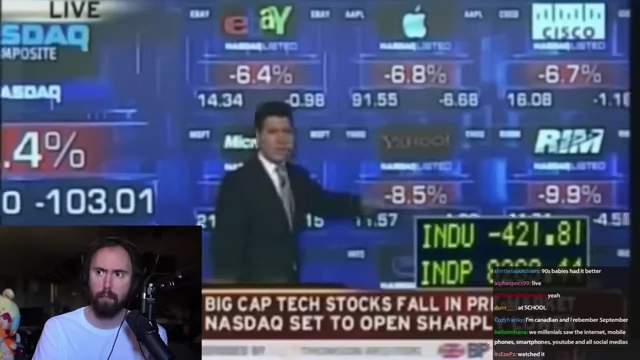
Nasdaq index during the 2008 financial crisis, showing the decline in tech stocks [ 00:00:52 ] - Faced the COVID-19 pandemic at the beginning of their adulthood, leading to societal shutdowns.
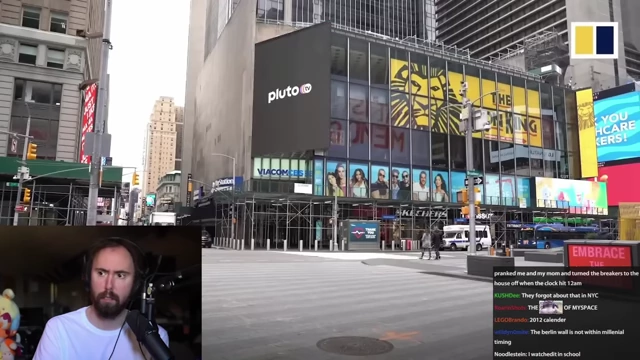
Empty Times Square in New York City during the 2020 COVID-19 pandemic [ 00:00:58 ] - Have been participating in school shooting drills since the age of five, living in a constant state of crisis.
- Their mindset is considered a visual metaphor of "half human brain, half machine."
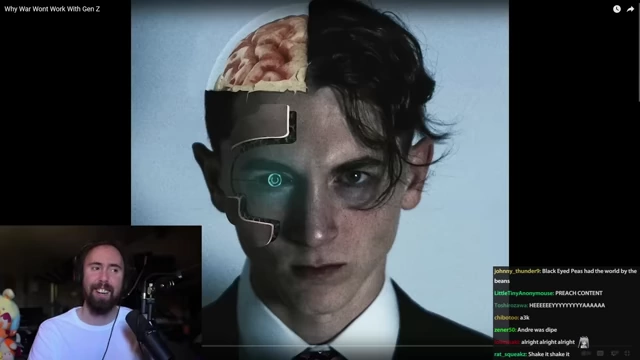
Visual metaphor of half human brain, half machine, symbolizing Gen Z's unique mindset [ 00:02:07 ]
- Born or raised during the 9/11 terrorist attacks and experienced the 2008 financial crisis.
- Expresses strong resistance to potential conscription.
- The video mentions that many Gen Z members would rather go to jail than serve in the military.
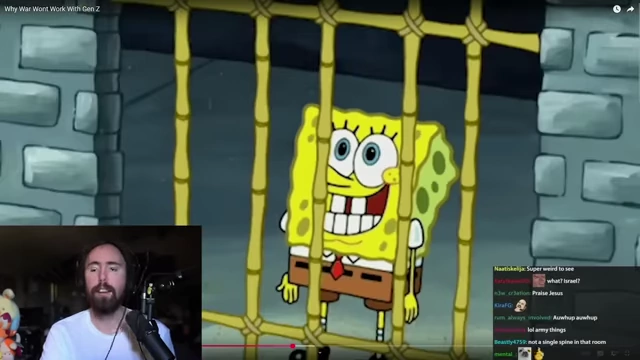
Animated character SpongeBob smiling in jail, representing Gen Z's attitude of preferring imprisonment over military service [ 00:17:00 ] - Evading military service can result in a maximum of five years in prison or a $250,000 fine.
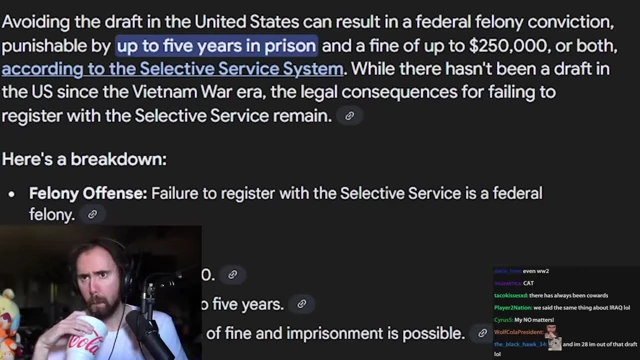
Text describing the consequences of evading military service [ 00:17:36 ] - High school graduates of 2025 may face the risk of conscription.
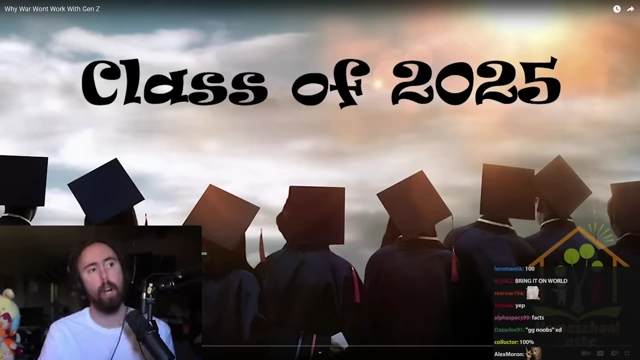
Silhouette of the graduating class of 2025, representing Gen Z [ 00:03:17 ]
- The video mentions that many Gen Z members would rather go to jail than serve in the military.
The Debate on Propaganda: Old vs. New [0:04:42]
- TommyNFG's view: The American "propaganda era" is dead.
- In the past, people had high trust in politicians and the media, and high school students even lied about their age to join the military.
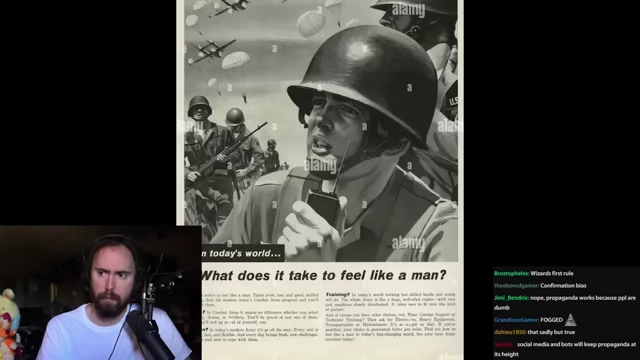
Old-fashioned recruitment ad in a newspaper: "In today's world... what does it take to be a man?" [ 00:11:18 ] - Walter Cronkite's questioning of the Vietnam War shook public trust.
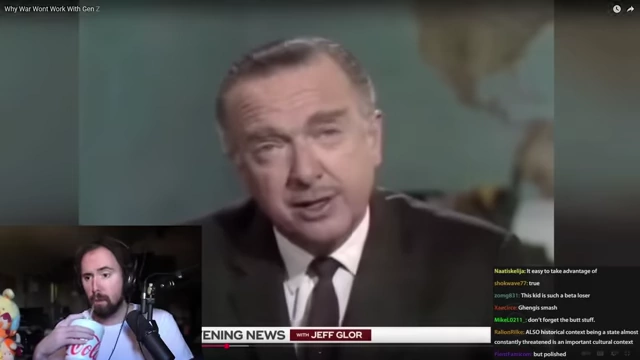
Walter Cronkite in a news broadcast [ 00:12:19 ]
- In the past, people had high trust in politicians and the media, and high school students even lied about their age to join the military.
- Asmongold's rebuttal: Propaganda has only evolved, becoming more covert to the point where people don't realize they're in it.
- The rapid mobilization of the entire United States after 9/11 demonstrated a powerful ability to guide public opinion.
- The rise of identity politics after the "Occupy Wall Street" movement is believed to be intentional by higher-ups, aimed at diverting public attention from real oligarchical issues.
- The handling of the COVID-19 pandemic is considered the best example of modern propaganda still fully operational.
- Propaganda is always effective because people tend to believe information that aligns with their own views, making it difficult to overcome.
- Propaganda methods in authoritarian countries are still fully operational, such as speeches and parades by North Korean leaders.
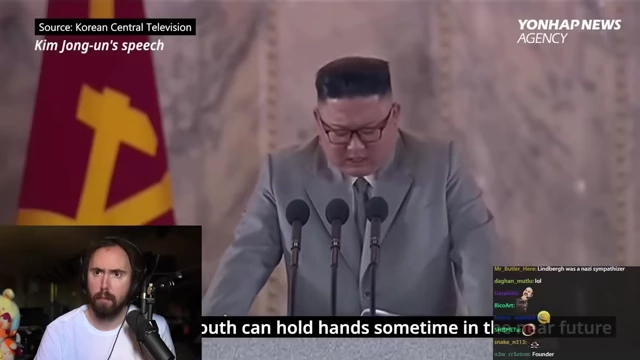
Kim Jong-un giving a speech with the North Korean flag in the background, symbolizing propaganda in authoritarian countries [ 00:25:52 ] 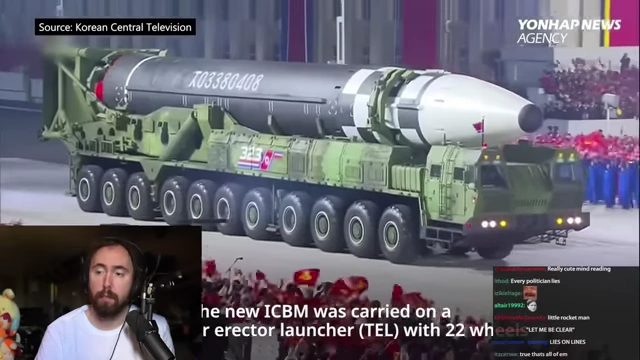
Intercontinental ballistic missiles displayed in a North Korean military parade, showing its military power [ 00:25:55 ]
Government Trust and Willingness to Enlist [0:16:26]
- A significant decline in public trust in the US government is an important reason why Gen Z is unwilling to join the military.
- Israeli Prime Minister Netanyahu giving a speech in the US Congress and members of Congress giving him a standing ovation is considered a manifestation of the US government being "bought and paid for" by foreign interests.
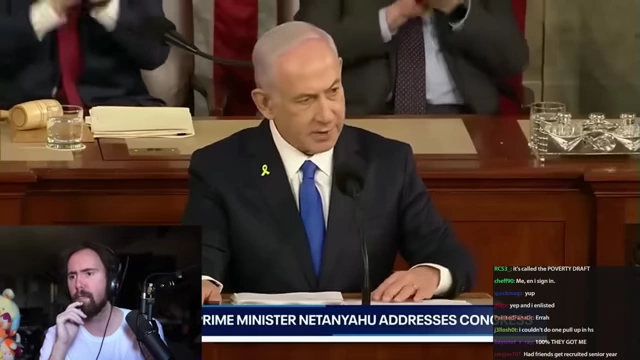
Israeli Prime Minister Netanyahu giving a speech in the US Congress, with members of Congress giving him a standing ovation [ 00:16:28 ] - The Capitol Building covered with a large red X, symbolizing a decline in trust in the government.
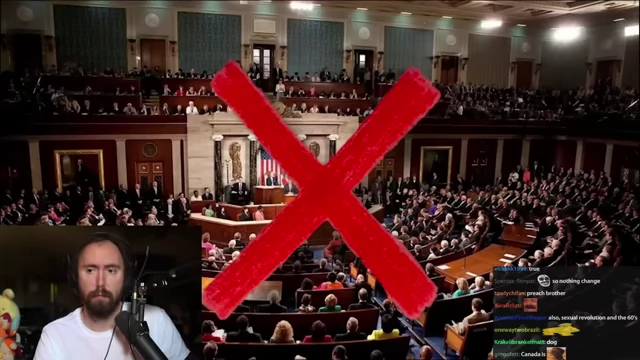
US Capitol Building with a large red X, symbolizing a decline in trust in the government [ 00:30:37 ] - Current international conflicts, such as the US involvement in the Israeli-Iranian conflict and the bombing of Iranian nuclear facilities, exacerbate distrust.
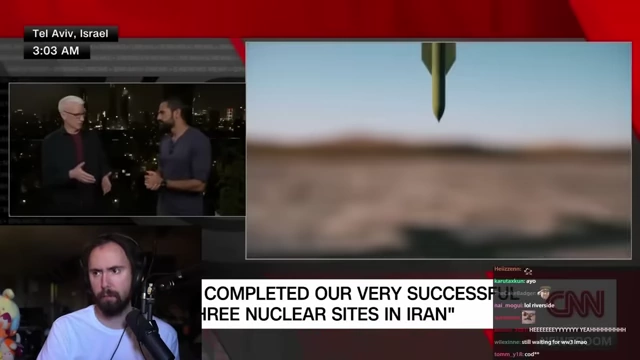
CNN report showing the bombing of Iranian nuclear facilities [ 00:02:21 ] 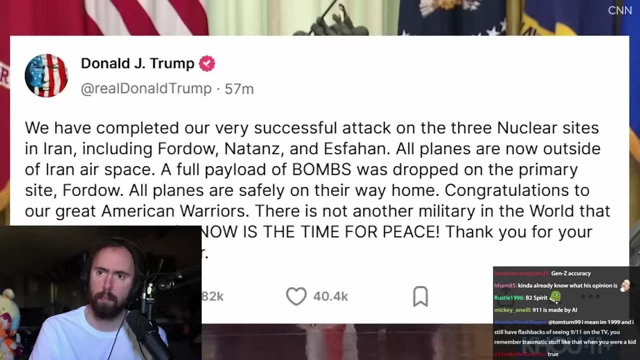
Screenshot of Trump's tweet announcing the bombing of Iranian nuclear facilities [ 00:02:53 ]
- Israeli Prime Minister Netanyahu giving a speech in the US Congress and members of Congress giving him a standing ovation is considered a manifestation of the US government being "bought and paid for" by foreign interests.
- Gen Z generally has a negative view of Trump.
- The video mentions that at least eight out of ten Gen Z youths dislike Trump.
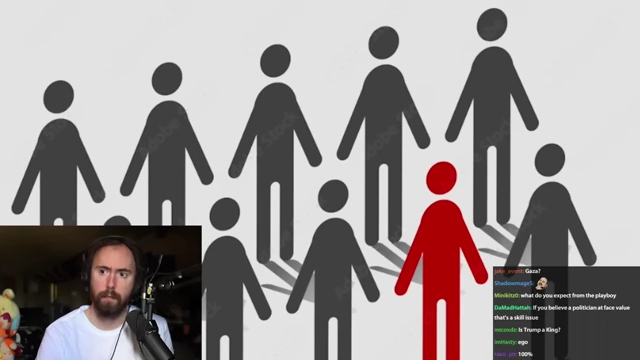
Chart showing public opinion, with one red figure representing supporters and multiple black figures representing opponents [ 00:26:28 ] 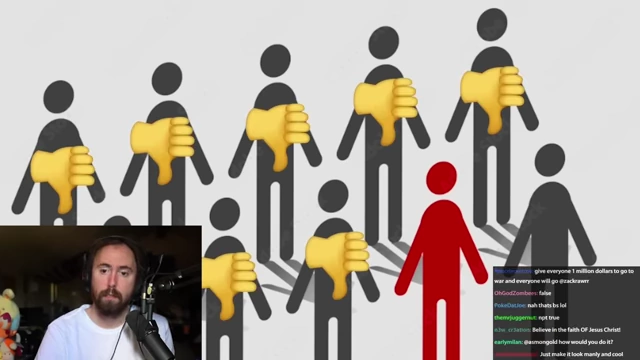
Chart with a thumbs down icon, specifically showing negative views of Trump [ 00:26:30 ] - Asmongold points out that this may be a one-sided view, and that many in the younger generation are actually becoming more conservative, and Trump's approval rating may be higher than the media portrays.
- The video mentions that at least eight out of ten Gen Z youths dislike Trump.
Evolution of Military Recruitment Strategies [0:14:04]
- The military has adopted various new recruitment methods to address the decline in enlistment numbers.
- In the past, recruitment mainly took place in working-class high schools, using the GI Bill to provide college education benefits.
- Now it has expanded to events such as anime conventions, Twitch streaming platforms, and NBA games.
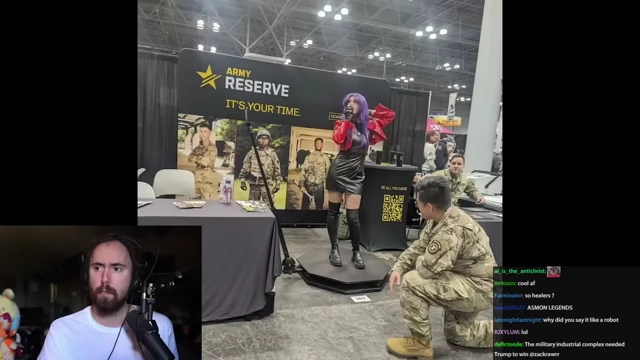
Army reservists recruiting at an anime convention, with a cosplayer on stage [ 00:15:40 ] 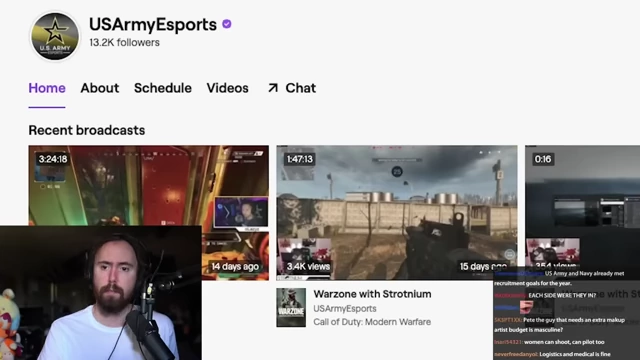
Screenshot of the US Army Esports Twitch channel, showing how the military uses live streaming platforms for recruitment [ 00:15:41 ] 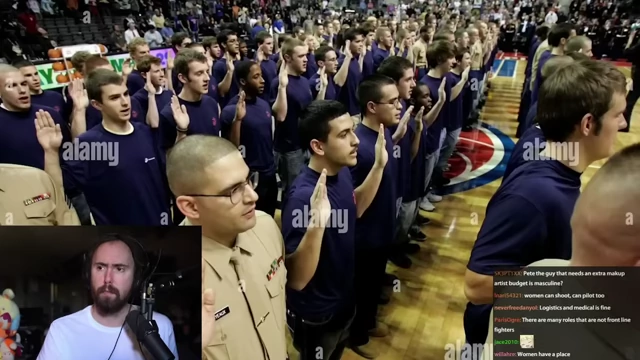
Military recruits taking the oath of enlistment at an NBA game [ 00:15:43 ]
The Reality of War and Veteran Benefits [0:18:41]
- Gen Z has a more direct understanding of the brutality of war and its consequences through the internet.
- The brutal traps in the Vietnam War, such as bamboo spike pits, are mentioned as examples.
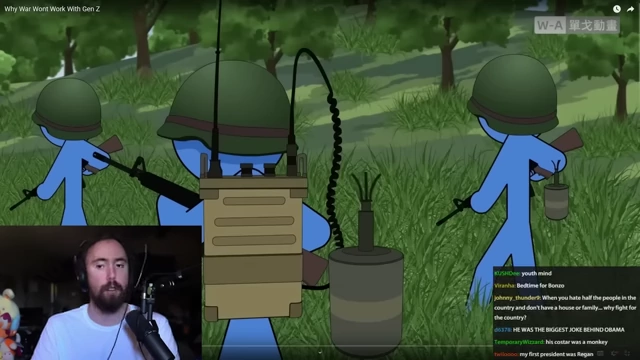
Blue-green stick figure animation soldiers in a Vietnam War setting [ 00:06:58 ] 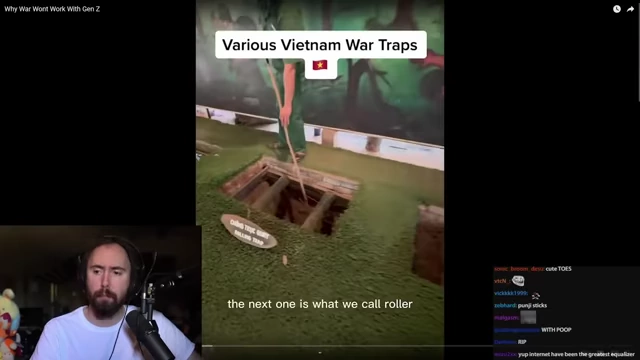
Diagram of various traps during the Vietnam War, such as bamboo spike pits [ 00:08:10 ] - The video vividly depicts the horrors of war that can lead to loss of body parts and the permanent damage to body and mind, such as the hot weather in Iraq.
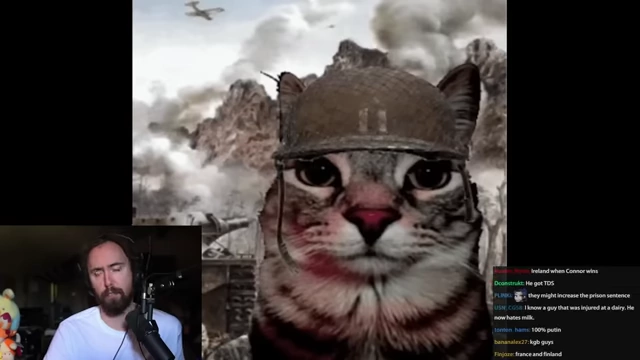
Cartoon cat wearing a helmet in an exploding battlefield, symbolizing the brutality of war and possible disabilities [ 00:18:47 ] 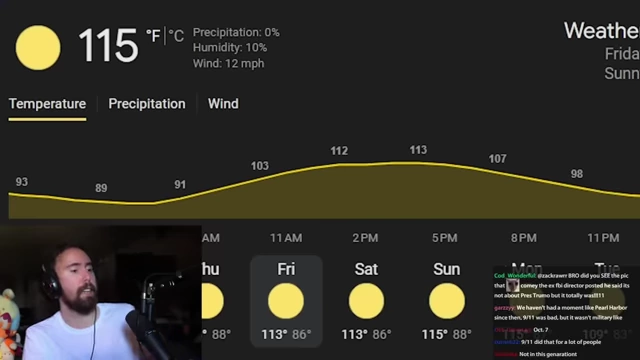
Iraqi weather forecast map showing high temperatures and wind conditions [ 00:19:56 ] 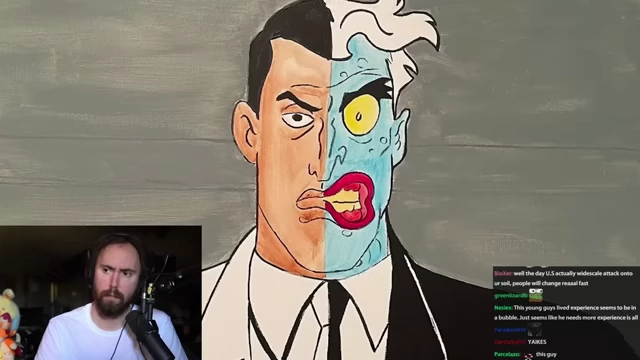
Two-faced man cartoon figure, symbolizing permanent damage to body and mind caused by war [ 00:20:05 ]
- The brutal traps in the Vietnam War, such as bamboo spike pits, are mentioned as examples.
- Serious dissatisfaction with veteran benefits.
- Heartbreakingly, many veterans who served their country end up homeless and receive no government help.
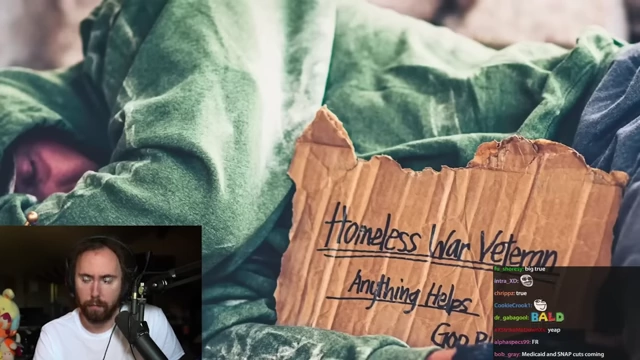
Homeless veteran's cardboard sign: "Homeless Veteran Any Help Appreciated" [ 00:30:44 ] - The annual military spending of up to $880 billion is in stark contrast to the plight of veterans, and the host believes that all veterans should have a secure life.
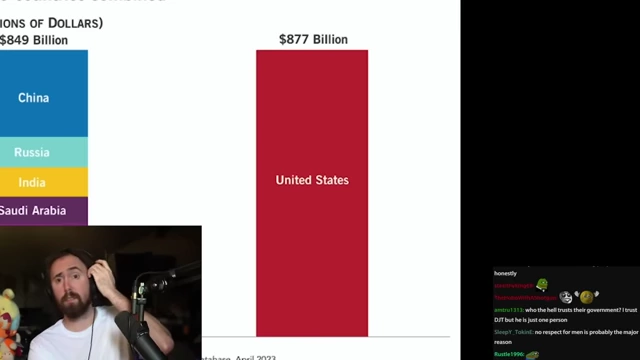
Bar graph showing military spending by country, highlighting the US's huge defense budget ($877 billion), far exceeding other countries [ 00:30:51 ]
- Heartbreakingly, many veterans who served their country end up homeless and receive no government help.
Economic Hardship and the Breakdown of the Social Contract [0:28:41]
- Gen Z is pessimistic about the future economic prospects and has lost hope in the "American Dream."
- The economic impact of the COVID-19 pandemic and ongoing inflation make it difficult to find jobs, and many Gen Z may never be able to own their own homes.

Crying SpongeBob meme, symbolizing Gen Z's pessimism about the American dream and economic outlook [ 00:28:49 ] - In the past, young people who fought in wars could at least expect to get decent jobs and housing after the war.
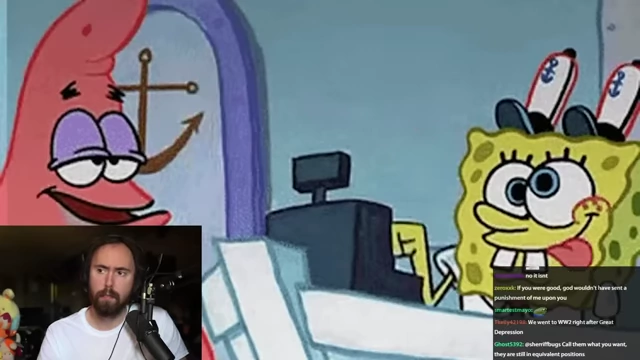
SpongeBob working at a cash register with Patrick next to him, metaphorically suggesting that young people used to easily find jobs and buy homes [ 00:29:12 ]
- The economic impact of the COVID-19 pandemic and ongoing inflation make it difficult to find jobs, and many Gen Z may never be able to own their own homes.
- The breakdown of the "social contract."
- The traditional promise of studying hard, going to college, getting a good job, and living a good life has been broken in America.
- This trend of decoupling productivity from wage growth began to appear as early as 1975-1980, and has become more prominent today.
The Possibility of Conscription and the Future of Modern Warfare [0:33:50]
- The video believes that mass conscription is unlikely to occur.
- Mainly because the development of modern warfare technology has made the role of ground troops increasingly obsolete and ineffective, like cavalry in World War I.

SpongeBob and Patrick operating artillery in a trench, metaphorically suggesting that traditional ground forces are obsolete in modern warfare [ 00:34:00 ] - The United States' huge annual military spending ($880 billion) makes it far ahead in military technology, creating a huge gap with potential opponents, reducing the likelihood of needing mass conscription.
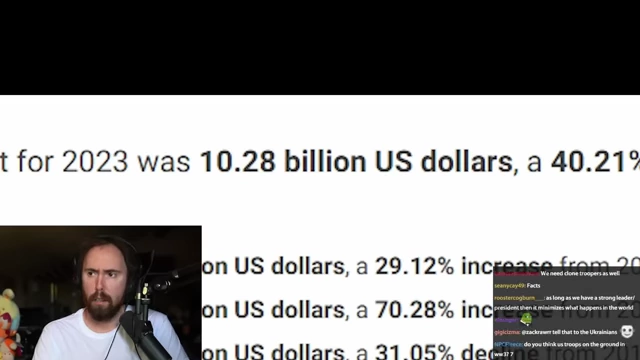
Specific data showing Iran's defense spending in 2023 ($10.28 billion) [ 00:34:28 ] 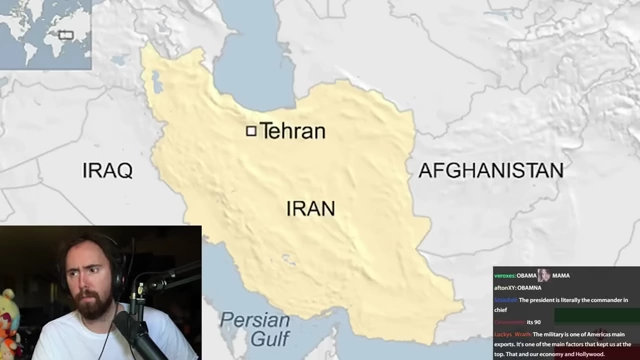
Map of Iran and its surrounding countries (Iraq, Afghanistan) [ 00:35:53 ]
- Mainly because the development of modern warfare technology has made the role of ground troops increasingly obsolete and ineffective, like cavalry in World War I.
Conclusion and Personal Opinion [0:36:05]
- Host Asmongold respects the views of the younger generation and believes it is important to listen to their voices, even if he doesn't fully agree.
- He reiterates his view that public opinion is easily manipulated and points out that the US president can take military action without congressional approval under the War Powers Act, making it relatively easy to start wars.