US Housing Market Outlook 2025-2026: Impact of Federal Reserve Actions on Home Prices and Mortgage Rates
Summary:
This video provides a housing market update for 2025-2026, analyzing home prices, mortgage rates, and future predictions based on Federal Reserve actions.
- Home prices show varied trends across the US; 195 out of 300 major metro areas saw increases, while 105 experienced decreases over the past 12 months, leading to a national average increase of 1.7%.

One-year change in metro-level home prices showing declines in the South and West Coast. [ 00:00:20 ] - Mortgage interest rates have been falling in 2025, currently near 6% for a 30-year fixed mortgage, due to Fed rate cuts and moderated inflation.

Graph of the 30-year fixed-rate mortgage average in the United States from 2021 to 2025. [ 00:02:10 ] - The Federal Reserve is expected to end its monetary tightening and begin quantitative easing (money printing) in 2026, which is predicted to further lower mortgage rates temporarily before inflation drives them up again.
- Foreclosure activity is increasing but remains significantly lower than the levels seen during the 2008 housing crash, suggesting it won't trigger an immediate market crash.
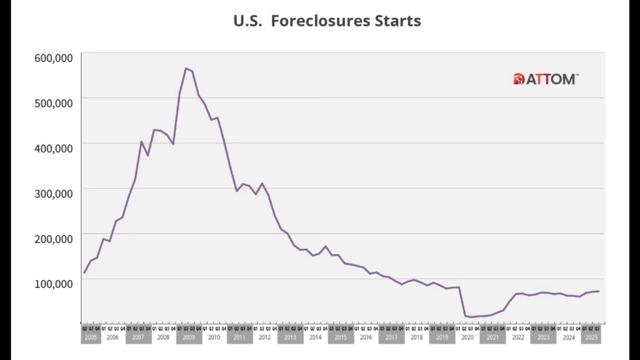
Graph illustrating U.S. foreclosure starts from 2007 to 2025, comparing current levels to previous peaks. [ 00:08:18 ] - The speaker advises buying a home now, if possible, viewing it as a protection against inflation, rather than a short-term investment, and warns that housing affordability may worsen.
Current US Housing Market Overview [00:00:16]
- Metro Area Home Price Changes (September 2024 - September 2025)
- Areas with Falling Home Prices: Out of 300 largest metro areas, 105 experienced a decline.
- Heaviest concentrations were observed in the South, particularly Florida and the West Coast.
One-year change in metro-level home prices between September 2024 and September 2025 showing declines. [ 00:00:20 ]
- Heaviest concentrations were observed in the South, particularly Florida and the West Coast.
- Areas with Rising Home Prices: 195 metro areas saw an increase in home prices.
- The largest gains were concentrated in the Midwest and Northeast regions.

One-year change in metro-level home prices between September 2024 and September 2025 showing increases. [ 00:00:45 ]
- The largest gains were concentrated in the Midwest and Northeast regions.
- Areas with Falling Home Prices: Out of 300 largest metro areas, 105 experienced a decline.
- National Average Home Price Trends
- The median sale price nationally is $435,295, showing a 1.7% increase year-over-year. [00:01:25]
- The number of homes sold is 440,830, a 0.2% increase year-over-year. [00:01:29]
- The speaker emphasizes that while some areas see significant declines, others experience substantial gains, averaging out to the national increase. [00:01:32]

Overview of national median home sale price, number of homes sold, and average 30-year fixed mortgage rate over 5 years. [ 00:01:25 ]
Mortgage Interest Rate Trends and Federal Reserve Actions [00:01:53]
- Mortgage Rate Decline in 2025
- Mortgage rates have been falling, reaching their lowest level in 2025. [00:01:57]
- The national average 30-year fixed mortgage rate is near 6.19%. [00:02:08]
- This is an improvement from late 2023 when rates approached 8%, though still higher than the sub-3% rates seen 3-4 years prior. [00:02:22]
Graph showing the 30-year fixed-rate mortgage average in the United States from 2021 to 2025. [ 00:02:10 ]
- Federal Reserve's Influence on Mortgage Rates
- The Federal Reserve influences mortgage rates indirectly by cutting its Fed funds rates, which primarily affects short-term government debts. [00:03:02]
- Mortgage rates are more directly correlated with the interest rates on 10-year government debts. [00:03:17]
- The current moderate decline in mortgage rates is a result of the Fed's rate cuts and inflation undershooting expectations. [00:03:28]
- Anticipated Quantitative Easing (QE) [00:03:45]
- The Federal Reserve is expected to end its monetary tightening cycle soon, possibly this month, and begin a quantitative easing cycle in 2026. [00:03:49]
- QE involves the Fed buying assets (Treasuries, MBS) and essentially "printing money" to keep the system afloat. [00:04:00]
- Each successive QE cycle requires printing more money, indicating a worsening economic dependency. [00:04:14]
- The timing of heavy easing is unpredictable but likely in 2026, triggered by a need to bail out sectors like banks, commercial real estate, or the stock market. [00:04:26]
Future Outlook for Home Prices and Refinancing Opportunities [00:04:44]
- Impact of QE on Inflation and Home Prices
- Quantitative easing will lead to increased inflation across all sectors, including food, utilities, and home prices. [00:06:21]
- Home prices are not immune to this inflation and are expected to continue rising. [00:06:29]
- The idea that home prices will crash because affordability is strained is dismissed, citing continuously high prices in areas like California and New York City. [00:06:50]
- Major institutions like BlackRock are seen as potential primary buyers in an increasingly unaffordable market for individuals. [00:07:28]
- Refinancing Window
- The ongoing fall in mortgage rates presents an opportunity for those with current rates of 6-7% to refinance. [00:04:50]
- This window is expected to last a few months while rates bottom out before inflation causes them to spike again. [00:05:06]
- Once the Fed's balance sheet expands and inflation catches up, the 10-year and 30-year yields will rise, pushing mortgage rates back up. [00:05:35]
Foreclosure Activity and Its Market Impact [00:07:44]
- Increasing Foreclosure Activity: US foreclosure activity increased annually in Q3 2025, which the speaker attributes to a struggling labor market and unacknowledged recession. [00:07:46]
- Comparison to Previous Housing Market Crash:
- Despite the increase, current foreclosure levels are nowhere near those of the 2008 housing market crash. [00:08:30]
- Foreclosures today are even below 2005 levels, which preceded the peak of the last crash by about 5 years. [00:08:39]
- Home prices did not bottom out until 2012 in the previous crash, suggesting a long waiting period if one expects foreclosures to trigger a market bottom. [00:08:59]
Graph illustrating U.S. foreclosure starts from 2007 to 2025, comparing current levels to previous peaks. [ 00:08:18 ]
The Case for Home Ownership in an Inflated Economy [00:09:55]
- Home Ownership as an Inflation Hedge
- Buying a home to live in is presented not as a short-term investment but as a means of owning an asset to protect against inflation. [00:10:21]
- Renters are indirectly affected by rising property taxes and other costs, as landlords pass these expenses on. [00:10:10]
- The speaker shares an anecdote about a friend's rent increasing by 40% overnight during the pandemic, highlighting the vulnerability of renters to inflation. [00:10:40]
- Call to Action: If currently able, buying a home is advised, as the housing situation is expected to worsen with continued inflation and rising prices. [00:07:34]