In an interview with Rob Copeland, author of "The Fund," a new book dissects Ray Dalio's true path to success, often attributed to his widely publicized "Principles."
Copeland's book provides the first unauthorized biography of Dalio and Bridgewater, drawing on hundreds of employee interviews, and faced a multi-billion dollar lawsuit threat from Dalio before its publication.
The book argues Dalio's success stems more from his charm, influential connections (including a wealthy surrogate family and his Vanderbilt wife), and PR genius rather than solely his principles.
Bridgewater's culture, under the guise of "radical transparency," fostered paranoia, extensive surveillance, and a system where Dalio's opinion was consistently prioritized.
The "Principles" themselves only emerged after Dalio was already a billionaire (around 2005) and were increasingly "weaponized" to control employees, with systems like the "dot program" allegedly rigged to favor Dalio.
Contrary to its systematized image, Bridgewater's investment process, for a long time, relied on outdated tools like Microsoft Excel and was managed by a small "circle of trust" of about 10 people.
Dalio's obsession with legacy, inspired by figures like Steve Jobs, fueled his public promotion of the principles, even as actual investment performance lagged and the firm's assets under management decreased.
The COVID-19 lockdowns significantly reduced the enforcement of Dalio's principles within Bridgewater, leading to layoffs of staff dedicated to the "apparatus," and Dalio even sought a licensing fee to continue their use, which was denied.
Copeland concludes that while Dalio is a brilliant marketer, his focus on the principles overshadows genuine investment substance and created a challenging, often toxic, work environment.
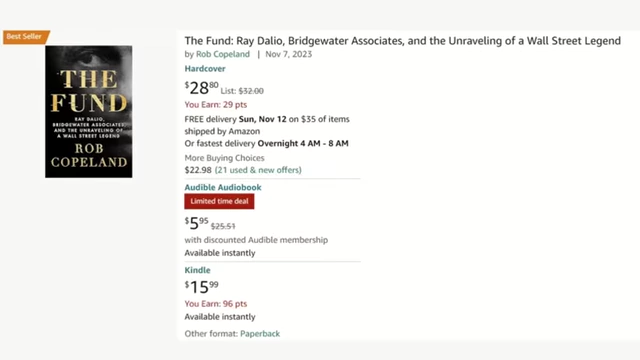
Rob Copeland's new book, "The Fund," on Amazon
[
00:01:10
]
Introduction to "The Fund" and Its Controversy [0:01:01]
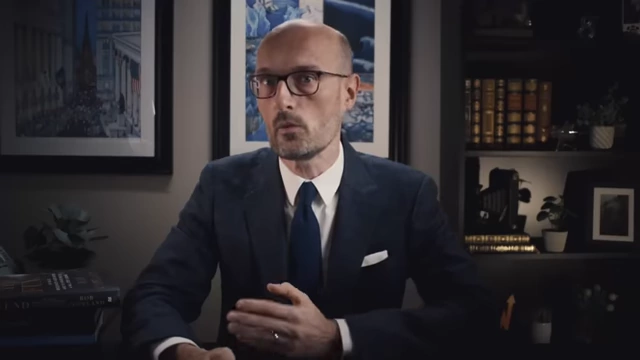
Patrick Boyle interviewing Rob Copeland
[
00:00:01
]
Rob Copeland's new book, "The Fund," offers an unauthorized biography of Ray Dalio, founder of Bridgewater Associates, the world's largest hedge fund.
Rob Copeland's new book, "The Fund," on Amazon
[
00:01:10
]
This book is controversial, marked by a publisher-issued NDA for reviewers and footnotes clarifying Bridgewater's side of the story [0:01:14][0:01:20][0:03:35].
Dalio responded poorly to the book's announcement in mid-2020, hiring law and PR firms and threatening a multi-billion dollar lawsuit before the book was even written [0:04:14][0:04:30][0:04:37].
Dalio reportedly dislikes any independent journalism about him that isn't entirely laudatory, having attacked reporters from the New York Times and Wall Street Journal [0:04:48][0:05:03].
Copeland hired a fact-checker who sent every fact to Dalio, but instead of responding directly, Dalio's libel attorneys sent hundreds of pages of threat letters [0:05:19][0:05:31].
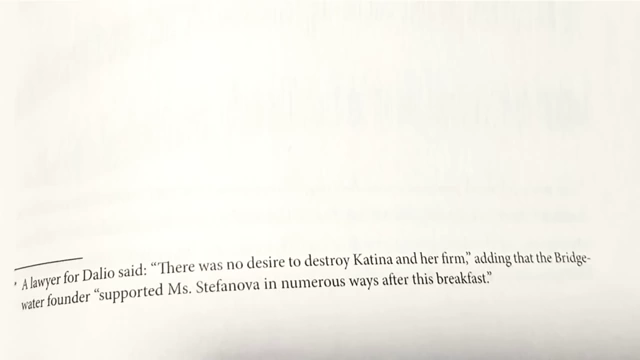
An example of a footnote from Dalio's lawyers defending his actions
[
00:05:40
]
Copeland believes his book provides a different, more human perspective on Dalio's success, highlighting factors beyond his publicized "Principles" [0:01:45][0:06:13].
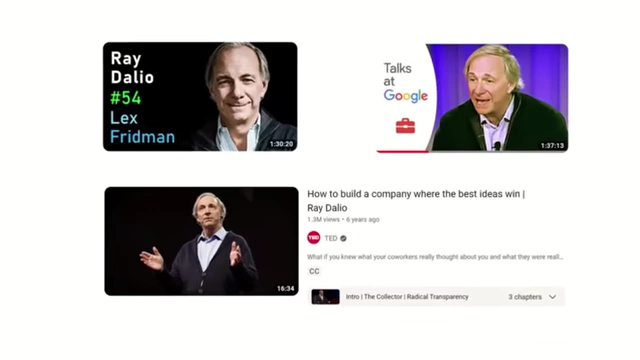
Ray Dalio's numerous media appearances discussing his principles
[
00:01:31
]
Ray Dalio's Origin Story: A Different Perspective [0:06:25]
Dalio's widely told "rags-to-riches" narrative, often featured in his autobiography "Principles," omits significant influences [0:07:24][0:09:37].
The book reveals the profound impact of the wealthy "Lives" family, who took Dalio in as a surrogate son, providing him with connections and polish [0:06:46][0:07:35][0:07:57].
This aspect, which Dalio rarely mentions, shows that his ascent was also due to connections and charm, not solely intelligence or effort [0:07:41][0:08:03].
The revelation of the "Lives" family story led to it "magically" appearing on Dalio's Wikipedia page after Copeland began asking questions [0:08:09][0:08:15].
Dalio has also rarely discussed his wife's background as a Vanderbilt, a family with colossal wealth and legacy [0:09:22][0:09:30].
Copeland asserts that while Dalio is intelligent and hardworking, his narrative simplifies a more complex, human story [0:09:49][0:09:58].
Bridgewater's Operational Culture and Structure [0:10:31]
Bridgewater, at its peak, employed over 2,000 people, including temporary contractors and consultants [0:11:27].
A significant portion of the firm was dedicated to managing the internal "dot program" and the principles, rather than direct investment work [0:10:45][0:11:05].
Matt Levine famously joked that 90% of Bridgewater's staff dealt with the dot program, which Copeland suggests might be an overestimation, as only about 10 people in a "circle of trust" truly understood the investing [0:11:17][0:11:34][0:11:39].
This implies a disproportionate focus on internal management and adherence to the principles over actual investment operations [0:11:51].
The Case of Katina Stefanova and Employee Treatment [0:11:57]
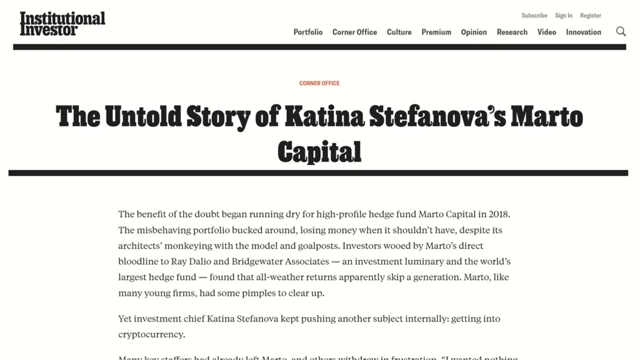
Katina Stefanova, a prominent figure in the book, launched her own hedge fund after working at Bridgewater, despite not being part of the "circle of trust" and not having significant investment experience at the firm [0:12:04][0:12:17][0:12:23][0:12:38].
Article on "The Untold Story of Katina Stefanova's Marto Capital"
[
00:12:12
]
Dalio reportedly treated Stefanova "monstrously," yet she continued to seek his counsel, highlighting Dalio's "siren call" influence over people [0:12:49][0:12:54].
The public attention around Stefanova's departure contrasted with the lack of scrutiny on Bridgewater's internal workings [0:13:13][0:13:20].
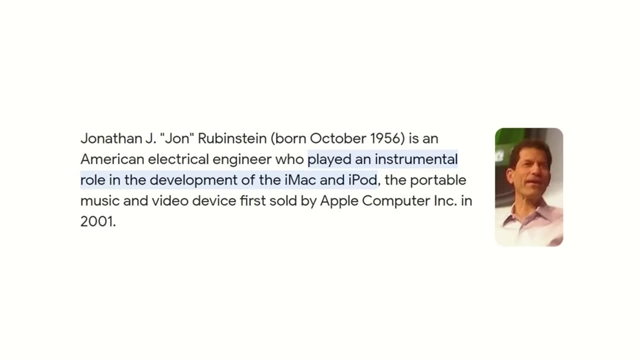
The book, titled "No Heroes" in its final chapter, suggests that many employees, even wealthy ones like John Rubenstein (inventor of the iPod), tolerated mistreatment due to a complex mix of financial incentives and a desire to be associated with Dalio [0:13:30][0:14:19][0:15:20].
Jonathan "Jon" Rubenstein, instrumental in iMac and iPod development
[
00:15:01
]
Rubenstein, for example, was paid $50 million for doing "close to nothing of worth" and signed a separation agreement to remain silent about Bridgewater [0:15:32][0:15:41][0:15:48].
Dalio's assertion that criticisms come from a "small number of disaffected employees" is challenged by his widespread use of strict NDAs and hefty severance payments to ensure silence from departing staff [0:16:00][0:16:05][0:16:10].
Surveillance and Intimidation at Bridgewater [0:16:35]
Bridgewater had surprisingly high security measures, extending beyond typical investment secret protection [0:16:41].
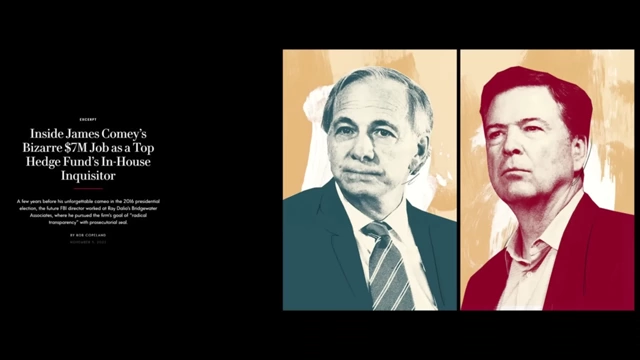
Article discussing James Comey's role as an "In-House Inquisitor" at Bridgewater
[
00:16:54
]
Rumors circulated among employees that even conversations in the woods outside the office were monitored, especially during Jim Comey's tenure [0:16:50][0:17:01][0:18:06][0:18:10].
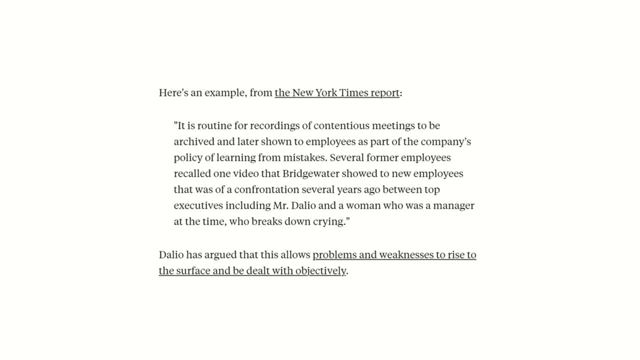
Nearly everything at Bridgewater was recorded, and employees were constantly watched; security would leave notes if screensavers weren't activated [0:17:43][0:17:48][0:17:53].
Excerpt from a New York Times report on recorded meetings and Dalio's "radical transparency"
[
00:17:45
]
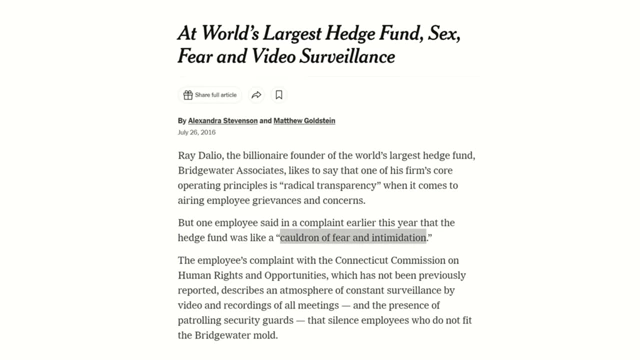
A former employee sued Bridgewater, calling it a "cauldron of fear and intimidation," leading to a settlement [0:17:24][0:17:31].
Article describing Bridgewater as a "cauldron of fear and intimidation" due to surveillance
[
00:17:28
]
Copeland's findings suggest that this extensive security apparatus primarily served to intimidate and suppress dissent rather than protect substantive trading secrets, which he argues were few [0:18:24][0:18:31].
The vast staff, compared to other hedge funds like Millennium, was largely occupied with internal principle enforcement and surveillance rather than investment tasks [0:18:37][0:18:49][0:19:02].
The culture made Bridgewater a "very challenging place to work," where fear of being fired was constant [0:19:40][0:19:54][0:31:52].
The Evolution and Weaponization of Principles [0:24:21]
Dalio began discussing his "Principles" around 2005, only after he had already become a billionaire and Bridgewater was a successful firm [0:24:59][0:25:05][0:25:10].
Initially, even his long-time partner, Bob Prince, viewed them as "Ray's things" rather than universal truths [0:25:21][0:25:27][0:25:32].
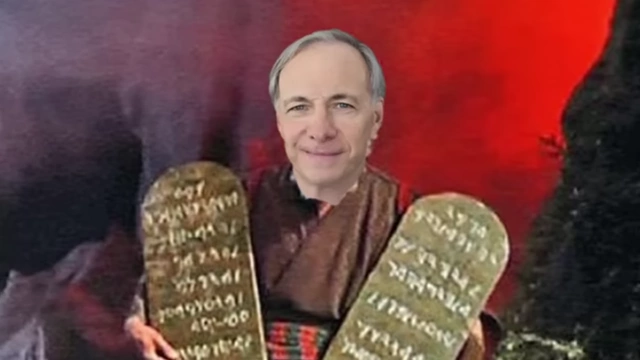
A humorous depiction of Ray Dalio holding "tablets" representing his principles
[
00:25:37
]
After the perceived prediction of the 2008 financial crisis, Dalio "weaponized" the principles, continuously creating and deleting them, and using them to put people "on trial" [0:25:40][0:25:45][0:25:51][0:25:58].
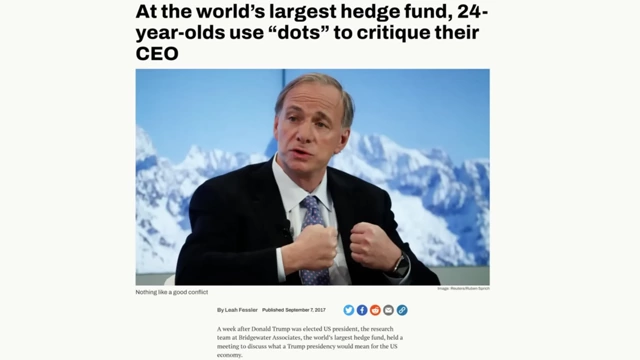
Dalio's public argument claims the principles led to a quantitative rating system for employees to identify the best talent, a "meritocracy" [0:26:44][0:26:50][0:26:57][0:27:02].
Article about employees using the "dot program" to critique Dalio
[
00:26:53
]
However, Copeland reveals this system was "rigged from second number one" to ensure Dalio was always the top-ranked person in almost all important categories [0:27:14][0:27:21][0:27:27].
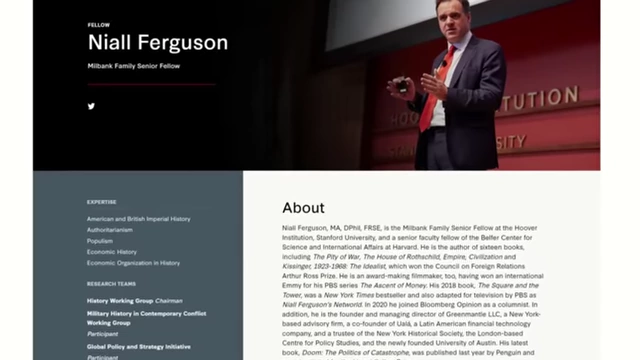
This rigging was evident in anecdotes like Dalio holding impromptu polls during meetings, even with a Harvard professor like Niall Ferguson, where his employees were incentivized to vote in his favor, and his own vote was weighted more heavily [0:27:41][0:27:48][0:28:01][0:28:08][0:28:26][0:28:32][0:28:43][0:28:50].
Niall Ferguson's profile as a Milbank Senior Fellow at Harvard
[
00:28:29
]
The absurdity extended to a poll between Dalio and a facilities person, where the staff's economic incentive dictated their vote [0:29:07][0:29:14].
Dalio's Quest for Legacy and Public Image [0:37:25]
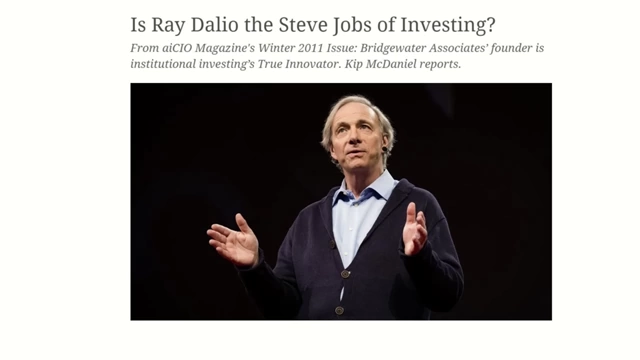
Dalio's ultimate goal is to establish a legacy as a great business leader, akin to Steve Jobs or Warren Buffett, driven by his thoughts and principles rather than merely financial returns [0:37:38][0:37:48][0:37:56][0:38:01][0:38:20][0:38:26].
Article asking if Ray Dalio is "the Steve Jobs of Investing"
[
00:38:40
]
He was reportedly obsessed with Steve Jobs, seeking Walter Isaacson to write his biography and hiring Jobs's former lieutenant, John Rubenstein [0:38:35][0:38:42][0:38:48].
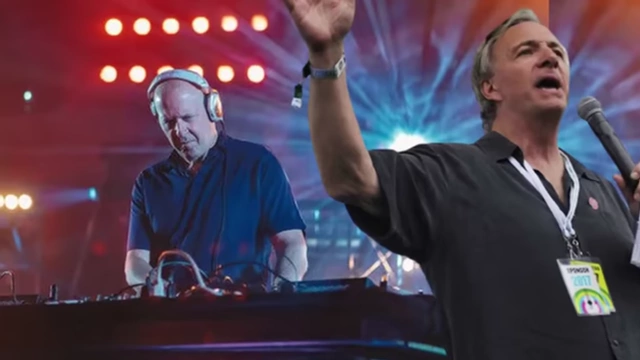
Dalio's mastery of PR, exemplified by his appearance on Oprah while competitors went on CNBC, helped him popularize his image [0:21:39][0:21:45][0:21:51].
However, Dalio never publicly discussed the Oprah interview, likely because his comments from that time would be considered "not appropriate for 2023" [0:22:08][0:22:13][0:22:26][0:22:32].
Ray Dalio engaging with an audience at a public event
[
00:39:59
]
- Dalio's claim to be P Diddy's mentor was unconfirmed by P Diddy's representatives [0:39:29][0:39:37].
Article on Ray Dalio becoming P Diddy's business coach
[
00:39:23
]
His public promotion of the principles, even as they became detached from actual investing, was a core part of this legacy building [0:20:17][0:20:22][0:26:04][0:39:01].
Dalio's interest in authoritarian leaders like Putin and Xi, and his creation of a "Politburo" at Bridgewater (inspired by China's), reflects a desire for control and unchallenged authority [0:46:54][0:47:04][0:47:11][0:47:32][0:47:39][0:47:45].
This Politburo functioned to investigate anyone Dalio wished, with employees complying despite being purportedly independent thinkers [0:47:50][0:47:57][0:48:04][0:48:09].
The Reality of Bridgewater's Investment Process [0:34:36]
Bridgewater describes its investment approach as "systematized" rather than purely quantitative, distinguishing it from firms like Renaissance Technologies [0:34:52][0:34:58][0:35:04].
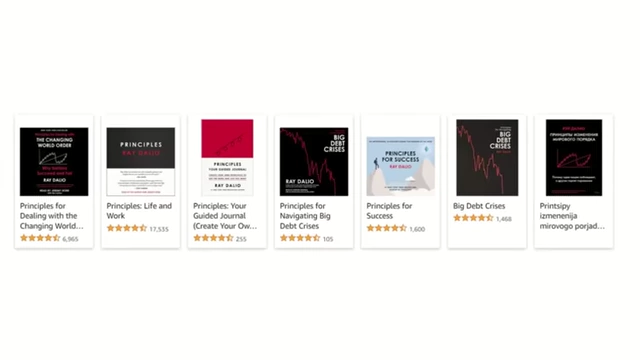
Despite its reputation, Dalio's principles book offers little substantive information about investing [0:19:59].
Ray Dalio's books, including "Principles," which focus little on substantive investing
[
00:01:27
]
As recently as 2018, the investment team at Bridgewater was reportedly still using Microsoft Excel, highlighting a lack of advanced quantitative technology compared to leading hedge funds [0:35:19][0:35:24].
The "systematized" approach often boiled down to "a rule" or "a theory of history" rather than robust quantitative models, falling behind industry standards that have evolved since the 1990s and early 2000s [0:35:30][0:35:35][0:35:42][0:35:49][0:35:55][0:36:01].
Dalio's "rules" are often descriptive and open to interpretation, unlike the statistically rigorous approach needed for modern trading [0:36:14][0:36:23][0:36:31][0:36:39][0:36:49].
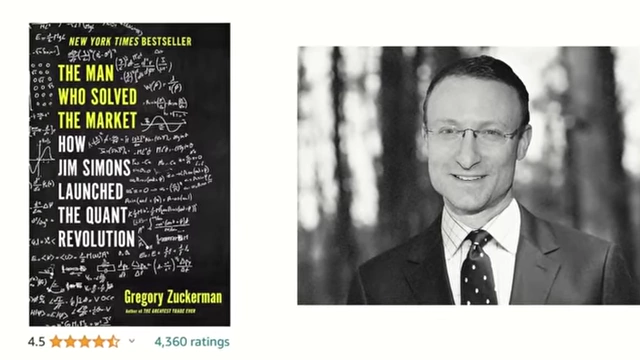
Unlike Jim Simons of Renaissance Technologies, who acknowledges not fully understanding every trade, Dalio's insistence on rules only he could understand caused Bridgewater to fall behind true leading hedge funds [0:36:59][0:37:05][0:37:10][0:37:18].
“The Man Who Solved The Market” about Jim Simons and Renaissance Technologies
[
00:36:56
]
Dalio's Inability to Cede Control and the Firm's Performance [0:44:47]
Hedge funds often struggle with continuity plans beyond their founders [0:44:47][0:44:53][0:44:59].
Dalio claimed for two decades that he was about to retire, with a system in place, but consistently found excuses for not doing so, often blaming subordinates [0:45:44][0:45:51][0:45:57][0:46:02].
Even after his alleged retirement, Dalio remained on the board and suggested starting his own fund within Bridgewater when the firm's investments under current leadership faltered [0:46:09][0:46:14][0:46:19][0:46:24]. This demonstrates his continued need to be "right" [0:46:34].
His power remains significant; a single tweet or public statement expressing a lack of confidence in Bridgewater's leadership could effectively end the firm [0:50:04][0:50:09][0:50:14][0:50:20][0:50:25][0:50:31].
The firm's strong performance, particularly in 2008, contributed to its reputation, but over the past 13 years (since 2011), returns have been "extremely poor" relative to markets and other hedge funds [0:52:40][0:52:43][0:52:50][0:52:57].
Dalio cunningly spun this mediocre performance, claiming Bridgewater was "stewards of capital" rather than losing money [0:53:03][0:53:12].
Bridgewater's assets under management have declined from a peak of $168 billion to around $125 billion or less [0:53:18][0:53:26].
High management fees (once over 3%) and performance fees on any raw performance (not just outperformance) allowed the firm to generate significant revenue even with modest returns, a testament to Dalio's marketing prowess [0:53:33][0:53:41][0:53:48][0:53:55][0:54:01][0:54:09][0:55:39][0:55:45].
The COVID-19 lockdowns proved challenging for Dalio's system, leading to the layoff of most staff dedicated to the principles apparatus by the end of 2021; the Politburo no longer exists functionally [0:48:51][0:48:59][0:49:04][0:49:09][0:49:15].
Dalio's attempt to charge Bridgewater a licensing fee to use his "principles tools" after his retirement was rejected, providing an excuse for current leadership to abandon them [0:49:21][0:49:28][0:49:36][0:49:42].
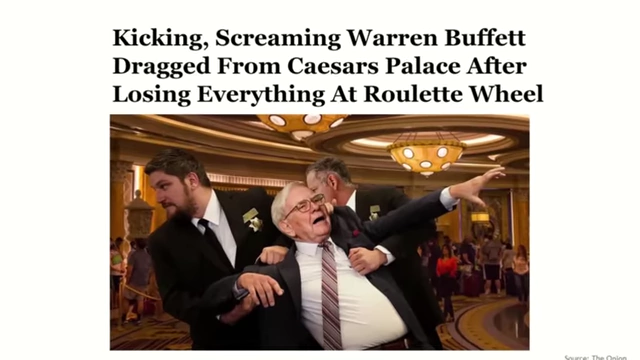
A satirical headline about Warren Buffett being "dragged from Caesars Palace"
[
00:41:05
]
Copeland values Dalio's principle of "trust in truth" – striving not to lie or find excuses – though Dalio himself often failed to follow it [0:56:33][0:56:40][0:56:46].
A key takeaway is the importance of directly addressing disagreements and seeking a "third option" rather than simply asserting one's own correctness, an approach Copeland applies in his journalism [0:56:53][0:56:59][0:57:04][0:57:10][0:57:16][0:57:22][0:57:27][0:57:32][0:57:38][0:57:45].
Another lesson is that not everything in life needs a grand system or reason; it's okay for things to be due to luck or disappointment, and it's important to move past them [0:57:58][0:58:05][0:58:11].
The book highlights individuals at Bridgewater who, despite not being powerful, made small stands and then chose to leave rather than tolerate the environment, which Copeland finds inspiring [0:58:19][0:58:25][0:58:30][0:58:37][0:58:42].
Joseph Campbell's book "The Hero with a Thousand Faces," referenced in the context of Greg Jensen's journey
[
00:44:28
]
Ultimately, Dalio's inability to move beyond his singular focus on the principles, even in later life, is presented as a tragic aspect of his journey [0:59:55][1:01:02][1:01:09][1:01:14][1:01:19][1:01:25].