Understanding and Integrating the Four Quadrants of the Schizoid True Self
This video explains that the "true self" in individuals with Schizoid Personality Disorder (SPD) is not singular but fragmented into four distinct quadrants, which influence behavior and coping strategies.
- The Exile is a retreat into self, fostering independence, creativity, and a sense of safety, though it can eventually lead to loneliness.
- The Betrayer emerges when overwhelmed, causing anger, destructive behavior, and a disregard for values, often leading to isolation.
- The Master signifies a need for control, self-reliance, and perceived superiority, boosting self-esteem but potentially alienating others.
- The Slave involves pleasing others, proving oneself, or sacrificing personal needs, often driven by low self-esteem or codependency.
These quadrants are dynamic, and individuals often shift between them. The key to healthy functioning is to increase self-awareness of these parts and integrate them, aiming for a balanced approach rather than extremes, to better cope with stress and emotions.
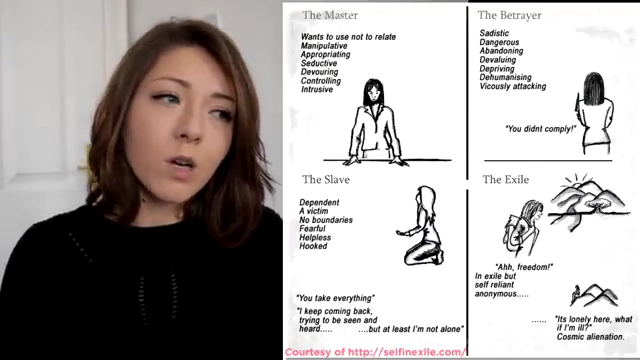
Diagram of the four quadrants of the schizoid true self: Master, Slave, Betrayer, and Exile, with associated characteristics and simple illustrations. [ 00:04:58 ]
The Fragmented True Self in Schizoid Personality Disorder [0:00]
The video explores the concept of the true or authentic self in Schizoid Personality Disorder (SPD), challenging the common idea of a single core self by presenting it as fragmented.
- Traditional view of the true self [1:31]
- Generally perceived as a singular core defining an individual's values, life orientation, and goals.
- Schizoid true self [1:54]
- For individuals with SPD, the true self is not singular but complex and split into multiple parts.
- Inspiration for the theory [2:01]
- The theory is inspired by the "Self in Exile" website, developed by people with SPD, offering an experience-based understanding.
- Role of dissociation [2:46]
- Dissociation is a primary mechanism in SPD, causing splits within the mind.
- This personality split is distinct from Multiple Personality Disorder (characterized by blackouts and amnesia) and Schizophrenia (where the conscious mind is deeply fragmented with autonomous parts).
- While some suggest SPD might predispose to schizophrenia, they are fundamentally different conditions, with schizophrenia being a serious illness rather than a personality disorder.
The Four Quadrants of the Schizoid True Self [4:35]
The true self in SPD is described as comprising four distinct parts or "quadrants," each reflecting different coping mechanisms and emotional states.
- 1. The Exile [5:00]
- Characteristics: Total retreat into oneself, feeling independent, self-reliant, and completely isolated from others.
- Connection: May involve a feeling of connection with the universe but not with people.
- Benefits: Often a highly creative state, allowing for avoidance of distractions and fostering unique, distant perspectives on life and others.
- Emotional state: Initially characterized by happiness, a feeling of refreshment, and safety, being deep within oneself, free from external threats.
- Eventual realization: Eventually leads to an acknowledgment of loneliness.
- Perceived positivity: Considered the most positive state, with minimal distrust, promoting productivity and engagement in creative projects.
- 2. The Betrayer [7:30]
- Characteristics: The most destructive state, arising when an individual is overwhelmed by the outside world, relationships, or job circumstances.
- Behavior: Involves being nasty, impolite, abusive, or expressing anger inappropriately towards others.
- Triggers: Stem from feeling disappointed, overwhelmed, cheated, misunderstood, or exposed by others.
- Consequences: Can lead to the destruction of relationships, career positions, and other achievements, forcing a fresh start.
- Emotional core: The primary emotions are anger and frustration, often discharged in extreme ways due to a lack of healthy expression mechanisms.
- Progression: Often precedes the Exile, as the individual becomes embarrassed or overwhelmed by their destructive actions.
- 3. The Master [10:25]
- Characteristics: A state of feeling in control, superior to others, and having everything together.
- Beliefs: Believes others are not good enough, perhaps deserve criticism, and that they know better.
- Self-perception: May involve a "villain behind the curtain" or "puppet master" fantasy, an illusion of control.
- Purpose: Crucial for maintaining self-esteem, providing a sense of independence and self-reliance.
- Invulnerability: For some, this mode is a mask of invulnerability, where emotions are controlled, and nothing can truly affect them.
- 4. The Slave [12:55]
- Characteristics: The direct opposite of the Master, where one feels obligated to others, needing to please, prove oneself, or explain actions.
- Emotional state: May feel childlike, seeking guidance, and typically experiences low self-esteem.
- Relational context: Often manifests in intimate relationships, potentially leading to codependency and self-sacrifice for others.
- Motivation: Hopes that compliance will lead to understanding and alleviate loneliness.
- Realization: Eventually leads to recognizing exploitation, having given too much energy and time without return.
- Progression: A natural progression from the Slave state is often to the Betrayer, as the feeling of being exploited leads to anger and a decision to no longer comply.
Dynamics and Interplay Between the Quadrants [14:48]
The movement between these quadrants is dynamic and non-linear, meaning individuals can shift between them frequently and in various sequences.
- Master to Slave transition [14:51]
- Occurs when the individual, in the Master mode, begins to doubt their actions, questioning if they are too demanding or taking too much from others, leading to self-doubt and a shift to the Slave position.
- Non-sequential movement [15:18]
- An individual can move from the Betrayer to the Slave, or the Master, and vice-versa.
- It's possible to experience influences from multiple parts within a very short timeframe.
Strategies for Integration and Better Functioning [15:39]
The core challenges in SPD often arise from internal conflicts between these fragmented parts of the self.
- The problem of conflict [15:51]
- Different parts of the personality can have conflicting desires and needs, leading to distress, confusion, and an inability to ascertain one's true wants.
- 1. Increasing Self-Awareness [16:18]
- The initial and most crucial step is to enhance awareness and understanding of how each part functions and influences daily thoughts, emotions, and behaviors.
- A practical method is to keep a diary, noting when specific modes arise, take control, or exert influence.
- 2. The Imperative of Integration, Not Elimination [16:52]
- It is vital not to judge any part as "bad" (e.g., the Betrayer) and attempt to eliminate it.
- Each of the four parts is integral and serves a necessary function for the true self:
- The Betrayer: Signals when boundaries have been violated, when stress is overwhelming, or when there is a need to step back and recharge.
- The Master: Provides energy, motivation, a sense of control, and drives achievement and self-esteem.
- The Slave: Balances the Master, encouraging passivity, patience, compassion, and the capacity to give to others.
- The Exile: Fosters creativity, maintains unique perspectives, and offers comfort and refuge during difficult times.
- 3. Achieving Inner Balance [18:33]
- The ultimate goal is to integrate all these parts into conscious awareness (the ego), thereby avoiding extreme reactions and behaviors.
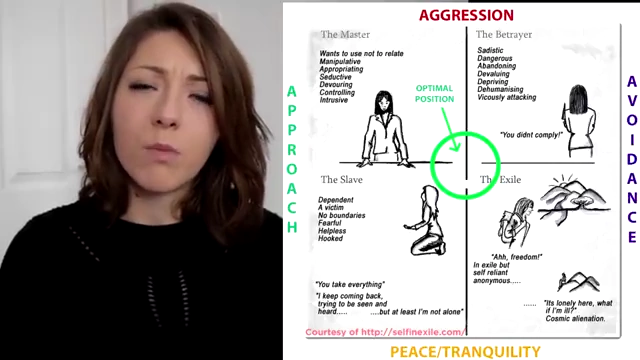
Quadrant model showing the optimal integrated position at the center, balancing approach and avoidance with aggression and peace/tranquility. [ 00:19:27 ] - By learning to stay in the "middle of the spectrum," an individual can gain perspective from all four quadrants, applying the most appropriate response to any given situation.
- This integrated perspective enhances the ability to cope with diverse situations, manage stress, and process emotions healthily.
- Combining this awareness with an understanding of personal defense mechanisms helps prevent further personality splits and dissociations, leading to more stable and functional living.
- The ultimate goal is to integrate all these parts into conscious awareness (the ego), thereby avoiding extreme reactions and behaviors.
- Conclusion [19:53]
- The authentic self in SPD is fragmented into four major parts that dictate behavior, emotions, and coping. Integrating these parts through awareness and balance is crucial for improved overall functioning.