The Growing Crisis in Private Equity: Exits, Valuations, and the Push into 401(k)s
Summary:
- Private equity firms are struggling to exit investments at attractive prices, causing distributions to slow and making it harder to raise new capital.
- Publicly listed private equity firms are underperforming the broader stock market, with many seeing double-digit declines in their stock prices.
- Private equity relies heavily on leverage for returns, often financing deals with 60-75% debt, which amplifies returns but also introduces fragility.
- The industry uses metrics like "since-inception IRR" and practices like "continuation funds" to create an illusion of stable, high returns, but these often mask true performance and volatility.
- The recent executive order allowing private equity into 401(k)s is seen less as democratization and more as a search for new retail investor capital to address existing investor frustration and liquidity challenges.
- Critiques extend beyond finance to the social impact of private equity strategies, such as roll-ups leading to reduced competition and compromised service quality in sectors like healthcare.
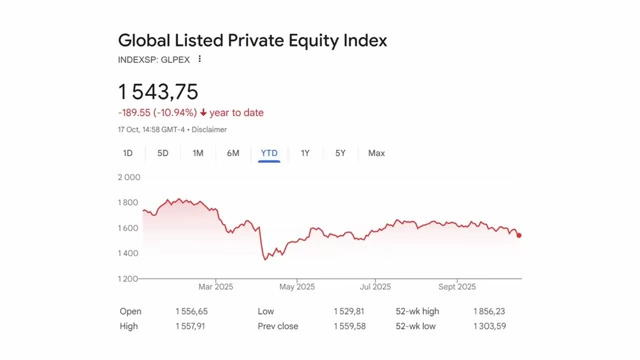
The Global Listed Private Equity Index shows a nearly 10% year-to-date decline by October 2025. [ 00:00:30 ]
Private Equity Underperforms Amidst Push into 401(k)s [00:00:00]
- Executive Order and 401(k) Access [00:00:00]
- President Trump signed an executive order allowing private equity firms to access America's 401(k) system.

President Trump signing an executive order to allow private equity firms into 401(k)s. [ 00:00:00 ] - The stated goal was to democratize access for smaller investors, enabling them to invest like pension and sovereign wealth funds.
- President Trump signed an executive order allowing private equity firms to access America's 401(k) system.
- Underperformance of Publicly Listed PE Firms [00:00:25]
- Despite the potential for new capital from 401(k)s, shares of publicly listed private equity firms have underperformed the broader stock market.
The Global Listed Private Equity Index shows a nearly 10% year-to-date decline by October 2025. [ 00:00:30 ] - The GLPE index is down nearly 10% year-to-date, with major firms like Apollo and Blue Owl down over 20%.
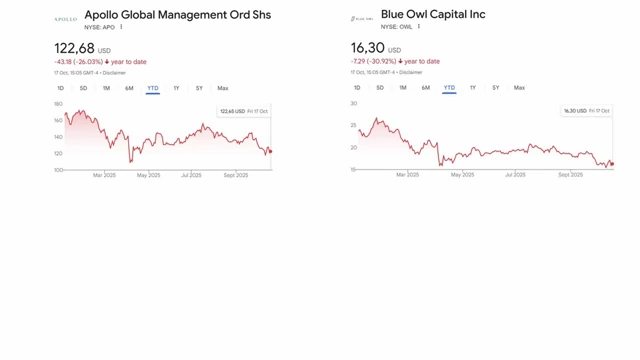
Stock performance of Apollo Global Management and Blue Owl Capital show significant year-to-date declines. [ 00:00:49 ] - This underperformance may partly reflect an overhang from a prior rally before S&P 500 inclusion.
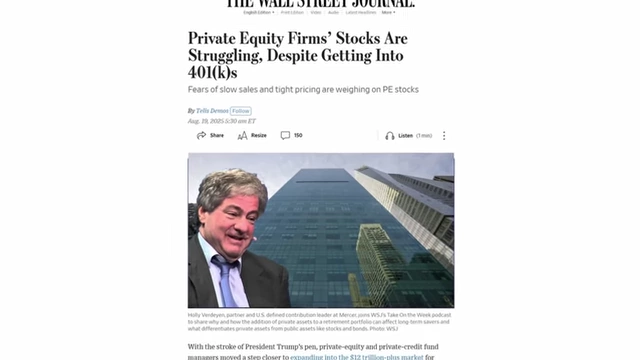
A Wall Street Journal headline highlights that private equity firms' stocks are struggling despite gaining access to 401(k)s. [ 00:01:15 ]
- Despite the potential for new capital from 401(k)s, shares of publicly listed private equity firms have underperformed the broader stock market.
- Challenges in Exiting Investments [00:01:31]
- Private equity firms are struggling to sell prior investments at attractive prices, leading to a slowdown in distributions to investors.
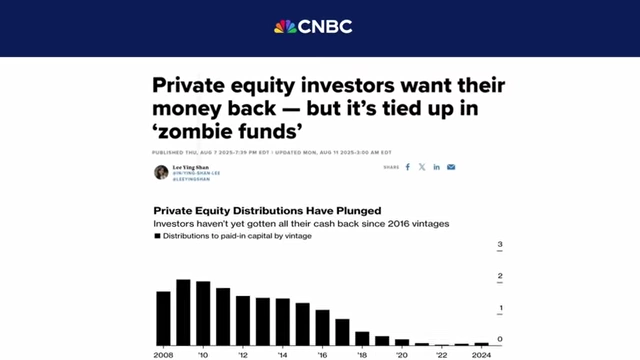
CNBC reports on "zombie funds" and a chart illustrating the plunge in private equity distributions to paid-in capital since 2016. [ 00:01:36 ] - Without successful exits and distributions, raising new capital becomes significantly harder.
- The industry's "flywheel" of raising, deploying, exiting, distributing, and repeating is not functioning as it used to.
- Private equity firms are struggling to sell prior investments at attractive prices, leading to a slowdown in distributions to investors.
- The Search for New Investors [00:01:50]
- The push into 401(k)s is seen as a way to find new investors due to frustration among existing ones.
The Disconnect Between PE and the Broader Market [00:02:01]
- Market Dynamics and PE Holdings [00:02:01]
- The S&P 500's 14% gain this year is concentrated in a few tech giants (e.g., "Magnificent Seven") which exhibit strong earnings growth, cash flow, and less leverage.

An Inc. article headline indicates that Big Tech is the primary driver of stock market gains. [ 00:02:14 ] 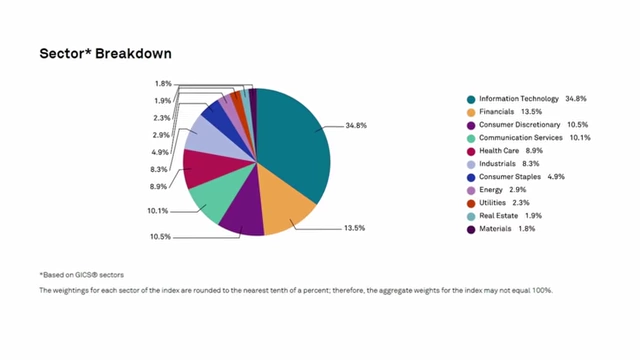
A pie chart shows the sector breakdown of the S&P 500, with Information Technology making up 34.8%. [ 00:02:22 ] - Private equity typically invests in smaller businesses, often in slower-growing sectors, with higher debt levels.

A Bloomberg article states that the current market is not like the Dot-Com Bubble, emphasizing the quality of leading tech firms. [ 00:02:30 ] - These companies are akin to leveraged small-cap value stocks, a market segment that has been lagging.
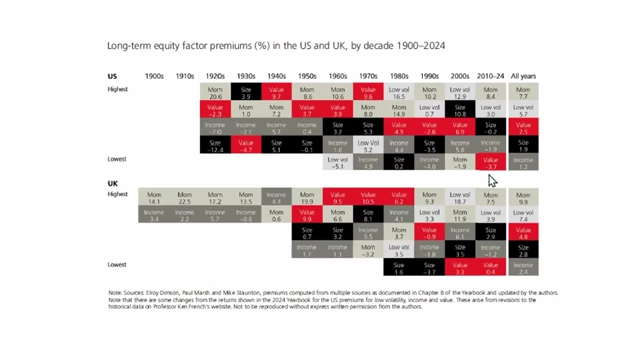
A table displays long-term equity factor premiums, showing that small-cap and value factors have not consistently outperformed in recent decades. [ 00:02:57 ]
- The S&P 500's 14% gain this year is concentrated in a few tech giants (e.g., "Magnificent Seven") which exhibit strong earnings growth, cash flow, and less leverage.
- IPO Market Stagnation [00:03:16]
- The IPO market has been dormant, and public investors are not interested in the slow-growth, heavily indebted businesses that private equity holds.
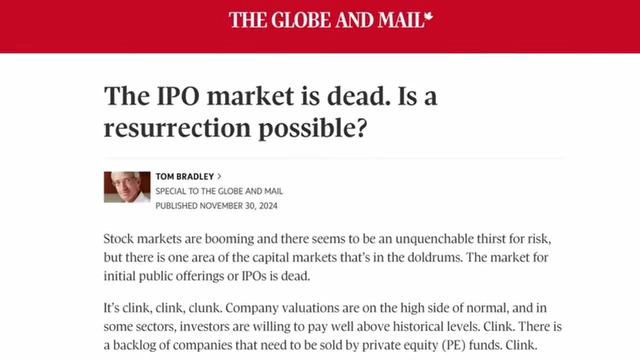
A Globe and Mail article discusses the stagnant IPO market, posing the question of whether a resurrection is possible. [ 00:03:21 ]
- The IPO market has been dormant, and public investors are not interested in the slow-growth, heavily indebted businesses that private equity holds.
- Benchmarking Challenges [00:03:42]
- Benchmarking private equity against the S&P 500 is problematic due to differences in company size, cyclicality, and leverage.
- A more accurate comparison would be leveraged small-cap value stocks, but private equity funds charge much higher fees (2 and 20).
The Nature of Private Equity Returns [00:04:09]
- Leverage as the Primary Driver [00:04:09]
- Private equity is primarily a structure, with most capital deployed through buyout funds using a mix of equity and debt.
- Debt, typically 60-75% of a deal's financing, is the main driver of returns, amplifying gains but also increasing fragility.
- The Myth of Operational Alpha [00:07:30]
- Private equity firms promote a narrative of "operational alpha," transforming underperforming companies through operational excellence.
- However, margin expansion from operational improvements rarely materializes. Bain's 2025 report shows margin growth contributed only 6% to value creation in software over the last decade.
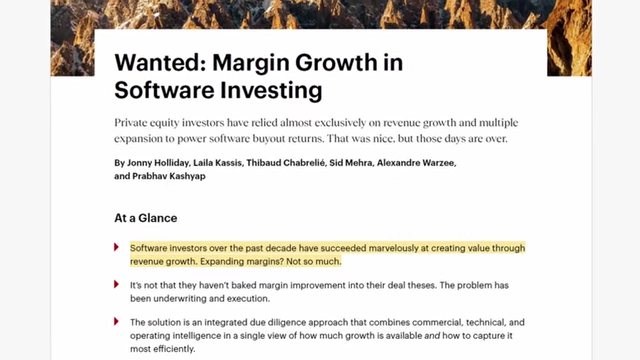
A Bain & Company report section titled "Wanted: Margin Growth in Software Investing" highlights that revenue growth and multiple expansion, not margin growth, have driven value. [ 00:09:17 ] - In carve-out transactions, margin improvement has fallen from 29% pre-2012 to 2% recently.
- Misleading Performance Metrics (IRR) [00:09:40]
- The industry's preferred metric, "since-inception IRR," is highly sensitive to cash flow timing and can be manipulated.
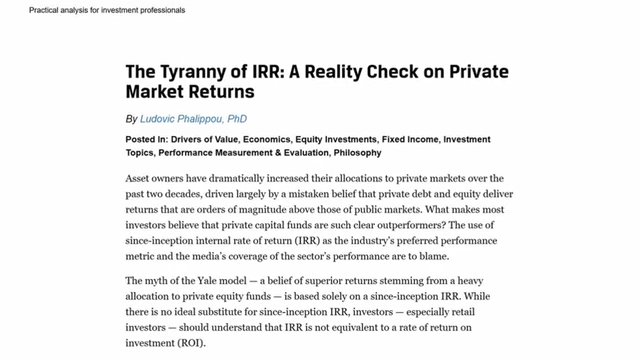
An article titled "The Tyranny of IRR: A Reality Check on Private Market Returns" critiques the use of since-inception IRR as a misleading performance metric. [ 00:09:54 ] - Warren Buffett criticized this, noting that IRR calculations often exclude the cost of idle cash held by investors.
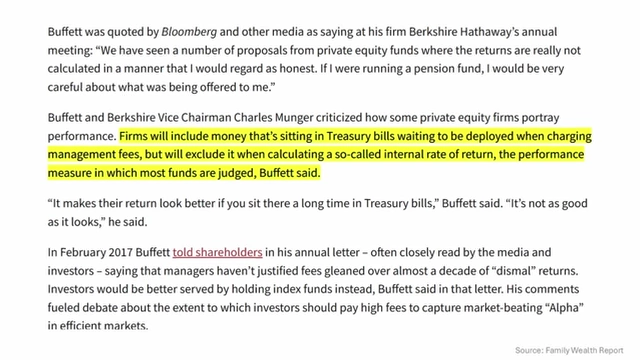
Warren Buffett criticizes private equity's IRR calculations for excluding the cost of idle cash held by investors. [ 00:10:30 ] - Tactics like delaying capital calls and using short-term loans can artificially inflate IRR, making a fund appear to deliver higher returns than investors actually receive.
- The industry's preferred metric, "since-inception IRR," is highly sensitive to cash flow timing and can be manipulated.
The Illusion of Stability and Liquidity Maneuvers [00:11:04]
- Stale Pricing and Volatility Laundering [00:11:04]
- Private equity projects an image of stability with smooth, upward-sloping returns, but this is often due to "stale pricing."
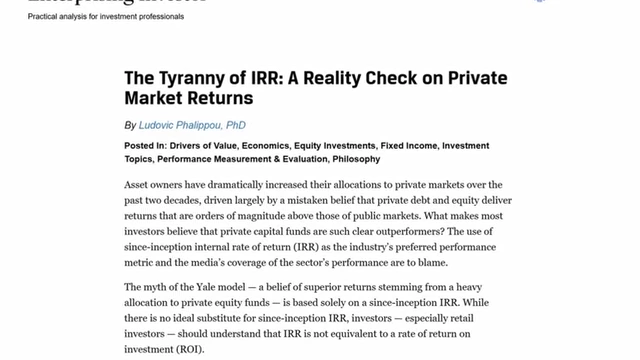
An article from the CFA Institute further elaborates on how since-inception IRR is not a true economic rate of return. [ 00:12:31 ] - Private assets are not marked to market daily but are appraised periodically, sometimes by the fund managers themselves, creating an illusion of low volatility.
- This "volatility laundering" appeals to institutional investors, but it obscures true risk and underperformance.
- Private equity projects an image of stability with smooth, upward-sloping returns, but this is often due to "stale pricing."
- Liquidity Challenges and Financial Maneuvers [00:15:36]
- The industry is struggling to convert paper gains into actual cash, with over $3.6 trillion in unsold companies.
- Distributions as a percentage of net asset value have fallen to 11%, the lowest in over a decade.
- With the IPO market comatose and strategic buyers cautious, PE firms resort to "continuation funds," "secondaries," and "NAV loans" to generate liquidity.
- Continuation funds allow a PE firm to sell an asset from one fund to another it manages, resetting the clock and creating a paper gain without a true exit.
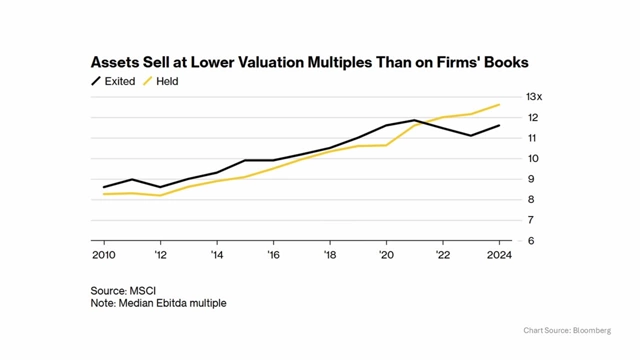
A chart from Bloomberg shows that assets sold (exited) by private equity firms generally have lower valuation multiples than those still held on firms' books. [ 00:14:40 ] - Secondary market discounts (15% or more) indicate the true value investors place on these assets.
- First Brands Collapse as a Warning [00:16:51]
- The collapse of First Brands, which borrowed heavily and used opaque financing, illustrates the system's fragility.
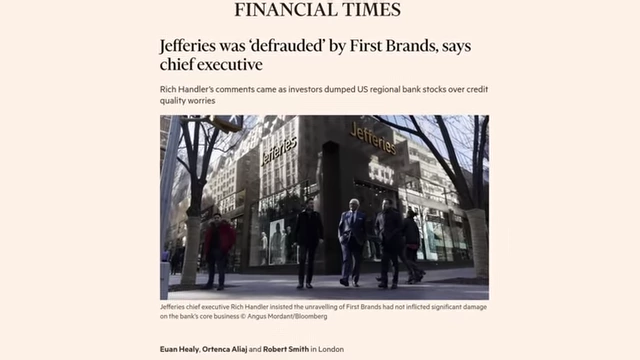
A Financial Times headline reports that Jefferies claims it was 'defrauded' by First Brands. [ 00:17:16 ] 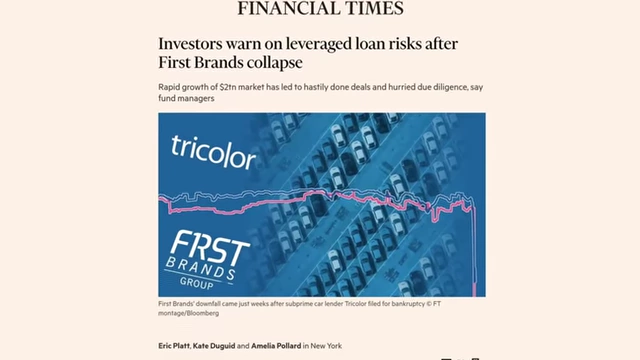
The Financial Times warns about leveraged loan risks following the First Brands collapse. [ 00:17:26 ] - Its failure led to $2.3 billion in vanished assets, highlighting risks in private credit.
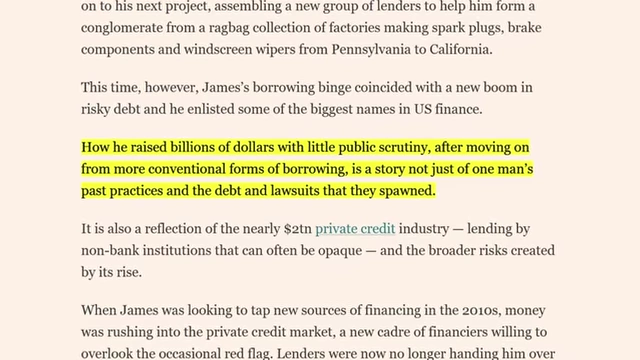
An excerpt from a Financial Times article questions how First Brands raised billions with little public scrutiny. [ 00:17:39 ]
- The collapse of First Brands, which borrowed heavily and used opaque financing, illustrates the system's fragility.
Social and Regulatory Concerns [00:21:02]
- Impact on Society [00:21:02]
- Beyond financial performance, private equity faces criticism for its social impact, where the goal often becomes wealth extraction rather than growth or customer focus.
- Congressional investigations into PE-owned dental chains revealed practices that prioritized profit over patient care, leading to unnecessary procedures.

A congressional investigation found that private equity-owned dental organizations prioritized profits over patient care, leading to unnecessary procedures. [ 00:21:43 ] - The pursuit of EBITDA growth can result in negative outcomes like understaffed care homes and hollowed-out retailers.
- Antitrust Issues with Roll-up Strategies [00:21:54]
- Private equity's "roll-up" strategies, where many small businesses in fragmented industries (e.g., doctors' offices) are consolidated, raise antitrust concerns.
- This consolidation can reduce competition and lead to higher consumer costs.
The End of Cheap Debt and a Fragile Future [00:22:17]
- Higher Interest Rates Impact [00:22:17]
- Private equity thrived on cheap debt in a falling interest rate environment, a tailwind that is now gone.
- Higher interest rates significantly increase financing costs, reduce valuations, and lead to fewer exits.
- Many PE-backed companies are highly indebted (6-8 times EBITDA), which increases bankruptcy risk as rates rise.
- Uncertainty and Shrinking Returns [00:23:13]
- Inflation, tariffs, and policy uncertainty make underwriting new deals difficult, particularly for smaller businesses.
- The industry's pitch of diversification, excess returns, and stability is being challenged by high fees, uncertain exits, and shrinking returns.
- The expansion into 401(k)s, despite sophisticated repackaging, presents retail investors with high fees, long lockups, and limited transparency, potentially selling them a "bug" instead of a "feature."

President Trump displays the signed executive order allowing private equity firms to access 401(k) retirement funds. [ 00:18:20 ] 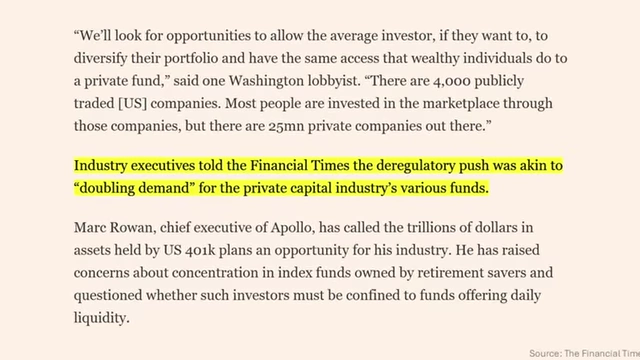
A Financial Times article highlights that industry executives saw the deregulatory push for 401(k) access as "doubling demand" for private capital. [ 00:18:39 ] 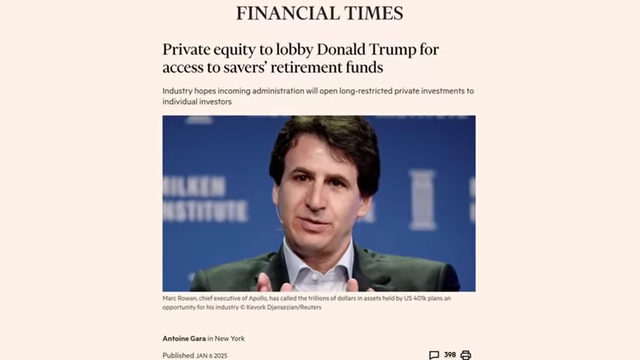
The Financial Times reports on private equity lobbying efforts to gain access to Donald Trump for savers' retirement funds. [ 00:19:13 ] 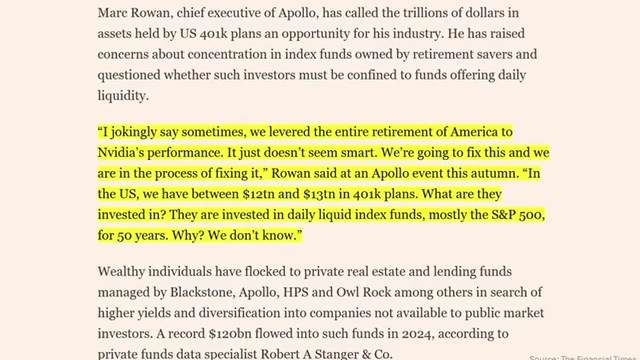
Marc Rowan of Apollo is quoted expressing concern about 401(k) systems being overexposed to tech stocks and advocating for private market access. [ 00:19:32 ] 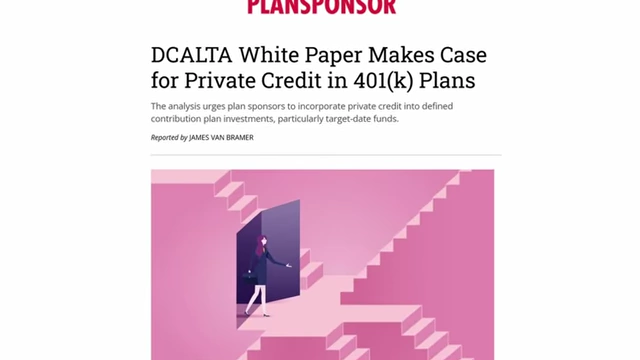
A Plansponsor white paper makes the case for including private credit in 401(k) plans. [ 00:19:50 ] 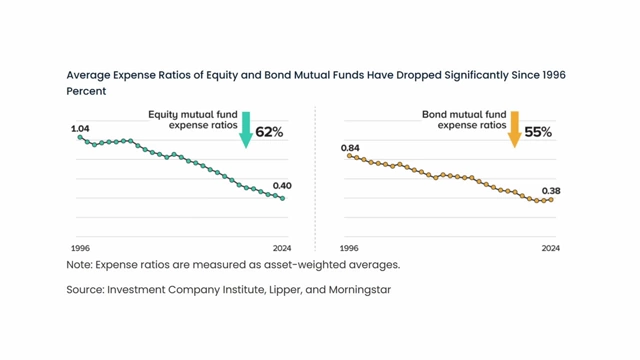
A chart illustrates the significant drop in average expense ratios for equity and bond mutual funds since 1996, indicating investor preference for lower fees. [ 00:20:49 ] - Ultimately, private equity needs real exits and distributions to prove its value, rather than relying on flattering presentations and accounting maneuvers.

An illustrative "toddler's drawing of a rollercoaster labeled 'steady growth'" is used as a metaphor for private equity's illusion of stability. [ 00:23:56 ]