Exercise Your Fifth Amendment Rights: Why You Should Never Talk to the Police
Regent University School of Law
Summary:
This video, presented by a law professor and a seasoned police officer, explains why you should never talk to the police under any circumstances. Key points include:
- Talking to the police cannot help you, as exculpatory statements are inadmissible as evidence in court, while any self-incriminating statements can be used against you.
- Even innocent people can provide false confessions or say seemingly harmless truths that are ultimately used for conviction due to pressure, misunderstanding of the law, or their own mistakes.
- The complexity of the law makes it difficult for ordinary people to fully understand all possible charges.
- The police can legally use lies and misleading tactics during interrogation, and their verbal testimony is highly credible in court, even without recordings.
- Remaining silent, exercising your Fifth Amendment right against self-incrimination, is the best way to protect yourself, regardless of your innocence.

Video theme: The importance of not talking to the police [ 00:00:00 ]
Introduction: The Importance of Not Talking to the Police [00:00:00]

- Regent University Law Professor James Duane states that he would never talk to any police officer under any circumstances and emphasizes his pride in having the Fifth Amendment right to do so.
- He points out that the Fifth Amendment states, "No person...shall be compelled in any criminal case to be a witness against himself." However, this amendment has been unfortunately maligned in recent times.
- The professor will discuss the "talking to the police" issue with a seasoned police officer, emphasizing that this is an extraordinary move that a "legal expert would never do" because he will allow the police to refute his arguments to ensure fairness.
The Legal Expert's View: Never Talk to the Police [00:02:57]
- Justice Robert Jackson's Advice [00:03:02]
- Justice Jackson was an experienced prosecutor before becoming a Justice of the U.S. Supreme Court.
- He clearly stated, "Any lawyer worth his salt will tell the suspect in no uncertain terms to make no statement to police under any circumstances."
- Professor Duane will explain why Justice Jackson's view is correct, even though it may seem counterintuitive.
- Why Even Experienced People Make Mistakes [00:03:22]
- Many experienced professionals, including senators, public relations experts, and even criminal defense attorneys, have mistakenly believed they could talk to the police without harm.
- Case: An experienced criminal defense lawyer was accused of criminal assault. Although there were no other witnesses, and he denied touching the victim, after talking to the police, the police testified that he had admitted to "jokingly" putting his hand on the victim's throat. As the conversation was not recorded, the lawyer was ultimately convicted.
The Seven Risks of Talking to the Police [00:07:46]
- 1. It Cannot Help You [00:07:55]
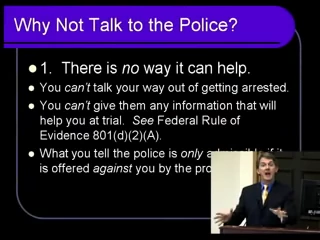
The first risk of talking to the police: It cannot help you [ 00:07:54 ] - You Can't Talk Your Way Out of Arrest [00:08:04]
- Police rarely abandon an arrest because of a suspect's eloquence or persuasiveness, no matter how eloquent their statements.
- Exculpatory Statements Can't Help You [00:08:45]
- According to Federal Rule of Evidence 801(d)2, any exculpatory (proving your innocence) statements you tell the police are "hearsay" in court and cannot be used to help you.
- The police will not be allowed to testify in court to relay your exculpatory statements for you.
- Self-Incriminating Statements Can Be Used [00:08:55]
- However, anything you tell the police can and will be used against you.
- You Can't Talk Your Way Out of Arrest [00:08:04]
- 2. Innocent People Confess [00:09:30]

The second risk of talking to the police: Innocent people confess [ 00:09:34 ] - The Prevalence of Confessions [00:10:04]
- In federal court, 84.6% of defendants choose to plead guilty at some stage before trial.
- If you are indeed guilty, there will always be an opportunity to reach a plea agreement with the help of a lawyer or seek a reduced sentence. There is no need to rush to confess to the police.
- The Innocence Project Cases [00:11:12]

The Innocence Project: In more than a quarter of DNA exoneration cases, innocent defendants made self-incriminating statements [ 00:11:20 ] - The Innocence Project has confirmed that in more than 25% of DNA exoneration cases, innocent defendants made self-incriminating statements, direct confessions, or pleas of guilt.

Cases of wrongfully convicted innocent people: Eddie Joe Lloyd (left) and Earl Washington (right) [ 00:11:40 ] - Eddie Joe Lloyd [00:11:37]: Convicted in 1984 for the murder of a 16-year-old girl. He suffered from mental illness, and the police tricked him into signing a confession and recording a statement by feeding him details of the case and lying that the confession could help them find the real killer. He served nearly 20 years in prison before DNA evidence proved his innocence.
- Earl Washington [00:12:17]: Intellectually disabled and confessed to several crimes (including rape and murder) at the request of the police, some of which we now know he could not have committed. He was exonerated by DNA evidence and released after serving 18 years.
- The Innocence Project has confirmed that in more than 25% of DNA exoneration cases, innocent defendants made self-incriminating statements, direct confessions, or pleas of guilt.
- The Prevalence of Confessions [00:10:04]
- 3. Grave Consequences From Small Lies or Mistakes [00:13:06]

The third risk of talking to the police: Grave consequences from small lies or mistakes [ 00:13:10 ] - Even if your client is innocent, denies guilt, and tells the truth most of the time, it is easy for him to tell some small lies or make some small mistakes out of pressure or nervousness, which could lead to his conviction.
- For example: An innocent person, to emphasize their innocence, might claim that they have never used a gun or never been to a certain place, but if these statements are proven false, even trivial lies can lead to their conviction.
- 4. Even the Truth Can Be Used to Convict You [00:14:00]

The fourth risk of talking to the police: Even the truth can be used to convict you [ 00:14:03 ] - Even if your client is innocent and only tells the truth, they will always provide some information that can be used to help convict them.

Example of a truthful statement by an innocent person denying guilt [ 00:14:29 ] 
The "self-incriminating" part that the police might emphasize in court [ 00:14:54 ] - U.S. Supreme Court's View [00:15:19]

The Supreme Court emphasizes in Ohio v. Reiner that the Fifth Amendment is intended to protect the innocent [ 00:15:30 ] - In Ohio v. Reiner, the U.S. Supreme Court stated: "One of the Fifth Amendment's basic functions is to protect innocent men who might otherwise be ensnared by ambiguous circumstances. Truthful responses of the innocent witness, as well as those of the wrongdoer, may provide the government with incriminating evidence."

The Supreme Court points out in Ullmann v. United States that invoking the Fifth Amendment is not an admission of guilt [ 00:16:50 ] - In Ullmann v. United States, the Supreme Court emphasized that many people mistakenly believe that someone who invokes the Fifth Amendment privilege is either guilty or committing perjury, but this is not the case.
- In Ohio v. Reiner, the U.S. Supreme Court stated: "One of the Fifth Amendment's basic functions is to protect innocent men who might otherwise be ensnared by ambiguous circumstances. Truthful responses of the innocent witness, as well as those of the wrongdoer, may provide the government with incriminating evidence."
- Even if your client is innocent and only tells the truth, they will always provide some information that can be used to help convict them.
- 5. The Risk of Inaccurate Police Recollection [00:17:09]

The fifth risk of talking to the police: Inaccurate police recollection leads to misjudgment [ 00:17:10 ] - Even if your client is innocent, only tells the truth, provides no self-incriminating information, and the statement is videotaped, your answers can still be used to frame you if the police cannot recall their questions 100% accurately.
- Example: The professor conducts a quiz in class, where he only mentions "murder," but many students will subconsciously think the case involves a "shooting." Similarly, a police officer in court may unintentionally misremember their initial question, making the defendant's mention of a particular word (such as "gun") seem suspicious, thereby constituting self-incriminating evidence.
- 6. The Risk of Misunderstanding in Video Recordings [00:19:00]

The sixth risk of talking to the police: Video evidence can also backfire due to police misunderstanding of the questions [ 00:19:00 ] - Even if the entire interrogation process (including questions and answers) is videotaped, your answers can still be used to frame you if the police do not recall their initial questions 100% accurately.
- Example: A police officer asks about a "murder" case, and an innocent suspect says, "I didn't touch the gun." In court, the officer can testify that he never mentioned "gun" and that the suspect brought it up on their own, implying that the suspect knew details of the case, thereby constituting evidence.
- 7. The Backlash of Unreliable Evidence [00:22:27]

The seventh risk of talking to the police: Unreliable evidence backfires on truthful statements [ 00:22:30 ] - Even if your client is innocent, tells the truth, provides no self-incriminating information, and the entire interview is videotaped, your truthful answers can still be used to frame you if any evidence the police have is wrong, misunderstood, or unreliable (even if your statements are true).

Example of a truthful but easily misunderstood confession by an innocent person [ 00:21:19 ] - Example: A suspect truthfully claims to have been in the Outer Banks at the time of the crime, but the police have a witness who honestly but mistakenly claims to have seen the suspect in Virginia Beach. In this case, the suspect's truthful confession, combined with this incorrect testimony, will cause them to be convicted for "lying."
- Celebrity Cases [00:24:08]
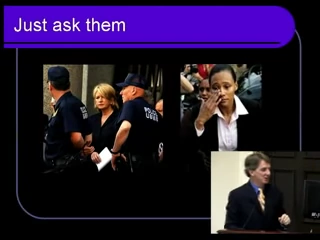
Cases of celebrities convicted of lying to federal investigators: Martha Stewart (left) and Marion Jones (right) [ 00:24:09 ] - Martha Stewart [00:24:20]: Was not convicted of securities fraud but was sentenced for lying to federal investigators.
- Marion Jones [00:24:45]: Initially denied using steroids and was ultimately jailed for perjury, although she could have invoked the Fifth Amendment.
- Michael Vick [00:25:17]: Initially lied to police, denying involvement in dog fighting, and although he eventually pleaded guilty, the lying resulted in a longer sentence.
- Even if your client is innocent, tells the truth, provides no self-incriminating information, and the entire interview is videotaped, your truthful answers can still be used to frame you if any evidence the police have is wrong, misunderstood, or unreliable (even if your statements are true).
A Police Officer's Perspective: Confirmation and Tactics [00:26:52]
- Testimony of Officer George Bruch [00:27:00]
- He confirms that everything Professor Duane has said is true and correct.
- Officer Bruch has served as a criminal investigator, interviewing thousands of people, handling thousands of felony and misdemeanor cases, with a 98% conviction rate, 80% of which did not require court appearances because confessions were obtained.
- People's "Stupidity" and Police Tactics [00:29:46]
- Officer Bruch admits that many people (including criminals) are "stupid," meaning they are naturally honest or easily persuaded to talk.
- Exploiting Human Nature [00:30:37]: People like to tell their stories and hate silence. Under the pressure of the interrogation room, the interrogated often yearn to leave as soon as possible, while the police have the patience to wait and exploit this psychological weakness.
- Traffic Violation Example [00:29:08]: When asked, "Do you know how fast you were going?" even if slightly speeding, people usually report a number slightly higher than the speed limit, which in itself is an admission of a violation.
- Police Objectives [00:31:19]: A police officer's job is to gather evidence, establish probable cause, and obtain confessions.
- "Interviews" vs. "Interrogations" [00:43:39]: Officers refer to their conversations as "interviews" rather than the oppressive "interrogations."
- The Power of Oral Confessions [00:41:52]: Oral confessions do not need to be recorded or videotaped to be used as evidence in court. In the absence of a recording, it becomes a case of the defendant's word against the officer's. Since officers are "professional witnesses," juries usually believe them.
- Legal Deception [00:45:12]: Officers are legally allowed to lie during interrogations. For example, officers will tell a suspect that the victim is very angry with them and wants them to go to jail, thereby inducing the suspect to write an apology letter.
- Written Apology Letters [00:45:30]: Officers will induce suspects to write "apology letters," which are treated as written confessions and are very powerful evidence, almost guaranteeing a conviction.
- Unfair Advantage in Court [00:42:12]
- Juries usually have preconceived biases against defendants sitting next to defense lawyers.
- Police officers in uniform or detectives in suits are seen as "professional witnesses" in court, and their testimony has extremely high credibility.
- If the defendant has a confession, the officer will read it aloud in court from their notes, which usually becomes overwhelming evidence.
Conclusion: Remain Silent, Exercise Your Rights [00:25:47]
- Both Professor Duane and Officer Bruch emphasize that Justice Jackson's advice is absolutely correct.
- Any wise and competent lawyer would tell every client under any circumstances—regardless of their innocence or the facts—not to talk to the police.
- Speaking too early before understanding all the evidence the police have may lead to unintentional self-incrimination or even being framed by unreliable evidence.
- Therefore, the best strategy is to remain silent and exercise your Fifth Amendment right, which maximizes your protection.