Axial Flux Motors Explained: Design, Performance, and Manufacturing Advantages for Custom EV Powertrains
This video explains axial flux motors, comparing them to radial flux motors and discussing their role in EV powertrains.
- Axial vs. Radial Flux: Axial flux motors, like the Omni Powertrains unit torn down, feature magnetic flux passing parallel to the axis of rotation, while radial flux motors (e.g., Chevy Bolt) have flux moving perpendicular.
- Design & Cooling: Axial flux motors have a compact, disc-like rotor and two stators, allowing for effective cooling channels on both sides that keep water separate from windings.
- Components: Key components include a resolver for magnet position, a connecting shaft for stacking multiple motors, and a carbon brush to prevent bearing wear from static electricity.
- Performance Trade-offs: While theoretically offering higher torque density due to larger surface area, current axial flux motors demonstrate comparable performance to radial flux designs in production, with Lucid (radial flux) leading in power density.
- Manufacturing Innovation: The significant advantage of the Omni axial flux motor lies in its stator manufacturing. It uses an inexpensive "notching machine" to wind a steel strip like a Slinky, allowing windings to be dropped directly into open slots.
- Application Niche: This low-capital tooling cost makes axial flux motors ideal for custom, low-volume applications like motorsports, where specific performance tuning is critical without prohibitive initial investment.

Disassembled Omni Powertrains Axial Flux Motor Components [ 00:02:50 ]
Introduction to Axial Flux Motors [0:00:08]
Paul from Munro & Associates introduces axial flux motors, highlighting their recent interest in the electric vehicle (EV) industry. Munro Live acquired and tore down an axial flux motor from Omni Powertrains, a Shanghai-based company specializing in custom motors.

- The particular Omni Powertrains motor came as two stacked motors attached to a transmission.
- One of these motors was disassembled for analysis.
- Cooling System Design [0:01:04]:
- The motor utilizes a serpentine water cooling system, visible after removing the external plate and gasket.
- This design keeps water entirely separate from the motor windings, ensuring that any potential leak occurs outside the motor, preventing damage to the internal components.

Cooling channels on the motor plate [ 00:01:20 ] - The serpentine path ensures even cooling across all parts of the motor, preventing hot and cold spots in the windings.
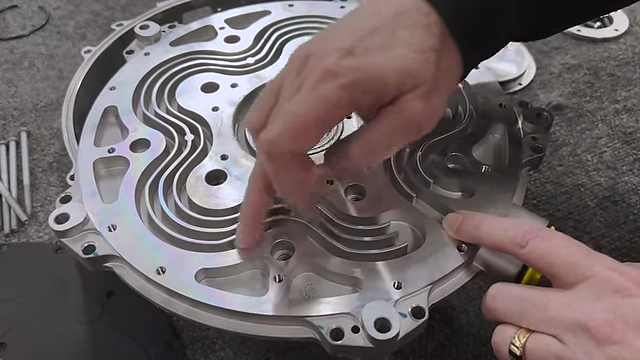
Paul demonstrating the serpentine cooling path [ 00:01:48 ] - Axial flux machines offer good access to both sides of the stator for effective cooling.
- Key Components of the Axial Flux Motor [0:02:24]:
- Resolver [0:02:26]: Essential for permanent magnet motors like this, providing accurate knowledge of the magnets' position relative to the stator.
- Connecting Shaft [0:02:40]: A coupler that connects multiple motors together, allowing the combination of power from both into a single gearbox. This stacking capability is a flexible design feature.
- Carbon Brush [0:03:05]: Helps prevent excessive bearing wear by discharging static electricity that can build up from the spinning plastic rotor rubbing against the air, which could otherwise cause arcing across bearings.

Carbon brush for static discharge [ 00:03:20 ] - Electrical Connections [0:03:49]: Three-phase electrical connections from each motor converge, typically leading to an inverter for the entire assembly.

Three-phase electrical connections of the axial flux motor [ 00:04:00 ] - The image below shows the disassembled components discussed.
Disassembled Omni Powertrains Axial Flux Motor Components [ 00:02:50 ]
- Manufacturing Observation [0:04:15]:
- Munro & Associates noted the extensive use of threaded fasteners in the assembly, suggesting potential for optimization in mass production.
- Omni Powertrains specializes in custom motors for applications like racing or heavy-duty machinery, producing lower volumes (e.g., 10-200 units), where extensive tooling optimization for millions of units might not be the priority.
Axial Flux vs. Radial Flux Motors [0:05:12]
The video delves into the fundamental differences between axial flux and traditional radial flux electric motors by comparing the Omni Powertrains axial flux motor with a Chevy Bolt radial flux motor of similar power and torque.
Motor Basic Parts [0:05:26]:
- Stator: The stationary part with windings.
- Rotor: The rotating part containing permanent magnets.
Axial Flux Motor Design [0:05:37]:
- The rotor is thin and disc-shaped, with magnets facing the stators.
- This particular motor uses two stators, sandwiching the rotor (stator-rotor-stator), allowing cooling on both sides of the stators.
- Flux Path: Magnetic flux passes axially (parallel to the rotation axis) from the magnets into the stator, around the stator, and back into the next magnet, forming a loop in the axial direction.

Axial flux motor stator (left) and rotor (right) [ 00:05:59 ]
Radial Flux Motor Design (Chevy Bolt example) [0:07:15]:
- Radial flux motors tend to be longer and smaller in diameter compared to axial flux motors of similar power.
- The magnets are within the rotor (lamination shown), and the flux travels radially (perpendicular to the rotation axis) from the magnets into the stator, around, and back to the magnets.

Chevy Bolt radial flux motor stator and a rotor lamination [ 00:07:19 ]
Advantages of Axial Flux Motors [0:08:14]:
- Larger Surface Area: For the same motor volume, axial flux motors present a larger surface area for magnetic interaction (transmitting torque), theoretically allowing for higher torque output.
- Potential for Higher Torque/Power Density: This larger surface area can, in principle, lead to greater torque and power density for a given package size.
Disadvantages and Engineering Challenges of Axial Flux Motors [00:09:10]:
- High Axial Forces: The strong magnetic forces between the rotor and stators generate significant axial forces.
- These forces must be managed by the motor's bearings.
- Imperfectly even air gaps between the rotor and stators can lead to very large loads on the bearings, increasing wear.
- Magnet Retention [0:10:09]: Magnets in the rotor need to be securely retained (e.g., by a carbon fiber ring) to prevent them from detaching or flying apart at high rotational speeds due to centrifugal forces.
- In contrast, radial flux motors inherently contain these forces within the stator, making their mechanical construction and bearing loads less complex.
- High Axial Forces: The strong magnetic forces between the rotor and stators generate significant axial forces.
Market Reality and Manufacturing Innovation [0:11:07]
Despite the theoretical benefits, the video points out the current practical reality of axial flux motors in the market and highlights a significant manufacturing innovation.
- Current Performance vs. Claims [0:11:13]:
- While some companies claim spectacular torque and power densities for axial flux motors, Munro's analysis indicates that current production axial flux motors offer comparable, or only slightly better, torque and power density than leading radial flux designs.
- The Lucid motor, a radial flux design, is currently considered the industry leader in production motor torque and power density.
- Manufacturing Innovation: The Stator [0:12:29]:
- The stator is typically one of the most expensive parts to tool up for motor production.
- Omni Powertrains' Approach: The stator in the Omni axial flux motor is manufactured by winding a notched strip of steel "like a Slinky."
- This process uses a "notching machine," which is a relatively inexpensive piece of equipment (around $10,000), akin to an industrial sewing machine that punches notches into a steel strip.
- As the steel strip is wound, the incrementally adjusted notches align perfectly to form straight slots.
- This "open slot" design allows the wire windings to be directly "dropped in," simplifying the winding process.

Axial flux stator winding with open slots [ 00:12:58 ]
- Contrast with Radial Flux Stator Manufacturing [0:14:35]:
- Radial flux stators often require complex and expensive stamping dies to form the stator and rotor from a single piece of steel.
- Their winding process, particularly for "bar wound" or "hairpin" machines, involves breaking up windings and forcing them into slots, then welding them on the opposite side, which is more complex and adds to capital cost.
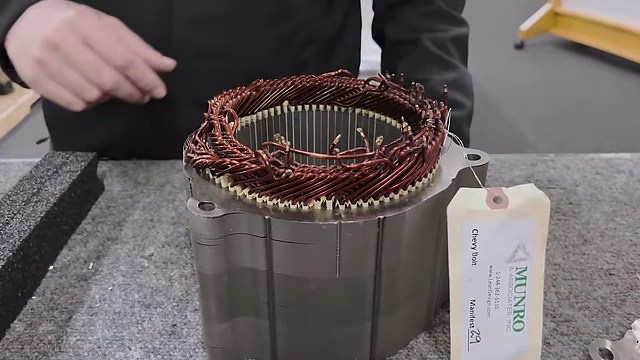
Radial flux stator with hairpin windings [ 00:14:47 ]
- The "Big Advantage" for Custom Applications [0:15:51]:
- The low capital cost associated with the notching die manufacturing process for the axial flux stator is the key benefit.
- For companies like Omni, which produce custom motors for low-volume applications (e.g., Motorsports, where only 10-12 vehicles might be built), this low capital investment makes axial flux motors highly competitive.
- It enables manufacturers to create custom-tailored motors for specific applications at a lower cost, despite similar material costs.
- This allows for precise tuning to customer needs without the prohibitive tooling costs associated with high-volume production radial flux motors.
- This innovation is driving the adoption of axial flux motors in high-end, specialized applications like Motorsports.