Evaluating the Value of Buying Used Germanium Transistors: A Comprehensive Guide and eBay Lot Test
This video evaluates the worth of buying used germanium transistors, focusing on three main acquisition methods:
- Matched Sets: Buying pre-sorted transistors from vendors like Small Bear Electronics (e.g., for Fuzz Face, Tone Bender, Range Master). This is convenient but expensive, costing $13-$17 per transistor.
- Individual Transistors: Purchasing single units from electronic sellers like Small Bear or NTE Parts Direct. This is cheaper (around $3-$7 per transistor) but lacks testing for gain (hFE), leakage, or noise.
- Used Bulk Lots: Acquiring unsorted, untested lots from platforms like eBay, which is the riskiest but potentially cheapest option.
The presenter bought an eBay lot of 98 GE 2N169 and other transistors for $65 (approx. $0.66 per transistor). Initial tests revealed inconsistent quality:
- Some transistors (e.g., a 2N44, 2N135, 2N136) had low gain (hFE 23-35) but low leakage (20-39 microamps), making them suitable for certain applications.
- One 2N169 initially showed "no component detected," indicating it was faulty.
- Other 2N169s tested well, with hFE around 112-116 and leakage between 79-428 microamps, the latter being high but acceptable for some fuzz pedals.
The conclusion is that while bulk lots are cheap, thorough testing is essential due to high variability.

An aerial view showing a pile of tested germanium transistors next to a Peak Atlas DCA75 transistor tester. [ 00:15:00 ]
Introduction to Germanium Transistors and Buying Options [00:00:00]
The video's host, Joe from Gray Bench Electronics, expresses his passion for germanium transistors, especially for building fuzz pedals. He aims to share his knowledge on buying these components, having experienced both successes and failures over numerous purchases.
1. Matched Sets (e.g., Small Bear Electronics) [00:00:43]
- Pros:
- Most straightforward method, recommended for building one or two specific germanium fuzzes like Fuzz Face, Tone Bender, or Range Master.
- No need to deal with matching or testing; sets are pre-selected.
- Vendors like Small Bear Electronics back up their sets, allowing returns for bad ones.
- Cons:
- Significant premium price due to the labor involved in matching and selecting.
- Examples of pricing: Tone Bender sets cost $32-$40 (approx. $13 per transistor for a 3-transistor set), generic Fuzz Face sets are $29 (approx. $15 per transistor for a 2-transistor set), and a single Range Master transistor is $17.

Small Bear Electronics website showing various germanium transistor matched sets. [ 00:00:50 ]
2. Individual Transistors (e.g., Small Bear, NTE Parts Direct) [00:02:01]
- Pros:
- Cheaper than matched sets. Small Bear sells individual transistors for $3-$7 each.
- NTE Parts Direct offers new old stock (NOS) parts, like a 2N404 for $4.55.
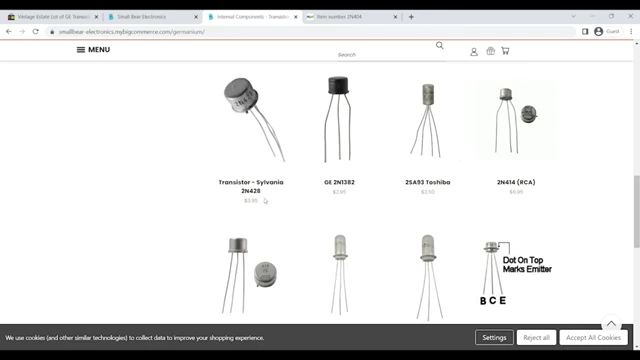
Small Bear Electronics website showing various individual germanium transistors for sale. [ 00:02:10 ] 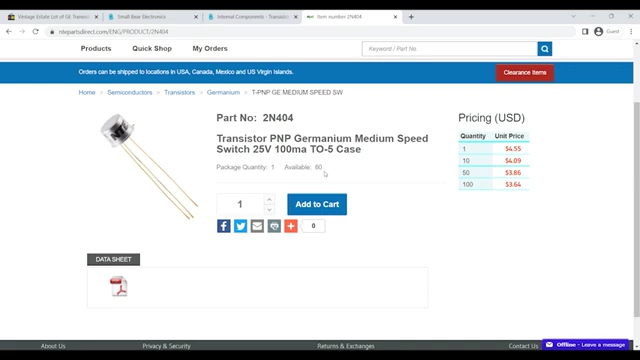
NTE Parts Direct website showing a 2N404 transistor with quantity-based pricing. [ 00:03:20 ]
- Cons:
- No testing for hFE (gain), excessive leakage, or noise.
- Higher risk compared to matched sets.
- While parts are new, quality for specific parameters (gain, leakage) is not guaranteed, and returns might be difficult depending on the seller's policy.
- The cost can quickly add up if multiple transistors are needed to find suitable ones, potentially negating the savings over matched sets.
3. Used Bulk Lots (e.g., eBay) [00:03:40]
- Pros:
- Cheapest option per transistor, aiming for less than a dollar per transistor.
- Cons:
- Highest risk as transistors are often sold "untested" or "for parts, not working."
- No recourse if the lot contains mostly duds or unsuitable transistors.
- The condition of leads (trimmed but straight) may suggest they were socketed and removed, potentially due to being faulty.
- "Rare" in listing titles for germanium transistors is a common marketing tactic, as all germanium transistors are considered rare.
Case Study: eBay Germanium Lot Purchase [00:03:40]
Listing Analysis [00:03:52]
- The presenter purchased a lot described as "vintage estate lot of GE transistors 2N169 and others rare."
- The image suggested 60-70 transistors.
- Identified part numbers included 2N169 (from General Electric, GE) and 2N44, in both crimped oval and round top hat packages.
- Noted that the leads were trimmed but not significantly bent, indicating they were likely socketed rather than soldered, and possibly removed from equipment because they were defective.
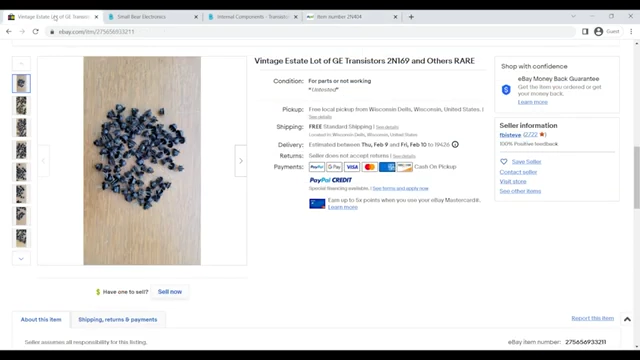
eBay listing showing a pile of "Vintage Estate Lot of GE Transistors 2N169 and others Rare". [ 00:03:40 ] 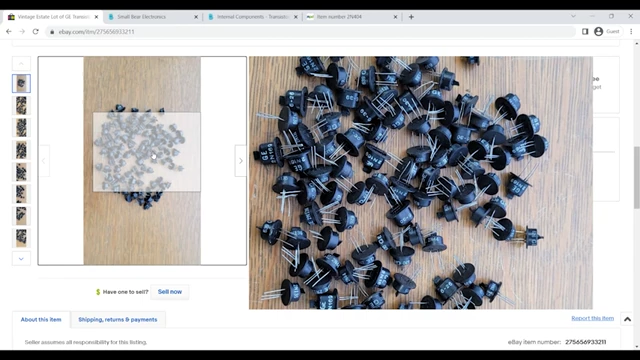
A close-up of the eBay listing image, highlighting the trimmed but straight leads of the transistors. [ 00:06:42 ]
Cost Analysis [00:05:50]
- The lot cost $65 with free shipping.
- After counting, there were 98 transistors in the lot.
- This brings the cost per transistor to approximately $0.66, which is below the presenter's target of $1.00 for such lots.
- American-made transistors (GE, Sylvania, Raytheon, Texas Instruments) typically fetch a premium, usually around $0.75 to $1.00 per unit even in bulk.
Unboxing and Initial Inspection [00:07:15]
- The package arrived from Wisconsin.
- The transistors were packed in an anti-static Ziploc bag.
- The total count was 98 transistors, exceeding the initial estimate.
- Identified part numbers upon closer inspection included 2N169s (all in oval packages), and a variety of 2N136s, 2N135s, and 2N44s (in round packages).
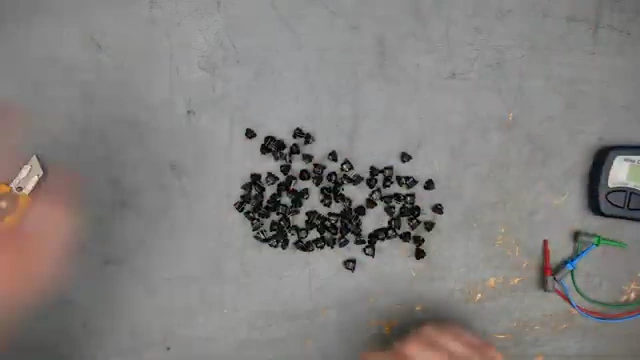
A pile of 98 small black germanium transistors are spread out on a grey surface next to a transistor tester. [ 00:08:20 ]
Testing Germanium Transistors [00:09:57]
The presenter used a Peak Atlas DCA75 to test the transistors, emphasizing the importance of not touching them with bare hands before or during testing, as body heat can significantly affect measurements and lead to thermal runaway.
Test 1: 2N44 (Round Package) [00:10:31]
- Results: PMP Germanium, hFE 23 (low gain), leakage 39 microamps (really low leakage).
- Evaluation: Decent candidate for a Darlington pair or complementary pair, where low leakage is critical, even with low individual gain.
Test 2 & 3: 2N169 (Oval Package - First Attempts) [00:11:19]
- Results: "No component detected."
- Evaluation: This usually indicates a bad transistor or poor contact with the tester. This initial result was concerning, suggesting some transistors might indeed be faulty, reinforcing the risk of buying untested lots.
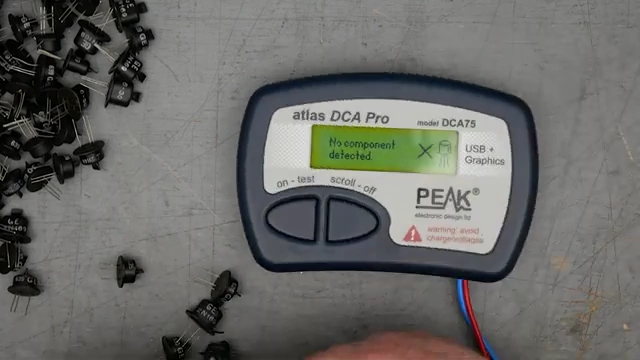
The Peak Atlas DCA75 displaying "No component detected.", indicating a faulty transistor or poor contact. [ 00:11:25 ]
Test 4: 2N169 (Oval Package - Second Attempt) [00:11:49]
- Results: NPN Germanium, hFE 116 (great gain), leakage 428 microamps (on the high side of acceptable).
- Evaluation: Acceptable for certain fuzz pedals like original Maestro Fuzz Tones or Tone Benders that "need that leakage" for correct biasing. Repeated tests showed consistent hFE and leakage, which is a good sign against thermal runaway (where values continuously increase).

The Peak Atlas DCA75 displaying "hFE=116" and "I_CEO=428µA", indicating the gain and leakage current of a tested transistor. [ 00:12:00 ]
Test 5: 2N135 (Round Package) [00:13:05]
- Results: PMP, hFE 35 (low gain), low leakage.
- Evaluation: Similar to the 2N44, suitable for applications requiring low leakage.
Test 6: 2N136 (Round Package) [00:13:23]
- Results: PMP, low gain, leakage 20 microamps (very low leakage).
- Evaluation: Low gains but excellent low leakage, which is crucial for complementary, Darlington, or Zipline pairs, as leakage multiplies in these configurations.
Test 7: 2N169 (Oval Package - Another Good One) [00:14:04]
- Results: NPN, hFE 112 (great gain), leakage 79 microamps (really good transistor).
- Evaluation: Very good measurable specs. Repeated tests confirmed consistent hFE and leakage, indicating stability.
Conclusion: Risks and Rewards of Used Lots [00:14:41]
- There's a lack of consistency in the quality of transistors in bulk unsorted used lots.
- Diligent testing and cataloging of results (like in the provided spreadsheet) are crucial to avoid disappointment when building pedals.
- Even if only half of the 98 transistors are usable, the cost per usable transistor would be around $1.20, still cheaper than buying NOS individual transistors from other vendors.
- The main risk is that a significant portion, or even all, of the transistors could be unusable.
- Good quality transistors are essential for making "really cool pedals."
- The presenter plans to select a set from this lot to build a pedal in a future video.
An aerial view showing a pile of tested germanium transistors next to a Peak Atlas DCA75 transistor tester. [ 00:15:00 ]