The Best Monetization Strategy for Creators Based on Channel Type, Audience Size, and Niche's Total Addressable Market
This video explains how to find the optimal monetization strategy for creators by analyzing three critical factors: channel type, audience size, and Total Addressable Market (TAM).
- Understanding Channel Types: The video outlines 5 core channel types (Entertainment, Creative Expression, Influencer/Lifestyle, Educational/Thought Leader, News & Media), highlighting that educational/thought leader channels offer the fastest path to monetization because their audiences are actively seeking solutions.
- Audience Size and Conversion: Hybrid monetization models, like low-to-mid-ticket digital products, require a significant active audience (1,000-5,000 active members or 20k-100k monthly views) due to typical conversion rates (e.g., 5% viewer to active, 2% active to buyer).
- Total Addressable Market (TAM): The niche's TAM, encompassing market interest, active buyers, and willingness to spend, sets a ceiling for monetization. Niches in the "Big 5 Markets" (personal finance, fitness, mental health, relationships, business) generally have larger TAMs.
- Addressing Monetization Challenges: Creators struggle with low-to-mid-ticket offers due to insufficient active audience or "feast and famine" cycles.
- Strategic Options for Creators:
- Become a Power Player: Double down on volume and consistently attract large audiences to offset lower conversion rates (e.g., Made with Lau).
- Reposition for Buyers: Shift content strategy to attract a targeted buyer market, often by moving towards educational/thought leadership, to monetize effectively with smaller audiences (e.g., Philip Lemoine).

Venn diagram illustrating the three core factors for creator monetization: Niche, Audience Size, and Channel Type. [ 00:00:37 ]
Why Listening to other Creator Success Stories Hold You Back [00:00]
Many creators struggle with monetization because they adopt one-size-fits-all business models that fail to account for individual differences in channel type, niche, and audience size.
- The speaker analyzed over a thousand creator businesses across 50 niches to identify the missing pieces of sustainable monetization.
- Success stories can be misleading if they don't consider these three crucial factors:
- Niche: The specific market segment a creator operates in.
- Audience Size: The number of active and engaged followers.
- Channel Type: The primary purpose or category of the content created.
Venn diagram illustrating the three core factors for creator monetization: Niche, Audience Size, and Channel Type. [ 00:00:37 ]
Step 1: Understand Your Channel Type [00:25]
Understanding your channel type is fundamental to choosing the right monetization strategy, as it reveals the emotional reason behind why people follow you and what kind of offers they're likely to buy.
- Purpose of Creation: Creators must determine if they are creating purely for expression or for both expression and income.
- Audience Motivation: The way an audience finds and follows a channel dictates the most suitable monetization methods.
- Risk of Wrong Offer: Not understanding the audience's emotional reason for following can lead to developing inappropriate offers that won't convert.
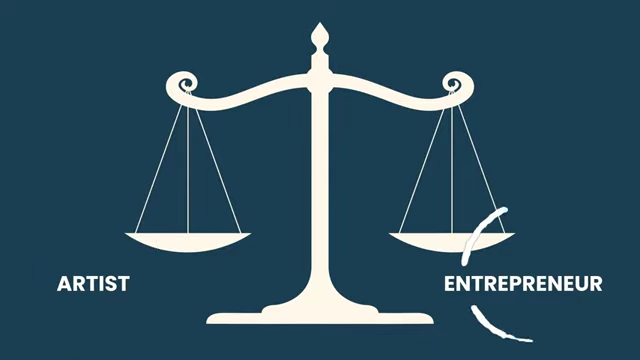
A scale balancing 'Artist' and 'Entrepreneur', signifying the creator's choice of focus. [ 00:01:32 ]
The 5 Channel Types and Why They Matter [01:50]
The video categorizes channels into five core types, each attracting audiences for different emotional reasons, which in turn influences monetization potential.
- 1. Entertainment Channels [01:51]:
- Reason: To entertain, allow audiences to be "brain dead," relax, and tune out of work.
- 2. Creative Expression Channels [02:01]:
- Reason: For audiences to experience something, be present, immersed, or moved by the act of creation.
- 3. Influencer / Lifestyle Channels [02:09]:
- Reason: For audiences to connect, aspire, relate to, or mirror a certain lifestyle.
- 4. Educational / Thought Leader Channels [02:20]:
- Reason: To provide clarity; audiences seek to understand, reframe, grow, and solve problems.
- Monetization Insight: Audiences are most likely to be buyers in these channels because they are looking to do something, not just passively consume.
- 5. News & Media Channels [02:32]:
- Reason: To inform; audiences follow to stay updated and aware.

A table listing the 5 core channel types and their corresponding reasons for audience engagement. [ 00:02:49 ]
- Reason: To inform; audiences follow to stay updated and aware.
The Fastest Monetization Path: Educational / Thought Leader Channels [02:40]
Educational and thought leadership channels are identified as the most direct route to monetization, especially for creators ready to embrace a business owner role.
- Audience Intent: Audiences for these channels are seeking clarity, new perspectives, and solutions to specific problems, making them prime buyers.
- Buyer Behavior: Unlike channels where audiences seek entertainment or connection, educational channel viewers are actively looking to take action.
- Monetization Strategies: This audience intent opens the door for controllable monetization strategies, such as hybrid and pure business models, which are more predictable than pure influencer models.

A flowchart showing different monetization strategies including Pure Influencer, Influencer Business Hybrid, and Pure Business, with their respective sub-categories like brand sponsorships, digital products, and high-ticket courses. [ 00:00:48 ]
What Hybrid Monetization Models Really Are [03:25]
Hybrid monetization models combine elements of influencer and business strategies, typically involving low-to-mid-ticket offers.
- Common Offers: These include low-ticket digital products, membership subscriptions, and low-to-mid-ticket courses.
- Perceived Benefits:
- Ease of Sale: Lower price points are thought to eliminate the need for complex sales systems or sales calls.
- Hands-off Delivery: The lower price suggests less post-delivery work, allowing for more passive sales.
- High Scalability: Perceived as highly scalable due to the first two points.
- Pricing Tiers:
- Low Ticket: $7-$150
- Mid Ticket: $150-$1,500
- High Ticket: $1,000-$25,000+

A graphic displaying price ranges for low, mid, and high-ticket products. [ 00:03:38 ]
Step 2: Understand Why Audience Size Determines Business Success [04:15]
The success of hybrid monetization heavily relies on having a substantial and active audience, as conversions don't happen magically.
- Minimum Audience Requirement: To sustain a hybrid monetization model, creators need at least 1,000 to 5,000 active audience members.
- Active vs. Passive: "Active" means regular viewers/fans, not just subscribers, typically equating to 20,000 to 100,000 monthly average views.
- Conversion Rates: Two key conversion rates impact revenue:
- View to Active Audience Member: Not every view translates to an active follower.
- Active Audience Member to Buyer: Not every active follower becomes a buyer.
- Example Conversion Rates: An average rate might be 5% from viewer to active audience, and 2% from active audience to buyer.

A funnel diagram illustrating the conversion process from viewers to active audience members to buyers, with example conversion rates of 5% and 2%. [ 00:05:27 ]
- Financial Math for Low-Ticket Offers [05:05]:
- Income Goal Example: To earn $5,000-$10,000 per month from a $50 digital product, you would need to sell 100-200 units.
- Required Audience/Views: With 5% view-to-active and 2% active-to-buyer conversion, this necessitates an active audience of 5,000-10,000, and 100,000-200,000 monthly average views across content.

A spreadsheet showing the required monthly views and active audience size to achieve income goals from a $50 digital product. [ 00:05:42 ]
- Why Creators May Struggle with Low-to-Mid Ticket Offers [06:09]:
- 1. Not Enough Active Audience Members: A high subscriber count doesn't guarantee an engaged, active audience. Creators must perfect their content experience to retain engaged viewers.
- 2. Feast and Famine Problem: Creators might achieve initial success with a low-to-mid-ticket launch, but then face "audience exhaustion" as they tap out their current buyer pool, leading to a drop in sales.
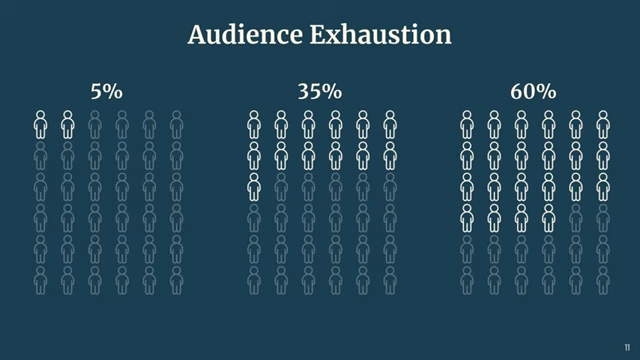
A diagram illustrating audience exhaustion percentages after product launches. [ 00:06:43 ] 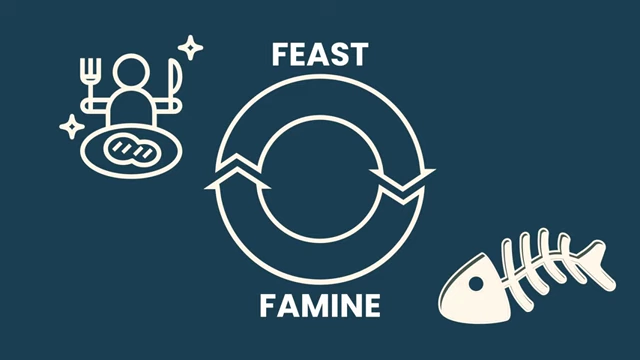
A diagram illustrating the "Feast and Famine" cycle, common with inconsistent content views. [ 00:06:49 ]
- Solution: Consistent views are crucial to keep the system running and attract new buyers, requiring focus on content and audience engagement.
Step 3: Your Niche TAM (Total Addressable Market) [07:30]
Even with consistent views, a creator's monetization potential is capped by their niche's Total Addressable Market (TAM).
- TAM Defined: TAM measures the maximum revenue opportunity for a product or service.
- Key TAM Questions:
- 1. Market Interest: How many people are even interested in this topic? (e.g., "underwater basket weaving" has a very small TAM).
- 2. Active Buyers: Of those interested, how many are actively buying solutions?
- 3. Willingness to Spend: If they are buying, how much are they willing to spend?

A funnel diagram illustrating different levels of buyers: Market Interest, Buyers $, and Buyers $$, emphasizing willingness to spend. [ 00:11:24 ] 
Wikipedia definition and images for "underwater basket weaving," used as an example of a niche with a very small Total Addressable Market (TAM). [ 00:07:56 ]
- Scaling Constraint: Niches with small TAMs will struggle to scale low-ticket offers, regardless of consistent views, especially for creators with higher income goals.
- The "Big 5" Markets [08:29]: These markets have the largest TAMs and highest buying intent:
- Personal Finance
- Fitness & Weight Loss
- Mental Health & Self-Improvement
- Dating & Relationships
- Business & Career Growth

A mind map showing the 'Big 5 Markets' with the largest Total Addressable Market (TAM): Personal Finance, Fitness & Weight Loss, Mental Health & Self-Improvement, Dating & Relationships, and Business & Career Growth. [ 00:08:26 ]
Why Some Channel Types Often Struggle to Monetize [09:20]
Certain channel types inherently attract more "watchers" than "buyers," making monetization more challenging for creators in those categories.
- Channels Attracting Watchers: Entertainment, Creative Expression, and News & Media channels typically draw audiences who seek to "just exist" – to experience, be informed, or be entertained, rather than to act or solve a problem.
- Lower Conversion to Buyer: For these channel types, the conversion rate from an active audience member to a buyer is likely to be even lower compared to educational channels.
- Artist vs. Business Owner: Creators face a critical decision:
- Artist Approach: Continue creating for expression's sake, accepting potentially limited income.
- Business Owner Approach: Be open to strategically shifting content to attract an audience more inclined to buy.

A scale balancing 'Artist' and 'Entrepreneur', signifying the choice creators face between creative expression and business focus. [ 00:09:38 ]
- Two Main Options for Income Growth [10:00]:
- Option 1: Volume, Large Audience (Become a Power Player):
- Good For: Channel types with more viewers than buyers (Entertainment, Creative Expression, Influencer/Lifestyle, News/Media).
- Strategy: Double down on generating massive traffic to offset lower conversion rates.
- Option 2: Go for a Different Audience (Reposition for Buying Markets):
- Good For: Audiences looking for solutions and clarity.
- Strategy: Lean into thought leadership and educational content to attract buyers.

A slide showing two options for creator monetization: Option 1 focuses on volume and large audience numbers to become a power player, suitable for channels with more viewers than buyers. Option 2 suggests going for a different audience by repositioning to target "buying" markets, usually through thought leadership and educational content. [ 00:10:05 ]
- Option 1: Volume, Large Audience (Become a Power Player):
Case Study 1: Become a Power Player Influencer [10:30]
The "Made with Lau" cooking channel exemplifies how to succeed by focusing on volume and becoming a power player within a niche that straddles creative expression and education.
- Channel Type Blending: Made with Lau combines elements of educational/thought leadership (teaching Chinese recipes) and creative expression (showcasing beautiful food).
- Mastering Views: They have excelled at consistently generating high views by mastering their content format, effectively driving traffic.
- Monetization Strategy: This volume allows them to easily leverage both pure influencer strategies (merch, sponsorships, affiliates) and hybrid models (low-ticket subscription like the "Kanto Cooking Club").
- TAM Advantage: Their success is bolstered by the large Total Addressable Market for cooking, particularly Asian cuisine, which makes the monetization math work despite potentially lower per-customer spending.
- Challenge with Mass Market: While successful, mass-market audiences (often beginners) are less likely to invest in high-ticket offers, so the strategy relies on high volume for low-to-mid-ticket sales.

Screenshot of the "Made With Lau" YouTube channel, showing their channel banner, subscriber count, and several cooking videos. [ 00:11:30 ]
Case Study 2: Reposition and Go After Buyer Markets [12:50]
Philip Lemoine demonstrates how repositioning content towards a buyer-centric market, even with a smaller audience, can lead to effective monetization.
- Creator Background: Philip Lemoine, with expertise in cinematography, could have created a pure creative expression channel showcasing his portfolio.
- Strategic Repositioning: Instead, he blended his passion for food with his cinematography skills to create a thought leadership channel.
- Content Shift: He teaches people how to create beautiful food content, rather than just showcasing his own. This targets aspiring food creators who are actively looking for solutions.
- Buyer-Focused Audience: This shift attracts a targeted pool of buyers who have a specific problem (how to film food) and are willing to invest money to solve it.
- Reduced Reliance on Volume: As a result, Philip Lemoine doesn't need millions of views because he's serving a niche with higher buying intent and spending power, enabling monetization without the "mega traffic game."

Screenshot of Philip Lemoine in his YouTube video, demonstrating how to shoot cooking videos on a phone. [ 00:15:29 ]
Recap [14:20]
To conclude, the optimal creator monetization strategy is a dynamic mix of your channel type, niche's Total Addressable Market (TAM), and current audience size with its conversion rates.
- Three Key Factors:
- Your channel type (e.g., educational vs. entertainment).
- The niche you operate in and its TAM (is it buyer-rich, and how much will they spend?).
- Your current audience size and the associated conversion rates (views to active audience, active audience to buyer).

A flowchart summarizing monetization paths based on whether a creator has traffic issues or significant traffic, and whether they should pursue pure business, hybrid, or low/mid-ticket models. [ 00:14:48 ]
- Educational/Thought Leadership Channels: If you have an educational/thought leadership channel with significant traffic (e.g., 20,000+ monthly views), you can likely succeed with low-to-mid-ticket hybrid offers. This requires consistent effort in maintaining views and ensuring your offer is not commoditized.

A table showing different conversion rate scenarios (Best Case, Good Case, Average Case, Low Case, Worst Case) for views to active audience and active audience to buyer, along with the overall conversion and notes on audience warmth and funnel quality. [ 00:14:40 ] - Other Channel Types / Low Traffic:
- If you struggle to get high views, consider pure business models (to be discussed in the next video).
- Creative expression channels can still make low-to-mid-ticket offers work through high volume (like Made with Lau).
- Alternatively, reposition your content to target a buyer market and lean into thought leadership, similar to Philip Lemoine, to monetize without needing massive traffic.