The Systemic Failure of the Soviet Computer Industry
The Soviet computer industry, despite early promise, ultimately failed due to a combination of systemic issues and poor strategic decisions.
- Early Promise and Political Interference: Initially, the USSR was a significant computing power, but political influence delayed digital computer development in favor of analog machines, while Ukraine's MESM proved digital feasibility.
- Internal Competition and Production Shortfalls: State-sponsored competition between the superior BESM-1 and the inferior STRELA, coupled with critical parts shortages orchestrated by rival ministries, hindered progress. Production lagged far behind the West, with the Soviet Union producing only $59 million in computer hardware in 1959 compared to America's $1 billion.
- Lack of Economic Incentive: The command economy disincentivized innovation, efficiency, and customer service for computer manufacturers, leading to a lack of demand and insufficient resource allocation.
- Delayed Adoption and Copying Strategy: The Soviets lagged behind in adopting second-generation transistor technology and, crucially, opted to copy the IBM System/360 for their third-generation Unified System (ES).
- Long-Term Consequences of Copying: This decision, made for short-term compatibility and political expediency, stifled native innovation, making the industry dependent on reverse engineering. As Western technology advanced, the gap widened and became permanent, leading to an aging, unreliable computer infrastructure vulnerable to export bans.
The Early Cold War Computing Landscape [00:00:01]
In 1986, the Soviet Union possessed only around 10,000 computers, starkly contrasting with America's 1.3 million, highlighting a significant and permanent computing gap.
- Initial Soviet Prowess:
- At the time of Stalin's death, the Soviet Union was the world's third most proficient computing power.
- The Soviet state supported science, industrial modernization, and had brilliant minds, evidenced by achievements like Sputnik and Venus landings.
- The Emerging Gap:
- By the 1960s, a computing gap between the US and the Soviet Union was already years long.
- Twenty years later, the gap was undeniable and permanent.
ITMVT and the First Soviet Computers [00:00:43]
News of the American ENIAC in 1948 spurred Soviet interest in computing, but initial efforts at the Institute of Precision Mechanics and Computer Technology (ITMVT) were misdirected.
- Early Soviet Reaction to ENIAC:
- In 1948, the Soviet Union learned about the ENIAC, the first general-purpose programmable computer in the US.
- Many Soviets dismissed the news as propaganda due to limited knowledge of its vacuum tube technology.
- Need for Enhanced Calculation:
- The nuclear weapons program, for example, required over 100 "calculator girls" working daily 8-hour shifts on manual calculations, highlighting a dire need for automation.
- Administrators were concerned about finding enough people to perform error-free complex calculations like differential equations.
- ITMVT's Misguided Direction:
- Established in 1948, the ITMVT initially focused on mechanical, analog calculating machines.
- This was largely due to the political influence of its director, General Nikolai Bruevich, who believed reliable electronic general-purpose computers were impossible in the near future.
- Many scientists disagreed, but dissent during the Stalin era was dangerous.
The MESM Breakthrough and BESM/STRELA Competition [00:02:25]
Sergey Lebedev's independent work in Ukraine led to the MESM, demonstrating the potential of digital computers and shifting the Soviet Union's computing strategy.
- Sergey Lebedev and the MESM:
- In 1948, Sergey Lebedev, director of the Kyiv Electrotechnical Institute, learned about American digital computer efforts.
- Lebedev, an electrical engineer and war hero, developed the Malaya Elektronno-Schetnaya Mashina (MESM) – "little calculating machine" – despite its large size (6,000 vacuum tubes, 60 square meters).
- In December 1951, MESM successfully solved a complex artillery calculation (250,000 calculations in 2.5 hours).
- MESM impressed future Soviet leader Nikita Khrushchev, which allowed scientists at ITMVT to depose Bruevich and pursue digital computers.

The MESM computer being operated by Sergey Lebedev's team in 1951. [ 00:03:00 ]
- The BESM-1 and STRELA Rivalry:
- The ITMVT began developing the Bolshaia Elektronno-Schetnaia Mashina (BESM-1), aiming for 8,000-10,000 operations per second (8-10 kiloFLOPS), which would have made it one of the world's fastest computers.
- Simultaneously, the Ministry of Machine and Instrument Engineering's SKB-245, originally for analog differential analyzers, developed its own digital computer, the STRELA (2 kiloFLOPS).

The BESM-1 computer, which was one of the world's fastest in the early 1950s but faced production hurdles. [ 00:04:10 ] - With Stalin's approval, both projects competed, hindering the BESM-1's progress.
- SKB-245's ministry refused to supply cathode ray tubes for BESM-1's memory, forcing the adoption of inferior mercury storage tubes.
- A 1951 state commission controversially chose STRELA over BESM-1, but STRELA proved unreliable and incapable of complex fission calculations, leading to demands for BESM replacements.
The Production Gap and Lack of Incentive [00:06:30]
Despite early scientific achievements, the Soviet computing industry suffered from a massive production gap and systemic disincentives inherent in its command economy.
- Massive Production Disparity:
- In 1959, the Soviet Union produced $59 million worth of computers, while the United States produced $1 billion.
- By 1964, the USSR produced 200 million semiconductor pieces, significantly less than the US's 1.36 billion.
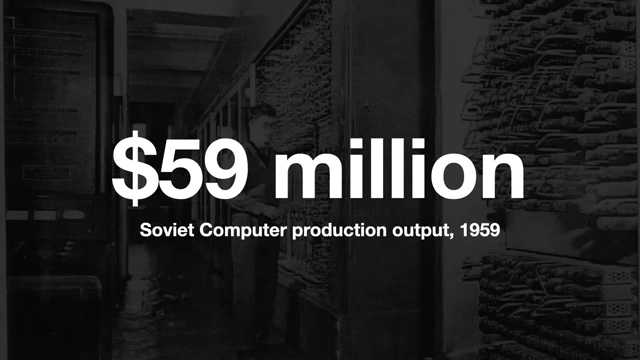
A graph showing the cumulative computer production output of the Soviet Union in 1959, valued at $59 million. [ 00:06:59 ]
- Command Economy Disincentives:
- The Soviet command economy failed to leverage the computer's potential, as industrial enterprises like steel makers only aimed to meet quotas, not improve efficiency or quality.
- Soviet computer makers lacked incentives to produce productivity-improving computers or provide necessary training and customer service.
- Ministers were reluctant to allocate limited resources to computer development, fearing risks to their quotas.
- Factories often lacked funding, materials, and skilled personnel; for instance, the Penza Computer Plant requested 50 experts but received only 7 in 1958.
- This was a recurring systemic problem, as the Soviets consistently lagged in diffusing new technologies across their economy, despite pioneering some innovations like steel-making and synthetic fibers.
The Second and Third Generations: Widening the Gap [00:09:15]
The transition to second and third-generation computing exposed critical weaknesses in the Soviet approach, leading to an irreversible technology gap.
- Second Generation Lag:
- In 1959, the West transitioned from vacuum tubes to transistors (second-generation), making computers smaller, more reliable, and powerful industrial tools.
- The IBM 1401 sold over 12,000 units, driving the development of peripherals and new programming paradigms.

The IBM 1401 Data Processing System, a widely successful second-generation computer in the West. [ 00:09:39 ] - The Soviets developed their own second-generation computers, notably the Ural series and the BESM-6 supercomputer (1 million operations/second), which entered production in 1967.
- While showing progress, by the time BESM-6 was widely adopted, the West was already moving to the next generation.

The BESM-6, the Soviet Union's first supercomputer, capable of over a million operations per second. [ 00:10:19 ]
- The Third Generation and the "Unified System" Decision:
- The third generation, based on integrated circuits, marked the definitive beginning of the US-Soviet computing gap.
- IBM's System/360, announced in 1964, revolutionized the industry with its compatibility and commercial success.

The IBM System/360, a revolutionary third-generation computer system that became a commercial success for IBM. [ 00:10:59 ] - Soviet newspapers like Izvestia and Pravda criticized the fragmented domestic computer industry, calling for centralization and acknowledging a "far from optimistic" situation.
- In 1967, the Communist Party issued Resolution 1180/420, establishing the Edinaina Sistema (ES) project to create a series of unified third-generation computers.
- This included a tenfold budget increase to 3 billion rubles by 1975, and plans to build 28 new plants and produce 20,000 computers.
The Momentous Decision to Copy and its Consequences [00:13:31]
The Soviet leadership's decision to copy the IBM System/360, driven by political expediency, had profound and ultimately detrimental effects on their computing industry.
- The IBM 360 Copying Strategy:
- The two ministries in charge opted to copy the IBM 360 design to ensure software compatibility.
- This was highly controversial, with some scientists warning it would make the USSR an "intellectual colony" and "bring the development of computer technology in our nation to an end."
- The US government forbade IBM from exporting 360 systems, forcing the Soviets to acquire technology through espionage or intermediaries, lacking proper documentation.
- Rejected Alternatives:
- ICL, a major British computer-maker, offered to share technology and documentation for its 360-compatible System-4 line, including specialists for co-development.
- This offered software compatibility, British programming methods, and industrial sovereignty.
- However, adopting ICL's offer would delay the project by at least 1.5 years, a politically unacceptable prospect given the existing gap and Brezhnev's focus on closing it.
- East Germany had already begun copying the IBM 360, making a change of direction politically difficult.
- Tragic Outcomes:
- The copying decision led to the resignation of several prominent computer scientists.
- Sergey Lebedev's efforts to reverse the decision reportedly hastened his death in 1974.
- Over 100 organizations and hundreds of thousands of workers across Eastern Bloc countries contributed to building the ES, often through reverse engineering.
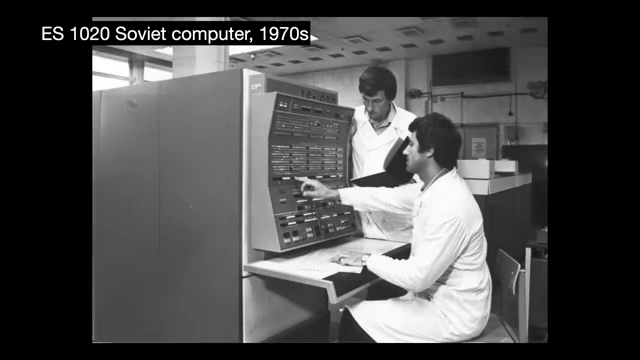
An ES 1020 Soviet computer from the 1970s, which was a reverse-engineered copy of IBM 360 technology. [ 00:17:18 ] - While 360-compatibility initially narrowed the gap (to 4-6 years by CIA estimates in the 1970s), this was a short-term gain.
- By the 1980s, the Soviets struggled to reverse-engineer increasingly complex Western computers, widening the gap permanently and losing native industrial capacity.
- Industrial productivity suffered as aging ES-1022 computers (based on 1965 technology) broke down frequently.
- Reliance on foreign technology also made the industry vulnerable to Western export bans during international crises.
Conclusion [00:18:07]
The decline of the Soviet computer industry serves as a critical case study in the limitations of centralized planning and strategic missteps.
- The Soviet computer industry failed due to wasted talents, lost progress, poor short-term political decisions overriding scientific advice, and the inherent limits of centralized planning.