Bryan Johnson's 'Don't Die' Longevity Movement: Philosophy for an AI Future and Its Challenge to Capitalism
Bryan Johnson, a wealthy entrepreneur, spearheads the "Don't Die" movement, a comprehensive longevity quest involving a strict health regimen (Blueprint protocol) and numerous experimental procedures. His philosophy centers on "survivalism," positing that humanity's ultimate goal in a future dominated by super-intelligent AI should be species survival, rendering traditional capitalist motivations obsolete. While the video's speaker finds some of Johnson's ideas ambitious yet plausible, particularly regarding AI-driven medical advancements, reservations exist about AI's impact on wealth distribution and the inaccessibility of Johnson's expensive lifestyle to the general public. Johnson faces criticism for perceived narcissism and the unproven efficacy of some of his extreme measures, yet his role as a "guinea pig" for humanity's longevity remains a point of interest, showcasing a dramatic personal transformation.
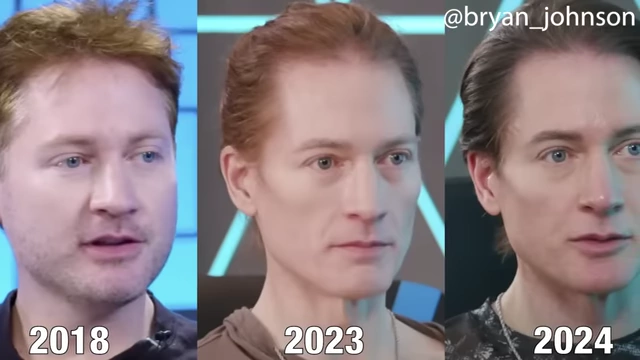
Bryan Johnson's Longevity Quest and Philosophy [00:00:00]
Bryan Johnson, a billionaire, is pursuing extreme longevity through an extensive health regimen and a new philosophy of life called "Don't Die."
Johnson's Extensive Health Regimen and Claims [00:00:07]
- He spends considerable wealth on experimental drugs and procedures to reverse aging and extend his lifespan.

Bryan Johnson with common longevity drugs like Rapamycin and Methylene Blue [ 00:00:10 ] - His "Blueprint" protocol involves a comprehensive supplement plan and various experimental treatments, including Botox injections and blood plasma replacement.

Bryan Johnson wearing a 'Don't Die' shirt while undergoing a blood draw, symbolizing his regimen [ 00:00:19 ] - Johnson claims to be the "healthiest person on the planet," asserting that his telomeres indicate a biological age of 10 years. [00:00:48]
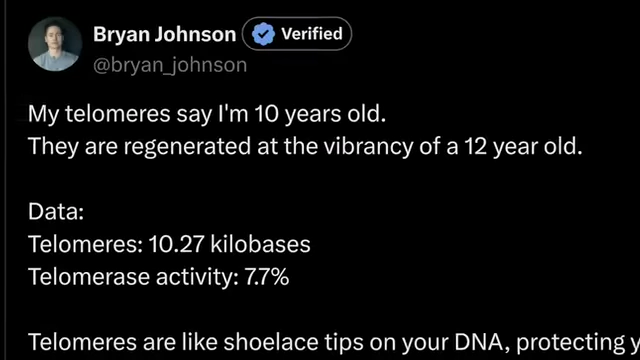
Bryan Johnson's tweet claiming his telomeres are 10 years old [ 00:00:50 ] - He publicly shares unconventional health metrics, such as the duration of his nighttime erections, with his recent record standing at 3 hours and 49 minutes. [00:00:54]

Bryan Johnson's tweet announcing a new record for his nighttime erection duration [ 00:01:00 ] - His ambitious long-term goal is to live long enough to witness the last Bitcoin halving in 2140, which is 115 years from the present. [00:01:01]
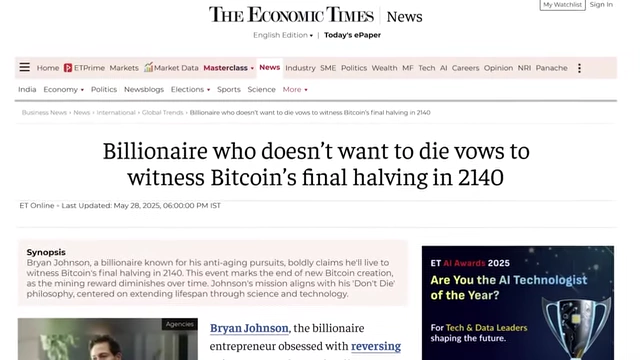
News headline reporting Bryan Johnson's vow to live until 2140 for Bitcoin's final halving [ 00:01:08 ]
- He spends considerable wealth on experimental drugs and procedures to reverse aging and extend his lifespan.
The "Don't Die" Movement and its Core Idea [00:01:17]
- "Don't Die" is presented as a movement that goes beyond individual health, advocating for the ultimate goal of species survival.

A crowd at an event with the 'Don't Die' logo displayed, symbolizing the movement [ 00:00:30 ] - Johnson criticizes human complacency regarding environmental contamination, work-life balance issues affecting sleep and exercise, and exposure to loud, bright, stressful, and unnatural living conditions. [00:01:24]
- He argues that society has accepted highly processed foods and other unhealthy practices as side effects of industrialization, neglecting the imperative to maintain health. [00:01:44]
- The movement seeks to inspire individuals to actively prevent the deterioration of their physical well-being. [00:02:07]
- "Don't Die" is presented as a movement that goes beyond individual health, advocating for the ultimate goal of species survival.
Johnson's Vision for a Post-AI World and Challenge to Capitalism [00:02:23]
- Johnson foresees artificial intelligence dramatically transforming the world, leading to a point where machines are more intelligent than humans.
- He believes that in this future, current societal systems like democracy and capitalism, which optimize well-being through profit, will become inadequate. [00:02:57]
- Johnson postulates that AI will render wealth irrelevant, making "don't die" the only rational and universal goal for humanity. [00:03:10]
- This philosophy, termed "survivalism," proposes measuring success by one's ability to survive, with health obsession serving as a quantifiable metric for living up to this new goal. [00:03:29]
- Johnson likens aging to the accumulation of errors in the body, which can be loosely interpreted as entropy increase, a process that can be locally reversed with sufficient energy. [00:05:09]
- The speaker concurs that, when considering the long-term prospects of any species, the ultimate goal inherently reverts to survival, aligning with Johnson's fundamental tenet. [00:06:35]
Critiques and Skepticism of Johnson's Approach [00:07:08]
Bryan Johnson's public persona and rigorous methods have elicited considerable criticism and skepticism from various quarters.
Public Perception: Narcissism, Inaccessibility, and Divisiveness [00:07:08]
- Johnson is often subjected to public derision, being labeled a scammer, snake oil salesman, narcissist, or someone experiencing a severe midlife crisis.

A graphic displaying 'Bryan Johnson Scammer' reflecting common public criticism [ 00:07:11 ] - His frequent social media updates, where he boasts about his superior biomarkers and health statistics, can be perceived as narcissistic or condescending, despite his stated intention to inspire. [00:07:36]
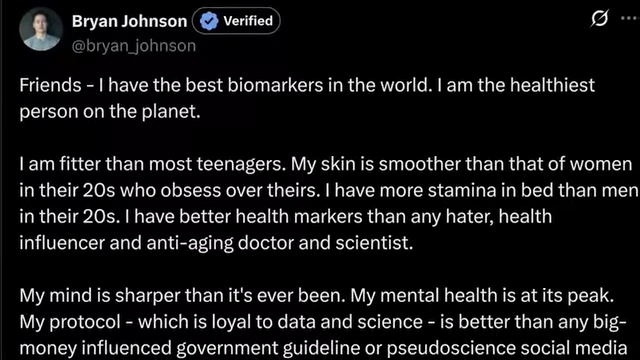
Bryan Johnson's tweet boasting about having the best biomarkers in the world and being 'fitter than most teenagers' [ 00:07:56 ]
- Johnson is often subjected to public derision, being labeled a scammer, snake oil salesman, narcissist, or someone experiencing a severe midlife crisis.
Financial Barriers and Lifestyle Demands [00:08:41]
- A significant source of public resentment stems from the fact that Johnson's highly structured and expensive lifestyle is unattainable for the majority of people.
- His protocol requires a very restrictive diet, extensive exercise, and strict sleep hygiene, which is challenging for individuals balancing demanding jobs (e.g., cardiologists working night shifts) or family responsibilities (e.g., caring for infants). [00:08:55]
- Many of the advanced treatments he employs, such as rapamycin, metformin (used off-label under supervision), total plasma replacement, stem cell therapies, and hyperbaric oxygen therapy, are costly and not readily accessible to the average person. [00:09:59]

Bryan Johnson after completing a total plasma exchange procedure [ 00:00:45 ] - This creates a narrative that extreme longevity might become exclusive to the wealthy, leading to widespread dismay. [00:10:20]
Scientific Validity of Biomarkers and Longevity Claims [00:11:05]
- There is scientific skepticism regarding the actual efficacy of Johnson's efforts in achieving significant longevity or reversing biological aging.
- While some biomarkers like blood glucose and liver values are established health indicators, the significance of others, such as telomere length, in predicting lifespan is less clear. [00:11:33]
- An example cited is a woman who lived to 117 years old despite having exceptionally short telomeres, suggesting that telomere length may not be a definitive indicator of health or longevity. [00:12:00]
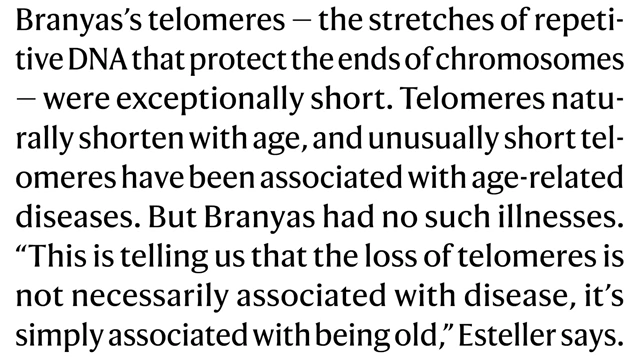
Text from an article describing a 117-year-old woman with exceptionally short telomeres, questioning the definitive link to health [ 00:12:12 ] - It remains uncertain how much of Johnson's apparent health and youthfulness is attributable to his interventions versus genetic predispositions or his previously sheltered life. [00:12:21]
- His improved facial appearance might also be partly due to cosmetic procedures, including various facial treatments to remove sun damage, increase collagen, and fat transfers, rather than solely biological age reversal. [00:12:34]

Syringes containing donor's fat being prepared for a facial fat transfer procedure on Bryan Johnson [ 00:12:49 ] - He also had an allergic reaction to one of his facial procedures. [00:12:50]

Bryan Johnson's face swollen after an allergic reaction to a cosmetic procedure [ 00:12:51 ]
The Speaker's Perspective and Broader Implications [00:13:10]
The speaker expresses broad agreement with Bryan Johnson's underlying ideas about human longevity and the future, while also highlighting key disagreements and broader societal considerations.
Agreement on AI's Impact and Potential Medical Advances [00:13:10]
- The speaker agrees that super-intelligent AI will likely accelerate medical progress, potentially leading to rapid advancements in treatments, such as the ability to regrow and replace worn-down organs. [00:13:22]
- The concept that humans must age is not a fundamental scientific truth; preventing the buildup of entropy is possible with sufficient energy. [00:13:50]
- It is plausible that effective longevity treatments will be discovered by scientists within the next decade. [00:13:57]
Disagreement on Wealth Irrelevance in an AI Future [00:05:53]
- The speaker disagrees with Johnson's prediction that AI will make wealth irrelevant, instead projecting that AI will further concentrate power and wealth in the hands of the affluent in the near future.
- Economists would likely argue that if survival becomes the primary goal, a market for products and services supporting this goal would naturally emerge, thereby sustaining or even reinforcing capitalism. [00:06:07]
The Value of Johnson's Experimentation [00:14:32]
- Johnson's health obsession is a recent development, starting a few years back after being overweight and living off junk food for the first 45 years of his life. [00:10:46]
Before-and-after comparison of Bryan Johnson's appearance from 2018 to 2024 [ 00:10:53 ] - Despite the criticisms, Johnson is viewed as a "guinea pig" who is inspiring a significant re-evaluation of human potential for longevity.
- He measures unusual biomarkers as part of his extreme experimentation. [00:11:26]

Bryan Johnson's tweet revealing a high concentration of microplastics in his ejaculate [ 00:11:28 ] - While reaching an age like 200 years may be improbable, optimizing nutrition and biomarkers could extend lifespan or mitigate age-related problems, potentially allowing individuals to live long enough for future AI-driven medical breakthroughs, or even "merge with an AI." [00:14:41]
- Johnson's health obsession is a recent development, starting a few years back after being overweight and living off junk food for the first 45 years of his life. [00:10:46]