Tatsuo Suzuki's Tokyo Street Photography: Style, Collective Work, and the Fujifilm Controversy
This video delves into the work of Tatsuo Suzuki, a Tokyo street photographer known for his raw, high-contrast black and white images.
- He captures the "friction and frustration" of Tokyo, influenced by figures like Robert Frank and Daido Moriyama.
- His acclaimed photo book "Friction/Tokyo Street" [2020] showcases 150 emotion-driven close-ups of people.
- Suzuki self-published six "Tokyo Street" zines, which explore his connection between photography, music (especially beatrock), and the inseparability of a photographer's personality from their art.
- He co-founded VoidTokyo, a collective aiming to publish printed work from online photographers, documenting Tokyo from diverse perspectives.
- Suzuki faced controversy when a Fujifilm ad for the X100V was criticized for his seemingly "abrasive" shooting style, leading Fujifilm to pull the ad.
- He has since reflected on his methods, emphasizing respect for subjects and a shift away from his former "aggressive" style to deepen his expression.

A man in glasses looks directly at the viewer amidst a blurred, moving crowd [ 00:00:01 ]
Introduction [0:00]
The video introduces Tatsuo Suzuki, a Tokyo street photographer whose work, described as "friction and frustration," prompts viewers to reconsider modern street photography. His high-contrast, black and white images connect him to a lineage of influential photographers like Daido Moriyama. Suzuki has also founded his own collective, VoidTokyo, and navigated a significant controversy involving Fujifilm, yet continues to produce distinctive work.

Who is Tatsuo Suzuki? [1:12]
Tatsuo Suzuki, born in Tokyo, began photographing the city and surrounding areas in 2008.
- He describes feeling "floating on the streets" despite living there.
- Transitioned from a law background to photography as a hobby with the advent of practical DSLRs.
- His career began serendipitously after a candid shot of a seller, realizing his desire to capture such moments.
- Signature Style: Characterized by an "in-your-face" approach, always black and white, and driven by raw emotion, aiming for a harmony between chaos and serenity.
- He believes his style expresses his feelings and should speak more than words.
- Black and white essentiality is crucial for conveying deep emotions and stimulating imagination.

A smiling man with a disheveled haircut in a close-up black and white street portrait [ 00:01:20 ] 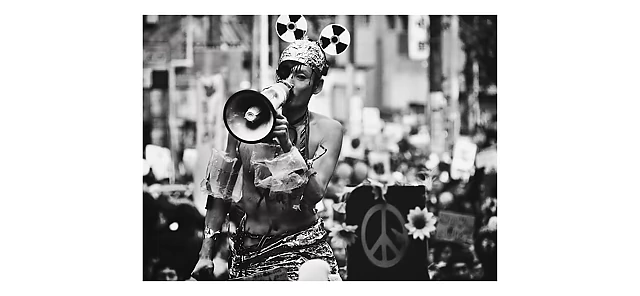
A woman with a megaphone and radiation symbol ears in a striking street protest scene [ 00:01:14 ]
Friction/Tokyo Street [2:23]
Released in 2020, "Friction/Tokyo Street" is Suzuki's most celebrated work to date.
- Artistic Intent: Suzuki aims to express the inherent tension, frustration, and atmosphere of the city through his own eyes.
- He captures mundane aspects of daily life with a strong personal voice across 150 images.
- Acclaim and Influence:
- The limited-run book is highly sought after, selling for roughly 10 times its original price.
- Influenced by Robert Frank's "The Americans," showcasing Tokyo in a similarly fluid, haphazard visual style.
- Bears influence from Daido Moriyama and William Klein, whom Suzuki cites as major impacts.
- Won the prestigious Steidl Book Award Japan, established in 2016.
- Creative Process: Suzuki emphasizes spontaneity and intuition, allowing him to encounter "special scenes" by following his feelings while walking through Tokyo.
- He considers the "hustle, noise, tension, loneliness" of the city, alongside inherent beauty.
- The book primarily features close-ups of people, reflecting his draw to emotions.
- His 25 years as a salesman informed his photography, seeing his own repressed emotions mirrored in the exhausted faces on Tokyo streets.
- He states that his work captures the intersection of his environment, emotions, and upbringing with Tokyo's bustling atmosphere, which creates a sense of tension.

A black and white street photograph depicting a person on a leash being led by another person through a busy street [ 00:02:00 ] 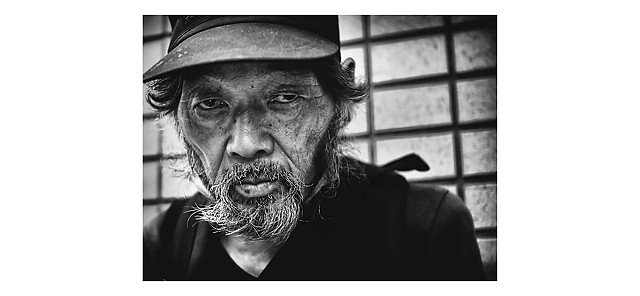
A man with an intense gaze and a cap looks directly at the viewer [ 00:03:23 ]
Tokyo Street Zines [4:33]
Tatsuo Suzuki has published six zines titled "Tokyo Street," with issue 6 being the final installment.
- Content and Format: Each issue includes a set of small prints and a poster, featuring an image on one side and Suzuki's reflections on the other.
- Issue 1 - Music and Shibuya:
- Music and Shibuya are primary influences.
- Shibuya's record stores and music venues highlight the connection between street culture and location.
- He connects to the rock subgenre "beatrock," which he feels expresses the alienation in the city through the "bustle, irritation, and nervousness of passengers and pedestrians."
- Initial ambitions were a monthly zine and more street portraits.
- Issue 2 - Dreams and Resonance:
- Features a reflection from a fellow photographer on the difficulty of fulfilling dreams in Tokyo.
- Suzuki's work stands out by accomplishing his dream, resonating due to three factors: being set in Tokyo, conveying the present moment, and connecting with people.
- Issue 3 - Photography and Music Parallel:
- Suzuki draws a further connection between photography and music, citing punk rock, New Wave, beatrock, free jazz, blues, garage rock, dub, and pop as influences.
- The emotions conveyed in these genres are similar to those in his photos.
- Key difference: Photography can manipulate time and sequence images in ways music cannot.
- He argues that the photographer's personality and their photos are inseparable, much like music shapes identity.
- Issues 4 & 5: Reflections from these issues will be discussed in the Fujifilm Controversy section.
- Issue 6 - "Ending is Beginning": The final issue's subtitle suggests new projects. The zine series was initially intended as a year-long project, extended due to the pandemic.

A black and white image of an older man with long, windblown hair and beard smiling [ 00:03:50 ] 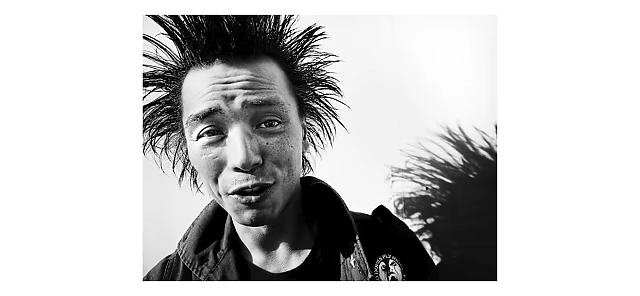
A man with spiky hair and a punk rock aesthetic looks intently at the camera [ 00:05:32 ]
VoidTokyo [7:57]
VoidTokyo, a photography collective, was founded by Tatsuo Suzuki in 2017 and has released eight zines.
- Mission and Impact:
- Aims to explore "what kind of world do we live in now" through collective photographic work.
- Had a gallery showing in Ginza in summer 2023, titled "Sharaku," which Suzuki suggests relates to sharing images from multiple perspectives.
- Objective: To transition photographers who mainly exist online into publishing printed versions of their work, including multiple photographers' work in each zine.
- Selection Criteria: Suzuki approached photographers interested in his work who were active online but lacked opportunities for exhibitions or photo book publications.
- Philosophy: To collectively photograph Tokyo and preserve these images on paper, countering the ephemeral nature of online content.
- Membership and Style:
- Composed of 11 members, mostly photographing in black and white.
- Each photographer employs a distinct style to capture different aspects of Tokyo (architecture, people, textures, abstract elements).
- The overarching subject for the entire group's work is Tokyo itself, viewed from their diverse perspectives as the city undergoes constant change.

A black and white image of a woman in glasses, looking intently towards the viewer, with blurred figures in the background [ 00:08:30 ] 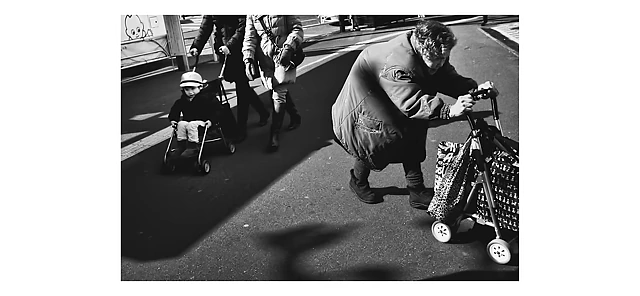
An elderly woman pushing a shopping cart alongside a child in a stroller on a Tokyo street [ 00:09:54 ]
FujiFilm Controversy [10:07]
Tatsuo Suzuki faced significant backlash and was "cancelled" by some after a Fujifilm ad campaign promoting him and the X100V camera.
- The Incident: Viewers were shocked by his "abrasive" shooting conduct in the video, leading to its deletion within half a day and Fujifilm dropping him as a brand ambassador.
- Suzuki's Prior Stance on Ethics:
- Emphasized paying "utmost attention" to ensure subjects are not demeaned.
- Photographs with an "open posture" to make it clear he's shooting.
- Excludes images if subjects appear uncomfortable or avoid the camera, even if already shot.
- Removes photos that might "work against" a subject, with rare exceptions.
- Acknowledges his decisions are subjective but always strives to photograph with respect.
- Changes in Technique Post-Controversy:
- During the pandemic, he maintained distance and lost interest in the "abrasive" style.
- After "Friction/Tokyo Street," he felt he had exhausted that style and wanted to expand his expression, avoiding "unnecessary self-replication."
- Perspectives from Supporters:
- Lino (Samuel Streetlife): While his approach might look aggressive, Suzuki is considerate, apologizes for discomfort, and is aware of consequences.
- Ulys Zoki: The controversial video showed only a portion of his shooting style; other footage shows him smiling and interacting. The incident made candid photographers rethink ethics and their relationship with society and companies.
- Kenji Takazawa's Reflection (Tokyo Street Zine Issue 5):
- A single photo can be taken out of context. A large body of work provides enough information to determine if a subject is portrayed artistically or negatively.
- Street photography becomes art when the photographer takes full liability for their expression.
- Suzuki blurs the lines between reality and fiction by mixing street snaps with model photographs, challenging the myth of "unconscious expression" and addressing "snap-phobia."
- Suzuki's Own Account (Tokyo Street Zine Issue 4):
- His excitement over being the only Japanese photographer selected for the Fujifilm video made him more aggressive than usual.
- He considered the negative outcome "inevitable."
- Since the incident, he continues to shoot, has received no complaints, and maintains his ethical selection process by not developing or selecting uncomfortable/unethical photos.
- He contemplates deeply on "ambivalent" photos, taking full responsibility for chosen images.
- He briefly stopped shooting due to the situation but affirms that "continuing to shoot is my life." He remains committed to finding respectful ways to express his subjects through street photography.
- Conclusion: While debate exists, Suzuki's statements and testimonials suggest no malicious intent. The situation offers a lesson for photographers to care for subjects as much as the photographs themselves, and to portray people artistically.

A busy street crossing with a man in a full tiger-print costume and face paint, with many blurred people around him [ 00:11:00 ] 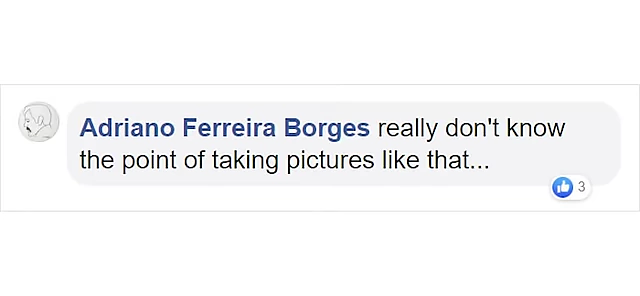
A screenshot of a Facebook comment questioning the point of taking pictures like that [ 00:12:49 ] 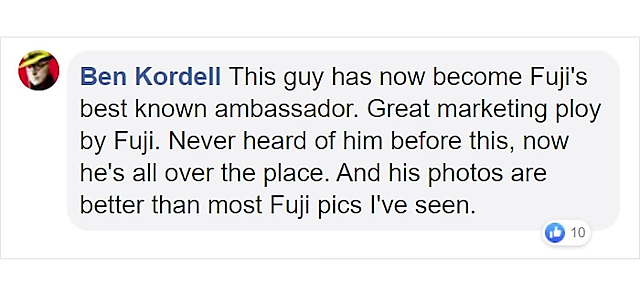
A screenshot of a Facebook comment stating the photographer became Fuji's best-known ambassador, improving his visibility [ 00:12:58 ]