Analyzing the AI Market: Are Current Valuations and Investments a Bubble Like the Dot-Com Crash?
The AI market is displaying characteristics of a potential bubble, drawing parallels to the dot-com era with soaring company valuations and significant investments despite many AI firms currently operating at a loss. Key concerns include massive spending by unprofitable companies, circular financing deals, and questions about future demand and infrastructure bottlenecks. However, critical differences exist, such as stronger financial backings for major tech players, less extreme overall market valuations compared to the dot-com peak, and performance-based investment deals.
Growing Concerns of an AI Bubble [0:00]
The rapid advancements in generative AI since ChatGPT's launch three years ago have led to a "golden age" of artificial intelligence, but also a growing concern that the market is in a bubble, reminiscent of the dot-com crisis of 2000.
- Evidence of Bubble Allegations [0:31]
- A Bank of America survey found 54% of global fund managers believe AI is in a bubble, with the IMF and Bank of England warning about soaring valuations.

Bank of America survey showing 54% of investors believe AI is in a bubble [ 00:00:40 ] - Investor Michael Burry (known for shorting the 2008 housing market) has taken a short position against key AI companies.

Headline: Michael Burry Returns With Two Big Shorts: Palantir and Nvidia [ 00:00:55 ] - Sam Altman, CEO of OpenAI, has also admitted to being in a bubble.
- A Bank of America survey found 54% of global fund managers believe AI is in a bubble, with the IMF and Bank of England warning about soaring valuations.
- Overvalued and Unprofitable Companies [1:05]
- Investors are pouring money into a new technological revolution, pushing CAPE ratios to dot-com bubble levels.
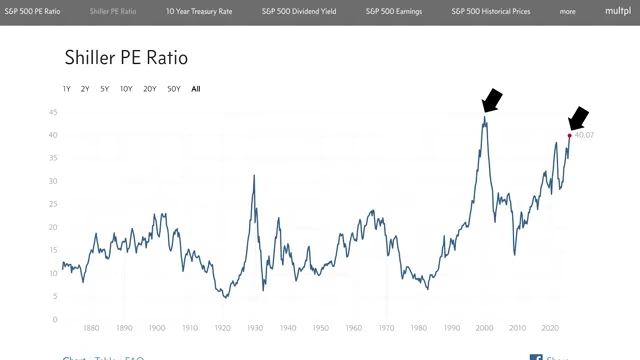
Shiller PE Ratio (CAPE Ratio) showing current valuations approaching dot-com bubble levels [ 00:01:17 ] - OpenAI, creators of ChatGPT and Sora, was recently valued at $500 billion despite only $10 billion in annual revenue and significant losses.

Headline: OpenAI hits $500 billion valuation after share sale to SoftBank, others [ 00:01:30 ] - OpenAI is projected to target $13 billion in revenue and $8.5 billion in losses for 2025, with estimated spending of $115 billion through 2029.

OpenAI's projected full-year revenue target and cash-burn target for 2025 [ 00:04:33 ] - They are even losing money on their $200/month subscriptions due to higher-than-expected usage.
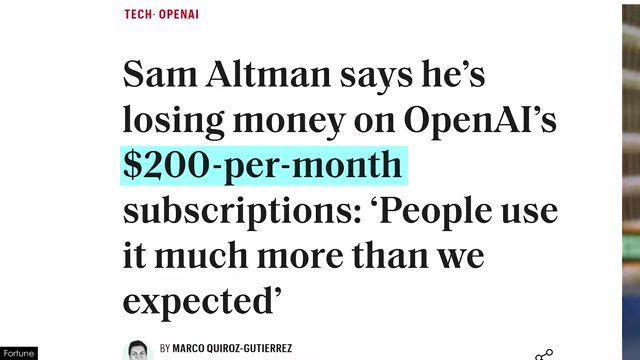
Headline: Sam Altman says he's losing money on OpenAI's $200-per-month subscriptions [ 00:04:48 ]
- Investors are pouring money into a new technological revolution, pushing CAPE ratios to dot-com bubble levels.
- Massive Scale of Investment and Circular Funding [4:03]
- OpenAI plans to build out an additional 26 gigawatts of data center capacity and has committed to around $1.5 trillion in AI deals.
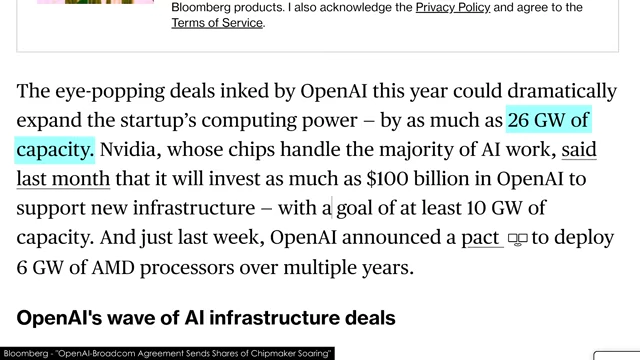
Bloomberg article detailing OpenAI's plan to build up to 26 GW of data center capacity [ 00:05:11 ] - This includes Project Stargate ($500 billion for US data centers), a $300 billion deal with Oracle for compute power, and deals to buy chips from Nvidia ($500 billion) and AMD ($300 billion).

Financial Times article detailing OpenAI's multi-billion dollar deals with Nvidia, AMD, and Oracle [ 00:05:33 ] - McKinsey estimates that data centers will need nearly $7 trillion in capital expenditures by 2030 to meet AI demand, which is roughly one-fifth of America's total capital expenditures across all industries in 2024.
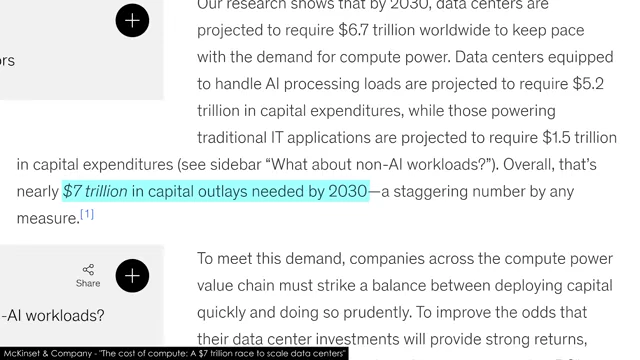
McKinsey estimate of nearly $7 trillion in capital outlays needed by 2030 for data centers [ 00:06:16 ] 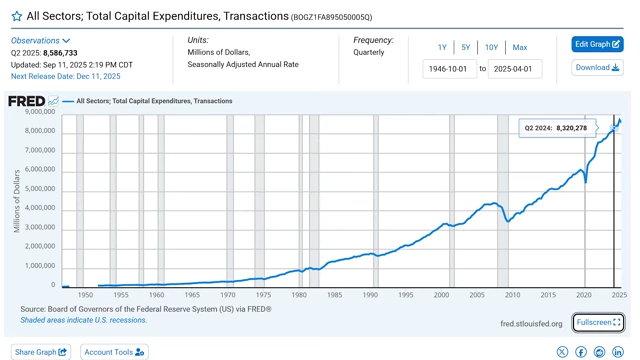
Graph of US Total Capital Expenditures across all sectors, showing rapid increase [ 00:06:31 ] - Venture capitalists have poured nearly $200 billion into AI startups this year, with over half of total VC investments going into the space.
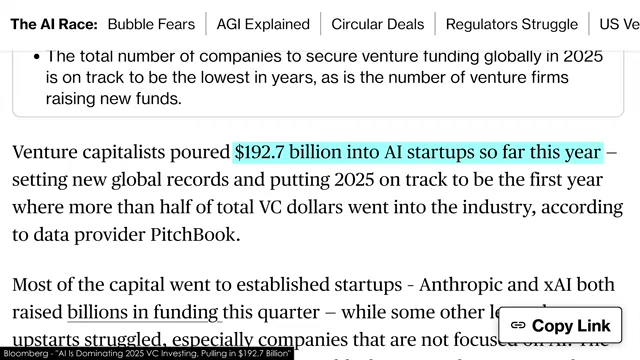
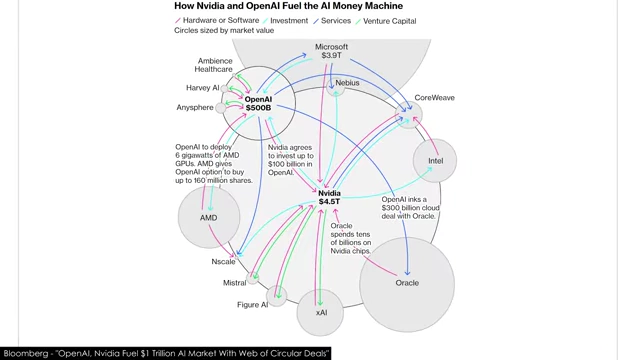
Bloomberg article reporting venture capitalists poured $192.7 billion into AI startups [ 00:07:03 ] - The "circular financing" chart illustrates how companies like Nvidia invest in AI companies (e.g., OpenAI, CoreWeave) that then purchase their chips or services. [7:10]
Diagram illustrating circular financial relationships in the AI ecosystem [ 00:01:49 ] - This raises concerns that Nvidia might be overstating profits by effectively selling products at a discount through customer investments.
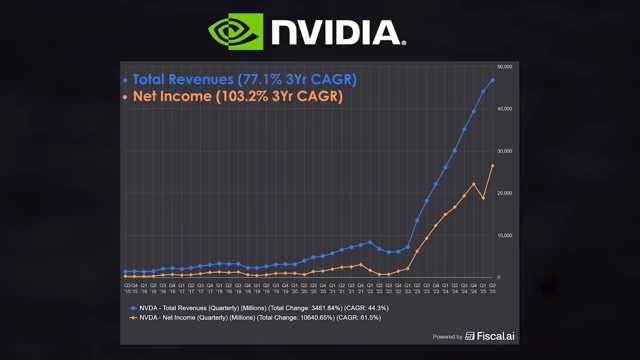
Nvidia's Total Revenues and Net Income showing significant growth from 2022 to 2025 [ 00:03:10 ] - Vendor financing and AI companies borrowing billions, using chips as collateral, further suggest unsustainable demand.
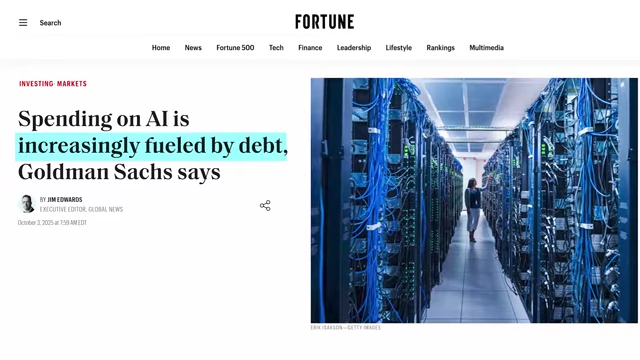
Headline: Spending on AI is increasingly fueled by debt, Goldman Sachs says [ 00:09:40 ]
- OpenAI plans to build out an additional 26 gigawatts of data center capacity and has committed to around $1.5 trillion in AI deals.
- Questions of Demand and Profitability [9:57]
- Bain & Company estimates AI companies will need $2 trillion in annual revenue by 2030 to be profitable, which is more than the combined 2024 revenue of Microsoft, Meta, Alphabet, Amazon, Apple, and Nvidia.
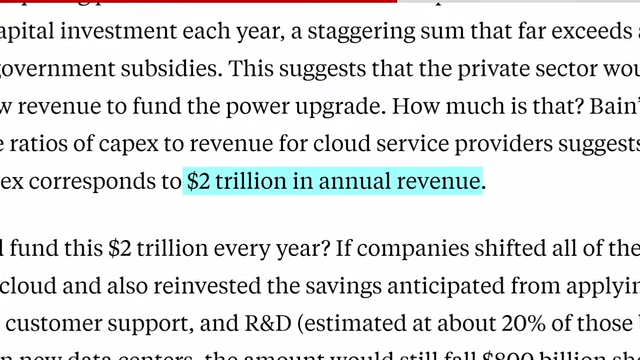
Bain & Company's estimate that AI companies need $2 trillion in annual revenue by 2030 to be profitable [ 00:10:04 ] - While 88% of companies use AI and ChatGPT has 800 million weekly active users, only about 6% are paying subscribers.
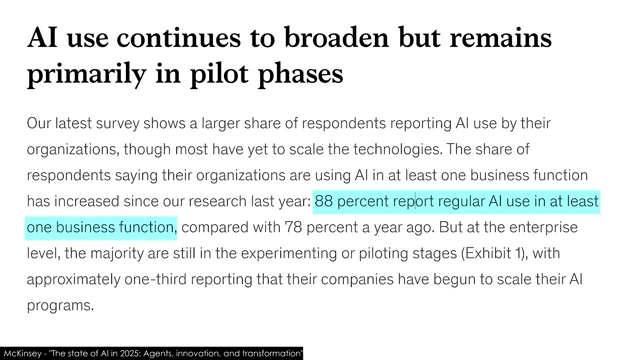
McKinsey report showing 88 percent of organizations report regular AI use in at least one business function [ 00:10:27 ] 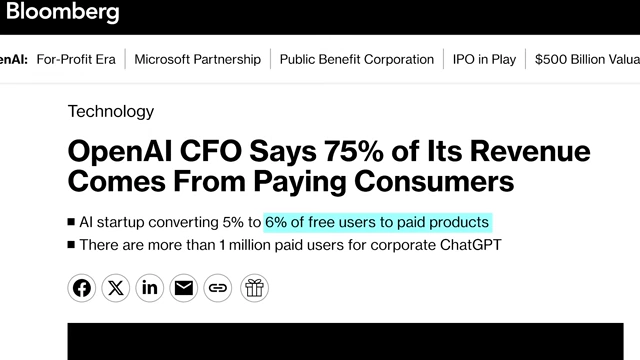
Bloomberg article stating OpenAI CFO says 5% to 6% of its revenue comes from paying consumers [ 00:10:43 ] - 61% of companies using AI currently don't see an enterprise impact on earnings before interest and taxes (EBIT).
- Citi estimates AI revenue will reach $780 billion by 2030, less than half of what Bain estimated for the industry to break even.
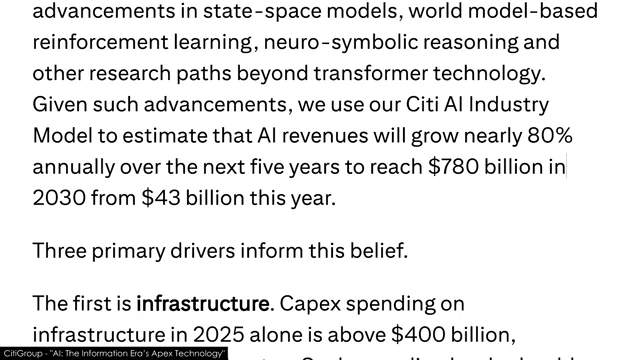
Citi AI Industry Model estimating AI revenues will reach $780 billion in 2030 [ 00:10:57 ]
- Bain & Company estimates AI companies will need $2 trillion in annual revenue by 2030 to be profitable, which is more than the combined 2024 revenue of Microsoft, Meta, Alphabet, Amazon, Apple, and Nvidia.
- Bottlenecks and Market Concentration [11:17]
- Electricity supply is a major bottleneck; building new power infrastructure takes years, and regulatory hurdles are significant.

NPR article headline: Three Mile Island nuclear plant will reopen to power Microsoft data centers [ 00:11:39 ] 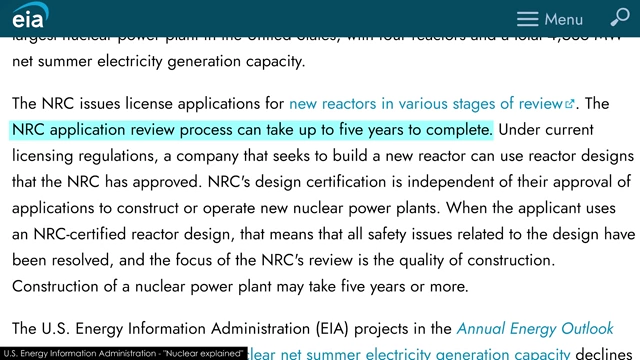
EIA text stating NRC application review process can take up to five years to complete for nuclear reactors [ 00:11:46 ] 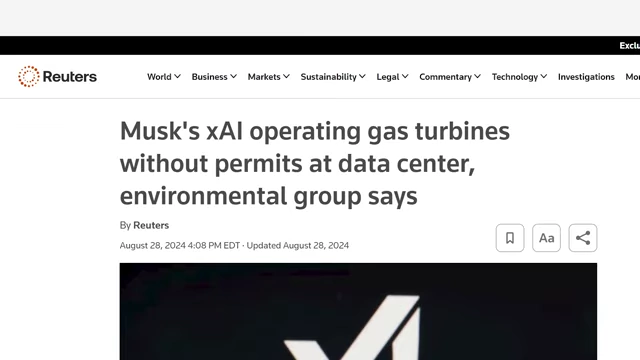
Reuters headline: Musk's xAI operating gas turbines without permits at data center [ 00:11:59 ] - The estimated lifetime of data center hardware is debated, with some arguing that rapid chip advancements mean shorter replacement cycles, leading to higher undeclared replacement costs.
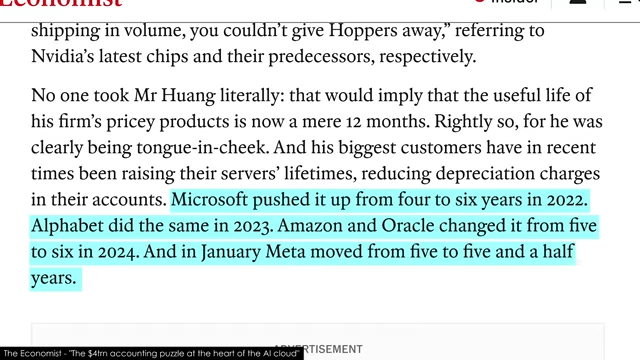
The Economist article highlighting major tech firms raising their server lifetimes from 4-5 to 6 years [ 00:12:16 ] - The AI industry is highly concentrated: 35-36 companies account for 99% of AI token spending, and 10 companies (mostly AI-related) make up 40% of the S&P 500's weight. The failure of one of these companies could have significant market impact.

Groq CEO statement that 35-36 companies are responsible for 99% of AI token spending [ 00:12:38 ] 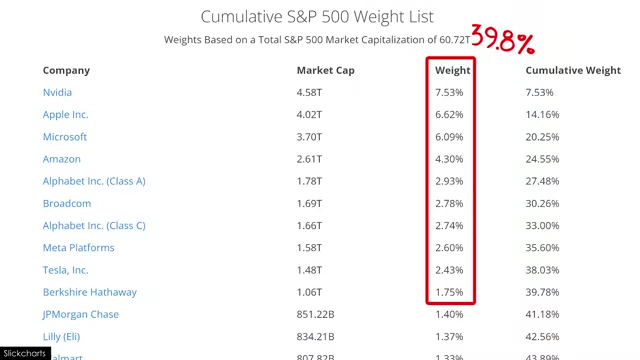
Cumulative S&P 500 Weight List with AI-related companies dominating the top positions [ 00:12:46 ] - OpenAI's deal announcements have added hundreds of billions to market values of companies like Broadcom, Nvidia, and AMD.
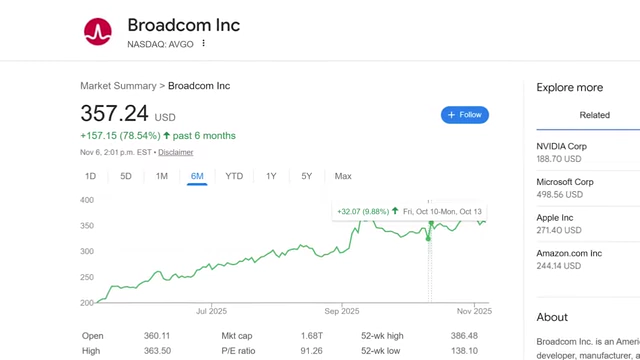
Broadcom Inc. stock chart showing a significant increase in value [ 00:13:11 ]
- Electricity supply is a major bottleneck; building new power infrastructure takes years, and regulatory hurdles are significant.
- Historical Parallels to the Dot-Com Bubble [13:31]
- Private domestic investment in IT as a percentage of GDP is back to dot-com bubble levels.
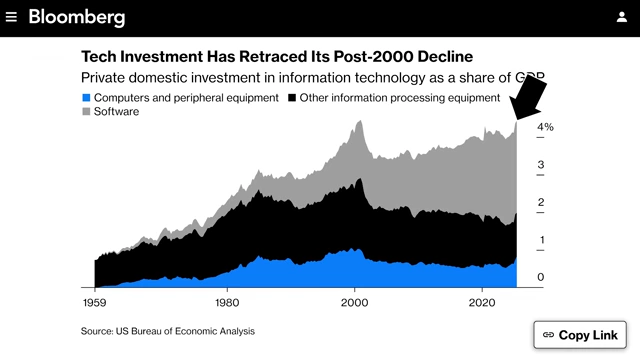
Bloomberg chart showing Tech Investment as a share of GDP, returning to post-2000 decline levels [ 00:13:40 ] - The internet revolutionized lives but also led to an 80% NASDAQ collapse, as many unprofitable startups failed.
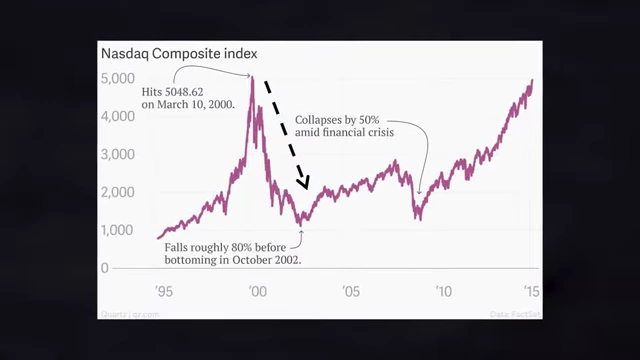
NASDAQ Composite Index showing a sharp peak in 2000 followed by an 80% collapse [ 00:13:57 ]
- Private domestic investment in IT as a percentage of GDP is back to dot-com bubble levels.
Key Differences from the Dot-Com Bubble [14:10]
Despite the parallels, there are several key differences that distinguish the current AI situation from the dot-com bubble.
- Valuations Are Less Extreme [14:24]
- While the CAPE ratio is high, the more basic trailing P/E ratio for the S&P 500 is around 30 times, compared to 46 times during the dot-com peak, indicating less extreme overvaluation.

S&P 500 PE Ratio chart showing current levels around 30x compared to 46x during dot-com peak [ 00:15:05 ] - S&P 500 companies are generating three times the cash flow relative to their valuations compared to 2000.
- There are nearly half as many unprofitable technology companies today (19%) compared to 36% in 2000.

Graph comparing the percentage of unprofitable tech companies in the dot-com era vs. Q3 2025 [ 00:15:38 ] - Many AI startups are backed by highly profitable, financially strong tech companies with substantial cash reserves and little debt.

Chart showing Cash And Equivalents for major tech companies like Nvidia, Meta, Alphabet, Amazon, Apple, and Oracle [ 00:15:57 ]
- While the CAPE ratio is high, the more basic trailing P/E ratio for the S&P 500 is around 30 times, compared to 46 times during the dot-com peak, indicating less extreme overvaluation.
- Context of Circular Dealings [16:17]
- Nvidia's investments in the AI ecosystem can be seen as a strategic move to incubate future customers and ensure demand for its chips, especially given its massive free cash flow.
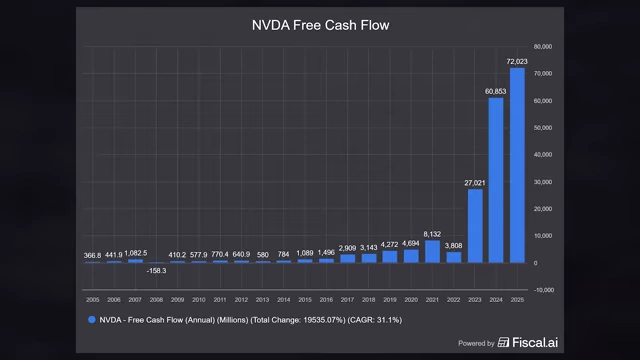
Nvidia's Free Cash Flow showing a massive increase from 2022 to 2025 [ 00:16:37 ] - These arrangements are not dollar-for-dollar and vendor financing represents only a fraction of overall AI spending.
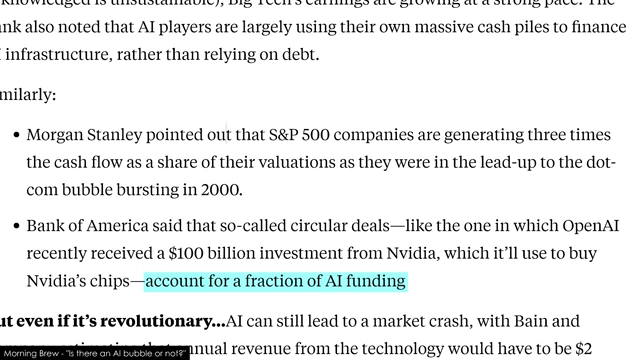
Morgan Stanley report excerpt: Bank of America said that so-called circular deals account for a fraction of AI funding [ 00:17:34 ] - Many larger future financing deals with OpenAI are performance-based, meaning funds are contingent on achieving certain milestones, mitigating some risk.
- Nvidia's investments in the AI ecosystem can be seen as a strategic move to incubate future customers and ensure demand for its chips, especially given its massive free cash flow.
- Improved Regulations and Economic Environment [17:37]
- Reporting standards have improved since the post-dot-com and Enron fraud crises, potentially reducing the likelihood of widespread accounting fraud.
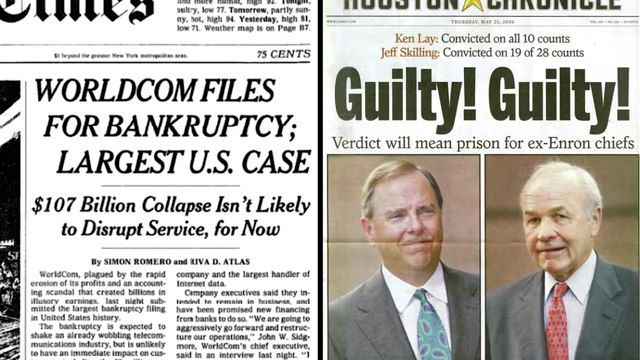
Newspaper clippings showing WorldCom and Enron fraud headlines [ 00:17:47 ] - The current economic environment differs, with the Federal Reserve potentially on a downward interest rate trajectory, whereas rising rates contributed to the dot-com bubble's collapse.
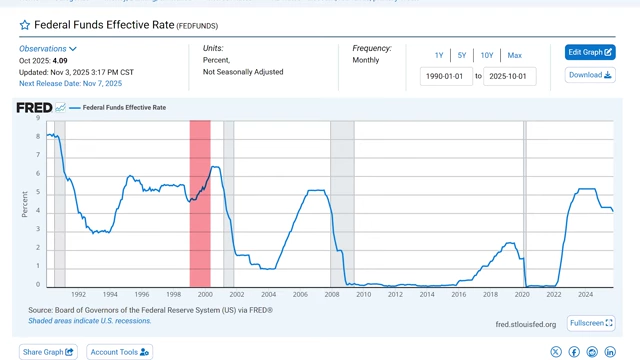
Federal Funds Effective Rate chart showing interest rate trends [ 00:18:08 ]
- Reporting standards have improved since the post-dot-com and Enron fraud crises, potentially reducing the likelihood of widespread accounting fraud.
- OpenAI's Scaling Potential [18:14]
- Sam Altman projects OpenAI to reach $20 billion in annualized revenue for 2025 and hundreds of billions by 2030, although unprofitability is still expected in the near term.
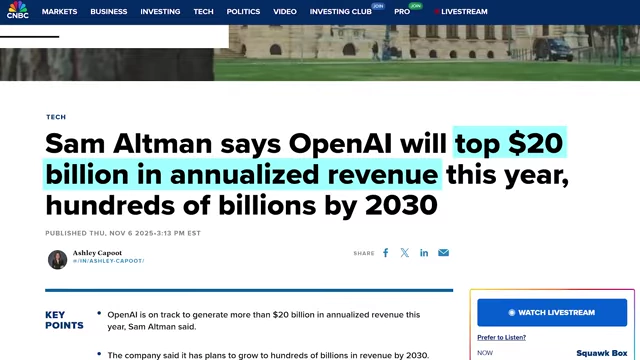
CNBC headline: Sam Altman says OpenAI will top $20 billion in annualized revenue this year, hundreds of billions by 2030 [ 00:18:40 ] - Investors in private companies like OpenAI have more detailed financial insights than the public.
- While past investments like Meta's metaverse have failed, it's dangerous to assume all current investments are irrational.

Mark Zuckerberg's metaverse avatar shown during a presentation [ 00:19:00 ]
- Sam Altman projects OpenAI to reach $20 billion in annualized revenue for 2025 and hundreds of billions by 2030, although unprofitability is still expected in the near term.
Conclusion and Future Outlook [19:10]
The AI market presents a complex picture with elements of both a bubble and genuine transformative potential.
- Likelihood of a Correction [19:10]
- A bubble of some sort exists, and there is a high risk of market correction due to lofty valuations and little room for error.
- Current investment activity is unsustainable given the scale of AI activity.
- Signs of strain include layoffs at big tech companies and declining market liquidity, which could limit future lending to AI startups.
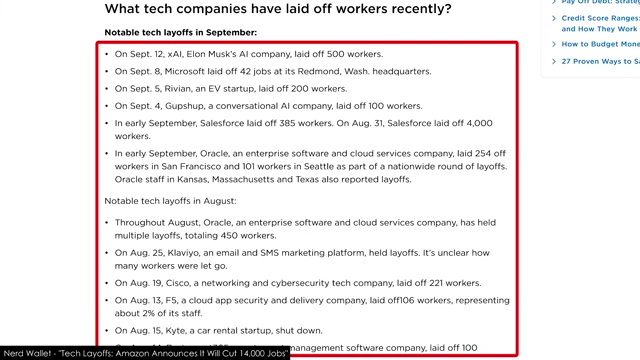
List of notable tech layoffs in September and August [ 00:19:42 ] 
Bloomberg headline: Global Money Markets Are Flashing Signals Liquidity Is Drying Up [ 00:19:52 ]
- Industry Consolidation and Historical Precedent [19:59]
- Industry consolidation is likely, similar to the dot-com era, as there isn't enough demand to sustain 500 AI unicorns.
- Historically, technological revolutions have often been bad investments on average due to boom-and-bust cycles and high attrition rates, even if the core technology succeeds (e.g., Netscape during the dot-com bubble).
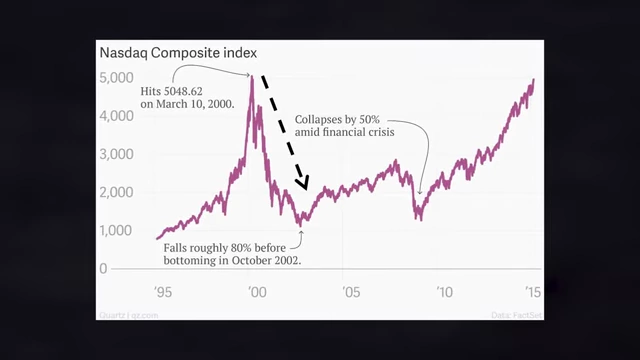
NASDAQ Composite Index showing the dot-com bubble peak and subsequent collapse [ 00:20:20 ] 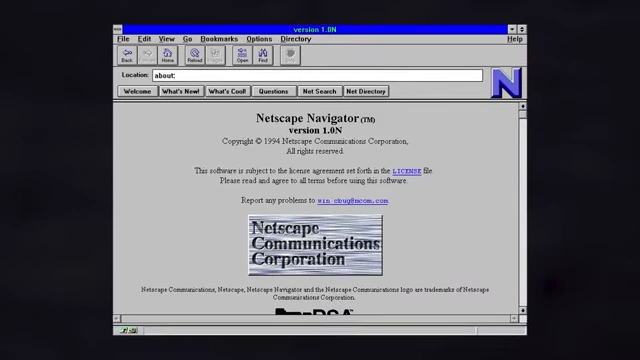
Screenshot of the Netscape Navigator browser, a former market leader [ 00:20:30 ]
- Uncertainty and Timing Challenges [20:39]
- The future remains uncertain; AI could prove highly profitable or fail to meet expectations, akin to a "metaverse 2.0" scenario.
- Geopolitical events or new developments could drastically alter the outlook.
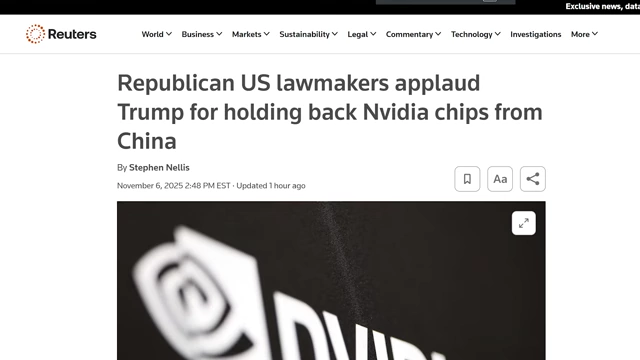
Reuters headline: Republican US lawmakers applaud Trump for holding back Nvidia chips from China [ 00:21:01 ] 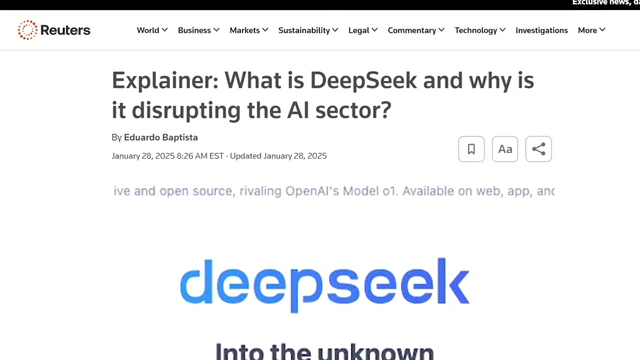
Reuters headline: Explainer: What is DeepSeek and why is it disrupting the AI sector? [ 00:21:04 ] - Timing a bubble burst is extremely difficult, as exemplified by Alan Greenspan's premature warning about "irrational exuberance" years before the dot-com collapse.
- Rallies can persist as long as investors continue to pour money in, though companies will eventually need to transition from investor funding to customer revenue.

Fortune headline: Mark Zuckerberg says Meta 'misspending a couple of hundred billion' would be 'unfortunate,' but 'the risk is higher on the other side' [ 00:21:25 ]