2026 Investment Strategy: Leveraging Federal Reserve Easing, Increasing Liquidity, and a Weakening Dollar for Asset Growth
Summary:
This video outlines an investment strategy for 2026, asserting that the Federal Reserve's actions, particularly an easing monetary policy, will drive asset prices higher.
- Liquidity's Impact: The speaker explains that plentiful liquidity (cheap and accessible money) leads to cheaper borrowing, increased money flow, and rising asset prices, acting like a rising water level in a pool.
- Fed's Easing Cycle: The Federal Reserve is shifting from a tightening to an easing cycle, characterized by interest rate cuts and a restarted balance sheet expansion (money printing of $40 billion/month), which injects liquidity into the system.
- Weakening US Dollar: Falling interest rates and increased money supply are expected to weaken the US dollar, consequently pushing up prices for US stocks, gold, silver, and commodities as more dollars are needed to buy the same assets.
- The "Fed Put": The video highlights the "Fed put" mechanism, where the Fed intervenes with policy support (rate cuts, liquidity injections) to prevent widespread economic damage from market crashes, as the system is highly sensitive to liquidity.
- Investment Approach: For 2026, the strategy is to stay invested, avoid taking money off the table (due to inflation), and buy dips, anticipating major tailwinds for stocks and precious metals.

Liquidity's Role in Financial Markets [ 00:00:50 ]
Introduction to 2026 Investment Outlook [0:00]
- Addressing common investor questions for 2026: [0:04]
- Core argument: The Federal Reserve is making money cheaper, which naturally causes asset prices to increase. [0:27]
- This applies to stocks, gold, silver, and real assets in general, as the system is designed to function this way. [0:36]
Understanding Liquidity's Role in Markets [0:47]
- Definition of liquidity: It refers to how much money is available in the system and how easy it is to access. [0:52]
- Impact of liquidity levels: [1:02]
- Analogy: Liquidity is likened to water in a pool; when the water level rises, everything floats higher, and when it drains, everything sinks. [1:26]
- Market behavior versus economic sentiment: [1:42]
- Financial markets prioritize access to money over public sentiment or current economic strength. [1:56]
- When liquidity increases, money actively seeks returns, flowing into stocks, ETFs, gold, silver, precious metals, and other perceived stores of value. [2:04]
- This explains how markets can continue to rise even if the economy is not booming. [2:21]
Comparison of Tight vs. Plentiful Liquidity and its Market Effects [ 00:00:50 ]
Federal Reserve's Easing Cycle and Money Printing [2:28]
- The significance of interest rates: [2:28]
- The Federal Reserve controls short-term interest rates. [2:32]
- Raising rates makes borrowing expensive; cutting rates makes it cheaper. [2:36]
- Cheaper money influences economic behavior across the economy: [2:45]
- Companies refinance debt.
- Investors take on more risk.
- Cash earns less, prompting a search for returns elsewhere.
- Valuations rise as future profits are discounted at lower rates. [3:01]
- For 2026, the market is in an easing cycle, which supports higher asset prices. [3:14]
- Restarted balance sheet expansion (money printing): [3:22]
- The Federal Reserve has restarted balance sheet expansion, terming it "reserve management," which is effectively printing money. [3:26]
- Initial phase: $40 billion per month in securities purchases, started December 12th. [3:34]
- Market response: The actual impact of injecting money into the financial system is what matters to markets, regardless of the Fed's terminology ("technical," "temporary," "not QE"). [3:40]
- The persistence of liquidity: [4:07]
- Money printing is not a one-time event because the financial system inherently requires liquidity. [4:07]
- Factors driving this need include large US government deficits, banks' need for reserves, and markets' dependence on stable funding conditions. [4:22]
- Attempting to quickly shut off the liquidity "spigot" risks systemic breakdown, leading liquidity cycles to last longer than expected and balance sheet expansion to occur in phases. [4:35]

News headline discussing the Federal Reserve's pivot to easing through rate cuts and liquidity injection [ 00:02:05 ]
Weakening US Dollar and Asset Prices [4:54]
- Consequences of falling interest rates and increased money supply: The US dollar typically weakens. [4:57]
- Reasons for dollar weakening: [5:05]
- Lower interest rates reduce the incentive to hold dollars.
- An increased supply of dollars in existence decreases its purchasing power.
- Reasons for dollar weakening: [5:05]
- Impact on asset prices: A weaker dollar contributes to pushing up prices for US stocks, gold, silver, precious metals, and commodities. [5:16]
- Example with precious metals: If gold or silver prices rise in dollar terms, it indicates the dollar is weakening, not necessarily an increase in the intrinsic value of the metal itself. [5:29]
- Policy implications of dollar strength: [6:18]
- A very strong dollar: [6:22]
- Hurts exports.
- Tightens global financial conditions.
- Increases stress on debt markets.
- Slows down economic activity (GDP).
- A moderately weaker dollar: [6:37]
- Supports growth.
- Helps manage large debt loads.
- Makes financial conditions easier.
- Dollar weakness is therefore a deliberate "release valve" in policy. [6:50]
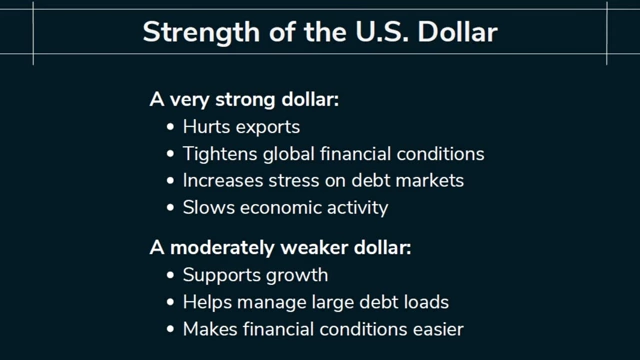
An infographic detailing the effects of a strong versus a moderately weaker U.S. dollar on the economy. [ 00:06:23 ]
- A very strong dollar: [6:22]
The "Fed Put" and Market Support [6:57]
- Definition of "Fed put": The Federal Reserve's recurrent intervention to support markets when they fall sharply. [7:00]
- Rationale for Fed intervention: [7:29]
- Fed's typical response to severe stress: [7:53]
- Rate cuts.
- Liquidity injections.
- Emergency programs.
- Balance sheet expansion.
- Implication: A "Fed put" means that major market declines will be met with policy support, not that markets cannot fall. [8:05]
- Why the Fed is "trapped" into supporting markets: [8:15]
- The current system is more sensitive to liquidity than ever before. [8:21]
- Contributing factors: [8:27]
- Higher debt levels.
- More interconnected markets.
- Faster spread of financial stress.
- This necessitates faster and larger policy responses from the Fed. [8:45]

List of reasons why a market crash doesn't stay in the market and how the Fed responds to stress. [ 00:07:28 ]
Future Outlook: New Fed Leadership in 2026 [8:49]
- Upcoming change: A new Federal Reserve chair will be announced in early 2026. [8:52]
- Expected policy shift: New leadership typically brings a shift towards an easier, rather than tighter, monetary policy. [9:03]
- Political incentives: The new Fed will likely aim to boost economic activity, markets, and inflation to run "hot" leading into midterm elections. [9:12]
Investment Plan for 2026 [9:49]
- Conclusion: The combination of falling rates, increasing liquidity, a weakening dollar, and the Fed's readiness to intervene creates significant tailwinds for investments in 2026. [9:22]
- Personal investment strategy for 2026: [9:49]
- Stay invested: Recognize the major tailwinds for stocks and precious metals. [9:55]
- Avoid taking money off the table: Do not lose capital to inflation. [10:04]
- Do not wait on the sidelines: Avoid hoping for a market crash in this environment. [10:11]
- Buy the dips: Take advantage of any market pullbacks in a liquidity-rich environment. [10:17]
- Rationale: The question of "how much higher can markets go" is tied to "how much more money can the government print," and the expectation is that printing will not stop soon. [10:30]

The speaker's investment plan for 2026, outlining key strategies like staying invested and buying dips. [ 00:09:47 ]