Understanding Sunscreen Safety: Deconstructing EU vs. US Regulations on Oxybenzone and Other UV Filters
The video explains that the EU's Scientific Committee on Consumer Safety (SCCS) lowered limits for some sunscreen ingredients, like oxybenzone (from 6% to 2.2% in body products), leading to "not safe" claims for US sunscreens. This "not safe" refers to exceeding a strict safety margin (typically 100 times below the "No Observed Adverse Effect Level" from animal studies) and does not mean imminent harm to human users. The SCCS applies conservative estimates for consumer exposure and hazard. For instance, 6% oxybenzone in body products provided a 38x safety margin, prompting the reduction to 2.2% to meet the 100x target. Face products often have different, higher limits due to lower application amounts. Other ingredients like octocrylene and homosalate also saw limit adjustments, while 4-MBC was flagged as a potential endocrine disruptor. These regulatory updates reflect the system's continuous refinement based on new data and a highly cautious approach, rather than evidence of adverse health effects from current products.
Understanding Recent Sunscreen Safety Concerns [0:00]
- The video addresses prevalent fear-mongering regarding chemical sunscreens, often fueled by sensationalized media headlines.
- Examples of sensationalized news headlines about sunscreen absorption, coral reef harm, and cancer-causing chemicals.

Examples of sensationalized news headlines about sunscreen absorption, coral reef harm, and cancer-causing chemicals. [ 00:00:39 ] - Previous concerns include absorption into the bloodstream, harm to coral reefs, zinc oxide toxicity, and benzene contamination.
- Examples of sensationalized news headlines about sunscreen absorption, coral reef harm, and cancer-causing chemicals.
- The European Union (EU) has reviewed sunscreen safety and subsequently lowered the allowed limits for specific ingredients.
- For example, the maximum allowed limit for oxybenzone in body products was reduced from 6% to 2.2%.
- An excerpt from the SCCS report stating that 6% oxybenzone in body products is 'not safe for the consumer' and recommending 2.2%.
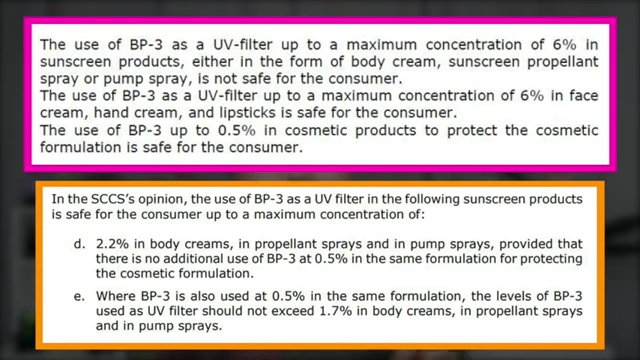
An excerpt from the SCCS report stating that 6% oxybenzone in body products is 'not safe for the consumer' and recommending 2.2%. [ 00:04:36 ] - The EU's Scientific Committee on Consumer Safety (SCCS) stated that "the use of benzophenone-3 (oxybenzone) at 6% in body products is not safe for the consumer."
- This statement has led to misconceptions that US sunscreens with 6% oxybenzone are inherently unsafe.
EU Sunscreen Regulation Framework [1:52]
- In the EU, sunscreens are classified as cosmetics, not drugs, though UV filtering ingredients are subject to rigorous safety checks.
- These ingredients must be on a special approved list, which also specifies maximum usage percentages.
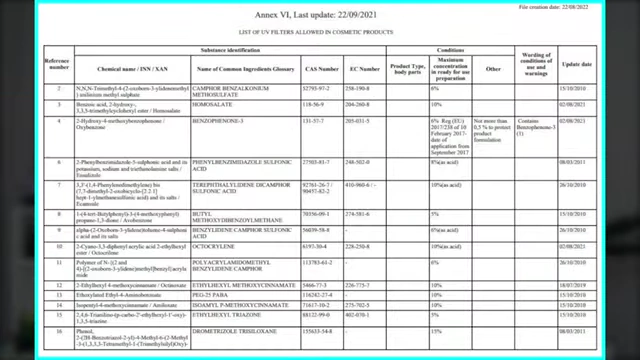
A table listing UV filters allowed in EU cosmetic products, including maximum concentration limits. [ 00:02:16 ]
- These ingredients must be on a special approved list, which also specifies maximum usage percentages.
- The EU has a broader range of approved sunscreen ingredients compared to the US.
- The EU permits approximately 20 common sunscreen ingredients.
- The US list has remained largely unchanged since 1999, featuring only about seven commonly used chemical sunscreen ingredients.

A list of US-approved sunscreen ingredients and their maximum allowed concentrations. [ 00:02:39 ] - Until 2021, maximum percentages for common ingredients were similar between the EU and US.
The Role of SCCS in Safety Assessments [2:56]
- The EU's Scientific Committee on Consumer Safety (SCCS) conducts detailed safety assessments, known as "opinions," based on extensive guidelines and scientific evidence.
- The European Commission's public website for SCCS Opinions, detailing safety assessments for consumer products.
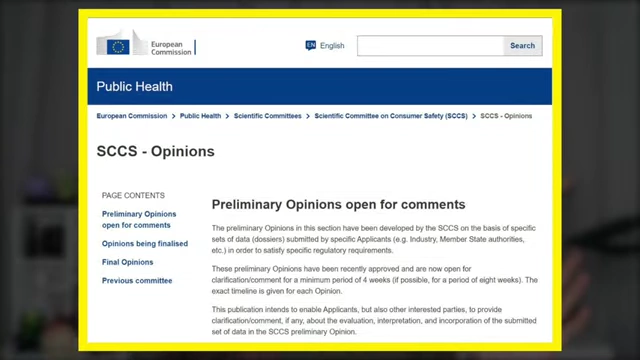
The European Commission's public website for SCCS Opinions, detailing safety assessments for consumer products. [ 00:03:05 ] - The SCCS focuses on the safety of various consumer products, including personal care items (like sunscreens), household products, and services.
- Its members include toxicologists, chemists, pharmacists, and dermatologists, whose credentials and potential conflicts of interest are publicly transparent.

A partial list of SCCS members and their affiliations, demonstrating transparency in their expert committee. [ 00:03:44 ]
- The European Commission's public website for SCCS Opinions, detailing safety assessments for consumer products.
- The European Commission periodically requests the SCCS to evaluate potential risks from new data or newly developed ingredients.
- These evaluations result in recommendations for ingredient usage, such as reduced concentrations or outright bans.
- These recommendations are then typically incorporated into the EU Cosmetics Regulation.
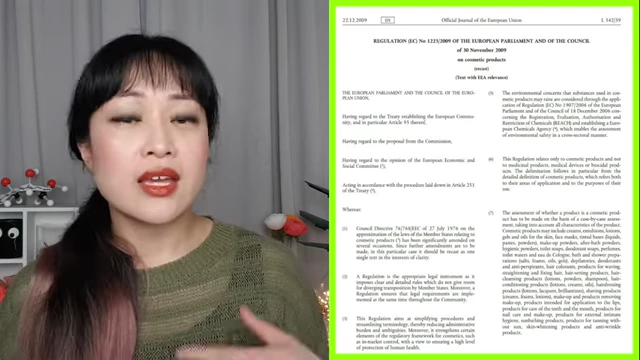
An official Journal of the European Union document outlining regulations on cosmetic products. [ 00:04:22 ]
- A 2018 review by the European Commission into potential endocrine disruptors initiated the current opinions on certain sunscreen ingredients.
Interpreting "Not Safe" in Scientific Context [4:28]
- The scientific definition of "not safe" differs significantly from its everyday interpretation.
- In science, "significant" refers to statistical certainty, not necessarily importance (e.g., being consistently 10 seconds late is scientifically significant, but not practically important).
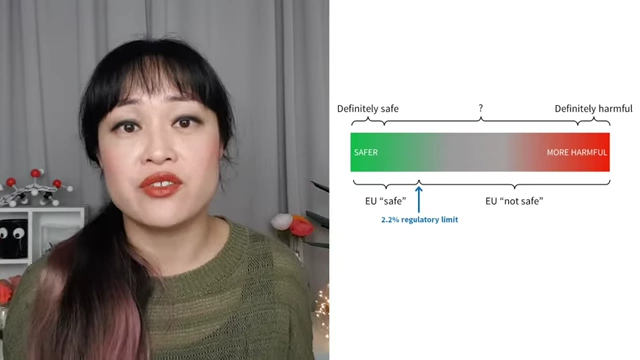
- In daily life, "safe" and "harmful" are often seen as binary, but scientific safety exists on a spectrum.
- "Not safe" in an SCCS assessment means that the ingredient's usage level falls outside the scientifically conservative comfort zone, implying a higher level of uncertainty rather than guaranteed harm.
- A spectrum illustrating the concept of safety in toxicology, showing a 'safe' green zone, a 'harmful' red zone, and a large 'grey zone' in between, with the SCCS 2.2% limit aiming for the green area.
A spectrum illustrating the concept of safety in toxicology, showing a 'safe' green zone, a 'harmful' red zone, and a large 'grey zone' in between, with the SCCS 2.2% limit aiming for the green area. [ 00:07:08 ] - Regulatory bodies across different regions employ varying approaches to set safety limits.
- The 6% oxybenzone limit, previously accepted in both EU and US, lies further into this "grey area" of uncertainty for the SCCS.
- A spectrum illustrating the concept of safety in toxicology, showing a 'safe' green zone, a 'harmful' red zone, and a large 'grey zone' in between, with the SCCS 2.2% limit aiming for the green area.
Differentiating Hazard and Risk [7:20]
- The actual risk posed by something is determined by two factors: hazard and exposure.
- Hazard: The inherent potential of something to cause harm (e.g., a lion).
- Exposure: The extent to which one comes into contact with the hazard.
- The formula demonstrating that risk is a product of exposure and hazard.
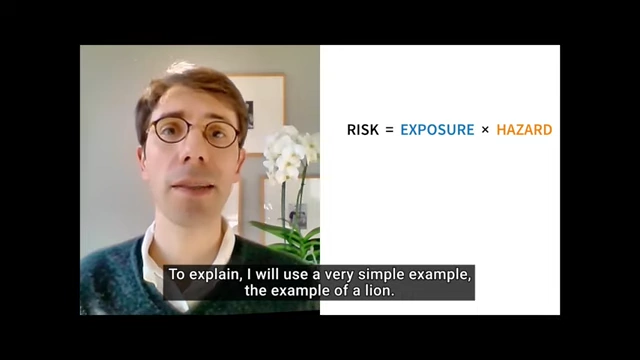
The formula demonstrating that risk is a product of exposure and hazard. [ 00:07:26 ]
- An analogy with a lion illustrates this:
- An analogy illustrating low risk: a high hazard (lion) with no exposure (in a cage) results in low risk.
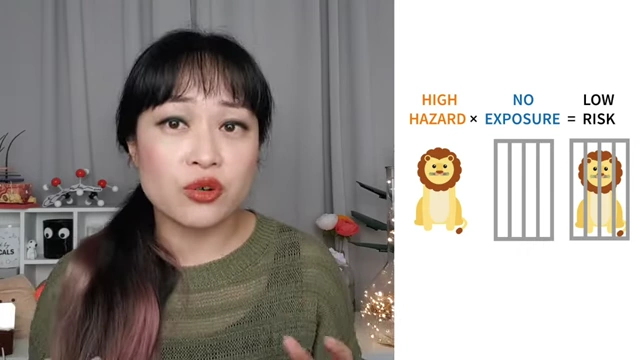
An analogy illustrating low risk: a high hazard (lion) with no exposure (in a cage) results in low risk. [ 00:07:47 ] - An analogy illustrating high risk: a high hazard (lion) with full exposure (in a cage with the person) results in high risk.
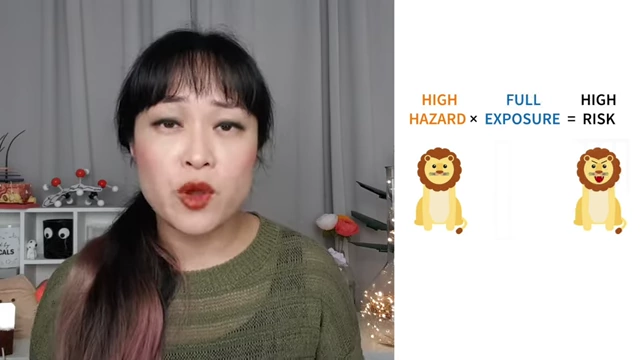
An analogy illustrating high risk: a high hazard (lion) with full exposure (in a cage with the person) results in high risk. [ 00:07:53 ] - This concept is encapsulated by the saying, "the dose makes the poison."
- An analogy illustrating low risk: a high hazard (lion) with no exposure (in a cage) results in low risk.
Assessing Consumer Exposure [8:14]
- The SCCS quantifies exposure by estimating the amount of an ingredient that 95% of consumers would reasonably be exposed to during normal product use.
- Factors influencing exposure include chemical properties, skin absorption rates, product type (e.g., leave-on), concentration in products, application amount, frequency of use, and surface area covered.
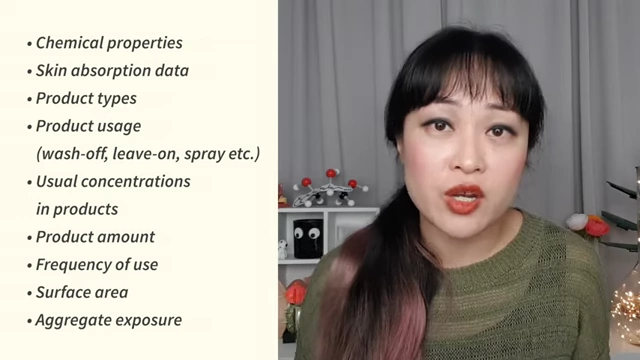
A list of factors considered by the SCCS when assessing consumer exposure to an ingredient, including chemical properties and product usage. [ 00:08:58 ] - Aggregate exposure is considered, accounting for an ingredient being used in multiple products.
- Factors influencing exposure include chemical properties, skin absorption rates, product type (e.g., leave-on), concentration in products, application amount, frequency of use, and surface area covered.
- For oxybenzone, the SCCS used a conservative estimate of 9.9% absorption into the blood, which is more than three times the average measured absorption in skin studies.
- An SCCS document detailing the conservative estimate of 9.9% dermal absorption for systemic exposure dose calculation.
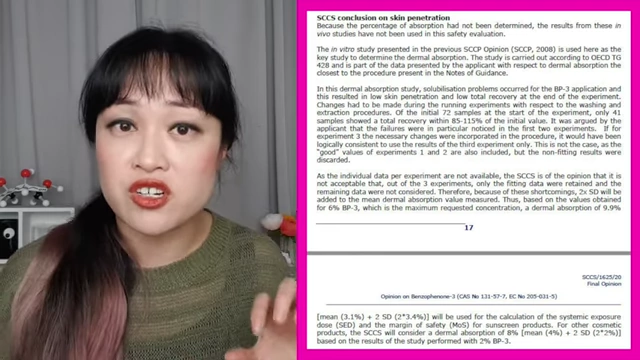
An SCCS document detailing the conservative estimate of 9.9% dermal absorption for systemic exposure dose calculation. [ 00:09:31 ] - The average body sunscreen application was taken as 18 grams.
- Based on these figures for an average 60 kg person, the Systemic Exposure Dose (SED) for 6% oxybenzone in body sunscreen was calculated to be 1.8 milligrams of oxybenzone per kilogram of body weight per day.
- A table illustrating the calculation of the Systemic Exposure Dose (SED) for various product types, factoring in application, concentration, and absorption.
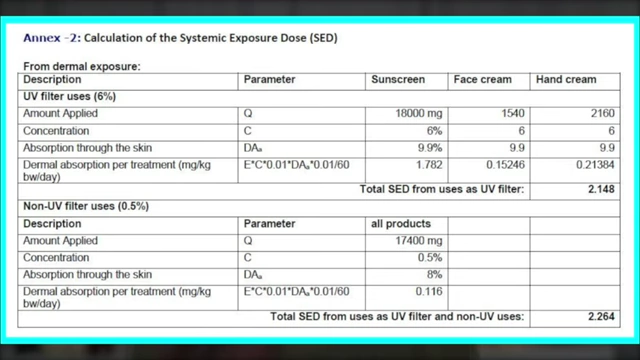
A table illustrating the calculation of the Systemic Exposure Dose (SED) for various product types, factoring in application, concentration, and absorption. [ 00:10:16 ]
- An SCCS document detailing the conservative estimate of 9.9% dermal absorption for systemic exposure dose calculation.
Determining Ingredient Hazard [10:40]
- SCCS assessments thoroughly review all available data on an ingredient's potential harmful effects.
- This includes effects like skin irritation, allergies, carcinogenicity, reproductive toxicity, genotoxicity (DNA damage), and endocrine disruption.
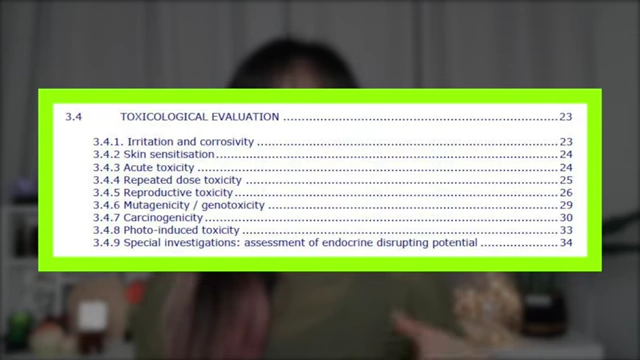
A list of toxicological endpoints evaluated by the SCCS during hazard assessment, including skin irritation, carcinogenicity, and endocrine disruption. [ 00:10:53 ] - Data sources encompass in vitro studies (cells), in vivo studies (living organisms, primarily animals), in silico models (computer simulations), clinical studies (human volunteers), case reports, and epidemiological studies (population-level data).

Different types of studies and data sources, from in vitro to clinical, used by SCCS for hazard assessment. [ 00:11:13 ]
- This includes effects like skin irritation, allergies, carcinogenicity, reproductive toxicity, genotoxicity (DNA damage), and endocrine disruption.
- For chemical sunscreens, there's limited human data on long-term health effects, which is positive as it indicates no clear widespread serious harm since their introduction in the 1970s.
- However, this scarcity of human data necessitates reliance on animal studies for safety assessments, requiring extrapolation to human physiology, which introduces uncertainty.
- A sensationalized headline from 'Daily Beast' about the beauty industry's potential harm.
A sensationalized headline from 'Daily Beast' about the beauty industry's potential harm. [ 00:12:02 ]
- The SCCS identifies the No Observed Adverse Effect Level (NOAEL), which is the highest dose of an ingredient that did not cause a harmful effect in animal studies.
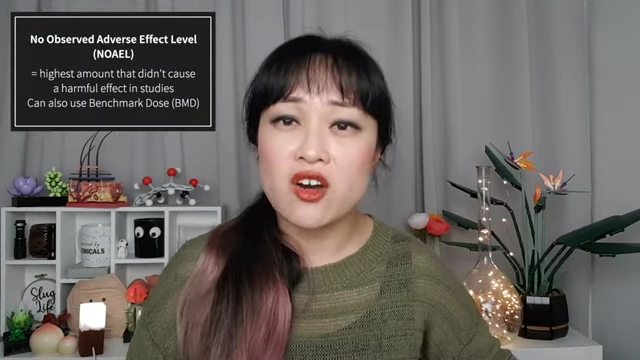
Definition of No Observed Adverse Effect Level (NOAEL) as the highest dose without a harmful effect. [ 00:13:38 ] - For oxybenzone, the SCCS selected the lowest NOAEL from a rat study, specifically focusing on a reduction in sperm-producing cells in male rat fetuses when pregnant rats were fed high doses.
- Harmful effects observed in rats at a high oxybenzone dose, including reduced anogenital distance and spermatocytes.
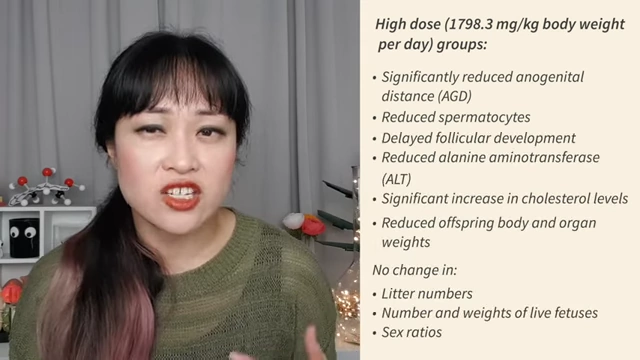
Harmful effects observed in rats at a high oxybenzone dose, including reduced anogenital distance and spermatocytes. [ 00:13:45 ] - The Lowest Observed Adverse Effect Level (LOAEL) for oxybenzone, specifically reduced spermatocytes in male rat fetuses.
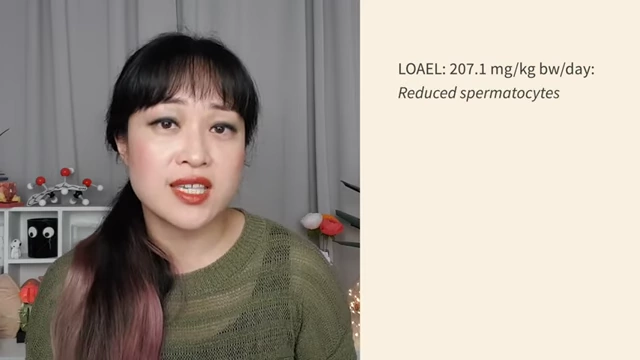
The Lowest Observed Adverse Effect Level (LOAEL) for oxybenzone, specifically reduced spermatocytes in male rat fetuses. [ 00:14:09 ]
Calculating the Margin of Safety [14:13]
- The Margin of Safety (MOS) is calculated by dividing the NOAEL (the lowest "safe" exposure level from animal studies) by the SED (Systemic Exposure Dose, the actual exposure consumers get).
- The No Observed Adverse Effect Level (NOAEL) and Systemic Exposure Dose (SED) values used in Margin of Safety calculation for oxybenzone.
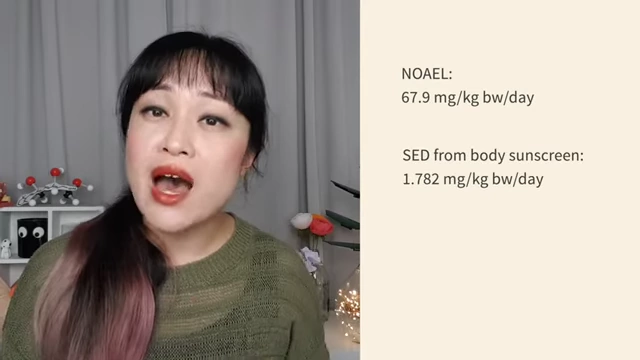
The No Observed Adverse Effect Level (NOAEL) and Systemic Exposure Dose (SED) values used in Margin of Safety calculation for oxybenzone. [ 00:14:25 ]
- The No Observed Adverse Effect Level (NOAEL) and Systemic Exposure Dose (SED) values used in Margin of Safety calculation for oxybenzone.
- For 6% oxybenzone in a body sunscreen, the calculated MOS was 38.
- This means the average consumer's exposure is 1/38th of the NOAEL.
- Table showing Margin of Safety (MOS) calculations for different products containing oxybenzone (BP-3), including body and face creams.
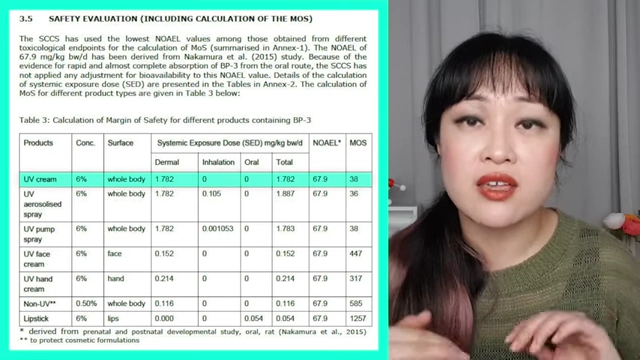
Table showing Margin of Safety (MOS) calculations for different products containing oxybenzone (BP-3), including body and face creams. [ 00:14:35 ] - A summary of the Margin of Safety calculation for 6% oxybenzone sunscreen, resulting in 1/38th of the NOAEL.
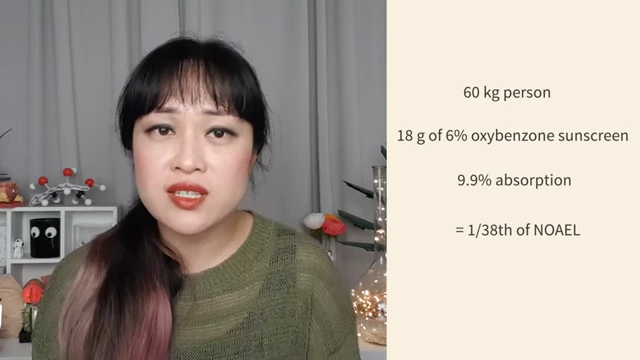
A summary of the Margin of Safety calculation for 6% oxybenzone sunscreen, resulting in 1/38th of the NOAEL. [ 00:14:59 ]
- The SCCS typically aims for a MOS of 100, meaning consumer exposure should be 1/100th of the NOAEL, to account for various uncertainties.
- These uncertainties include converting animal data to humans, individual variability in responses, and incomplete data.
- To achieve this MOS of 100, the allowed concentration of oxybenzone in body products was reduced from 6% to 2.2%.
- At 2.2% oxybenzone, a 60 kg person using the average amount would receive 1/100th of the NOAEL.
- The speaker emphasizes that reaching the actual NOAEL (the dose at which the smallest harmful effect was observed) would require using 100 times the average amount of sunscreen or a sunscreen with an unrealistic 220% oxybenzone concentration.
- Additional safety buffers are embedded in the assessment:
- The effect considered (fetal sperm cell reduction) is on developing fetuses, which are highly sensitive, and most users are not pregnant.
- The dose causing the effect in the rat study was three times higher than the NOAEL chosen for calculation.
- Comparison of LOAEL (effect happened) and NOAEL (effect didn't happen) from the rat study, highlighting the SCCS's conservative choice for setting limits.
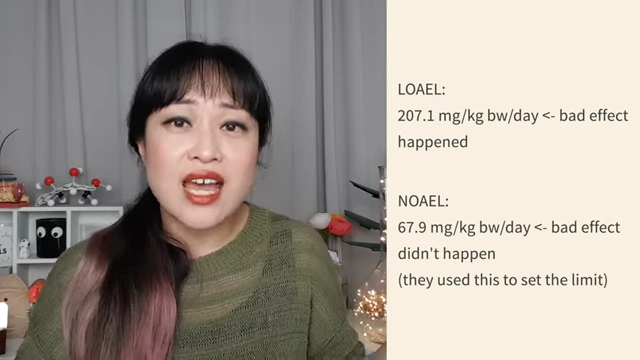
Comparison of LOAEL (effect happened) and NOAEL (effect didn't happen) from the rat study, highlighting the SCCS's conservative choice for setting limits. [ 00:15:54 ] - The estimated skin absorption (9.9%) was three times higher than the measured average.
- The two-year transition period for the new EU limits underscores that 6% oxybenzone is not considered immediately harmful.
- SCCS document showing the adoption date (March 2021) of the opinion on Benzophenone-3 (Oxybenzone).
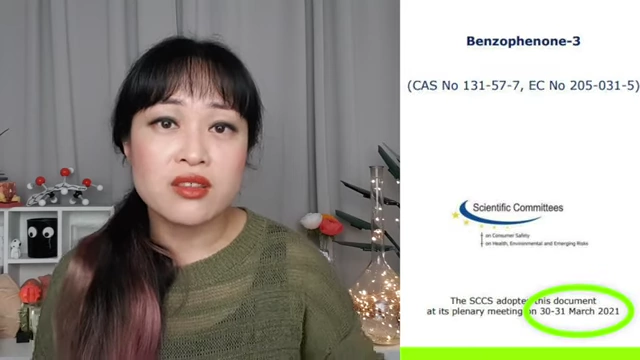
SCCS document showing the adoption date (March 2021) of the opinion on Benzophenone-3 (Oxybenzone). [ 00:17:44 ]
- SCCS document showing the adoption date (March 2021) of the opinion on Benzophenone-3 (Oxybenzone).
- For face products, where less product is applied to a smaller area, 6% oxybenzone was deemed safe, yielding an MOS of 447.
Safety Assessments of Other Sunscreen Ingredients [18:31]
- Octocrylene: Confirmed safe at up to 10% for humans. For spray applications combined with other products (aggregate exposure), the limit was lowered to 9% to maintain a MOS of 100. The SCCS found insufficient evidence to classify it as an endocrine disruptor.
- Table presenting Margin of Safety (MOS) calculations for Octocrylene in various product types and aggregated exposures.
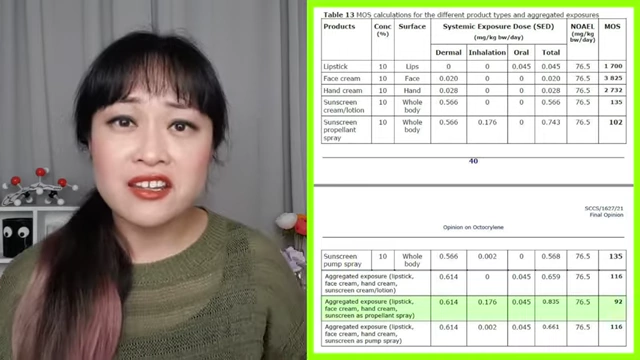
Table presenting Margin of Safety (MOS) calculations for Octocrylene in various product types and aggregated exposures. [ 00:18:49 ]
- Table presenting Margin of Safety (MOS) calculations for Octocrylene in various product types and aggregated exposures.
- Homosalate: Deemed "not safe" at 10%. The limit was significantly lowered to 0.5% for body products and 7.34% for face products. This reduction poses a challenge for body sunscreen reformulation, as homosalate aids in dissolving other UV filters. No evidence suggests it is an endocrine disruptor.
- 4-Methylbenzylidene Camphor (4-MBC): The SCCS stated there was enough evidence that it "may act as an endocrine disruptor and has effects on both the thyroid and estrogen systems." Data was insufficient to set a new, lower limit, but it was confirmed it would be below the current 4% limit.
- SCCS opinion on 4-Methylbenzylidene-Camphor (4-MBC), indicating it may act as an endocrine disruptor with thyroid and estrogen system effects.
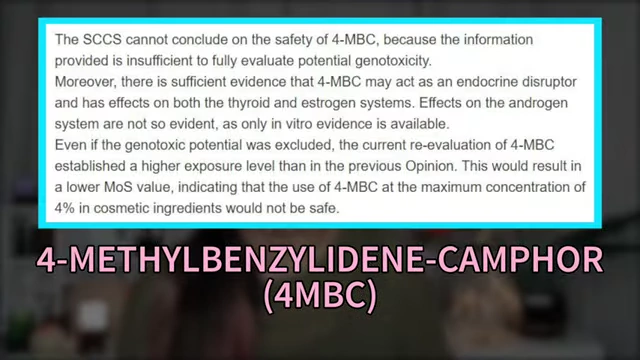
SCCS opinion on 4-Methylbenzylidene-Camphor (4-MBC), indicating it may act as an endocrine disruptor with thyroid and estrogen system effects. [ 00:19:23 ]
- SCCS opinion on 4-Methylbenzylidene-Camphor (4-MBC), indicating it may act as an endocrine disruptor with thyroid and estrogen system effects.
- Octinoxate and Titanium Dioxide are scheduled for future reassessment.
Personal Considerations for Sunscreen Use [19:39]
- The speaker cannot offer personal medical advice, as individual risk assessment is unique and should involve consultation with a doctor.
- Key factors for personal consideration include:
- Exposure and Dose: Evaluate how much sunscreen you typically use and how frequently. An outdoor worker applying sunscreen multiple times daily has significantly higher exposure than someone using it only a few days a year.
- Vulnerability: Consider if specific risks of a sunscreen ingredient are particularly relevant to you. Pregnancy is a common concern, as developing fetuses are more sensitive to various substances. These safety assessments often establish limits based on fetal effects.
- Costs of Not Using: Weigh the risks of not using sunscreen. Factors include personal or family history of skin cancer, typical UV exposure levels, and access to suitable alternative sun protection methods (e.g., other sunscreens, protective clothing, hats, umbrellas).
- Key questions for individuals to consider when assessing personal risk for sunscreen use, such as family history and UV exposure.
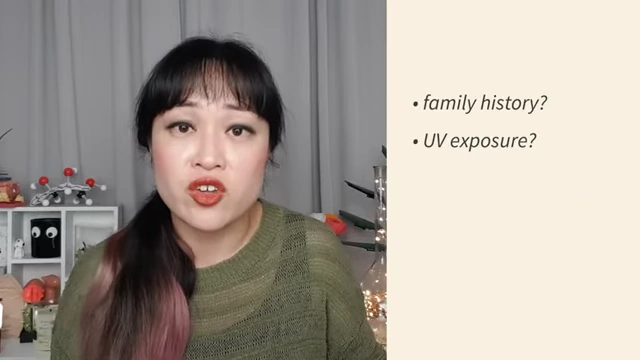
Key questions for individuals to consider when assessing personal risk for sunscreen use, such as family history and UV exposure. [ 00:21:12 ]
- Safety limits for cosmetic ingredients are constantly evolving due to new research, regulations, and assessment methodologies.
- This inherent uncertainty can feel uncomfortable, as humans are not evolved to be at ease with potential harm.
- However, these regulatory adjustments are a positive sign of a functioning system that continually refines safety standards, rather than an indication of widespread harm caused by existing products.
- Most changes are driven by new experimental data and models, not by adverse health effects reported in real-world use.