Misen Carbon Nonstick vs. Strata vs. Anolon EverLast N2: The Best "Forever Nonstick" Pan Reviewed
This video reviews three "forever nonstick" pans: Misen Carbon Nonstick, Strata, and Anolon EverLast N2, which claim to offer nonstick performance without traditional coatings. The reviewer conducts a series of tests to compare their durability, warp resistance, rust resistance, heat performance, nonstick properties, and design.

- Construction: Misen and Anolon use nitrided carbon steel for rust resistance and inherent nonstick properties, while Strata uses regular carbon steel requiring seasoning.
- Durability: All three pans resisted deep scratches from metal utensils, though they developed light scuff marks.
- Warp Resistance: All pans maintained their shape after intense heating, showing good warp resistance.
- Seasoning and Rust: Misen and Anolon proved low-maintenance, resisting rust and acidic foods without seasoning. Strata, being regular carbon steel, rusted after tomato sauce stripped its seasoning.
- Liquid Interaction: Boiling water in Strata showed seasoning leaching, unlike the clear water from Misen and Anolon.
- Heat Performance: Anolon heated fastest but was prone to overheating, Strata provided the most even heat, and Strata also retained heat best.
- Nonstick Performance: All pans performed well with adequate fat, but Misen and Strata struggled with fat-free cooking, while Anolon performed slightly better.
- Design: Strata had the most comfortable handle, while Misen had the widest cooking surface. Anolon was heavier in the 12-inch size.
- Recommendation: Misen is recommended for low-maintenance, everyday nonstick use due to its nitrided surface. Strata is ideal for those who prefer seasoning and even heat. Anolon is a solid, heavier option for those who prefer classic carbon steel feel.
Test Methods [0:00]
The video introduces three "forever nonstick" pans: Misen Carbon Nonstick, Strata, and Anolon EverLast N2. These pans claim to provide nonstick performance without traditional coatings. The reviewer conducted a comprehensive series of tests to evaluate their performance and durability.
- Tests Conducted:
- Metal utensil durability: Scraped with a 5 lb weighted metal ladle 50 times and a metal spatula, followed by a stand mixer whisk in constant contact for two minutes.

Demonstration of metal utensil durability tests using a weighted ladle and a stand mixer whisk. [ 00:00:34 ] - Acidic food simmering: Simmered crushed tomatoes for 15 minutes to check seasoning breakdown.

Two pans simmering crushed tomatoes to test resistance to acidic foods. [ 00:00:36 ] - Overnight water test: Left pans wet overnight to check for rust.

The three pans after being left wet overnight to check for rust. [ 00:00:38 ] - Warp resistance: Heated to 425°F on an induction cooktop for 2 minutes and measured flatness before and after.

Pan being heated on an induction cooktop to test warp resistance. [ 00:00:41 ] 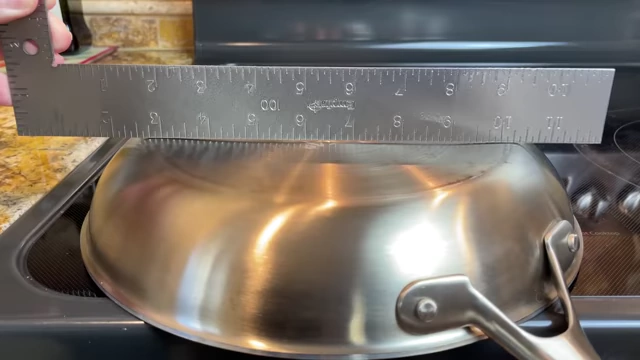
Measuring the flatness of the pan with a ruler to detect warping. [ 00:00:42 ] - Heat conduction and retention: Measured surface temperature at center and edge after 2 minutes on medium heat, and temperature drop after 5 minutes off heat.

Measuring the pan's surface temperature with a thermometer during heat tests. [ 00:00:53 ] - Nonstick performance: Cooked dozens of eggs, pancakes, fish, vegetables, and meats over several months, including controlled tests with varying amounts of fat.

Side-by-side comparison of eggs cooking in the three different pans. [ 00:00:58 ]
- Metal utensil durability: Scraped with a 5 lb weighted metal ladle 50 times and a metal spatula, followed by a stand mixer whisk in constant contact for two minutes.
Construction [1:14]
The video explains the material composition of each pan, highlighting the differences in their construction.
- Misen Carbon Nonstick:
- Composed of three layers.
- Core layer: Aluminum.

Cross-section view of the Misen pan revealing its aluminum core layer. [ 00:01:25 ] - Top and bottom layers: Nitrided carbon steel.
- Nitriding process: Steel is baked in a nitrogen-rich oven, hardening the surface, improving rust resistance, and enhancing food release without seasoning.
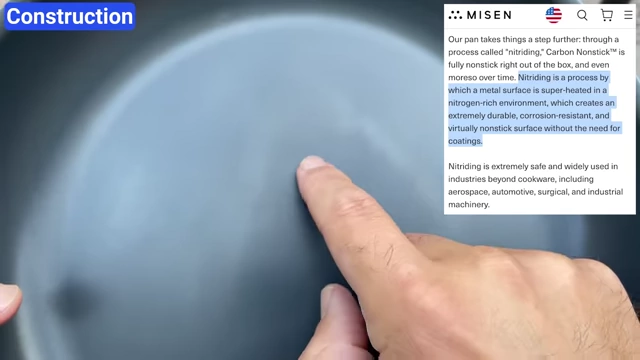
Misen's description of the nitriding process for its Carbon Nonstick™ pan. [ 00:01:32 ] 
Pork chops cooking in the Misen Carbon Nonstick pan, illustrating its nonstick properties. [ 00:01:38 ]
- Anolon EverLast N2:
- Single layer of nitrided carbon steel.
- No aluminum core.
- Benefits from nitriding for rust resistance and nonstick properties without seasoning.

Anolon EverLast N2 pan demonstrating nonstick performance with an egg. [ 00:00:21 ]
- Strata:
- Cooking surface: Regular carbon steel, requiring seasoning.
- Core: Aluminum.
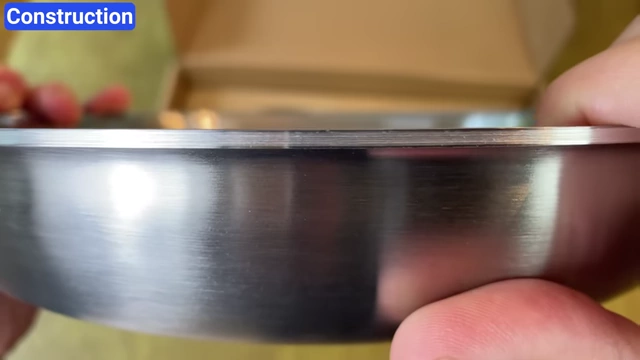
Cross-section view of the Strata pan showing its aluminum core. [ 00:01:52 ] - Exterior: Stainless steel, which does not require seasoning.
- The different materials impact how the pans perform in terms of durability, rust, and nonstick properties.
Durability [2:02][3:22]
All three pans claim to be safe for metal utensils due to the absence of traditional nonstick coatings. The reviewer rigorously tested this claim.
- Metal Utensil Test:
- Involved scraping with a 5 lb weighted metal ladle 50 times.

Weighted metal ladle being scraped across the pan surface to test durability. [ 00:03:27 ] - Followed by scraping with a metal spatula.
- Concluded with a stand mixer whisk in constant contact for two minutes.

Stand mixer whisk in continuous contact with the pan surface for a durability test. [ 00:03:37 ]
- Involved scraping with a 5 lb weighted metal ladle 50 times.
- Results:
- All three pans developed some light scuff marks.
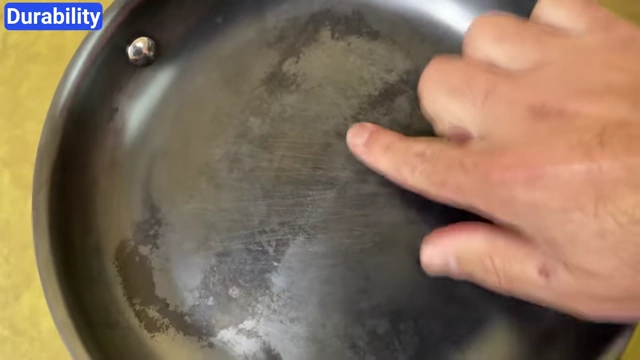
Close-up of light scuff marks on a pan after rigorous metal utensil testing. [ 00:03:45 ] - No deep scratches or significant damage was observed.
- Comparison to Traditional Nonstick:
- A Teflon-coated pan, a ceramic nonstick pan, and a HexClad pan, tested similarly, all showed visible scratches or coating damage.

Traditional nonstick and HexClad pans showing visible scratches and coating damage after durability tests. [ 00:03:48 ]
- A Teflon-coated pan, a ceramic nonstick pan, and a HexClad pan, tested similarly, all showed visible scratches or coating damage.
- The scuff marks on the tested pans did not significantly impact their nonstick performance later in the tests.
- All three pans developed some light scuff marks.
Warp Resistance [4:04]
Warping is a common concern with carbon steel pans, especially on high-heat induction cooktops. The test assessed how well each pan maintained its shape under thermal stress.
- Mechanism of Warping: Occurs when different parts of the pan expand at uneven rates, creating stress in the metal.
- Pan Vulnerabilities:
- Anolon: Being a single layer of carbon steel, it is theoretically more vulnerable to warping.
- Misen and Strata: Their aluminum cores are designed to help distribute heat more evenly, thereby reducing stress and potential warping.
- Test Method:
- Measured the initial flatness of each pan.
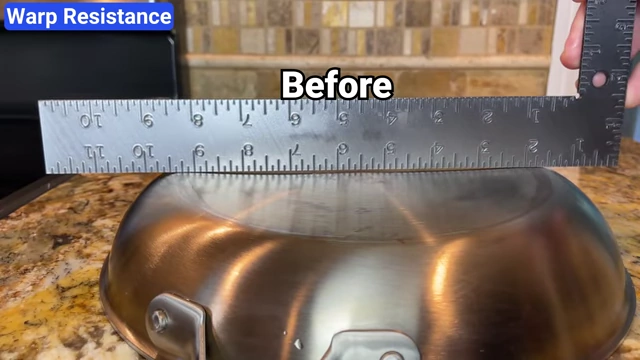
Measuring pan flatness before heating to establish a baseline for warp resistance. [ 00:04:41 ] - Heated each pan to 425°F on an induction cooktop for 2 minutes.
- Re-measured flatness after heating.
- Measured the initial flatness of each pan.
- Results:
- All three pans started slightly concave, a common design feature to accommodate expansion.
- None of the pans showed any visible change or warping after the heating test.
- Other carbon steel pans in previous tests by the reviewer have not always held their shape.

Example of a carbon steel pan that warped after intense heating. [ 00:04:50 ]
Seasoning and Rust [4:54]
This section details how the different materials and treatments affect the pans' need for seasoning and their susceptibility to rust and acidic foods.
- Misen and Anolon (Nitrided Carbon Steel):
- Claim: Do not require seasoning due to nitrided surface.

The three pans, showing Strata's seasoned surface alongside Misen and Anolon's nitrided surfaces. [ 00:05:03 ] - Rust test: No rust appeared after being left wet overnight.
- Acidic food test: Simmering crushed tomatoes for 15 minutes caused no change to their surfaces, confirming their resistance to acid.

Anolon pan remaining unchanged after the acidic tomato sauce test. [ 00:05:29 ] - Maintenance: Truly low-maintenance, resisting rust and acidic foods without seasoning.
- Claim: Do not require seasoning due to nitrided surface.
- Strata (Regular Carbon Steel with Stainless Steel Exterior):
- Requires seasoning to prevent rust and enhance nonstick properties.
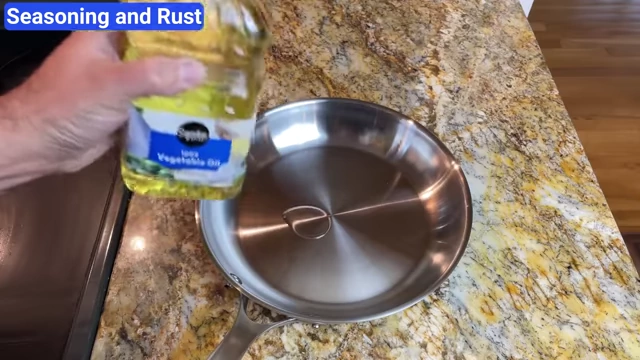
Applying and spreading oil to a Strata pan for seasoning. [ 00:05:07 ] - Rust test: No rust appeared after being left wet overnight initially.
- Acidic food test: Simmering crushed tomatoes stripped away its seasoning layer, changing its surface from dark and seasoned to light and patchy.

Strata pan showing seasoning being stripped away by simmering crushed tomatoes. [ 00:05:24 ] 
Before and after comparison of Strata's cooking surface, showing seasoning loss after acidic food contact. [ 00:05:32 ] - Repeated rust test: After seasoning was stripped by tomatoes, Strata became rusty after being left wet overnight.
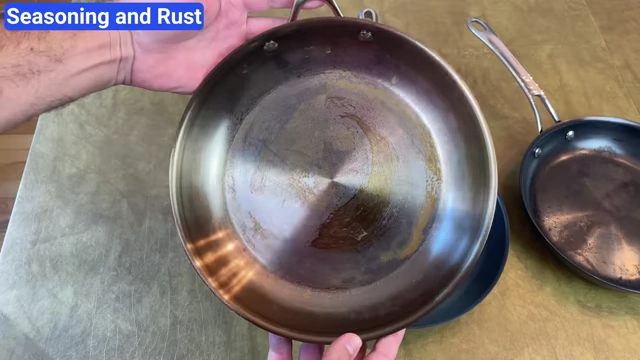
Strata pan showing rust after its seasoning was stripped by tomato sauce and then left wet overnight. [ 00:05:41 ] - Maintenance: Higher maintenance due to the need for seasoning and re-seasoning after cooking acidic foods.

Finger wiping orange-tinted residue, indicating seasoning breakdown from the Strata pan. [ 00:05:52 ]
- Requires seasoning to prevent rust and enhance nonstick properties.
Liquids [5:54]
The interaction of the pan surfaces with liquids, especially in terms of seasoning integrity, was evaluated.
- Test Method:
- Poured clean filtered water into each pan.
- Boiled the water for 10 minutes.
- Poured the water back into glasses for observation.
- Results:
- Misen and Anolon: The water remained completely clear, indicating no material leaching.
- Strata: The water was cloudy with a yellow tint.

Water samples from Misen, Anolon, and Strata after boiling, illustrating seasoning leaching from Strata. [ 00:06:10 ] - Interpretation: The yellow tint in Strata's water indicated that bits of its seasoning layer were breaking down and leaching into the liquid.
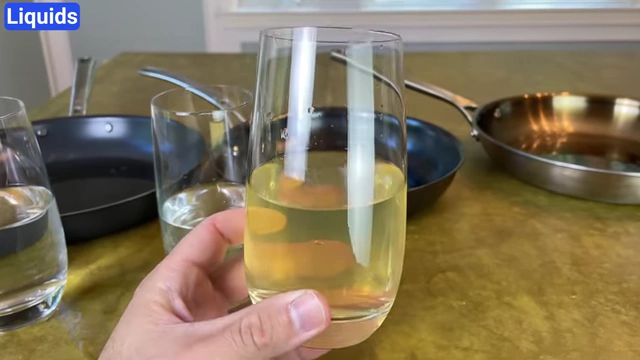
Close-up of the cloudy, yellow-tinted water from the Strata pan, indicating seasoning breakdown. [ 00:06:23 ] - Significance: This is typical for seasoned carbon steel or cast iron but highlights a disadvantage of Strata compared to the nitrided surfaces of Misen and Anolon for liquid-heavy meals.
Heat Performance [6:29]
The video analyzes how quickly and evenly the pans heat up and how well they retain heat.
- Heat Conduction (Speed and Evenness):
- Test Method: Heated each pan on medium heat for 2 minutes, measuring surface temperature at the center and edge.
- Anolon: Fastest to heat but prone to overheating, leading to smoking if not carefully managed. Temperature difference: 104°F (center 575°F / edge 471°F).

Anolon pan smoking due to overheating, a common issue during testing. [ 00:06:50 ] - Misen: Heated at a moderate pace. Temperature difference: 70°F (center 535°F / edge 465°F).
- Strata: Heated less quickly but was the most even, with only a 3°F difference between the center and edge (center 418°F / edge 415°F). This evenness was confirmed in real-world cooking (e.g., chicken browning).
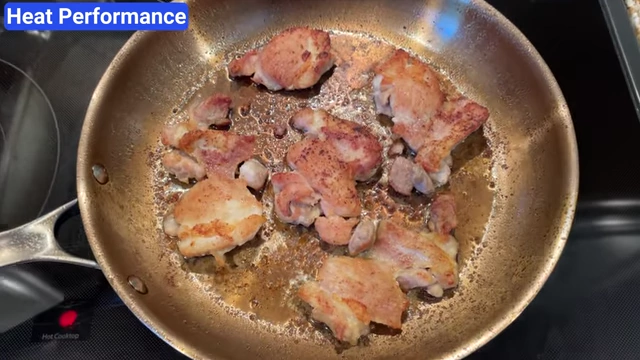
Chicken pieces browning evenly across the entire surface of the Strata pan. [ 00:07:06 ]
- Heat Retention:
- Test Method: Heated each pan to 400°F, removed from burner, and measured temperature after 5 minutes.
- Pans are generally lightweight and not optimized for retention like thicker cast iron.
- Strata: Retained heat the best, dropping by 117°F.
- Misen: Dropped by 119°F.
- Anolon: Dropped by 129°F.
- Within this group, Strata had superior heat retention.

Heat performance comparison table showing center and edge temperatures, and temperature differences for Anolon, Misen, and Strata pans. [ 00:06:44 ] - Uneven browning comparison.

Traditional cast iron pan showing uneven browning, contrasting with Strata's heat distribution. [ 00:07:12 ]
Nonstick Performance [7:34]
This crucial section assesses the nonstick capabilities of each pan both new and after extended use and durability tests.
- Claims:
- Strata and Anolon: Surfaces become naturally nonstick over time as seasoning builds.

Claims from Anolon and Strata describing their pans as naturally nonstick or stick-resistant. [ 00:07:45 ] - Misen: Nonstick right out of the box and improves with use, branded as "Carbon Nonstick™" due to the nitriding process.

Misen's claim that its Carbon Nonstick™ pan is fully nonstick right out of the box. [ 00:07:52 ]
- Strata and Anolon: Surfaces become naturally nonstick over time as seasoning builds.
- Controlled Tests (after months of use and durability tests):
- Test 1: Egg with 1 tsp oil, 5g butter: All three pans passed; eggs slid with no sticking. Anolon initially overheated, causing sticking, but performed fine with slower preheating.

Egg cooking in the Misen pan during a controlled nonstick test. [ 00:08:21 ] 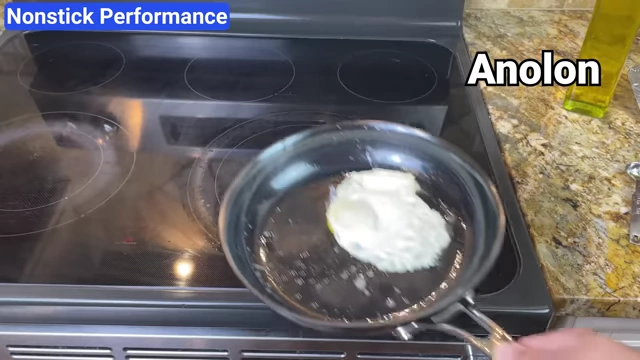
Egg sliding easily in the Anolon pan after controlled preheating. [ 00:08:37 ] - Test 2: Egg with 0.5 tsp oil, 2g butter: All three pans passed without sticking.
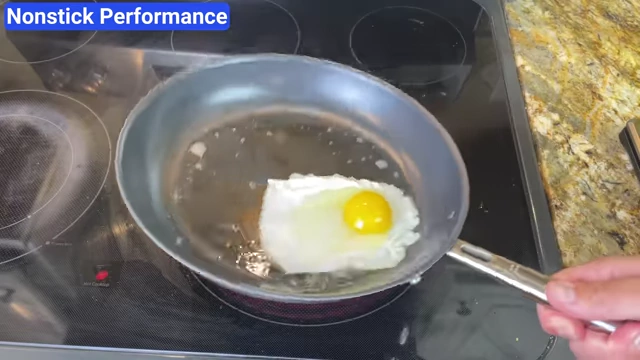
Reduced fat egg test showing an egg cooking without sticking in the pan. [ 00:08:43 ] - Test 3: Pancakes with light butter: Misen and Anolon released cleanly. Strata had slight sticking but was flippable.

Pancakes releasing cleanly from Misen or Anolon with light butter. [ 00:08:51 ] 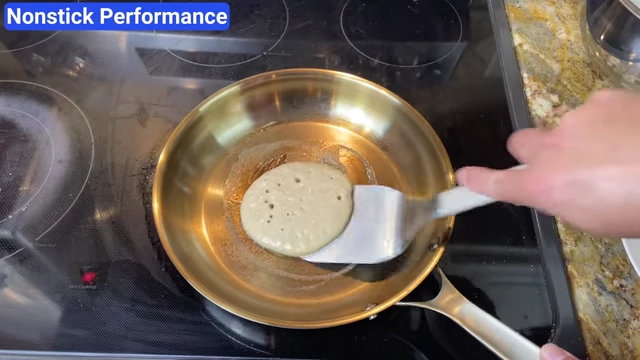
Strata pan showing slight sticking during the light butter pancake test. [ 00:08:55 ] - Test 4: Pancakes with no fat:
- Anolon: Slight sticking but pancake was flippable without breaking.

Anolon pan releasing a pancake with minimal sticking during a fat-free test. [ 00:09:05 ] - Misen: Stuck badly, couldn't flip without tearing.
- Strata: Similar issue to Misen, stuck badly and tore.

Misen or Strata pan showing significant sticking with a pancake cooked without fat. [ 00:09:12 ]
- Anolon: Slight sticking but pancake was flippable without breaking.
- Test 1: Egg with 1 tsp oil, 5g butter: All three pans passed; eggs slid with no sticking. Anolon initially overheated, causing sticking, but performed fine with slower preheating.
- General Performance (Day-to-Day Cooking):
- Misen and Anolon: Impressively nonstick out of the box and maintained performance for months. Not as slick as new Teflon but functional with some oil/butter and proper heat management. No performance decline observed unless overheated.

An egg sliding effortlessly in a new Misen Carbon Nonstick pan. [ 00:09:19 ] - Strata: Similar performance to Misen and Anolon when using fat and managing heat.
- Main Challenge with Strata: Seasoning. Applying too much oil or uneven spreading can make the surface tacky and cause sticking. Proper seasoning is crucial to achieve comparable results to Misen and Anolon.
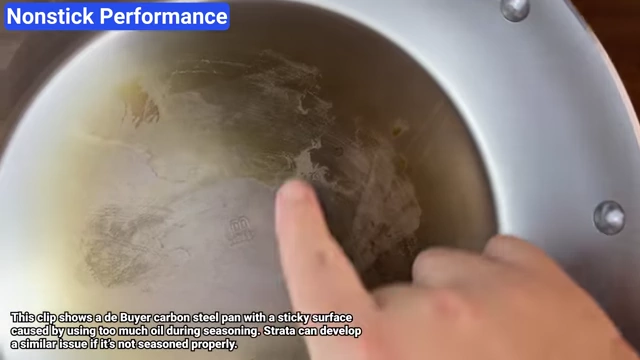
A De Buyer carbon steel pan with a tacky surface due to improper seasoning. [ 00:09:53 ]
- Misen and Anolon: Impressively nonstick out of the box and maintained performance for months. Not as slick as new Teflon but functional with some oil/butter and proper heat management. No performance decline observed unless overheated.
Design [10:04]
The reviewer discusses notable design differences, including handles, finishes, and dimensions.
- Handles:
- Misen: Comfortable but rounded, can be slippery with wet or mitt-covered hands.
- Anolon: Flatter with a shallow groove for thumb rest, offering a more secure grip, though it is thin.
- Strata: Best design; thicker, more substantial, flat top with a slight groove to prevent rotation. Features a round hanging loop.
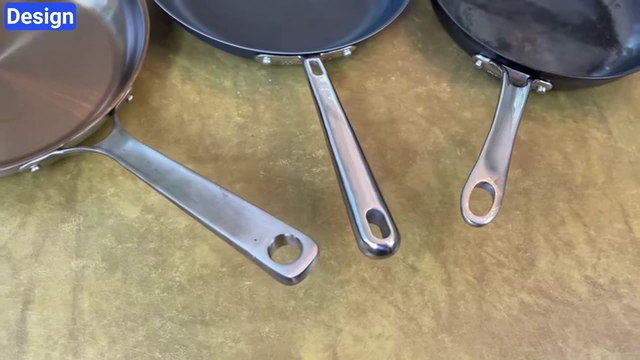
Comparison of handles on Strata, Misen, and Anolon pans. [ 00:10:09 ]
- Finishes:
- Misen: Dark matte surface that slightly fades with use.

Misen pan showcasing its dark matte surface. [ 00:10:43 ] - Anolon: Shiny with a bluish tint, develops a patina over time.

Anolon pan with its shiny, bluish tint finish. [ 00:10:47 ] - Strata: Starts silvery like stainless steel, develops a golden-brown hue and darkens as seasoning builds.
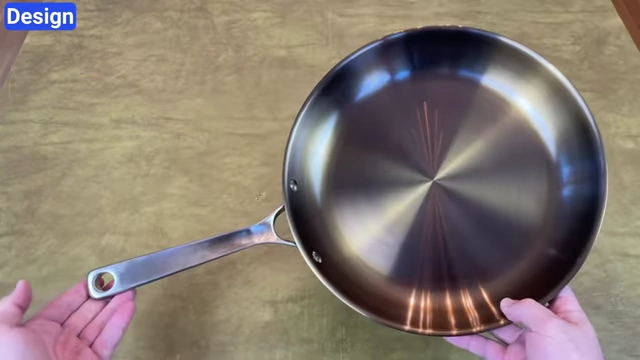
Strata pan displaying its evolving golden-brown seasoned surface. [ 00:10:53 ]
- Misen: Dark matte surface that slightly fades with use.
- Dimensions (10-inch pans):
- Weight: All are under 3 lbs, making them easy to maneuver.
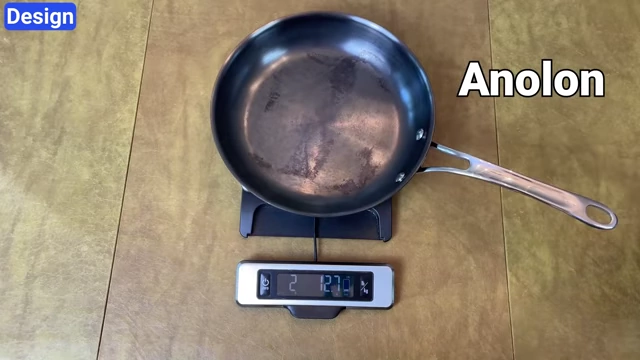
Weight of the 10-inch Anolon pan on a scale. [ 00:11:02 ] - Misen: Widest cooking surface, lowest walls (1.75 inches).

Measuring the cooking surface width of Strata, Anolon, and Misen 10-inch pans. [ 00:11:07 ] - Strata: Walls just under 2 inches.
- Anolon: Walls just under 2.25 inches.

Visual comparison of the wall heights of Strata, Misen, and Anolon pans. [ 00:11:10 ]
- Weight: All are under 3 lbs, making them easy to maneuver.
- Dimensions (12-inch pans):
- Weight: Strata and Misen around 3 lbs; Anolon jumps to 4.3 lbs.

Weight of the 12-inch Strata pan on a scale. [ 00:11:16 ] 
Weight of the 12-inch Anolon pan on a scale. [ 00:11:19 ] - Anolon: Extra weight attributed to a helper handle and taller walls.

Anolon 12-inch pan featuring a helper handle. [ 00:11:23 ] 
Measuring the wall height of the Anolon pan. [ 00:11:29 ]
- Weight: Strata and Misen around 3 lbs; Anolon jumps to 4.3 lbs.
The Winner Is... [11:37]
The reviewer summarizes the findings and provides recommendations based on different user preferences.
- Overall Performance: All three pans performed exceptionally well and are similarly priced.
- Key Decision Point: Seasoning Preference:
- If you prefer no seasoning/low maintenance: Misen and Anolon are the best options.
- Both don't require seasoning, resist rust, handle acidic foods well, and maintain nonstick properties over time.
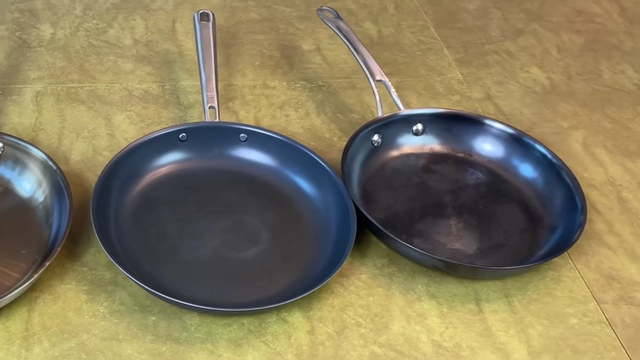
Misen and Anolon pans, representing the low-maintenance, nitrided carbon steel options. [ 00:12:04 ] 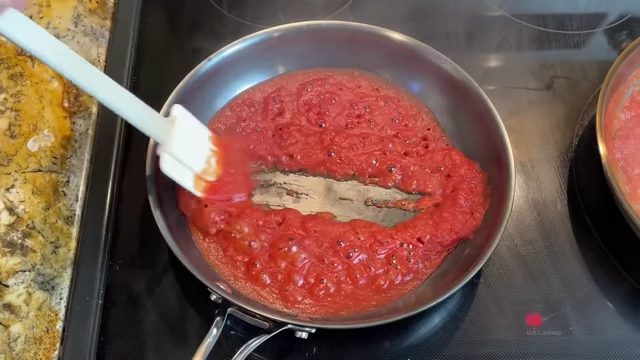
Anolon pan with tomato sauce, showing its resistance to acidic foods. [ 00:12:08 ] - Recommendation: Misen Carbon Nonstick.
- Closest replacement for a traditional Teflon-coated aluminum pan.
- Lightweight and easy to handle.
- Excellent for quick, everyday cooking, especially eggs.

An omelet cooking and effortlessly sliding out of the Misen pan. [ 00:12:17 ] 
Bottom view of the Misen pan, featuring its brand inscription. [ 00:13:00 ]
- Alternative: Anolon EverLast N2.
- A nicer, more elegant-looking pan with a polished finish and curved handle.
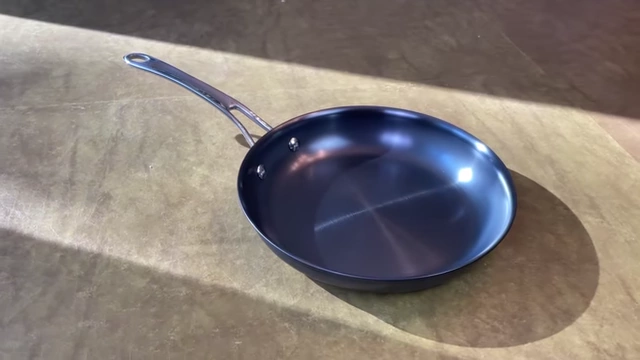
Anolon pan showcasing its elegant polished finish and curved handle. [ 00:12:30 ] - Heavier with taller walls, feeling more like a classic carbon steel pan (e.g., de Buyer, Matfer).
- Requires careful heat management to prevent overheating.
- A nicer, more elegant-looking pan with a polished finish and curved handle.
- Both don't require seasoning, resist rust, handle acidic foods well, and maintain nonstick properties over time.
- If you are willing to season and prefer even heat: Strata is the best option.
- Heats more evenly than the other two.
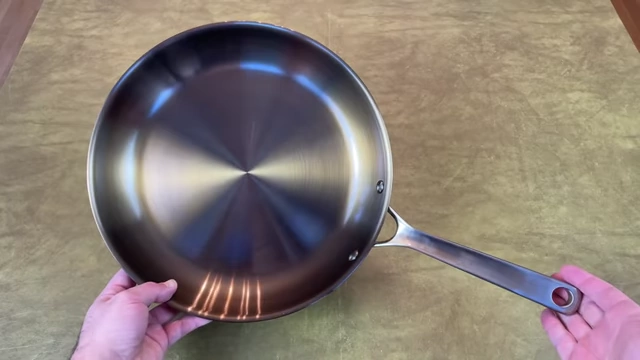
Strata pan highlighting its even heat and comfortable handle. [ 00:12:47 ] - Lightweight with the best handle design.
- Requires more maintenance due to seasoning needs, which can break down with acidic foods.
- Heats more evenly than the other two.
- If you prefer no seasoning/low maintenance: Misen and Anolon are the best options.
- Conclusion: All three pans are solid choices, and the best pick depends on individual preferences for seasoning and pan characteristics.