Understanding Different DaVinci Resolve Node Trees: A Discussion with Cullen Kelly and Darren Mostyn
Summary:
This video features an interview between colorists Darren Mostyn and Cullen Kelly, discussing their contrasting approaches to node trees in DaVinci Resolve.
- Cullen Kelly recently moved his studio to the Lola Visual Effects building in LA to accommodate family life and leverage VFX synergy.
- They discussed the advantages of Cullen's new studio setup, including a large client viewing screen and improved security protocols.
- The main discussion centered on their differing node tree philosophies: Darren uses a pre-built, templated "ripple grading" approach for speed in documentary work, while Cullen prefers an "à la carte" method, building nodes as needed for specific shots.
- They acknowledged the validity of both approaches, highlighting that both aim for optimal and consistent results, just through different techniques.
- They also touched on the growing openness in the color grading community and shared thoughts on HDR for YouTube, noting its complexity but potential for improved viewing conditions.
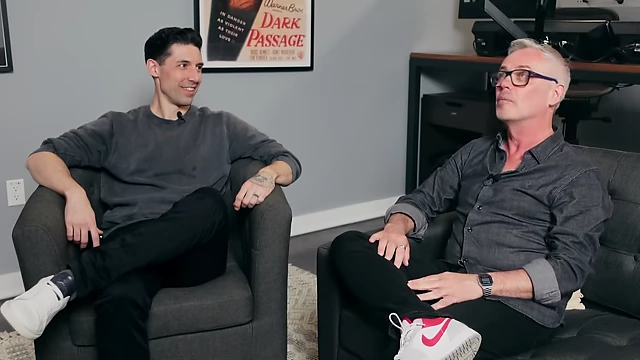
Darren Mostyn and Cullen Kelly discussing color grading workflows [ 00:03:10 ]
Cullen Kelly's New Studio Space [00:00:45]
- Cullen Kelly relocated his studio to the Lola Visual Effects building in Los Angeles.
- This move was prompted by having two young children, making an offsite studio more practical.
- The new location offers a dedicated professional space away from home.
- The studio setup features a client area with a 77-inch LG CE3 monitor.
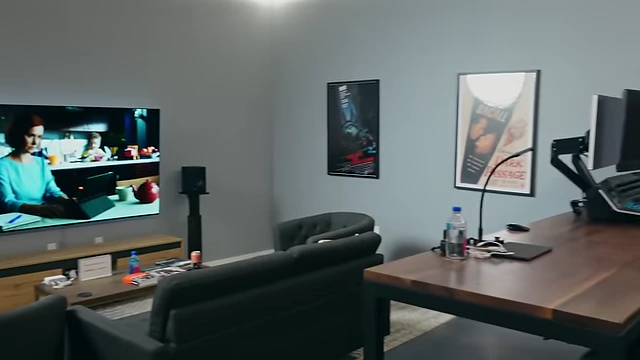
Cullen Kelly's color grading studio setup with a large client viewing screen [ 00:00:53 ] - Cullen sits behind the console, providing a designated zone for clients.
- He periodically comes out from behind the console to interact with clients face-to-face.
- The setup helps prevent clients from hovering over his workstation.
- Both Cullen and Darren use the Flandra Scientific XMP310 monitor.
- They praised its uniform 180-degree viewing angle, which ensures directors and DPs see the same image as the colorist.
- The studio's location within a VFX facility offers synergistic benefits.
- Easy access to VFX resources for tasks like screen replacements.
- Attracts new clients who need both VFX and color work.
- Provides professional amenities and security protocols (TPN certification) not available in a home setup.
Contrasting Node Tree Philosophies [00:09:41]
- Darren and Cullen, both experienced colorists, use different node tree structures in DaVinci Resolve.
- Darren's approach: Templated "Ripple Grading"
- He uses a larger, pre-built node tree, especially for documentary work.
- This allows for "ripple grading," where changes to specific nodes (e.g., node 7 for log tools) are quickly applied across groups of shots (e.g., by camera or scene).
- He prioritizes speed and efficiency for high-volume work (300-500 shots a day).
- His first few nodes focus on achieving a solid overall look (exposure, balance, saturation) before branching off for secondaries.
- He ensures qualifications for secondaries are fed from the original, unmanipulated image state to maintain consistency.
- Cullen's approach: "À la carte" and Adaptive
- He views his node tree as an "à la carte" system, adding nodes as needed for specific shots.
- His philosophy is that if more nodes are present, they will be used, and if fewer, fewer will be used, but the result remains similar.
- He constantly adjusts his first three nodes based on client feedback to address issues early, reducing the need for many secondary nodes later.
- He prefers to avoid having secondaries dependent on a specific image state that might change through primary adjustments, to prevent them from "breaking."
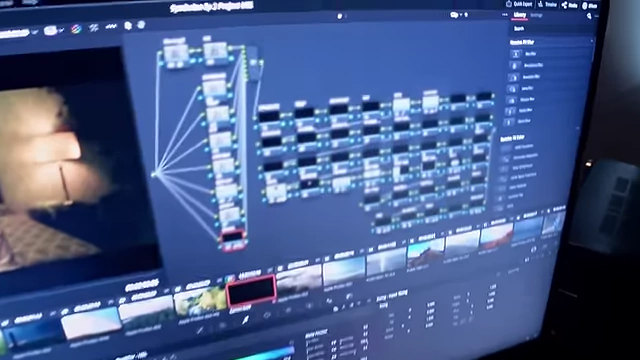
A complex DaVinci Resolve node tree on a monitor [ 00:18:37 ]
- Darren's approach: Templated "Ripple Grading"
- Both acknowledge the validity and effectiveness of each other's methods.
- Darren understands the logic of Cullen's adaptive approach, especially for narrative work.
- Cullen finds Darren's ripple grading fascinating for maintaining consistency across many shots.
- They aim for the same outcome: consistent, optimal adjustments across all necessary shots.
- Darren also mentions Mark Todd Osborne's extensive node tree, which shares similarities with his own templated approach.
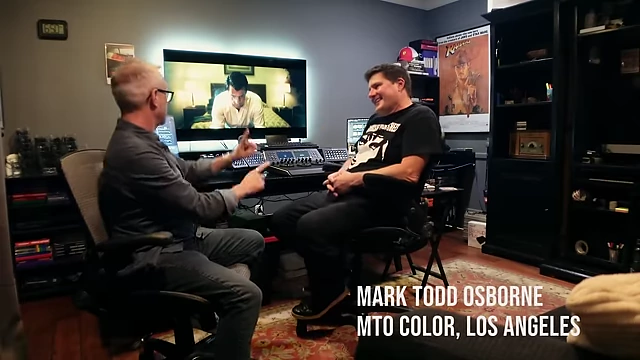
Darren Mostyn interviewing Mark Todd Osborne in his color grading studio [ 00:18:37 ]
YouTube Community and HDR [00:19:36]
- Darren and Cullen discussed their engagement with the YouTube community.
- Cullen recently passed 100 "Grade School" live sessions, highlighting the passion and consistent attendance of his community members.
- He sees live sessions as a "gym" for improving his on-camera communication skills, embracing technical hiccups as part of the live experience.
- Cullen's "Colorist Career Accelerator" course includes a Discord community of over 1,000 professional colorists, fostering knowledge exchange.
- Both appreciate the shift in the color grading industry from being secretive to more open and collaborative.
- They shared their perspectives on HDR for YouTube.
- Cullen mentioned his team successfully delivered an HDR film for YouTube, but it was a complex process taking days to figure out.
- He believes HDR should be simpler, essentially just a brighter image without needing drastically different display standards or complex tech specs.
- Darren agrees, stating that monitor calibration primarily affects brightness, not the gamma curve or image character.
- Cullen's friend describes HDR's main benefit as allowing images to hold up and look consistent under diverse viewing conditions (e.g., bright living rooms).
- Darren currently avoids HDR for YouTube to ensure broader accessibility for all viewers, regardless of their screen technology.
- They jokingly concluded that for color grading tutorials, optimal viewing conditions (e.g., at home, not a park bench) are more crucial than HDR.