Ranking 12 Popular ADHD Supplements by Clinical Evidence: What Works and What Doesn't
This video systematically ranks 12 popular ADHD supplements based on scientific evidence, categorizing them from F-tier (no evidence) to S-tier (highest evidence).
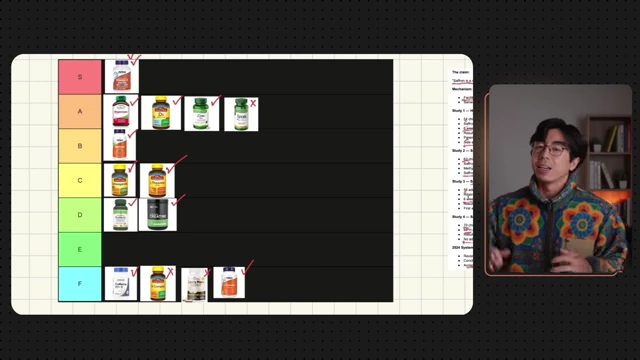
- F-Tier: Caffeine, Vitamin B, Lion's Mane, and Tyrosine lack significant scientific backing for core ADHD symptom improvement.
- D-Tier: Probiotics and Creatine show limited but promising results, with more research needed, especially regarding their impact on sleep and mood.
- C-Tier: Ashwagandha and L-Theanine offer emerging evidence for benefits in areas like emotional regulation, cognitive function, and anxiety, though often from "one-off" studies or in combination with other substances.
- B-Tier: Saffron demonstrates good evidence, even performing similarly to Ritalin for some symptoms and improving sleep.
- A-Tier: Magnesium, Vitamin D, Zinc, and Iron have strong clinical data. Many ADHD patients are deficient in these, and supplementation shows significant improvements in various ADHD-related symptoms and cognitive functions.
- S-Tier: Omega-3 (specifically EPA) has the highest level of clinical evidence, consistently linked to improving attention, reducing hyperactivity, and supporting overall brain function, especially in deficient individuals.
Introduction [0:00]
The video addresses the common frustration of finding ADHD supplement recommendations without scientific backing. The host, Eugene Yao, a dopamine coach completing a master's in neuroscience, reviewed published research to rank 12 popular ADHD supplements from F-tier (low to no evidence) to S-tier (highest evidence) based on clinical data. A disclaimer emphasizes that this is not medical advice, and viewers should consult a doctor before starting any supplements, especially if on ADHD medication.
F-Tier Supplements: Low to No Evidence [0:51]
Caffeine [0:51]
- Claim: Caffeine is a stimulant, similar to ADHD medications, so it should help.
- Mechanism: Increases norepinephrine and blocks adenosine, providing energy. However, it does not significantly raise prefrontal cortex dopamine and has a different mechanism than ADHD medication.
- Research Findings:
- A 2023 systematic review found no significant benefits for core ADHD symptoms when caffeine was used alone.
- Some studies indicated increased anxiety and impulsivity without improving focus.
- Why it Fails for ADHD: Spikes anxiety, disrupts sleep, and worsens restlessness, which are already challenges for ADHD brains. It's recommended to take caffeine 10 hours before bedtime due to its 5-hour half-life.
- Conclusion: F-tier. No evidence to support caffeine alone for ADHD symptoms.
Vitamin B [2:49]
- Claim: B vitamins are co-factors for dopamine and serotonin synthesis, essential for ADHD brains.
- Mechanism: B6 (PLP) is a co-factor in dopamine, serotonin, and GABA synthesis. B9 (folate) + B12 are involved in methylation and neurotransmitter production. Deficiency can impair brain function.
- Research Findings:
- A 2024 systematic review found associations between lower B vitamin levels and ADHD in children, but this was observational data (correlation, not causation) with no strong intervention trials.
- A 2023 meta-analysis of vitamin interventions for ADHD found Vitamin D to be the most effective, with B vitamins not standing out individually.
- Broad-spectrum micronutrient studies (e.g., with 36 ingredients) showed significant ADHD symptom improvement, but benefits couldn't be attributed solely to B vitamins.
- Conclusion: F-tier. No individual evidence that vitamin B solely improves ADHD symptoms.
Lion's Mane (Hericium erinaceus) [4:39]
- Claim: Boosts nerve growth factor, improves focus, and helps ADHD.
- Mechanism: Stimulates Nerve Growth Factor (NGF) production and crosses the blood-brain barrier.
- Research Findings:
- Zero ADHD-specific clinical trials.
- A 2023 pilot study on healthy young adults (41 participants, no ADHD) found it "may improve speed of performance, reduce subjective stress," but also noted "null findings" and a "tiny sample."
- A 2009 Japanese study on older adults (not ADHD) showed improved cognitive function in mild cognitive impairment.
- Conclusion: F-tier. No evidence to suggest it helps with ADHD symptoms.
Tyrosine [6:32]
- Claim: Tyrosine is a direct precursor to dopamine; since ADHD has low dopamine, taking tyrosine should make more dopamine.
- Mechanism: Tyrosine converts to L-DOPA, which converts to dopamine.
- Why it Doesn't Work: The brain regulates dopamine production; once enough dopamine exists, production slows down, regardless of excess tyrosine intake.
- Research Findings:
- A 2015 review found tyrosine helps under acute stress/cognitive demands but specifically in healthy populations, not ADHD. Potential for treating clinical disorders was "limited."
- An ADHD supplement review found "no evidence to support tyrosine for ADHD symptoms."
- Conclusion: F-tier. You already get plenty of tyrosine from protein-rich foods.
D-Tier Supplements: Limited but Promising Evidence [8:09]
Probiotics [8:09]
- Claim: The gut-brain axis affects dopamine and serotonin, so fixing the gut fixes ADHD.
- Mechanism: Gut bacteria influence neurotransmitter production (dopamine, serotonin, GABA). The gut-brain axis is a real biological connection.
- Research Findings:
- A 2023 meta-analysis of 15 RCTs on gut microbiota-based interventions showed a small but statistically significant benefit for ADHD, more effective than for autism. Multi-strain probiotics plus standard ADHD treatment showed stronger effects over 8-week interventions.
- Conflicting Evidence: A separate meta-analysis found no significant differences in gut diversity between ADHD and control groups. Data is heterogeneous and inconsistent.
- Conclusion: D-tier. Field is promising but very early; not enough strong, consistent evidence yet.
Creatine [15:43]
- Claim: Fuels the brain's energy system, improving executive function.
- Mechanism: Brain uses creatine for energy during demanding cognitive tasks. The theory is more brain fuel equals better executive function.
- Research Findings:
- A 2024 meta-analysis of 16 RCTs found creatine may help memory and processing speed in sleep-deprived or cognitively stressed people. It was not significant for executive function in well-rested healthy adults.
- The 2024 EFSA Panel concluded that a cause-and-effect relationship between creatine and cognitive improvement is not established.
- Zero ADHD-specific clinical trials.
- What's Promising: Showed great benefits for depression, which is highly comorbid with ADHD. It is safe, well-tolerated, and cheap.
- Conclusion: D-tier. Promising, especially for sleep-deprived individuals and depression, but needs more ADHD-specific trials.
C-Tier Supplements: Emerging Evidence, More Research Needed [10:08]
Ashwagandha [10:08]
- Claim: Reduces cortisol, calms the nervous system, improves focus, and is a perfect adaptogen for ADHD.
- Mechanism: Lowers cortisol (stress amplifies ADHD symptoms) and has GABAergic effects, modulating dopamine and serotonin.
- Research Findings:
- Study 1 (ADHD in children, 2024): 58 children (ages 5-12, mild ADHD) took 150mg/day for 56 days.
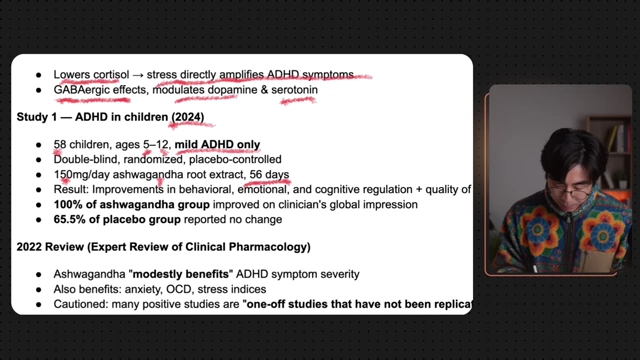
Ashwagandha study results showing 100% improvement in behavioral, emotional, and cognitive regulation in the treatment group. [ 00:11:10 ] - Resulted in 100% improvement in behavioral, emotional, and cognitive regulation + quality of life, vs. 65.5% of placebo group reporting no change.
- 2022 Review: Ashwagandha "moderately benefits" ADHD symptom severity, and also benefits anxiety, OCD, and stress. Cautioned that many positive studies are "one-off" and not replicated.
- Study 3 (Healthy adults, 2024): 59 healthy young adults took 225mg/day, improving memory, attention, vigilance, and executive function, and reducing tension and fatigue. (Note: This was not an ADHD population).
- Study 1 (ADHD in children, 2024): 58 children (ages 5-12, mild ADHD) took 150mg/day for 56 days.
- Conclusion: C-tier. Shows promising results, especially for stress, emotional regulation, and some cognitive aspects, but many studies are preliminary or not specifically on ADHD populations.
L-Theanine [13:01]
- Claim: Calms the ADHD brain without sedation and improves focus.
- Mechanism: An amino acid from green tea that promotes alpha brain waves, creating a calm but alert state. It crosses the blood-brain barrier.
- Research Findings:
- Study 1 (Sleep in ADHD boys, 2011): 98 boys with ADHD took 400mg daily for 6 weeks. Resulted in improved sleep efficiency but did not improve core ADHD symptoms (inattention, hyperactivity) when taken alone. Improved sleep can indirectly aid attention.
- Study 2 (L-Theanine alone vs. with caffeine, 2013): In 5 children with ADHD, L-Theanine alone worsened impulsivity, but L-Theanine + caffeine improved sustained attention and decreased impulsivity, indicating combination effects differ from either alone.
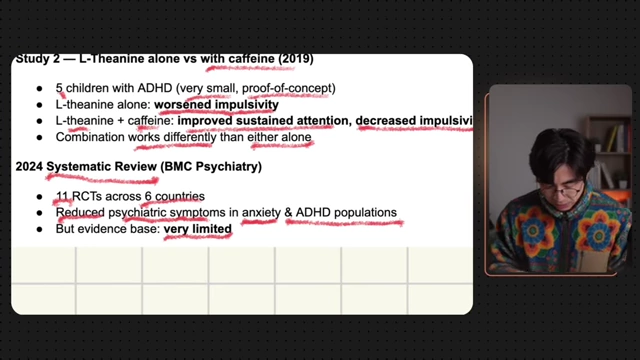
L-Theanine's contrasting effects: worsening impulsivity alone but improving attention and reducing impulsivity when combined with caffeine. [ 00:15:22 ] - 2024 Systematic Review: 11 RCTs across 6 countries showed reduced psychiatric symptoms in anxiety and ADHD populations, but the evidence base was very limited.
- Conclusion: C-tier. Improves sleep and can be beneficial when combined with caffeine for attention, but its standalone effect on core ADHD symptoms is not strongly established.
B-Tier Supplements: Good Evidence, Especially if Deficient [17:47]
Saffron [17:47]
- Claim: Natural stimulant, works as well as Ritalin for ADHD.
- Mechanism: Facilitates dopamine, serotonin, and noradrenaline release, targeting the same neurotransmitters as ADHD medication.
- Research Findings:
- Study 1 (Head-to-head vs Ritalin, 2019): 54 children (ages 6-17) showed no significant difference between saffron (20-30mg/day) and methylphenidate (Ritalin) on parent and teacher ADHD rating scales, with similar side effects.
- Study 2 (Saffron vs Methylphenidate with objective testing, 2022): In 63 children and adolescents (ages 7-17), saffron was more effective for hyperactivity, while methylphenidate was more effective for inattention. Saffron significantly improved time to fall asleep.
- Study 3 (Saffron + Ritalin in adults, 2022): 56 adults taking Ritalin + saffron (30mg/day) showed significantly better results than Ritalin alone for ADHD symptoms, a positive first adult ADHD trial for saffron.
- Study 4 (Saffron added to methylphenidate in children, 2021): In 70 children, the combination of MPH (Ritalin) + saffron was more effective than MPH alone, with no additional side effects.
- 2024 Systematic Review: Reviewed 4 clinical trials (118 total patients). Concluded saffron shows an "efficient role" as an adjunct or standalone therapy with an acceptable safety profile.
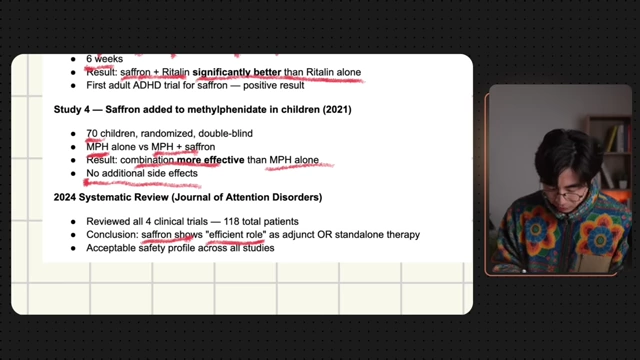
Saffron's efficacy as an adjunct or standalone therapy, showing significant improvement when combined with Ritalin. [ 00:21:00 ]
- Conclusion: B-tier. Strong evidence, performing comparably to or enhancing stimulant medications and improving sleep and hyperactivity.
A-Tier Supplements: Strong Clinical Data [21:39]
Magnesium [21:39]
- Claim: Calms the ADHD nervous system, improves sleep, and supports dopamine.
- Mechanism: Involved in over 300 metabolic reactions, regulates neurotransmitters, enhances GABA, and supports the nervous system. Most people, with or without ADHD, don't get enough magnesium from diet alone.
- Research Findings:
- A 2018 meta-analysis consistently found ADHD patients have significantly lower magnesium levels compared to healthy controls.
- MGH Pilot Study (Magnesium L-Threonate in adults): 15 adults with ADHD took Magnesium L-Threonate (which crosses the blood-brain barrier effectively) for 12 weeks. 47% met clinical response criteria, with improvements in attention, cognitive performance, and IQ scores.
- RCTs (Magnesium + Vitamin D in ADHD children): Showed significant improvements in conduct problems, social problems, anxiety, and overall mental health.
- Conclusion: A-tier. Robust evidence indicates ADHD patients are often deficient, and supplementation improves attention, cognitive performance, and behavioral issues.
Vitamin D [24:05]
- Claim: ADHD brains are often low in Vitamin D, and supplementing improves symptoms.
- Consistent Finding: Children and adults with ADHD have lower vitamin D levels than those without ADHD, consistently shown across multiple studies.
- Research Findings:
- A 2023 meta-analysis (reviewing studies from various sources) found Vitamin D supplementation to be more effective for ADHD behaviors than other vitamins studied.
- RCT 1 (Vitamin D + Magnesium in ADHD children): 66 children, double-blind, placebo-controlled, for 8 weeks, significantly reduced conduct problems, social problems, and anxiety.
- RCT 2 (Separate trial): Showed improvements in emotional problems, peer problems, and total difficulties scores.
- Conclusion: A-tier. Very strong evidence for widespread deficiency in ADHD populations and significant benefits for a range of ADHD behaviors and mental health issues.
Zinc [25:42]
- Claim: Regulates dopamine and can reduce ADHD symptoms.
- Mechanism: Directly modulates the dopamine transporter (DAT), which is the exact protein targeted by stimulant medications. This is a well-established neurobiology.
- Research Findings:
- Multiple meta-analyses consistently show children with ADHD have lower zinc levels.
- Two positive RCTs. A comprehensive review found zinc had some of the "best data of any ADHD supplement."
- Key Finding (Zinc + Stimulant Medication): Combining zinc with stimulant medications reduced the required medication dose by up to 40% in some studies. It also led to reductions in impulsivity and hyperactivity (though inattention was less consistently affected).
- Conclusion: A-tier. Strong evidence for deficiency in ADHD and its direct impact on dopamine transporters. It significantly aids in reducing medication dosage and improving hyperactivity/impulsivity.
Iron [27:26]
- Claim: Essential for dopamine production, and ADHD brains are often low.
- Mechanism: Without adequate iron, the brain cannot produce dopamine efficiently. If iron deficient, the enzyme using tyrosine is compromised. Iron is crucial for normal dopamine function.
- Research Findings:
- Landmark Study [2004]: 84% of ADHD children had significantly lower ferritin levels (iron storage protein) vs. 18% of children without ADHD.
- Multiple Meta-analyses (thousands of participants): Children with ADHD consistently have significantly lower serum ferritin. Severity of ADHD symptoms strongly correlates with the degree of iron deficiency.
- Brain Imaging Studies: ADHD children showed reduced iron in critical brain regions for attention, executive function, and motor control (frontal lobes, globus pallidus, caudate nucleus, substantia nigra, putamen, hippocampus).
- Clinical Trials: Iron supplementation in deficient children increased ferritin and decreased ADHD symptom scores.
- Conclusion: A-tier. Especially critical for individuals with iron deficiency (common in women with periods), as it directly impacts dopamine production and brain regions essential for core ADHD functions.
S-Tier Supplement: Highest Level of Evidence [30:20]
Omega-3 (Fish Oil) [30:20]
- Claim: Improves attention, reduces hyperactivity, and supports overall brain function in ADHD.
- Mechanism: EPA and DHA are building blocks of brain cell membranes. They support neurotransmitter signaling and have anti-inflammatory effects in the brain. EPA appears particularly important for ADHD.
- Evidence Level: CBEM Level-1 evidence (highest level of clinical evidence from Oxford Centre for Evidence-Based Medicine). This is supported by multiple systematic reviews and meta-analyses of Randomized Controlled Trials (RCTs).
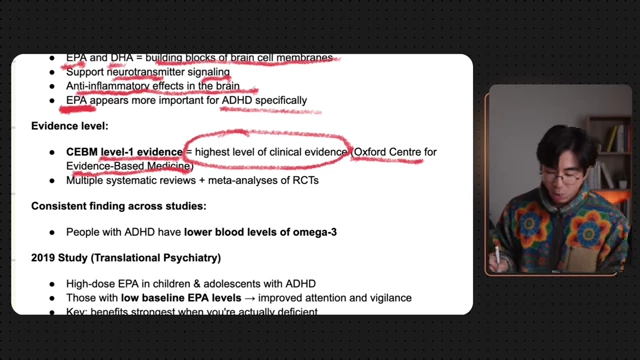
Omega-3 receives the highest level of clinical evidence (CEBM Level-1) for ADHD benefits. [ 00:31:30 ] - Consistent Finding Across Studies: People with ADHD consistently have lower blood levels of omega-3.
- Research Findings:
- 2019 Study (Translational Psychiatry): High-dose EPA in children and adolescents with ADHD (especially those with low baseline EPA levels) improved attention and vigilance. Benefits are strongest when deficient.
- 2023 Review (Frontiers in Nutrition): Confirmed omega-3 insufficiency is linked to ADHD, attention deficits, sleep disturbances, and mood dysregulation. Supplementation, especially combined with other nutrients, has protective effects on brain health.
- 2016 Review: Omega-3 has a positive effect on ADHD. Stimulant medication doses could potentially be reduced when combined with omega-3.
- What it Improves: Attention, hyperactivity, impulsivity, mood, and sleep. It hits multiple ADHD symptoms simultaneously.
- Conclusion: S-tier. Unparalleled amount and quality of research supporting its significant benefits for a wide range of ADHD symptoms and overall brain health.
Personal Supplement Regimen [33:19]
The presenter shares his personal supplement routine, emphasizing this is not medical advice:
- Caffeine: Takes in the morning with L-Theanine, 90 minutes after waking up.
- L-Theanine: Takes in the morning.
- Probiotics: Consumes yogurt daily.
- Creatine: Takes 10 milligrams after lunch.
- Ashwagandha: Cycles 8 weeks on, 2 weeks off; takes morning and night for anxiety and sleep.
- Saffron: Takes just before bed to help with sleep.
- Zinc: Takes after lunch.
- Vitamin D: Takes after lunch.
- Magnesium: Takes before bed (specifically Magnesium L-Threonate).
- Omega-3: Takes nearly 3,000 mg of EPA, morning and night, which is double the usual dosage. He advises caution and consulting a doctor for high doses.