Companies Pivot to Bitcoin Treasury Strategies for Stock Growth and Capital Access
A growing number of companies, from web design firms to hotel chains, are adopting a "Bitcoin treasury" strategy to boost their market value and stock prices. This trend was pioneered by MicroStrategy, which saw its stock soar by using capital raised from issuing stock and debt to acquire more Bitcoin. The strategy, dubbed an "infinite money glitch," involves selling company stock at a premium to the value of its Bitcoin holdings, then using the proceeds to buy more Bitcoin, further inflating stock and Bitcoin prices. Over 130 listed companies now collectively hold over 800,000 Bitcoins, driven by the belief that Bitcoin can unlock investor enthusiasm and capital market access. The US political landscape, particularly the Trump administration, has embraced crypto, leading to relaxed regulations that further encourage corporate Bitcoin adoption. While this strategy has led to significant stock price surges for many companies, it remains untested in a prolonged cryptocurrency downturn and raises concerns about shareholder alignment and financial risks.
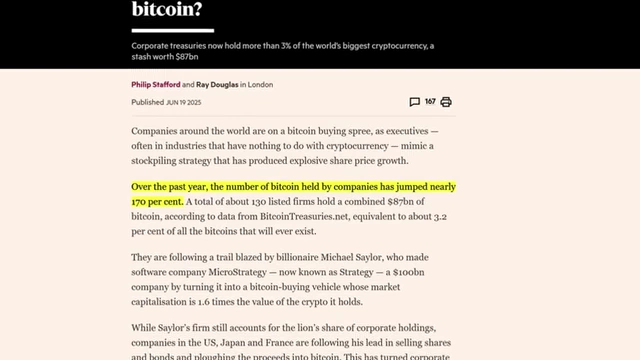
The Emergence of Bitcoin Treasury Companies [0:00]
Companies are increasingly adopting Bitcoin as a core treasury strategy, a trend exemplified by the surge in market value of firms that announce Bitcoin purchases.
- Smarter Web Company Example [0:00]
- A British web design firm saw its market value explode from £4 million to over a billion pounds in two months after announcing Bitcoin purchases.

News headline on Smarter Web Company's Bitcoin strategy [ 00:00:16 ] - This phenomenon is not directly tied to Bitcoin's price appreciation alone but to market perception.
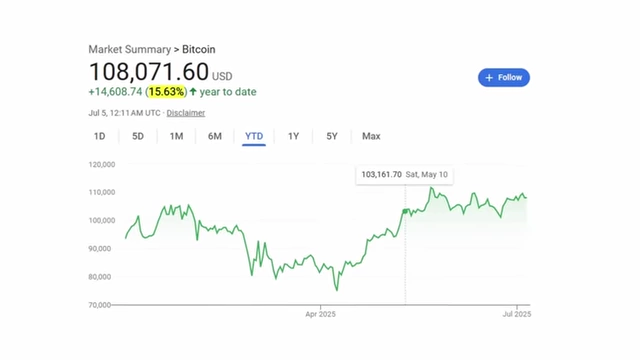
Bitcoin's year-to-date market performance [ 00:00:24 ]
- A British web design firm saw its market value explode from £4 million to over a billion pounds in two months after announcing Bitcoin purchases.
- MicroStrategy's Pioneering Role [0:00]
- The trend originated as an "experiment" by MicroStrategy, a US software firm, which became a $100 billion company through aggressive Bitcoin accumulation.

Article on high premiums for Bitcoin treasury companies [ 00:00:40 ] - MicroStrategy's core software business is unprofitable and generates tiny revenues.
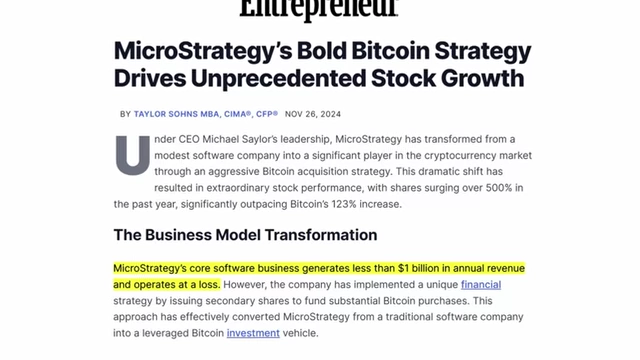
Article highlighting MicroStrategy's core software business operates at a loss despite its Bitcoin strategy [ 00:01:07 ] - The company recently changed its name from "MicroStrategy" to "Strategy" [1:14] to reflect its new, bolder direction.
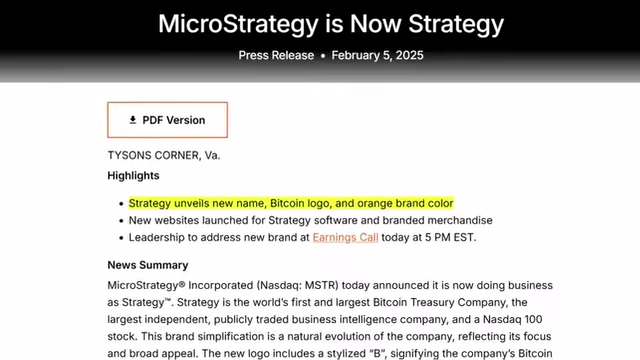
MicroStrategy's press release announcing its name change to "Strategy" [ 00:01:18 ] - The core strategy relies on investors paying a premium for a company that holds Bitcoin, allowing the company to sell stock, buy more Bitcoin, and perpetuate the cycle. [1:42]
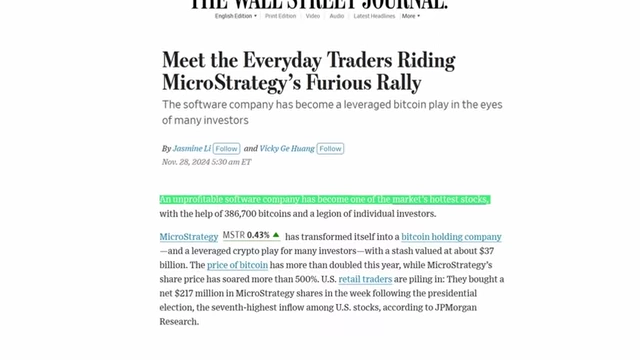
Wall Street Journal article describing MicroStrategy as an "unprofitable software company" turned Bitcoin play [ 00:01:35 ] 
Article questioning MicroStrategy's valuation premium over its Bitcoin holdings [ 00:01:46 ] 
Different forms of the Efficient Market Hypothesis [ 00:02:07 ]
- The trend originated as an "experiment" by MicroStrategy, a US software firm, which became a $100 billion company through aggressive Bitcoin accumulation.
- Past Controversies of MicroStrategy's Founder [2:28]
- Michael Saylor, the CEO, faced an SEC fraud accusation in 2000 for misreporting profits during the dot-com bubble. [2:54]
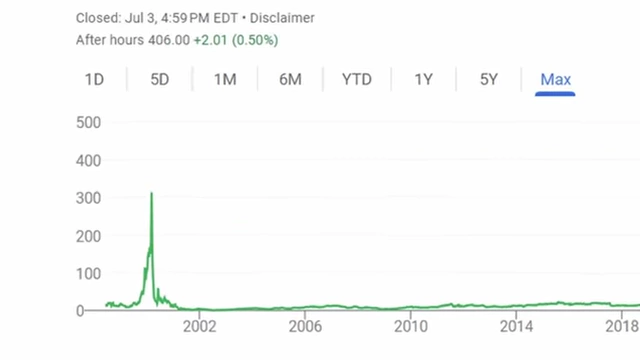
MicroStrategy's stock performance over time, showing the dot-com bubble peak and the recent Bitcoin-driven surge [ 00:03:00 ] 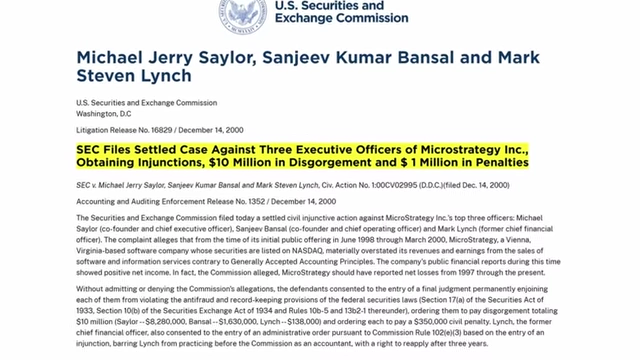
SEC filing detailing fraud accusations against Michael Saylor and other MicroStrategy executives in 2000 [ 00:02:44 ] - He also recently settled a $40 million tax fraud lawsuit. [3:20]
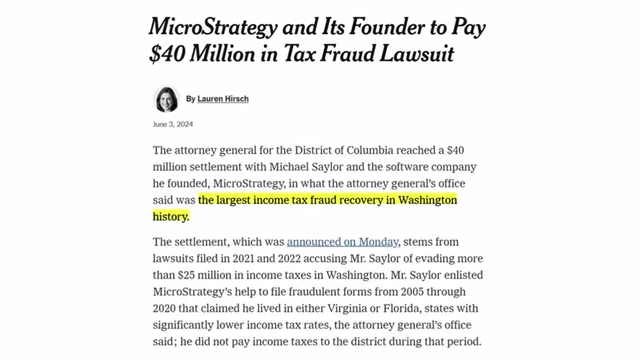
News on Michael Saylor's $40 million tax fraud lawsuit settlement [ 00:03:25 ] - Despite these issues, Saylor's strategy has been widely copied due to its perceived success.
- Michael Saylor, the CEO, faced an SEC fraud accusation in 2000 for misreporting profits during the dot-com bubble. [2:54]
Global Adoption and Industry Shifts [3:46]
The "Bitcoin treasury company" model, once a niche strategy, has gained significant traction worldwide, influencing diverse industries.
- Surge in Corporate Bitcoin Holdings [4:13]
- The number of listed companies holding Bitcoin has surged by nearly 170% in the past year. [4:13]
- Over 130 firms now collectively own more than 800,000 Bitcoins, representing over 3% of the total supply. [4:19]
Article on the significant increase in listed companies holding Bitcoin [ 00:04:16 ] - These companies span various sectors including web design, mining, healthcare, video game retail, and media. [4:29]
- Notable Company Examples
- Metaplanet (Japanese Hotel Developer) [9:24]
- Tesla [9:35]
- Initially bought $1.5 billion in Bitcoin in 2021, sold 75% a year later, but has since become a significant holder again. [9:38]
- Reported a $600 million earnings boost due to accounting rule changes recognizing crypto price rises, while quietly excluding a $97 million crypto loss. [9:56]
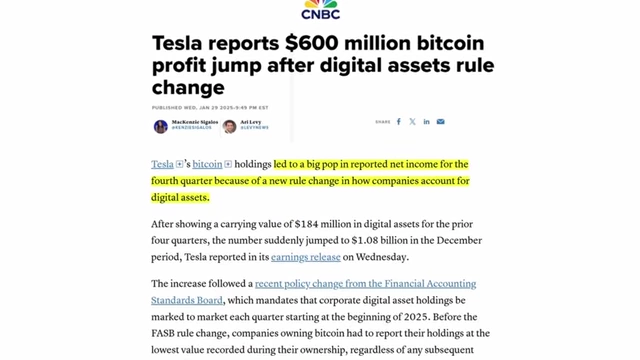
CNBC report on Tesla's Bitcoin profit due to accounting rule changes [ 00:10:03 ] 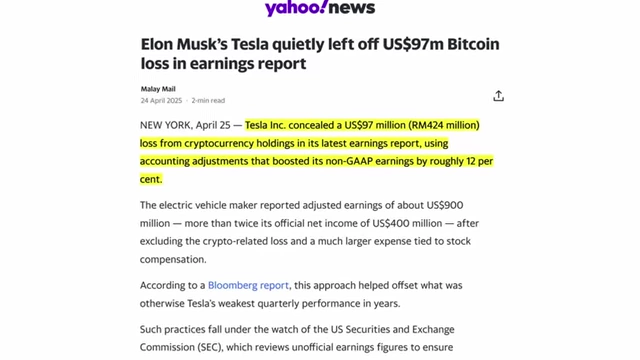
Yahoo News report on Tesla's exclusion of Bitcoin losses from earnings [ 00:10:15 ]
- Block (Jack Dorsey's Company) [10:26]
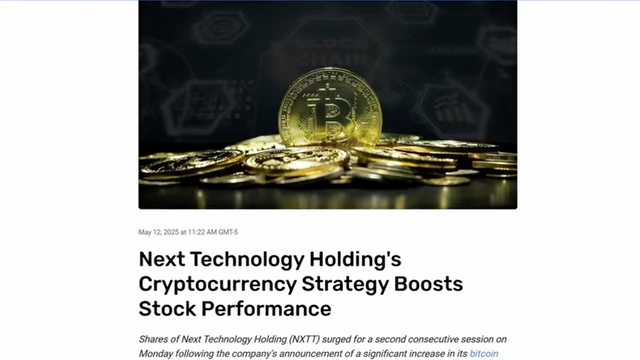
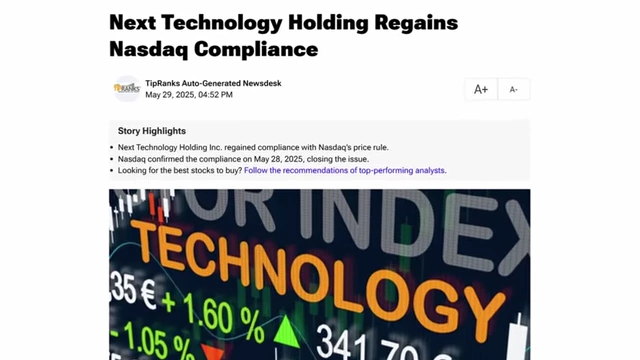
- Next Technology Holding (Chinese AI Software) [10:46]
- GameStop's Unique Case [11:12]
- Announced Bitcoin purchases, which surprisingly caused its stock price to fall 10%, suggesting investors prefer the company to focus on its core (unprofitable) retail business. [11:17]
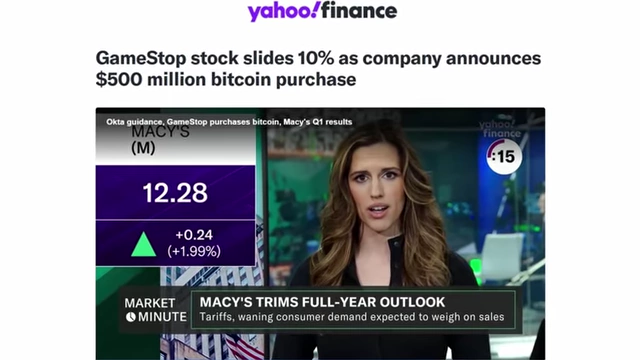
Yahoo Finance report on GameStop's stock drop after Bitcoin purchase [ 00:11:18 ] 
Article detailing GameStop's financial losses across all operating regions [ 00:11:40 ]
- Announced Bitcoin purchases, which surprisingly caused its stock price to fall 10%, suggesting investors prefer the company to focus on its core (unprofitable) retail business. [11:17]
- UK Firms Join the Trend [11:43]
- London, historically cautious, has seen a wave of small-cap British firms become Bitcoin treasury companies. [11:48]

Financial Times report on London-listed companies adopting Bitcoin treasury strategy [ 00:11:53 ] - At least nine UK-listed companies announced plans to add Bitcoin to their corporate treasuries in one week in June. [12:06]

Excerpt highlighting the number of UK firms adopting Bitcoin treasury [ 00:12:08 ] - Most UK firms adopting this strategy are small, loss-making companies with tiny trading volumes, seeing Bitcoin as a solution for explosive share price growth. [13:14]
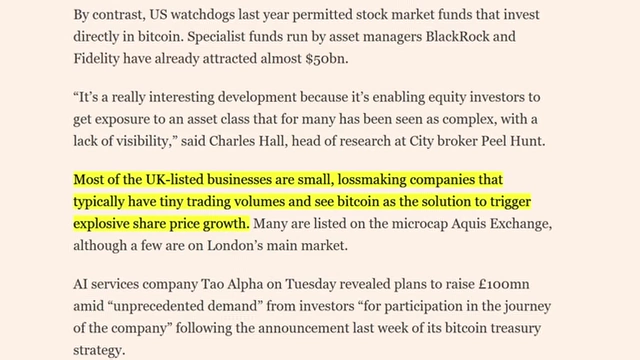
Article excerpt on UK small-cap firms using Bitcoin for share price growth [ 00:13:23 ]
- London, historically cautious, has seen a wave of small-cap British firms become Bitcoin treasury companies. [11:48]


Political and Regulatory Influence on Crypto Adoption [6:31]
Political figures and government actions, particularly in the US, have played a role in legitimizing and encouraging corporate crypto ventures.
- US Administration's Embrace of Crypto [6:37]
- The Trump administration has embraced crypto as an economic pillar. [6:52]
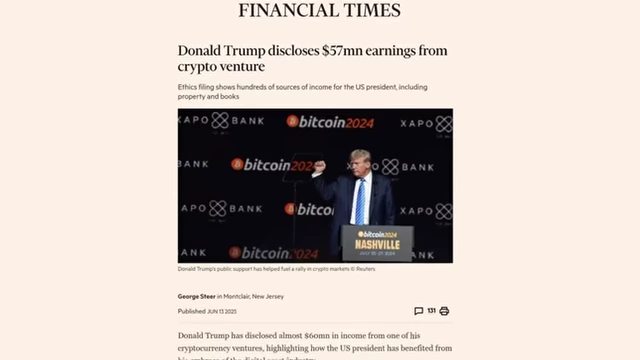
Financial Times report on Donald Trump's crypto earnings [ 00:06:49 ] - Vice President J.D. Vance declared Bitcoin and digital assets "part of the mainstream economy and are here to stay." [7:00]
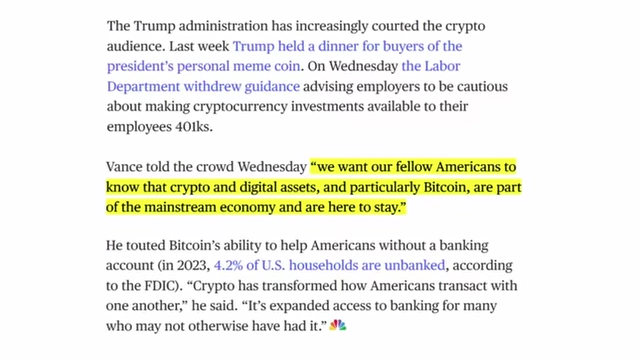
Quote from J.D. Vance on crypto being part of the mainstream economy [ 00:07:08 ]
- The Trump administration has embraced crypto as an economic pillar. [6:52]
- Relaxed Regulatory Environment [7:15]
- The SEC has dropped or paused numerous crypto-related cases and investigations. [7:21]
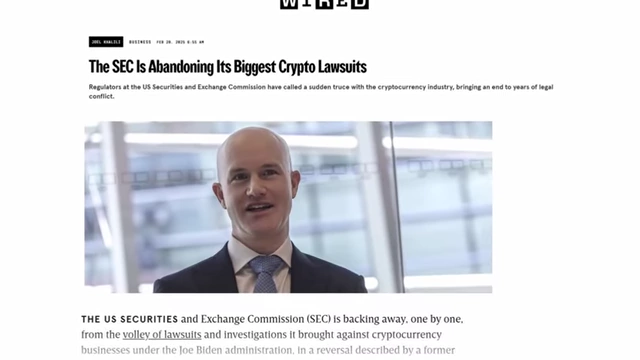
Wired article reporting the SEC abandoning major crypto lawsuits [ 00:07:25 ] - The Department of Justice disbanded its crypto enforcement team. [7:27]

Report on the US Department of Justice disbanding its crypto crimes team [ 00:07:28 ]
- The SEC has dropped or paused numerous crypto-related cases and investigations. [7:21]
- Politically-Tied Crypto Ventures [7:50]
- President Trump's family's media company confirmed plans to raise $2.5 billion to buy crypto. [7:51]
- Twenty One Capital, influential in El Salvador's Bitcoin legal tender status, struck a deal with Caner Equity Partners (backed by Commerce Secretary Howard Lutnik's son) to buy billions of dollars of Bitcoin. [8:00]

Financial Times report on 21 Capital's merger and Bitcoin acquisition strategy [ 00:08:12 ] - Strive (asset management firm) and American Bitcoin (crypto miner part-owned by Trump's sons) announced a merger to gain stock market access for Bitcoin acquisition vehicles. [8:32]
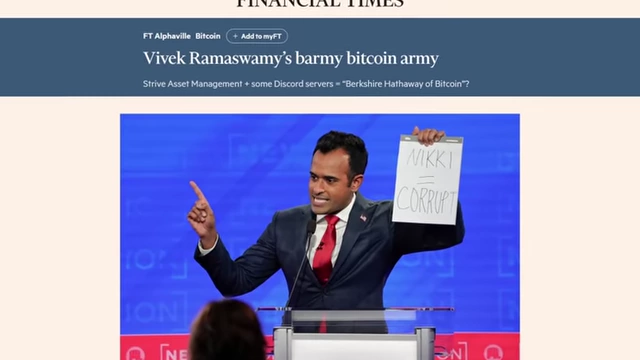
Financial Times article on Vivek Ramaswamy's involvement with Bitcoin [ 00:08:35 ] - Nakamoto Holdings merged with an opioid healthcare group, KindlyMD, to form a corporate Bitcoin treasury. [9:06]

Cointelegraph report on Nakamoto Holdings' merger to form a Bitcoin treasury [ 00:09:11 ] - Michael Saylor of MicroStrategy is actively advocating for large companies like Microsoft to buy Bitcoin instead of traditional stock buybacks. [12:45]

Michael Saylor, CEO of MicroStrategy [ 00:12:27 ] 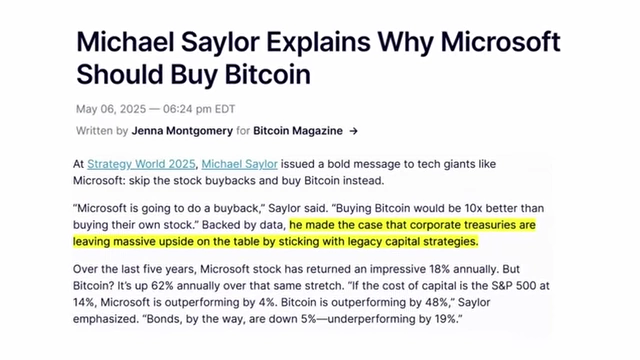
Article on Michael Saylor advocating for Microsoft to buy Bitcoin [ 00:12:49 ]
Investment Mechanics and Inherent Risks [15:00]
The financial mechanisms behind these corporate Bitcoin strategies, while seemingly lucrative, carry significant complexities and risks.
- Premium Valuation and Market Inefficiencies [15:15]
- British investors are buying shares in Bitcoin treasury companies at huge premiums, even though direct Bitcoin ETFs are banned for retail investors in the UK. [15:01]

Morningstar article on UK's proposed lifting of the crypto ETF ban [ 00:15:06 ] - American investors paying a premium is "much more confusing" given the existence of Bitcoin ETFs. [15:32]
- British investors are buying shares in Bitcoin treasury companies at huge premiums, even though direct Bitcoin ETFs are banned for retail investors in the UK. [15:01]
- Convertible Bonds as Funding [15:40]
- MicroStrategy frequently uses convertible bonds, which offer lower fixed interest but can convert to shares at an agreed price, providing equity upside with perceived bond downside protection. [15:43]
- The high volatility of MicroStrategy stock allows it to issue bonds with higher conversion premiums or even zero interest. [16:06]
- This volatility benefits convertible bond holders who often hedge their exposure, while leveraged ETF buyers, who bet against volatility, are harmed. [16:34]
- Risks and Governance Concerns [18:12]
- Bitcoin treasuries are untested in a prolonged cryptocurrency downturn, which could lead to struggles in repaying debt used for acquisitions. [18:16]
- Not all shareholders are aligned with transforming operating companies into crypto funds. [19:01]
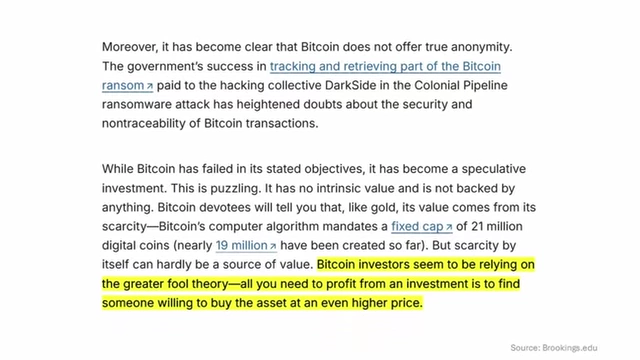
Brookings article on Bitcoin as a speculative investment relying on the "greater fool theory" [ 00:18:52 ] - Boards will face increasing pressure to justify these risks, especially if the strategy fails. [19:16]
Bitcoin's Evolving Narrative [19:27]
Bitcoin's role and perception have shifted dramatically since its inception, moving away from its original decentralized ethos.
- Original Intent vs. Current Use [19:33]
- Bitcoin was created after the 2008 financial crisis as a decentralized, transparent alternative to traditional finance. [19:35]
- It was initially seen as a currency for transactions, then an appreciating asset, and later "digital gold." [19:58]
- The "digital gold" narrative failed when its value dropped during inflation post-pandemic. [20:06]
- Push for Centralized Adoption [20:13]
- Now, investors are trying to encourage central banks and companies to buy Bitcoin, which contrasts with its original decentralized intention. [20:16]
- The current strategy involves investors gaining exposure by buying locally listed stocks at a significant premium to their Net Asset Value (NAV), denominated in local currency, which is described as confusing. [20:25]