Game Theory Reveals the Simple Strategy of "Tit for Tat" for Long-Term Success and Cooperation
This video explores game theory, defining it as the mathematical study of decision-making in situations where outcomes depend on others' choices. It illustrates this through the Prisoner's Dilemma, using a relatable roommate scenario about doing dishes. The video highlights two types of games: cooperative (shared goals) and non-cooperative (individual interests). It discusses a one-off "Golden Balls" game where "stealing" is the rational dominant strategy. However, real-life interactions are complex and repeated. Political scientist Robert Axelrod conducted tournaments using an "iterated prisoner's dilemma" to find the most effective strategy in repeated interactions. Surprisingly, the simple "Tit for Tat" strategy won consistently. This strategy involves starting with cooperation, then mirroring the opponent's last move, and being forgiving. It succeeded by fostering long-term cooperation, proving that an approach focused on overall success, rather than individual wins, is most effective.

The Roommate Dilemma: An Introduction to Game Theory [0:00:12]
The video opens with a relatable scenario of two roommates establishing chores, specifically dishes. Initially, they cooperate, but then one roommate begins to shirk their responsibility, leaving the other to decide whether to cooperate (do the dishes) or defect (leave them). This highlights the core challenge of decision-making when outcomes depend on another's choices.
Understanding Game Theory [0:02:40]
Game theory is introduced as the mathematical study of decision-making and strategies where outcomes are interdependent.
- The Prisoner's Dilemma [0:01:15]
- The roommate situation is a version of the Prisoner's Dilemma, a classic game theory concept where two individuals would benefit from cooperation but have an incentive to act selfishly, leading to a worse outcome for both if both defect.
- In the roommate example, the incentive is avoiding chores; the outcome is either a clean or messy kitchen and relationship.
- Definition of Game Theory [0:02:40]
- It is essentially the science of strategy in various contexts like social interactions, business, economics, and politics.
- Decisions, ranging from household chores to international relations, constantly impact all involved parties.
- Cooperative vs. Non-Cooperative Games [0:04:51]
- Cooperative Games [0:04:59]: Involve shared goals, free exchange of resources and information, and pursuit of mutual benefit (e.g., sports teams, business partners, international alliances).
- Non-Cooperative Games [0:05:18]: More prevalent, typically involve winners and losers as players act independently in self-interest, potentially at an opponent's expense.
- Dominant Strategy in One-Off Games [0:06:14]
- Using the example of the British game show "Golden Balls," where players decide to "split" or "steal" a sum of money in a one-off interaction.

A man stands at a crossroads, with one path labeled "STEAL" next to a pile of money, and another path "UNDER CONSTRUCTION" [ 00:06:46 ] - The dominant strategy is to "steal" because it yields the best result for a player regardless of the other player's choice.
- This is a "weakly dominant strategy" because if both steal, the payoff is the same as if both split (zero), but one is not exploited.
- Key difference from real life: Life interactions are rarely one-offs; they have lasting effects, involve repeated interactions, uncertainty, and complex outcomes.
- Using the example of the British game show "Golden Balls," where players decide to "split" or "steal" a sum of money in a one-off interaction.
Robert Axelrod's Tournaments: Discovering the Optimal Strategy [0:08:08]
Political scientist Robert Axelrod conducted experiments to find the most effective decision-making strategy in repeated non-cooperative interactions, similar to real-life scenarios.
- First Tournament Setup [1980] [0:08:16]
- Leading theorists submitted computer programs to compete in an iterated (repeated) version of the Prisoner's Dilemma.

A collection of 15 floppy disks, representing the programs submitted for Axelrod's tournament, including one labeled "random" [ 00:09:12 ] - Rules [0:08:37]:
- Each program played against every other program and a copy of itself.
- Players could either "cooperate" or "defect."
- Scoring:
- Both cooperate: 3 points each.
- One cooperates, one defects: Defector gets 5 points, cooperator gets 0.
- Both defect: 1 point each.
- Each game consisted of 200 rounds.
- The program with the most cumulative points won.
- Submitted Strategies [0:09:17]: 14 programs were submitted, ranging from "simple and nice" to "cunning and nasty," plus a random strategy.
- Results [0:09:42]:
- The tournament was run five times, yielding consistent results.
- The winner was "Tit for Tat," one of the simplest and most cooperative programs.

Table showing the ranking of programs in Axelrod's tournament, with Tit for Tat (TFT) at the top [ 00:09:47 ]
- Leading theorists submitted computer programs to compete in an iterated (repeated) version of the Prisoner's Dilemma.
- Second Tournament (More Realistic Conditions) [0:10:05]
- To better mirror real-world circumstances, the number of rounds per game was randomized and unknown, eliminating endgame calibration.
- 62 new strategies were submitted, plus a random one.
- Results [0:10:29]: "Tit for Tat" won again, reinforcing its effectiveness.
- This was surprising as many expected complex, competitive strategies to win.
The Tit for Tat Strategy [0:10:50]
"Tit for Tat" is a simple, yet robust strategy characterized by four key qualities:
- Gameplay Mechanics [0:10:50]
- Nice: Always starts with cooperation.
- Retaliatory: Copies the opponent's last move. If the opponent defects, Tit for Tat defects back.
- Forgiving: As soon as the opponent cooperates again, Tit for Tat returns to cooperating, not holding grudges for past defections.
- Clear: Its simple, predictable nature makes it easy for opponents to understand and respond to.
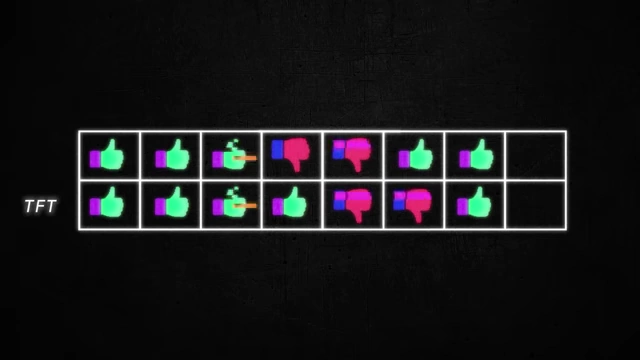
Visual representation of the Tit for Tat strategy, showing a sequence of cooperation (thumbs up) and defection (thumbs down) between TFT and an opponent [ 00:11:09 ]
- Why it Wins [0:11:22]
- Tit for Tat never won individual games (could only lose or draw) but won the overall tournament by fostering cooperation across many matchups, leading to the highest cumulative score.
- Its combination of niceness, retaliation, forgiveness, and clarity prevents exploitation, discourages persistent defection, restores cooperation, and elicits long-term cooperation.
- In later simulations with more chaotic conditions, a "generous" Tit for Tat (occasionally forgiving defections) proved even more effective.
- Nasty, highly competitive players often ended up in "defection wars" leading to mutual destruction.
- Cooperation emerges when players anticipate future interactions ("they might meet again").
Applying the Strategy and Acknowledging Limitations [0:12:35]
- Real-Life Implications [0:12:35]
- In repeated competitive interactions, leading with cooperation ("niceness") is a strength, not a weakness.
- Individuals who consistently defect are likely to weaken themselves over time.
- Holding grudges is a weakness; forgiveness is a strength.
- However, weakness itself is a weakness: letting oneself be wronged without consequence leads to exploitation.
- Consequences should be proportional, consistent, and clear, not manipulative, mirroring an "eye for an eye" ethos.
- On an individual level, this means being kind, forthright, and understanding, but never a pushover.
- Limitations of Game Theory [0:13:49]
- Programs and simulations cannot fully replicate the scale and complexity of real-world interactions.
- Real-life involves numerous people, issues, perspectives, goals, shifting opportunities, asymmetric leverage, known/unknown information, vast errors, chaos, and importantly, the emotional, sentimental, spiteful, and irrational nature of human beings.

Scattered golden orbs represent the many variables and complexities in real-world interactions [ 00:14:08 ]
Conclusion: The Path to Greater Wins [0:14:33]
Game theory teaches that constantly focusing on "winning" individual interactions can be less effective than a strategy that prioritizes long-term cooperation.
- Success across various areas of life requires accepting instances of draws and losses.
- By remaining open to trying again, standing up for oneself and one's values, and striving to meet and unite with the world around us, individuals can move towards "bigger, more important wins" of cooperation, kindness, and mutual benefit.
- While we cannot control others' choices, we can control our own decisions and understand their far-reaching influence on relationships, goals, systems, and even society.

A woman thinks about an abstract network diagram, representing the interconnectedness of decisions and their influence [ 00:15:32 ] - The video concludes with a simple call to action, relating back to the opening dilemma: "Let's be sure we do the dishes" when it's our turn.