The Current Crisis for Entry-Level Tech Jobs and What It Means for Software Engineering Careers
The tech job market is challenging for junior software engineers and new graduates, with entry-level hires significantly down.
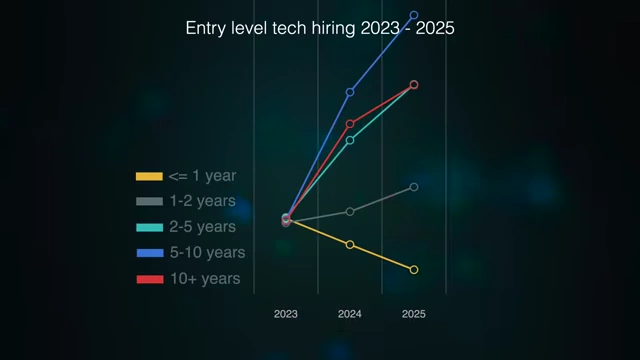
- Many "entry-level" job postings require 2+ years of experience, making true beginner roles scarce.
- Companies prioritize experienced engineers due to less risk and immediate productivity, a shift from the pre-2023 market.
- AI is beginning to handle simple, isolated tasks typically assigned to juniors, which can impact skill development, though the overall impact of AI on the labor market is currently debated.
- To navigate this market, new grads should focus on mastering fundamental skills rather than chasing fleeting trends.
- Despite high applicant numbers, much of the competition is "spray and pray," meaning focused, tailored applications for in-person or hybrid roles can reduce actual competition. The long-term outlook for experienced software engineers remains positive, with strong demand predicted over the next decade.
The Current Entry-Level Tech Job Market [0:00]
The tech job market is particularly tough for junior software engineers and new graduates.
- News reports indicate that new grad hiring has dropped 50% compared to pre-pandemic levels. [0:06]
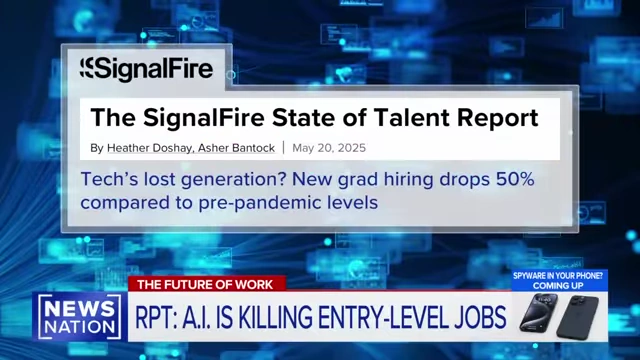
SignalFire report headline: Tech's lost generation? New grad hiring drops 50% compared to pre-pandemic levels. [ 00:00:06 ] - Entry-level tech hires are down 25% since 2023, even as hiring for mid-level and senior roles increases. [0:16]
Line graph showing entry-level tech hiring trends from 2023 to 2025, with hiring for <=1 year of experience declining while other experience levels increase. [ 00:00:20 ] - Anthropic CEO Dario Amodei predicted that up to half of all white-collar entry-level jobs might be eliminated by AI within 5 years. [0:24]

A quote from Dario Amodei, Anthropic CEO: "AI could wipe out half of all entry-level white-collar jobs and spike unemployment to 10-20% in the next one to five years." [ 00:00:28 ] - AI models are increasingly capable of performing tasks typically done by entry-level human workers. [0:31]
- Data from the Federal Reserve Bank of New York shows computer science graduates have one of the highest unemployment rates compared to other majors. [0:39]
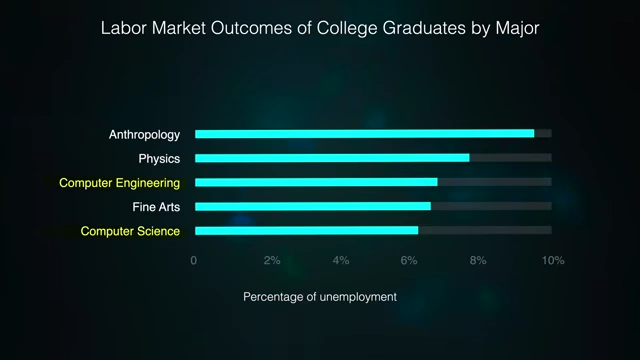
Bar chart titled 'Labor Market Outcomes of College Graduates by Major' showing the percentage of unemployment for Anthropology, Physics, Computer Engineering, Fine Arts, and Computer Science, with Computer Science exhibiting a relatively high unemployment rate. [ 00:00:44 ]
Understanding the Discrepancy in "Entry-Level" Job Postings [1:11]
There's a significant mismatch between the advertised "entry-level" roles and their actual experience requirements.
- About 22% of tech job postings are targeted at applicants with 0-3 years of experience. [1:18]
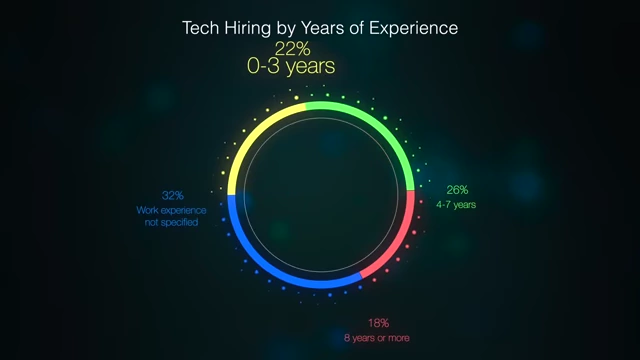
A donut chart showing 'Tech Hiring by Years of Experience,' with 22% of job postings for 0-3 years of experience. [ 00:01:20 ] - Although about a quarter of all software engineers in the US have under four years of experience, the number of truly entry-level positions doesn't match this proportion. [1:26]
- Many job postings categorized as "entry & mid-level" require at least 2 years of industry experience. [1:44]
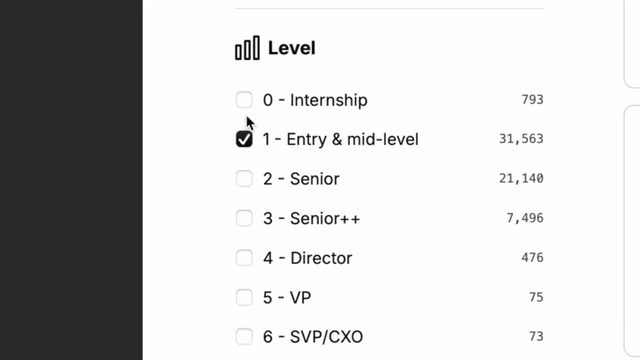
A screenshot of job level filter options on trueup.com, indicating 31,563 jobs categorized as 'Entry & mid-level'. [ 00:01:45 ] 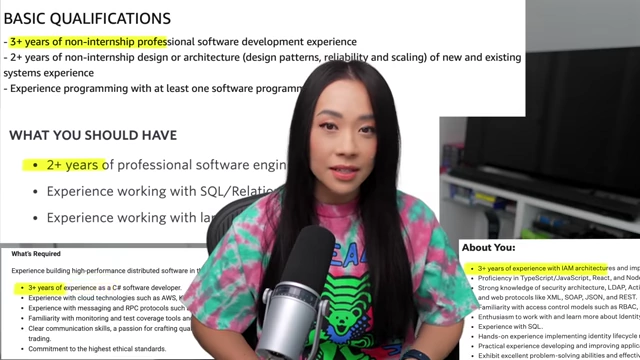
A split screen showing various job descriptions highlighting '2+ years' or '3+ years' of non-internship professional software development experience required for "entry-level" roles. [ 00:01:52 ] - A LinkedIn analysis found that most "entry-level" jobs required an average of two years of experience. [2:04]
- The only truly no-experience roles are internships, which are a small fraction of postings and often require current university enrollment. [2:13]
- A junior software engineer stated that "entry-level jobs now require ridiculous amounts of experience." [2:26]
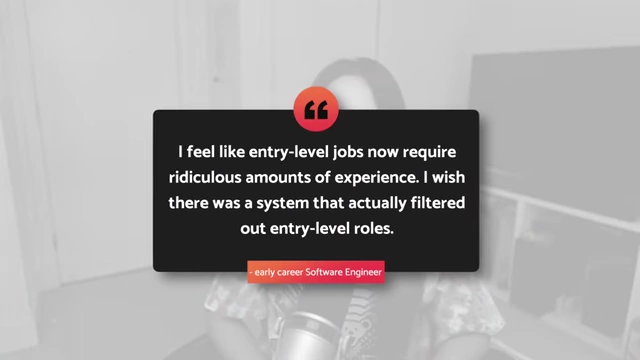
A quote box from an 'early career Software Engineer' stating, "I feel like entry-level jobs now require ridiculous amounts of experience. I wish there was a system that actually filtered out entry-level roles." [ 00:02:27 ]
- A junior software engineer stated that "entry-level jobs now require ridiculous amounts of experience." [2:26]
Why Companies Prefer Senior Engineers [2:59]
The current market favors senior hires for several strategic reasons.
- The job search is still challenging for seniors, but companies are more selective and demand higher technical proficiency, including "Leetcode hard" problems becoming common. [3:01]
- The World Economic Forum's 2025 future of jobs report indicates that "AI and big data" skills are becoming one of the necessary core skills by 2030. [3:25]
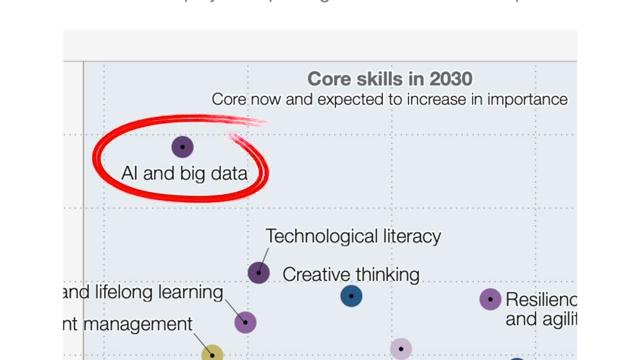
A segment of a chart titled 'Core skills in 2030,' highlighting 'AI and big data' as a core skill expected to increase in importance. [ 00:03:30 ] - The supply of senior engineers is naturally smaller due to attrition and career shifts within the industry, forming a "pyramid" structure where juniors make up the large base and seniors are at the smaller top. [4:57]
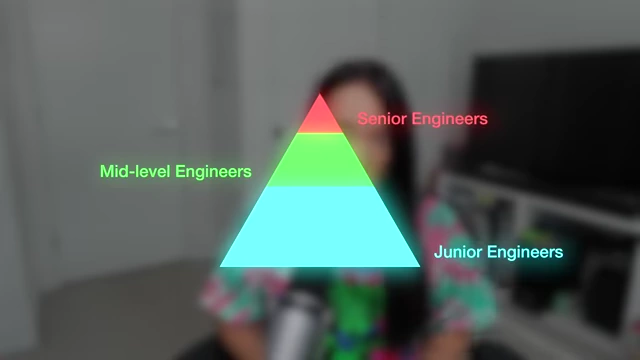
A pyramid diagram illustrating the distribution of engineers: Junior Engineers form the large base (blue), Mid-level Engineers are in the middle (green), and Senior Engineers are at the small top (red). [ 00:05:24 ] - Not all CS graduates become software engineers, and not all junior engineers aspire to become seniors or remain in the field. [5:02]
- Before 2023, a shortage of engineers compelled companies to hire juniors and bootcamp graduates, taking a "bet" on their potential. [5:37]
- From a company's perspective, juniors are a riskier hire:
- The current surplus of software engineers means companies no longer need to take these risks and can opt for experienced professionals. [6:26]
The Impact and Perception of AI on Junior Roles [6:33]
AI's role in the job market, particularly for entry-level positions, is complex and includes both practical effects and narrative hype.
- AI is already performing simple, isolated tasks (e.g., changing links, adding form validation) that were previously assigned to junior developers. [6:50]
- This impacts junior engineers' ability to learn fundamentals by solving simpler problems. [7:11]
- It's challenging to distinguish between AI hype and reality in job market shifts. [7:30]

A side-by-side cartoon depicting 'AI HYPE' as a strong, confident robot and 'AI REALITY' as a slumped, frustrated robot at a laptop, suggesting the current limitations of AI compared to public perception. [ 00:07:33 ] - Companies may use the narrative of AI replacing entry-level workers as a negotiation tactic to reduce employee leverage. [7:42]
- News headlines show that some companies are going "all-in on AI" leading to staff layoffs. [7:55]
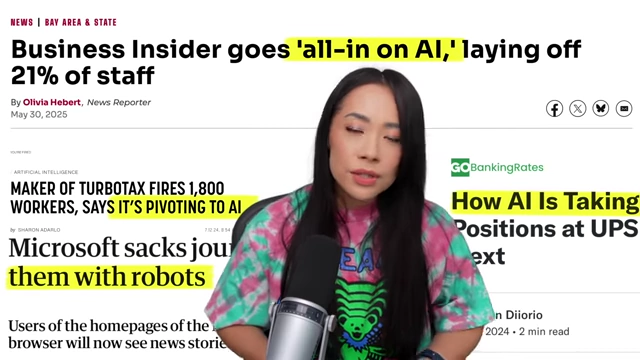
News headlines with titles such as 'Business Insider goes 'all-in on AI,' laying off 21% of staff' and 'MAKER OF TURBOTAX FIRES 1,800 WORKERS, SAYS IT'S PIVOTING TO AI'. [ 00:07:56 ] - Some companies, like Klarna and Duolingo, that attempted to replace staff with AI faced backlash and problems, discovering that customers prefer human interaction. [8:00]
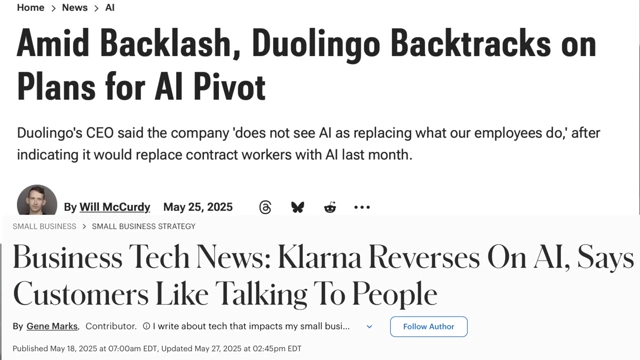
News headlines reporting 'Business Tech News: Klarna Reverses On AI, Says Customers Like Talking To People' and 'Amid Backlash, Duolingo Backtracks on Plans for AI Pivot'. [ 00:08:04 ] - A Federal Reserve Bank of New York survey indicated that AI's aggregate impact on the labor market is currently too small to be detectable. [8:14]
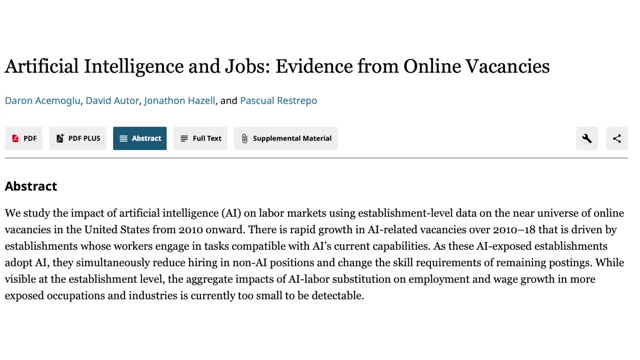
The abstract of a paper titled 'Artificial Intelligence and Jobs: Evidence from Online Vacancies', stating that 'the aggregate impacts of AI-labor substitution on employment and wage growth in more exposed occupations and industries is currently too small to be detectable.' [ 00:08:19 ]
Strategies for New Grads in a Competitive Market [8:38]
New graduates and juniors can enhance their job prospects by focusing on fundamental skills and strategic application.
- Avoid constantly chasing the "hot new trend" or framework; instead, build deep foundational knowledge in computer science. [9:06]
- Understand that reported competition numbers can be misleading. Many applicants engage in "spray and pray" tactics, applying to unqualified roles. [10:41]
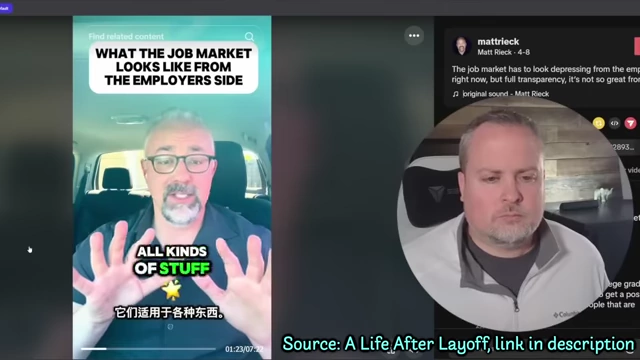
A TikTok video featuring a hiring manager explaining that 'most people just spray and pray' when applying for jobs, often for roles they are not qualified for. [ 00:10:59 ] - LinkedIn applicant counts often include anyone who clicked "apply" or "see more," not just those who completed the application. [11:15]

A TikTok video demonstrating how the applicant count on a LinkedIn job posting increases simply by clicking the 'Apply' button, even if the application is not completed. [ 00:11:26 ]
- LinkedIn applicant counts often include anyone who clicked "apply" or "see more," not just those who completed the application. [11:15]
- Consider applying for in-person or hybrid roles, as fully remote positions are significantly more competitive. [11:33]
- Securing the first job is the hardest; experience gained from an on-site or hybrid role will make future job searches easier. [11:53]
Long-Term Outlook for Software Engineering Careers [12:00]
Despite current challenges, the long-term future for experienced software engineers remains promising.
- The current difficulty in breaking into tech might lead to a future shortage of qualified, experienced engineers. [12:10]
- This scarcity could help maintain high salaries for skilled professionals. [12:45]
- As AI generates more code, there will likely be an increased demand for human engineers to debug, refine, and maintain "AI slop" and the resulting bugs. [12:50]
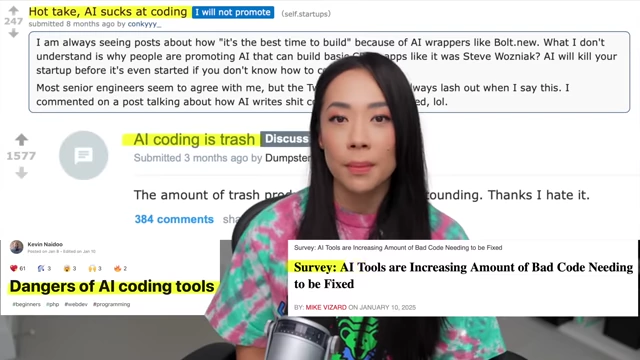
Screenshots of online discussions and news articles with titles like 'Hot take, AI sucks at coding' and 'Survey: AI Tools are Increasing Amount of Bad Code Needing to be Fixed,' highlighting issues with AI-generated code. [ 00:13:03 ] - Many senior engineers believe "AI can't code" effectively without human oversight. [13:02]
- Experts from organizations like the World Economic Forum and the Bureau of Labor predict strong demand for software engineers over the next decade. [13:20]
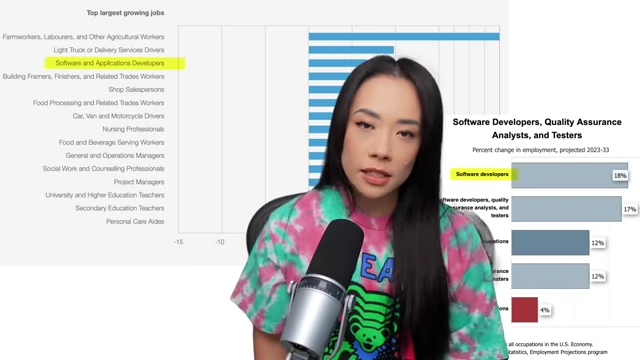
A bar chart from the Bureau of Labor Statistics showing a projected 18% increase in employment for 'Software Developers, Quality Assurance Analysts, and Testers' from 2023-2033. [ 00:13:22 ] - For new grads, enduring this challenging period and securing the first job is crucial, as the market is expected to brighten for mid-level and senior roles. [13:05]
- Focus on controllable factors like interview preparation and skill development, rather than dwelling on uncontrollable market conditions. [14:17]