DFUS vs. VTI: How a Non-Index ETF Outperforms a Total Market Index Fund
This video provides a detailed comparison of DFUS (Dimensional US Equity Market ETF) and VTI (Vanguard Total Stock Market ETF), explaining why DFUS has outperformed VTI since its ETF listing in June 2021.
- DFUS is a low-cost, broadly diversified US total market fund that does not track a specific index, allowing for evidence-based tweaks.
- VTI is a total US market index ETF that strictly tracks the CRSP US Total Market Index.
- Index Rebalancing Costs: Index funds like VTI incur "implicit costs" due to rigid quarterly rebalancing rules, which often force them to buy stocks when firms issue them (usually at high prices) and sell when firms buy back (usually at low prices). This leads to an estimated 60 basis point annual performance drag.
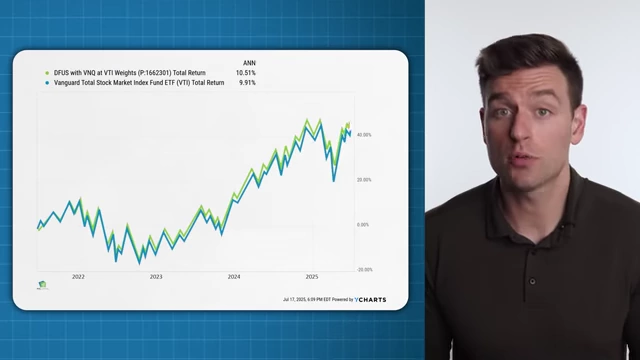
Performance of DFUS vs. VTI since June 2021 [ 00:00:20 ] - DFUS's Advantages: DFUS avoids these rebalancing costs by not tracking an index, delaying IPO purchases, and using trading rules to increase expected returns. It also excludes "junk" small-cap growth stocks known for poor returns and REITs, though the latter is a design choice.
- Market Coverage: While DFUS holds fewer stocks (2,430 vs. 3,564 for VTI), the excluded stocks represent a tiny portion (3.6%) of the total market cap, mostly consisting of REITs and poor-performing small caps.
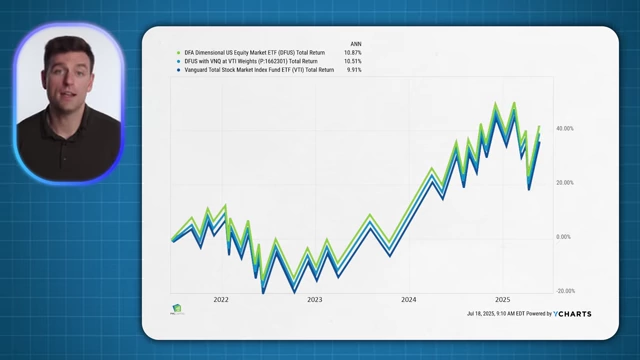
Comparison of DFUS + VNQ to VTI Performance [ 00:07:44 ] - Historical Context: Prior to its ETF conversion, DFUS (as mutual fund DTMEX) underperformed VTI, but this older data is not directly comparable due to DTMEX's different tax-efficiency objective, higher expense ratio, and lack of modern exclusion strategies.
- Conclusion: DFUS represents structural improvements over traditional index funds by being low-cost, diversified, tax-efficient, and intelligently avoiding market timing costs and poor-performing stocks. While this leads to tracking error relative to a benchmark, it can result in expected outperformance.
Introduction to Index Fund Limitations and DFUS [0:00]
The video revisits a previous comparison between DFUS and VTI, where DFUS (a non-index ETF) outperformed VTI (a total US market index ETF) since June 2021. The aim is to delve deeper into why non-index funds like DFUS can offer improvements over traditional index funds.
- Context and Purpose [0:00]
- The speaker previously compared DFUS (a low-cost total US market ETF that doesn't follow an index) to VTI (a total US market index ETF) to demonstrate potential benefits of not strictly following an index.
- Many viewers questioned this comparison, prompting a more detailed analysis.
- The video emphasizes that while low-cost total market index funds are excellent tools, they are not perfect and have room for improvement.
- DFUS vs. VTI Overview [2:06]
- DFUS (Dimensional US Equity Market ETF):
- A US total market fund designed to deliver market returns without strictly following an index.
- Implements evidence-based tweaks to its management and implementation.
- VTI (Vanguard Total Stock Market ETF):
- A US total market fund that tracks the CRSP US Total Market Index.
- Its sole objective is to closely track the index's performance, net of costs.
- Performance Observation [2:31]
- Since its launch as an ETF in June 2021 through July 2023, DFUS has outperformed VTI, while maintaining similar overall exposure to the total US stock market.
- DFUS (Dimensional US Equity Market ETF):
The Problem with Index Rebalancing [2:55]
Index funds, by their nature, are subject to "adverse selection" due to their rigid rebalancing rules, which can lead to implicit costs not visible in expense ratios.
- Understanding Index Rebalancing [2:55]
- Stock market indexes are representations of the market, not the market itself.
- Market composition changes daily due to IPOs, new share issuance, and stock buybacks.
- Most indexes, including VTI's underlying CRSP index, rebalance quarterly to reflect these changes.
- Between rebalancings, the index and the actual market will differ.
- Adverse Selection and Implicit Costs [3:36]
- Firms tend to issue stock when their share price is high and buy back stock when their price is low (similarly for IPOs).
- Index funds must follow the index, buying stock when firms issue or go public (often at high prices) and selling when firms buy back (often at low prices).
- This puts index fund rebalancing at odds with firms' own informed beliefs about their share prices.
- Research Findings: A 2023 paper, "Index Rebalancing and Stock Market Composition: Do Indexes Time the Market?", found that long-short portfolios mirroring index fund rebalancing trades have a negative 3.5% annual return.
- This translates to an estimated 60 basis point annual performance drag on the total market index.
- This "cost" is embedded in the index's returns, making it hard to discern for investors.
- "Lazy Indexes" and Returns [4:57]
- The paper suggests constructing "lazy indexes" that rebalance less frequently and incorporate a lag in incorporating market changes.
- These "lazy indexes" can boost returns by 40-60 basis points per year, primarily by avoiding buying stocks with low expected returns and selling stocks with high expected returns.
- While "lazy indexes" have higher tracking error relative to the actual market, the increase in expected returns outweighs the tracking error.

Index Rebalancing Concept [ 00:03:00 ] 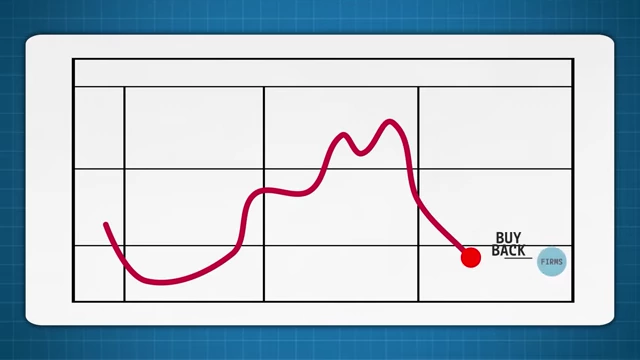
Stock Price Buyback Chart [ 00:03:50 ]
DFUS's Design Advantages and Exclusions [6:10]
DFUS, by not strictly tracking an index, largely avoids the adverse selection issues associated with index rebalancing and implements specific stock exclusions.
- Avoiding Rebalancing Issues [6:10]
- DFUS avoids the rebalancing problem by not tracking an index at all.
- It delays buying IPOs and follows trading rules designed to increase expected returns, rather than merely matching market composition changes.
- Stock Exclusions and Rationale [6:25]
- DFUS intentionally excludes certain types of stocks with historically poor returns:
- Small-cap growth stocks with weak profitability.
- Small-cap growth stocks with aggressive investment.
- Small-cap stocks with high securities lending fees (sometimes called "junk" or "small crap growth stocks").
- These exclusions, while not directly aimed at adverse selection from market composition changes, interact favorably with the research on rebalancing costs.
- REIT Exclusion: DFUS also excludes Real Estate Investment Trusts (REITs) as a product design choice, allowing investors to add REITs separately if desired.
- Addressing a common criticism: Adding a REIT allocation to DFUS (to match VTI's exposure) still leaves a significant portion of DFUS's outperformance attributable to its other exclusions and avoidance of adverse selection. The adjusted excess return (60 basis points) aligns with the findings from the index rebalancing research.
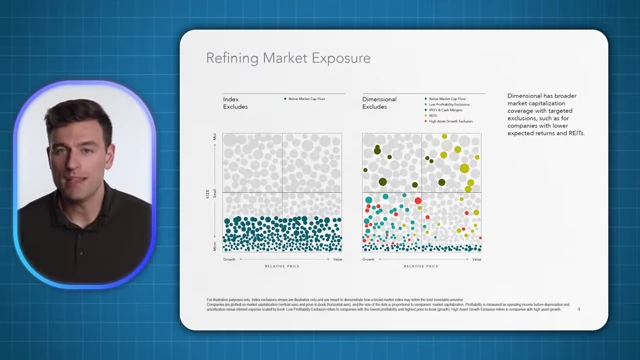
Refining Market Exposure with Exclusions [ 00:06:29 ]
DFUS + VNQ vs VTI Performance Comparison [ 00:07:44 ]
- Addressing a common criticism: Adding a REIT allocation to DFUS (to match VTI's exposure) still leaves a significant portion of DFUS's outperformance attributable to its other exclusions and avoidance of adverse selection. The adjusted excess return (60 basis points) aligns with the findings from the index rebalancing research.
- DFUS intentionally excludes certain types of stocks with historically poor returns:
- Market Coverage and Holdings [8:06]
- Number of Securities: VTI holds 3,564 stocks, while DFUS holds 2,430.
- Market Cap Weight Exclusions: Despite holding fewer stocks, DFUS excludes only a tiny portion of the market by market cap weight.
- The Russell 3000 index, against which DFUS is benchmarked, covers approximately 98% of the US stock market.
- DFUS excludes only 3.6% of the market cap weight covered by the Russell 3000.
- Of this 3.6%, roughly 2.6% are REITs, and the remaining 1% are the poor-performing small-cap exclusions.
- Over the sample period, these excluded small-cap stocks contributed a negative 0.1% to returns, indicating their removal was beneficial.
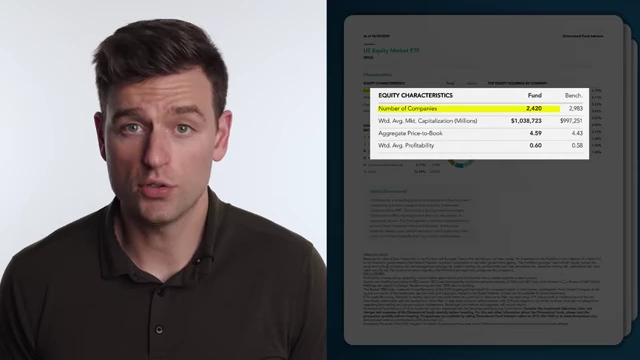
Number of holdings comparison for VTI and DFUS [ 00:08:29 ]
Historical Performance and ETF Conversion [9:56]
The pre-ETF performance of DFUS's predecessor (DTMEX) showed underperformance compared to VTI, but this data is not considered representative of DFUS's current capabilities due to significant structural and strategic differences.
- DTMEX (Predecessor Mutual Fund) Performance [10:02]
- From its inception (September 2001) through June 2021 (prior to ETF listing), VTI outperformed DTMEX by an annualized 0.47%.
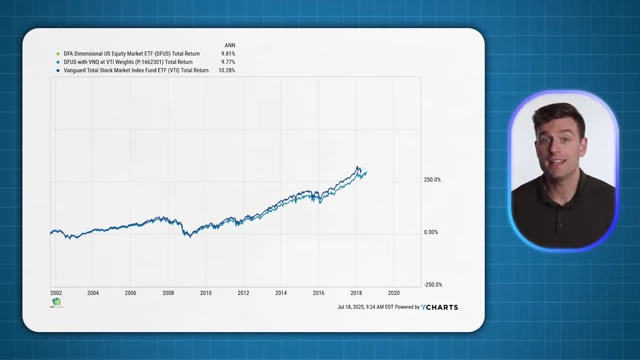
Historical performance comparison of DTMEX and VTI [ 00:10:13 ]
- From its inception (September 2001) through June 2021 (prior to ETF listing), VTI outperformed DTMEX by an annualized 0.47%.
- Reasons for Historical Discrepancies [10:33]
- Tax Efficiency Objective: DTMEX's primary objective was maximizing tax efficiency, leading it to hold lower dividend yield stocks and avoid short-term capital gains by holding stocks longer. DFUS, under its ETF structure, has more efficient ways to manage capital gains and no longer prioritizes holding low dividend yield stocks.
- Expense Ratios: DTMEX had a significantly higher expense ratio than VTI for most of their shared history.
- In 2001: DTMEX 0.25% vs. VTI 0.15%.
- By 2018: DTMEX 0.22% vs. VTI 0.03%, a 0.19% difference.
- Upon conversion to DFUS, the expense ratio dropped to 0.09%, only 0.06% higher than VTI.
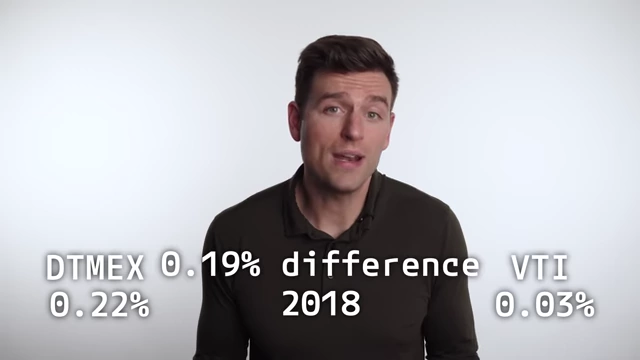
Expense ratio comparison over time for DTMEX and VTI [ 00:11:33 ]
- Evolution of Exclusions: The specific stock exclusions applied by DFUS (based on factors like profitability and aggressive investment) were developed from research conducted after DTMEX's launch and were introduced gradually, not being present for the full historical period.
- Conclusion on Historical Data Comparability [11:58]
- The speaker concludes that the pre-ETF and post-ETF conversion data are not comparable due to material differences in fund structure, objectives, and implementation of strategies.
- The recent outperformance of DFUS is considered indicative of its current expected performance, not just luck.
Final Thoughts on Index Investing and DFUS [12:24]
While index funds remain excellent investment tools, DFUS demonstrates how structural improvements beyond strict index tracking can lead to enhanced expected returns.
- Core Benefits of Total Market Funds [12:24]
- Both index and non-index total market funds share desirable characteristics: low cost, low turnover, broad diversification, and tax efficiency.
- Index Fund Limitations [12:33]
- Index funds are designed to represent the market, not be the market.
- They blindly follow indexes, aiming to match performance, but this can make them "bad market timers" due to the timing of market composition changes (e.g., share buybacks, issuance, IPOs).
- DFUS as an Improvement [12:51]
- DFUS delays incorporating changes in market composition and actively considers the expected returns of its holdings, leading to potential increases in expected returns.
- This approach differs from traditional active management, which often relies on concentrated portfolios or market timing, incurring higher fees and risking underperformance.
- DFUS maintains the benefits of a total market fund (low cost, diversified, tax-efficient) while adding structural enhancements.
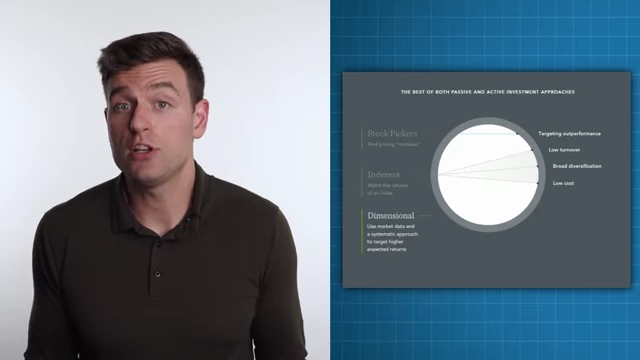
Traditional vs. Dimensional Approaches to Market Exposure [ 00:13:03 ]
- The Challenge of Tracking Error [13:47]
- The main "cost" of being different from the index is "tracking error" – performance that deviates from the benchmark.
- Periods of underperformance relative to well-known indexes can be challenging for investors to stick with the strategy.
- Despite this, for investors willing to accept tracking error and update their investment beliefs, minor improvements to low-cost total market investing are possible, and DFUS exemplifies this.