How to Guide Children from External Discipline to Self-Discipline and Foster Autonomy with Appropriate Freedom
This lecture by parenting author Shang Ruei-Jiun emphasizes the journey from parents controlling children to children developing self-discipline and autonomy. Key takeaways include:
- Parents must recognize children as independent individuals and appreciate their unique qualities.
- "Letting go" means empowering children with appropriate freedom and responsibility, not abandoning them.
- Parenting involves distinguishing between three types of matters: legally prohibited, those affecting family, and those solely belonging to the child.
- Parents should practice patience ("tolerate, stop, wait") and guide children to understand and manage their emotions.
- The family dynamic can evolve into one where children also care for parents, fostering a relationship built on love and trust.

A child gleefully runs down a path while an adult observes, embodying the "grab big, let go small" parenting concept. [ 00:09:27 ]
Parents' Awareness [0:07][0:47]
Parenting is a learned journey, not an innate skill, as evidenced by parents learning alongside their children's growth.
- Parents often sacrifice their freedom for their children, leading to children seeking more freedom as they grow.
- It's crucial for parents to recognize that a child is an independent individual with unique positive qualities, rather than focusing on differences as negative traits.
- Parents should learn to appreciate their child's unique personality and differences, encouraging their growth without imposing undue control.
Letting Go is Not Abandoning [6:10]
"Letting go" in parenting does not mean completely abandoning responsibility but rather guiding children towards self-management and independence.

- This concept is about "grab big, let go small," where parents set broad boundaries while allowing children freedom in smaller details.
A child gleefully runs down a path while an adult observes from a distance, embodying the "grab big, let go small" parenting concept. [ 00:09:27 ] - The speaker shares her personal journey of choosing to be a stay-at-home parent, highlighting that this was a choice with opportunity costs (career interruption) but allowed for better physical recovery and more time with her child, leading to a sense of freedom and enjoyment in parenting.
- As children grow, their sleep patterns change, allowing parents more personal time for self-care and hobbies.
- While children are young, parents provide full care; as they grow, they develop capabilities that allow parents to gradually release control.
- The speaker illustrates this with learning to ride a bicycle: parents initially support, then gradually let go as the child gains balance, always remaining nearby.

A child learns to ride a bike with a parent nearby, symbolizing gradually releasing control while still accompanying. [ 00:07:55 ] - Every aspect of parenting aims to prepare children for independent adulthood.
Two Concepts of Freedom [6:54]
The speaker introduces Isaiah Berlin's two concepts of freedom as a framework for understanding autonomy.

- Negative Freedom: Freedom from interference by others.
- Positive Freedom: The ability to control and realize oneself.
Three Categories of Children's Matters [10:22]
Parent-child interactions can be categorized into three main types of matters for effective guidance.

- 1. Legally Prohibited Matters [10:22]
- These are non-negotiable rules based on laws and safety.
- For example, children under 18 cannot legally drive a motorcycle or car, regardless of their perceived ability.
- Parents must clearly communicate these boundaries, ensuring the child's safety and the safety of others.
- Recent tragic events (e.g., a 15-year-old stealing a car causing fatalities) underscore the importance of strict adherence to these rules.
- 2. Matters Affecting Family Members [11:06]
- These require mutual discussion and consideration within the family.
- Family outings, for instance, should involve children in planning, especially as they get older and have their own schedules (e.g., school exams).
- Parents should consult the child's academic calendar and avoid scheduling events that conflict with important school dates.
- This fosters respect for the child's time and responsibilities.
- 3. Matters Solely Belonging to the Child [11:42]
- These are personal choices and preferences where children should have autonomy.
- Examples include personal style, such as hair color, perms, or ear piercings.
- Parents should discuss these matters with children and establish acceptable boundaries, respecting their growing individuality.
- The speaker shared her agreement with her child to allow ear piercing after 18, viewing it as a minor bodily alteration that should be the child's choice once they reach adulthood.
- Hair perms were considered acceptable, but hair dyeing was discussed as something that could be considered after 18 due to potential health concerns.
- The core principle is respecting the child's body and choices within reasonable limits.
Children are Independent Individuals [12:34]
Acknowledging children as independent beings is paramount, though it becomes challenging as they grow.
- From birth, parents instinctively cater to a baby's needs, recognizing their distinctness.
- However, as children enter school and develop their own interests and social circles, parents often project their own expectations, forgetting the child's distinct individuality.
- Educated parents might struggle to understand why their child faces academic difficulties.
- Talented parents might question why their child doesn't excel in their area of expertise (e.g., sports, art).
- It's crucial to consistently remember that children are different from their parents.
Parents' Self-Reminders: Tolerate a Bit, Stop a Bit, Wait a Bit [13:33]
These three reminders guide parental responses, especially during conflicts or when children make personal choices.

- 1. Tolerate a Bit [13:33]
- This applies when children are making choices about their personal appearance or preferences (e.g., clothing).
- Even young children develop preferences; allowing them to choose helps them learn to manage their own bodies.
- For teenagers, this becomes even more critical as they explore their identity through clothing choices, even if parents don't approve.
- This toleration is about letting them learn to manage their own bodies and expressions.
- 2. Stop a Bit [13:39]
- This reminder is for parents when they find themselves judging or criticizing their child's pace or personality.
- Parents often compare their child's actions to their own pace or expectations (e.g., whether the child is too slow or too impatient).
- By "stopping a bit," parents can step back and see the positive aspects of their child's unique traits instead of viewing them negatively.
- It's about appreciating the child's positive qualities and allowing them to develop at their own rhythm.
- 3. Wait a Bit [13:40]
- This applies to allowing children space for self-expression and emotional regulation.
- When children are upset or in conflict, waiting gives them time to calm down before engaging in communication.
- Interrupting or lecturing during heightened emotions only adds more negative stimuli.
- Waiting allows children to develop self-expression and helps them understand the roots of their emotional fluctuations.
- This fosters better communication and emotional intelligence in the child.
Accompanying Children to Understand Emotional Triggers [16:07]
Understanding and guiding children through their emotions, especially during adolescence, is vital to prevent damaging parent-child relationships.

- Adolescence brings more complex and volatile emotions.
- Parents should help children identify and understand their emotional triggers ("emotional landmines").
- This involves allowing space for emotions to calm down before engaging in dialogue.

A diagram showing emotional states as "stable" (left jar) vs. "chaotic" (right jar), highlighting the need for emotional regulation. [ 00:17:03 ] - The speaker illustrates with an example of an emotional outburst: instead of reacting immediately, a parent should take a deep breath and step away, returning to discuss the issue only once both parties have calmed down.
- Children, even in adolescence, do not remain in a constant state of emotional outburst. They need time to regulate and guidance to understand why they feel certain ways.

Parents are responsible for their children's upbringing but should not be overly harsh or self-blaming. [ 00:17:30 ]
Fluid Parent-Child Roles, Mutual Care [18:22]
The parent-child relationship should evolve from unidirectional care to a reciprocal one, where both give and receive.
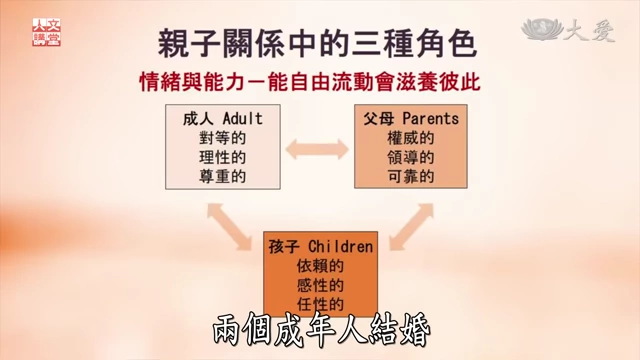
- As children grow, they develop abilities that allow them to contribute to the family and even care for their parents.
- Parents, while responsible for their children's upbringing, should also learn to accept care from their children.

The ideal parent-child relationship evolves into mutual care and respect. [ 00:19:03 ] - The speaker shares an anecdote where her son, though still young, was capable of helping his younger brother when his bicycle tire was flat. This demonstrated his ability to care and be responsible.
- This mutual care allows for a healthier and more balanced family dynamic, fostering harmony and shared emotional and practical support.
Love and Trust Foster Freedom and Security [21:38]
The foundation of a healthy parent-child relationship is built on love and trust, allowing both to feel secure and free within the relationship.
- The speaker reflects on her own parents' love and trust, which provided her with the freedom and opportunity to make her own choices in education and life.
- This upbringing empowered her to pursue her studies and travel freely.
- She endeavors to pass on this same love and trust to her children, allowing them the space to grow into their authentic selves.
- Her son's reflection, expressing gratitude for being her child and feeling understood, validates the success of this approach.
- Ultimately, this dynamic creates a home that nurtures the physical and mental well-being of both children and adults.