US Labor Market Update: Analyzing Job Cuts, Payrolls, and the Federal Reserve's December Rate Decision Amidst Government Shutdown
The US labor market is showing concerning signs, despite the official jobs report being unavailable due to a government shutdown, leading to reliance on private data.
- A Challenger report revealed a massive spike in October job cuts, reaching 153,074, the highest for the month in 22 years, and a 65% increase year-to-date (1,099,500 total).
- Key drivers for these layoffs include AI adoption, reduced consumer and corporate spending, and rising costs (inflation), affecting industries like technology, retail, services, and warehousing.
- Conversely, the ADP report indicated a surprising rise of 42,000 in private payrolls for October, offsetting some losses.
- The Federal Reserve, operating under a dual mandate of price stability and maximum employment, faces a dilemma.
- Market expectations, based on private data and Fed projections, suggest a 68.7% probability of a 0.25% interest rate cut in December, although some Fed members prioritize fighting inflation while others prioritize the weakening labor market.

October job cut announcements since 1995, with 2025 showing the highest level since 2003. [ 00:04:00 ]
Absence of Official Jobs Report & Reliance on Private Data [0:00]
Due to a US government shutdown, the Bureau of Labor Statistics (BLS) did not release the official jobs report, which is typically published on the first Friday of each month. This necessitated relying on private sector reports and data points to assess the health of the US labor market. The situation, described as "not a pretty picture," is crucial for the Federal Reserve's interest rate decision in December.


Challenger Report: Escalating Job Cuts [0:37]
The Challenger report indicated a severe downturn in the labor market.
- Massive Spike in October Job Cuts [0:40]
- US-based employers announced 153,074 job cuts in October.
- This figure represents a 175% increase from October of the previous year (55,397 cuts in Oct 2024) and a 183% increase from the prior month (54,064 cuts in September 2025).
- It marks the highest level of job cuts for any October in 22 years.

News headline reporting October job cuts hitting a 22-year high, according to Challenger. [ 00:00:40 ] 
Challenger report detail showing 153,074 job cuts in October, a 175% increase year-over-year. [ 00:01:00 ]
- Year-to-Date Job Cuts [1:33]
- Through October 2025, employers announced 1,099,500 job cuts, an increase of 65% compared to the first ten months of the previous year (664,839).
- This is the highest level of job cuts since 2020.
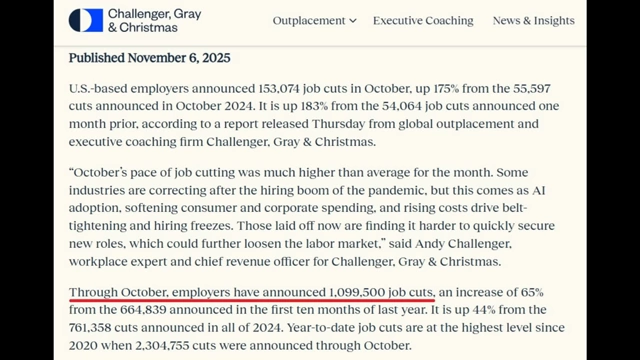
Challenger report detail showing 1,099,500 job cuts year-to-date through October, a 65% increase from the previous year. [ 00:02:12 ]
- Reasons for Layoffs [1:19]
- The report cites several factors driving the job cuts:
- AI adoption
- Softening consumer and corporate spending
- Rising costs (inflation)
- The report cites several factors driving the job cuts:
- Industries Most Affected in October [2:27]
- Technology: Announced 33,281 job cuts in October, significantly up from 5,639 in September.
- Retail: 2,431 job cuts in October, but 88,664 job cuts year-to-date, a 145% increase from 2024.
- Services: 63,580 job cuts year-to-date, a 62% increase year-over-year.
- Warehousing: 90,418 job cuts year-to-date, a 378% increase year-over-year.
- Consumer Products: 41,033 job cuts year-to-date, a 21% increase year-over-year.
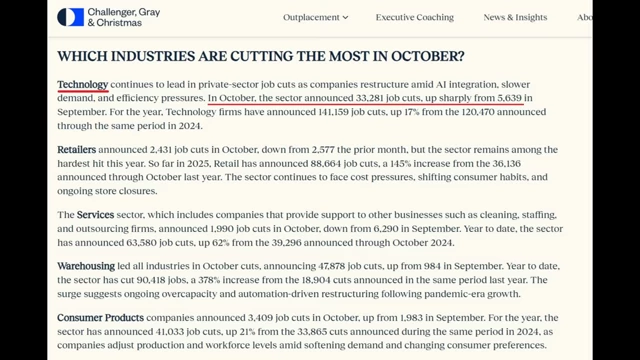
Table from Challenger report detailing industries with the most job cuts in October, including Technology, Retail, Services, Warehousing, and Consumer Products. [ 00:02:30 ]
- Underlying Causes for 2025 Cuts [3:29]
- "DOGE Impact": The leading reason for job cuts in 2025, accounting for 293,753 planned layoffs.
- Cost-Cutting: The top reason cited for October alone (50,857 layoffs).
- Artificial Intelligence (AI): The second most cited factor in October (31,039 cuts), contributing to 48,414 cuts this year.
- Market and Economic Conditions: Accounted for 21,104 cuts in October, totaling 229,331 year-to-date.
- Closings of stores, units, and plants: Resulted in 10,729 cuts in October and 161,391 year-to-date.
- Restructuring: Cited for 7,588 October announcements, with a total of 108,038 so far in 2025.
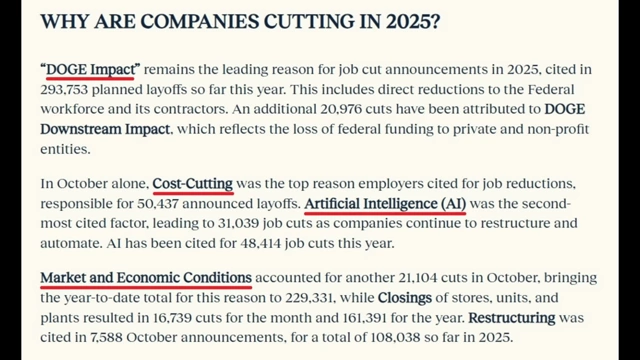
Challenger report outlining primary reasons for job cuts in 2025, highlighting 'DOGE Impact', 'Cost-Cutting', and 'Artificial Intelligence'. [ 00:03:30 ]
Bar chart illustrating October job cut announcements from 1995 to 2025, showing 2025 with the highest level since 2003. [ 00:04:00 ]
ADP Report: Private Payroll Growth (A Mixed Signal) [4:04]
In contrast to the Challenger report, the ADP report presented a more optimistic, albeit surprising, outlook.
- Unexpected Payroll Rise [4:06]
- Private payrolls rose by 42,000 in October.
- This was a shock, as analysts had expected net job losses for the month.
- The September ADP report had shown 29,000 job losses.
- Offsetting Gains [4:31]
- Job gains in transportation, utilities, and trade sectors helped to offset losses in other categories.
- Data Reliability Concerns [4:50]
- The speaker noted that ADP, like government reports, often revises its data, suggesting this report should be taken "with a grain of salt."

News headline reporting that private payrolls rose by 42,000 in October, exceeding expectations and easing labor market fears, according to ADP. [ 00:04:10 ]
- The speaker noted that ADP, like government reports, often revises its data, suggesting this report should be taken "with a grain of salt."
Federal Reserve's December Interest Rate Decision [5:15]
The private sector labor data influences the market's expectation for the Federal Reserve's upcoming interest rate decision.
- Current Fed Funds Rate and Upcoming Meeting [5:17]
- The current Fed fund's interest rate is 4.0%.
- The next Federal Reserve meeting is scheduled for December 10th.
- Market Expectations for December [5:26]
- According to the CME Fed Watch tool, there is a 68.7% chance that the Federal Reserve will cut interest rates by a quarter point (0.25%) at the December meeting.
- There is a 31.3% chance that interest rates will remain unchanged.
- This probability is only slightly down from 72% a week prior, indicating the new private sector data did not significantly alter market expectations.

CME Fed Watch tool displaying target rate probabilities for the December 10, 2025 Fed Meeting, showing a 68.7% chance of a rate cut. [ 00:05:30 ]
- Fed's September Projections [5:54]
- The Federal Reserve's projections from their September meeting had already indicated a rate cut for both October (which occurred) and December.
- The question remains whether the government shutdown and recent data have changed these projections.
Federal Reserve document highlighting "Projection Materials" from the September meeting, which included future rate cut forecasts. [ 00:06:03 ]
- Jay Powell's Stance [6:26]
- Fed Chair Jay Powell stated that the Fed is "data dependent" for its December decisions.
- He used an analogy, saying that when it's "foggy," one might want to "slow down," suggesting a cautious approach due to unclear data (especially with the absence of official reports).
Federal Reserve's Dual Mandate and Internal Disagreement [6:53]
The Federal Reserve operates under a dual mandate, which creates a complex challenge in the current economic environment.
- The Dual Mandate [6:53]
- 1. Price Stability: Keep inflation under control, with a target of 2%. Current inflation (CPI) is 3% and has been accelerating.
- 2. Maximum Employment: Ensure a strong and healthy labor market. The labor market is clearly weakening, with job additions slowing from over 100,000 to tens of thousands monthly, and job cuts spiking.
- The speaker posits that the Fed has "dropped the ball on both" mandates.
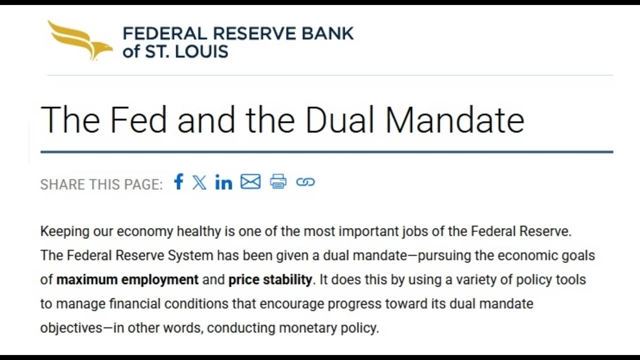
Federal Reserve Bank of St. Louis document explaining the Fed's dual mandate: maximum employment and price stability. [ 00:06:55 ]
- Conflicting Views Among Fed Members [8:12]
- Fed Governor Cook: Argues that "Labor Market Concerns Outweigh Inflation Risk" [8:12], advocating for interest rate cuts to boost the labor market, even if it might worsen inflation.

Bloomberg headline quoting Fed's Cook saying labor market concerns outweigh inflation risk. [ 00:08:15 ] - Fed President Goolsbee: Is "More Worried by Inflation Than Job Market" [8:47], suggesting the Fed should not cut interest rates to prioritize lowering inflation, even if it means the labor market continues to suffer.
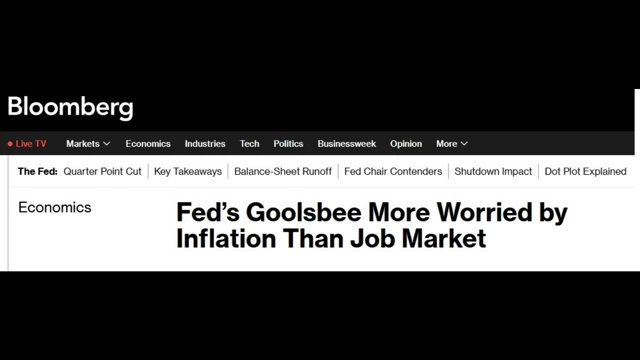
Bloomberg headline quoting Fed's Goolsbee being more worried by inflation than the job market. [ 00:08:50 ] - Jay Powell's Acknowledgment: The Fed Chair noted "hardening divisions" [9:21] among voting members regarding the December interest rate decision, leading to a neutral public stance.

Bloomberg headline discussing Powell's December warning exposing hardening divisions at the Fed. [ 00:09:59 ]
- Fed Governor Cook: Argues that "Labor Market Concerns Outweigh Inflation Risk" [8:12], advocating for interest rate cuts to boost the labor market, even if it might worsen inflation.