The Geopolitical Bottleneck: How Taiwan's TSMC Chip Monopoly Threatens the Global AI Economy
The current AI economy and the soaring stock market are heavily dependent on seven major tech companies, particularly Nvidia, which relies on advanced chips. However, the entire advanced chip manufacturing industry has a critical bottleneck: Taiwan Semiconductor Manufacturing Company (TSMC), based in Taiwan. TSMC produces 80-90% of the world's most sophisticated chips, including those for Nvidia and Apple. This concentration of production in Taiwan creates a significant geopolitical risk, as China is reportedly preparing to take control of the island by 2027. There are no viable immediate alternatives, as Samsung's advanced chip production suffers from quality issues, and new TSMC fabs being built in the US are years behind schedule, lack experienced talent, and will initially produce older-generation chips. A disruption to TSMC in Taiwan would cripple global chip supply, impacting major tech companies and potentially leading to a widespread economic collapse due to the interconnectedness of the AI industry.

The Big AI Bottleneck [0:00]
The stock market's recent growth is overwhelmingly driven by seven major AI companies, with Nvidia being a prime example of exceptional performance.
- Nvidia's Dominance: Nvidia's AI chips, such as the H100 and B200, are in insatiable demand, making the company a $4.5 trillion entity and accounting for over 7% of the S&P 500 index.
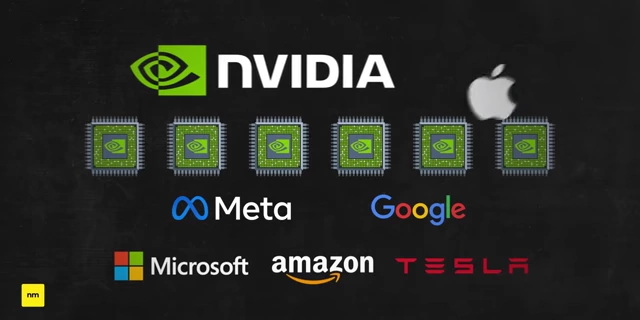
Major tech companies like Meta, Google, Microsoft, Amazon, and Tesla rely on Nvidia's chips; Apple designs its own [ 00:01:44 ] - Chip Design vs. Manufacturing: Nvidia and Apple design their proprietary chips but do not manufacture them.
- Single Manufacturing Point: The vast majority of the world's most advanced chips, including those for Apple's M/A series and Nvidia's A100, H100, H200, and B200, are manufactured by a single company: Taiwan Semiconductor Manufacturing Company (TSMC).
TSMC as the central bottleneck for advanced chip manufacturing for multiple tech giants [ 00:02:54 ]
The China Risk [2:50]
The concentration of advanced chip manufacturing in Taiwan poses a significant geopolitical risk.
- Taiwan's Vulnerability: TSMC manufactures 80-90% of its chips in Taiwan, an island that China views as a breakaway province and has expressed intentions to take control of.
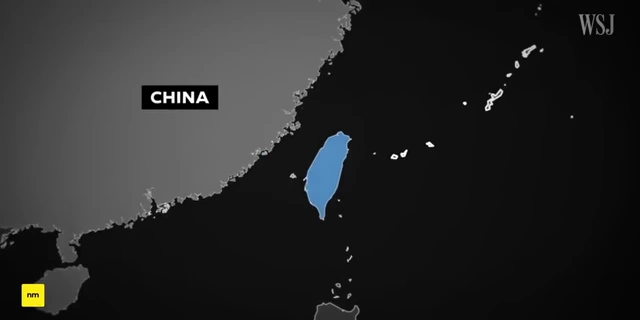
Geopolitical map highlighting China and Taiwan [ 00:03:29 ] 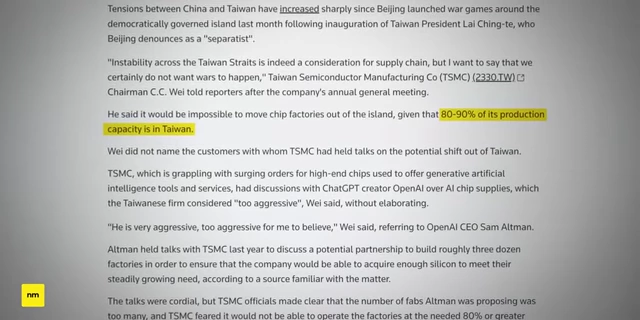
Article snippet confirming TSMC's 80-90% production capacity is in Taiwan [ 00:04:18 ] - Impending Threat: US intelligence suggests China is preparing its forces to invade Taiwan by 2027, evidenced by military drills, construction of new landing ships, and commercial ferries capable of transporting troops.
- Impossibility of Relocation: TSMC has stated that moving its fabrication plants out of Taiwan would be practically impossible.
The Samsung Option [4:30]
Exploring alternatives reveals a lack of viable solutions for advanced chip manufacturing.
- Limited Foundries: Only TSMC and Samsung possess the capability to manufacture the latest 3nm and 4nm generation chips due to the extreme precision required.
- Samsung's Challenges: Samsung, despite being the next most advanced foundry, struggles with matching TSMC's production quality, experiencing significant yield issues (e.g., 20% defective chips) with its 4nm processors.
- Nvidia previously used Samsung for its RTX 30 series GPUs but reverted to TSMC for subsequent generations due to poor yields.
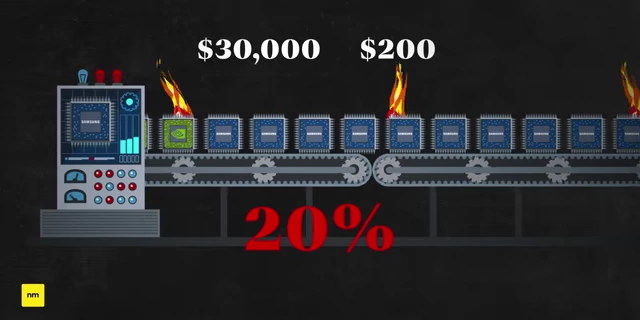
Diagram showing a 20% yield loss in Samsung's chip production, with high-value GPUs and iPhone processors highlighted [ 00:06:23 ]
- Nvidia previously used Samsung for its RTX 30 series GPUs but reverted to TSMC for subsequent generations due to poor yields.
- Proprietary Equipment and Expertise: Manufacturing these advanced chips requires highly specialized, multi-million dollar Extreme Ultraviolet (EUV) lithography machines, exclusively produced by ASML in the Netherlands. Beyond the machinery, decades of experience, specific software, and intricate supply chains are essential, which only TSMC and Samsung currently possess for high-volume production.

Microscopic view of a human hair, used to illustrate the scale difference with nanometer-sized transistors [ 00:05:15 ]
Just move to the USA? [7:00]
Efforts to establish advanced chip manufacturing in the United States face substantial hurdles.
- Delayed US Fabs: TSMC's new chip fabrication plants in Arizona are significantly behind schedule, with the first site delayed to late 2024 or 2025 and the second potentially not ready until 2028.
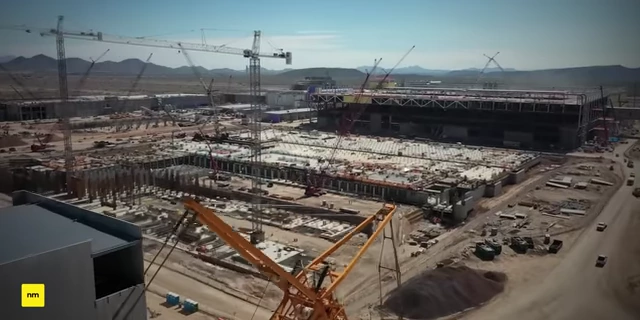
Large-scale construction of TSMC's new chip fabrication plant in Arizona [ 00:07:13 ] - Operational Complexity: These facilities are incredibly complex, demanding tens of billions in investment, pristine cleanroom environments (air cleaner than an operating room), and workers in specialized bunny suits to prevent contamination.
- Undeveloped Ecosystem: The US lacks the established local supply chains for specialized gases, chemicals, and precision machinery needed for state-of-the-art chip manufacturing.
- Talent Gap: The US workforce does not yet possess the decades of specialized expertise found among TSMC's Taiwanese engineers, requiring foreign engineers to be flown in to support operations.
- Technological Lag: The Arizona plants are planned to produce 4nm chips, which are a generation behind the cutting-edge 3nm and upcoming 2nm technology used for Nvidia's and Apple's most in-demand chips. Achieving state-of-the-art manufacturing at scale in the US will take many years, potentially a decade.
The Geopolitical Risk [9:30]
The potential for conflict over Taiwan presents a catastrophic risk to the global economy.
- Disruption of Supply Chains: In the event of a Chinese invasion, TSMC's facilities would likely cease production for Western markets, as their operations depend on global inputs and specialized software that would be instantly cut off.

Podcast interview with financial expert Steve Eisman discussing geopolitical risks [ 00:09:42 ] - US Strategy: The United States recognizes the critical importance of TSMC and has indicated it would intervene in an invasion, preferring to see TSMC's equipment disabled rather than fall under Chinese control. Contingency plans reportedly include evacuating Taiwanese engineers or remotely disabling factory tools.

Diagram depicting the potential disabling of TSMC chip production facilities [ 00:10:45 ] - China's Leverage Play: China already controls over 90% of global rare earth refining, a vital component for EVs, batteries, and defense equipment. Gaining control of TSMC would vastly increase its economic and geopolitical leverage, severely weakening the West.
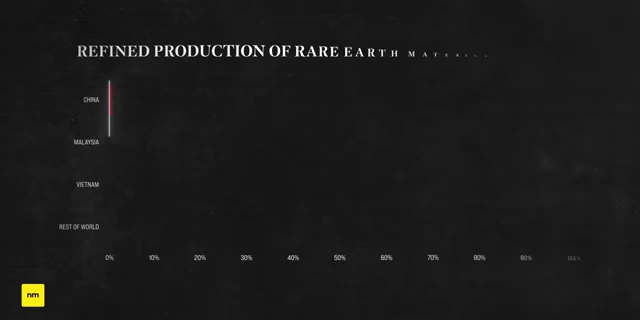
Bar chart illustrating China's overwhelming dominance (over 90%) in refined rare earth material production [ 00:11:10 ] 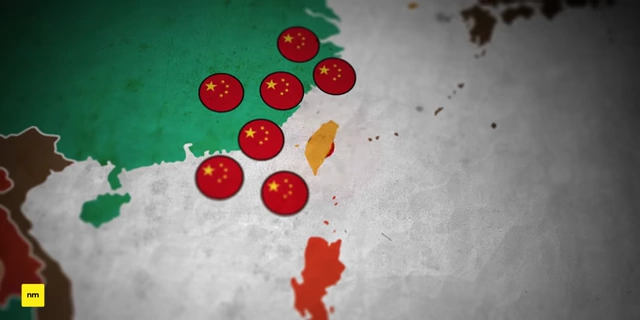
Map showing China's potential control over Taiwan and its surrounding waters, symbolizing a blockade [ 00:10:16 ] - Cascading Economic Impact: A disruption to TSMC's operations would halt chip production for major tech companies, leading to a profound and widespread collapse across the AI economy and the broader stock market, affecting companies like Amazon, Microsoft, Tesla, and Meta.