Six Months of Trump's Trade War: Economic Impacts on the US and Global Partners
After six months, Trump's trade war had mixed impacts on the US and global economies.
- US Economy: While inflation did not significantly increase, economic growth slowed as predicted. The dollar's value fell, contrary to expectations, largely due to decreased foreign investment. The stock market recovered from an initial collapse, partially offset by tax cuts and a reduction in peak tariff rates.
- Global Economy: Overall, the trade war negatively impacted the global economy due to increased uncertainty and foreign companies absorbing tariff costs.
- Key Trading Partners: Surprisingly, some partners found unexpected upsides. Europe's financial markets appeared more stable, and defense spending increased. Canada looked into reducing internal trade barriers and diversifying energy reliance. Mexico saw an opportunity to become a preferred manufacturing hub for US exports. China's global image improved, and Japan considered lowering outdated food import restrictions.
- Trump's Goals: Tariffs generated government revenue but were insufficient to offset significant tax cuts. Re-industrialization efforts were not clearly successful, with business investments falling due to ongoing tariff uncertainty.

Summary of expected vs. actual US economic impacts from Trump's trade war [ 00:10:09 ]
Introduction [00:00:00]
The video examines the actual effects of Trump's trade war six months after its initiation, contrasting early expectations with the reality experienced by the US economy and its major trading partners. The analysis aims to provide clarity on the tariff fluctuations and their broader economic consequences.
- Initial expectations predicted negative impacts on the US economy, including a fall in the stock market, a rise in the dollar, inflation, and slower economic growth.
- The video will cover:
- A visual overview of tariff changes.
- The effects on the US economy.
- The effects on the US's six biggest trading partners, noting any unexpected benefits.
- An assessment of whether Trump's re-industrialization plan is working.

Map of the US's major trading partners [ 00:10:44 ]
Trump's Trade War Timeline and Tariff Overview [00:01:40]
Keeping track of Trump's tariffs is complex due to varied targets (countries) and products (e.g., steel, cars). The video utilizes a graph from economist Joey Politano showing the average US tariff rate based on the 2024 import mix to simplify the overview.
- Methodology: The average US tariff rate is calculated hypothetically by considering the proportion of specific imported goods and their respective tariff rates. For example, if steel and aluminum constitute 10% of US imports, a 50% tariff on these would add 5% to the average US tariff rate.

How the average US tariff rate is calculated [ 00:02:27 ] - 10 Key Milestones in Tariff Changes:
- Early February: Trump introduced a 10% tariff increase against China after threatening tariffs on Mexico and Canada.
- Early March: More tariffs were imposed on China, Mexico, and Canada.
- March: The average tariff rate dropped due to the exclusion of goods covered under the original US-Mexico-Canada agreement.
- April: Tariffs on steel and aluminum were raised.
- April: 10% tariffs were introduced for most countries, with an additional 25% for cars.
- Liberation Day (May): A significant spike occurred due to reciprocal tariffs against all countries.
- May: Most general tariffs were quickly passed, but tariffs against China increased substantially, leading to a drop in the average rate but maintaining a high level.
- May: More tariffs were placed on Canada and Mexico.
- June: The average tariff rate dropped considerably after China tariffs were passed.
- June: The rate increased again with a 25% steel and aluminum tariff announcement.

A timeline of Trump's average US tariff rate [ 00:01:49 ]
- As of early July (when the video was recorded), the average tariff rate was around 17%, lower than the peak of 27% seen after Liberation Day.
Impact on the US Economy [00:04:24]
Economists widely predicted three negative effects from tariffs: inflation, less economic growth, and a more valuable dollar.
Expectations vs. Reality:

Initial expectations of Trump's trade war impacts on the US economy [ 00:05:07 ] - Inflation: Expected to rise, but instead, it continued to fall, with only a modest initial impact on highly tariffed products.
- Economic Growth: Expected to decrease, which indeed happened, with growth projections for 2025 falling from 2.4% to 1.5-1.7%.
- Dollar Value: Expected to increase, but it actually fell.
- Stock Market: Expected to collapse, and it did initially, but later recovered to higher levels than before.
Final summary of expected vs. actual US economic impacts from Trump's trade war [ 00:10:09 ]
Inflation (Reality) [00:05:15]
- Despite a 15% increase in tariffs, inflation continued to fall.

US PCE-Inflation trend [ 00:05:36 ] - Reasons for low inflation:
- Excess Inventory: US importers bought large quantities of goods before tariffs took effect, allowing them to keep prices low.
- Companies Absorbing Costs: Both American and foreign companies absorbed tariff costs. Foreign exporters, particularly, paid an estimated 53% of US tariffs on average to maintain market share.
- Reduced Spending: Trump's policy uncertainty may have caused Americans to spend less, leading to overall price reductions that partially offset import price increases.
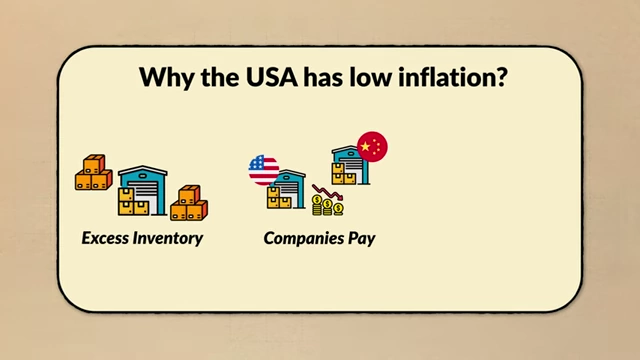
Factors contributing to low US inflation despite tariffs [ 00:06:22 ]
- Despite a 15% increase in tariffs, inflation continued to fall.
Economic Growth (Reality) [00:06:54]
- The prediction of lower GDP growth held true.
- US growth projections for 2025 dropped from 2.4% before Trump's trade war to an estimated 1.5-1.7%.

US GDP growth projections: Pre-Trump vs. Post-Trump [ 00:07:09 ]
Dollar Value (Reality) [00:07:21]
- The dollar fell after tariffs, contrasting with its increase during Trump's previous trade war.

The nominal US Dollar Index showing a recent decline [ 00:07:36 ] - Determinants of Exchange Rate:
- Trade: Reducing imports can increase a currency's value. In the previous trade war, reduced imports from China led to a stronger dollar.

Trade and finance as determinants of exchange rates [ 00:07:50 ] 
Trade balance affecting currency value in foreign exchange [ 00:08:03 ] - Finance: Foreign investment into a country increases demand for its currency.
- Trade: Reducing imports can increase a currency's value. In the previous trade war, reduced imports from China led to a stronger dollar.
- Current Situation: Despite falling imports, the dollar fell because foreign investors sought stability, investing less in the US and more in "safe haven" economies like Taiwan, Switzerland, and the Euro area, outweighing the trade effect.

Foreign investment's impact on the US dollar [ 00:08:41 ]
- The dollar fell after tariffs, contrasting with its increase during Trump's previous trade war.
Stock Market (Reality) [00:09:09]
- The US stock market initially collapsed after Liberation Day but later recovered to record highs.
- Explanations for Recovery:
- Tax Cuts: Trump's "big beautiful bill" provided massive tax cuts for wealthy Americans and corporations, offsetting some negative tariff effects.
- "Trump Always Chickens Out" (TACO) Trade: The average tariff rate of ~17% (as of July) was significantly lower than the 27% imposed after Liberation Day, indicating a de-escalation that reassured markets.
Impact on the Global Economy [00:10:21]
While some surprising upsides exist for major trading partners, Trump's trade war has generally harmed the global economy.
General Negative Effects:
- Uncertainty: Tariff uncertainty made it difficult for firms worldwide to make investment decisions, hurting global growth.

Tariff uncertainty hindering global investment decisions [ 00:11:03 ] - Foreigners Paying Tariffs: Many foreign firms, like Japanese carmakers, lowered their export prices to the US to maintain market share, resulting in less export revenue for their countries.

General negative effects of Trump's trade war on global economies [ 00:11:25 ]
- Uncertainty: Tariff uncertainty made it difficult for firms worldwide to make investment decisions, hurting global growth.
Specific Trading Partners:
European Union (EU) [00:11:52]
- Europe's financial markets appeared more stable than the US's, leading European stocks to outperform US ones.
- Trump's linking of tariffs to military spending pushed Europeans to increase defense spending, benefiting the economy in the short term.
- Facing US trade barriers, the EU recognized and started addressing its significant internal trade barriers, potentially strengthening its single market.
Canada [00:12:49]
- Trump's hostility may have contributed to the Liberal Party's election win over conservatives.
- Canada is actively adapting its energy infrastructure to reduce reliance on the US, aiming for future resilience.
- Trump's aggressive stance spurred Canada to re-examine its internal trade barriers between provinces, which are estimated to be equivalent to a 21% internal tariff by the IMF. Removing these could significantly benefit Canada.

- **Mexico** [<a href="https://youtube.com/watch?v=nBXwqN5-1n4&t=823">00:13:43</a>]
  - Mexico's development model, based on low-cost manufacturing for the US, was threatened. However, Trump largely respected the existing free trade deal.
  - With US tariffs on other nations significantly higher, Mexico's zero-tariff trade deal became a much larger competitive advantage, positioning it as a potentially prime manufacturing hub for firms exporting to the US.

- **China** [<a href="https://youtube.com/watch?v=nBXwqN5-1n4&t=872">00:14:32</a>]
  - Trump's policies led many countries to reconsider over-reliance on the US, improving China's global image.
  - Experts suggest China's new trade deal with Trump indicated a stronger negotiating position than anticipated.

- **Japan** [<a href="https://youtube.com/watch?v=nBXwqN5-1n4&t=893">00:14:53</a>]
  - Trump's threats could push Japan to lower its outdated food import restrictions, such as the estimated 233% tariff on rice, which could help with its current rice shortage.
- The trade war generally damaged the global economy, putting it on a path toward multipolar parity, where trade wars become far more common.

The global economy shifting towards multipolar parity due to trade wars [ 00:15:30 ]
Evaluating Trump's Goals: Government Revenue and Re-industrialization [00:15:35]
Trump's stated goals were to re-industrialize the US and generate government revenue to lower taxes for Americans.
Government Revenue [00:15:50]
- Tariffs have significantly increased customs duties, bringing in more government revenue than in previous years.

Monthly US customs duties, showing increased revenue [ 00:15:57 ] - However, the projected $189 billion in tariff revenue for 2025 is insufficient to offset the estimated $3 trillion increase in the US deficit caused by Trump's large tax cuts.

Comparison of tariff revenue with tax cut costs [ 00:16:20 ]
- Tariffs have significantly increased customs duties, bringing in more government revenue than in previous years.
Re-industrialization [00:16:30]
- It's uncertain if re-industrialization is working.
- Trump claimed businesses committed $12 trillion in investments, a number questioned as it included pre-planned projects.
- Data on business fixed investments (new machinery) shows a good first three months under Trump but declines significantly after Liberation Day, reaching levels comparable to the Omicron wave.

Quarterly US Business Fixed Investment, reflecting falling confidence [ 00:17:27 ] - Investment Uncertainty: Businesses, especially factories, are hesitant to invest in the US because tariffs, used as a negotiation tool, can be lowered at any moment, making long-term investments risky and potentially uncompetitive if tariffs are removed. This uncertainty causes businesses to delay investments globally.

Visualizing investment uncertainty for US factories [ 00:18:07 ]