Understanding BBQueue: A Lock-Free, DMA-Friendly Circular Buffer for Embedded Systems
BBQueue is a Rust library providing a specialized circular buffer designed for embedded systems and concurrency, featuring:
- It is a circular buffer inspired by "bit buffers" and is designed to be DMA (Direct Memory Access) friendly.
- It supports a single producer and a single consumer, allowing for thread-safe operations on different threads or between main application logic and interrupts.
- Unlike traditional circular buffers, BBQueue provides mutable and immutable "grants" (slices of memory) for writing and reading data, respectively, ensuring continuous memory regions.
- It avoids copying data byte by byte, making it highly efficient, especially for hardware offloading.
- BBQueue is a
no_stdcrate, making it suitable for environments without the standard library, and implements a lock-free algorithm for concurrent access without mutexes. - It includes a new "framed mode" that handles variable-sized messages by adding a small, variable-length header, ensuring that message frames are never split across non-contiguous memory regions.
Introduction to BBQueue [00:10:40]
BBQueue is a specialized circular buffer implemented as a Rust library, designed particularly for embedded systems due to its unique features.
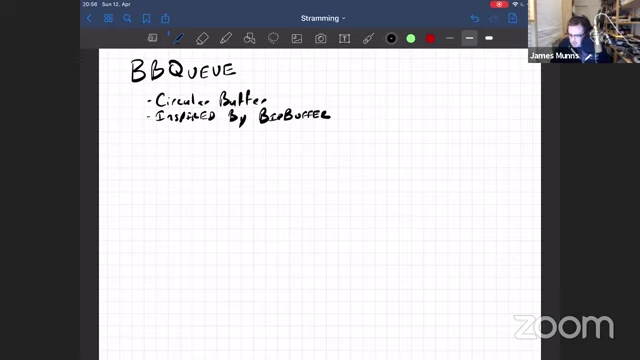
- Inspiration: It is inspired by "bit buffers" (also known as bipartite buffers), which are widely used in applications like audio processing where DMA is involved.
- Bit buffers differ from traditional circular buffers by allowing access to at least two chunks of data at a time.
- DMA Friendly: A core design principle is to be Direct Memory Access (DMA) friendly.
- DMA allows hardware peripherals to directly read from or write to memory without continuous CPU intervention, saving significant CPU cycles, especially for high-speed data transfers (e.g., serial ports at high baud rates).
- Concurrency Model: BBQueue operates as a Single Producer, Single Consumer (SPSC) queue.
- This design allows for thread-safe operations, enabling one thread (or an interrupt/hardware) to produce data and another to consume it independently.
- No Standard Library (
no_std): The library does not require the Rust standard library, making it highly suitable for embedded systems, WebAssembly (WASM), or operating system development where memory and resource constraints are tight. - Lock-Free Algorithm: BBQueue utilizes a lock-free algorithm, meaning it avoids mutexes or other locking mechanisms that could lead to deadlocks or performance bottlenecks in concurrent environments.
Understanding Traditional Circular Buffers [00:16:54]
To appreciate BBQueue, it's essential to understand how traditional circular buffers work and their limitations.
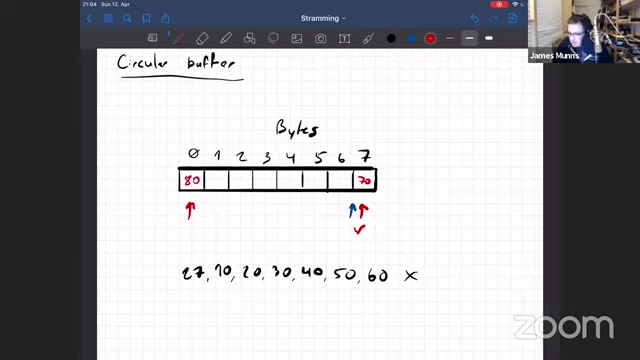
- Mechanism: A typical circular buffer uses a linear chunk of memory with read and write pointers that wrap around to the beginning once they reach the end.
- Data is written at the
write_pointerand read from theread_pointer. - Rules govern when pointers can touch to indicate empty or full states.
- Data is written at the
- Limitations of Traditional Circular Buffers:
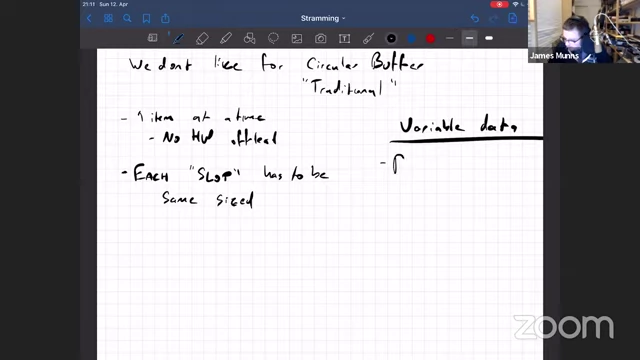
Limitations of traditional circular buffers, including one-item-at-a-time processing and fixed slot sizes. [ 00:28:49 ] - One Item at a Time: Most implementations require pushing or popping one item (byte or fixed-size struct) at a time.
- This prevents efficient hardware offloading, as hardware typically works with larger, continuous blocks of memory.
- Fixed Slot Size: Each slot in a traditional circular buffer must be of the same predefined size.
- This leads to wasted space when dealing with variable-length messages (e.g., network packets where one might be 120 bytes and another 20 bytes). If you allocate for the largest possible message, smaller messages waste significant memory.
- Lack of Continuous Regions: While the buffer itself is a continuous memory block, the logical data within it might span across the wrap-around point, making it appear discontinuous to a DMA engine.
- Bit Buffer vs. Double/Ping-Pong Buffer: While bit buffers allow for two chunks of data simultaneously and offer flexibility with variable-sized chunks, double or ping-pong buffers typically fix the size of the two buffers, potentially leading to wasted space if messages are smaller than the allocated buffer size.
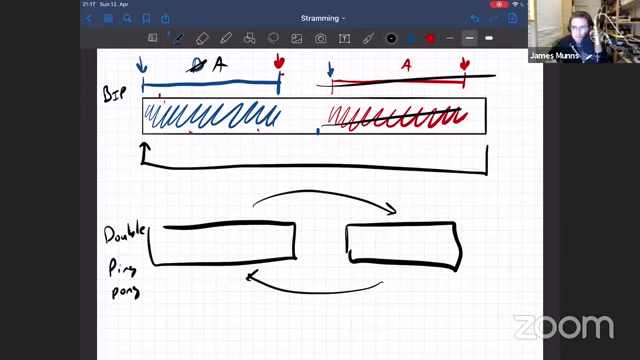
A comparison between Bip (Bipartite) Buffers, which allow two data chunks, and Double/Ping-Pong Buffers, which use two separate regions. [ 00:35:09 ]
- One Item at a Time: Most implementations require pushing or popping one item (byte or fixed-size struct) at a time.
BBQueue's Operational Model [00:36:30]
BBQueue addresses the limitations of traditional circular buffers by introducing a "grant" mechanism, allowing producers and consumers to work with continuous regions of memory.
The Four Core Operations [00:37:05]
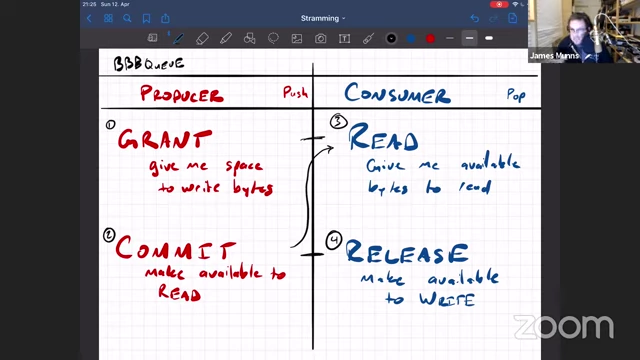
BBQueue's functionality is built around four primary, independent actions:
- 1. Grant (Producer): [00:37:56]
- The producer requests a mutable slice of memory of a specified size to write data.
- BBQueue guarantees that this granted slice is a continuous region of memory.
- The producer retains exclusive "ownership" (a mutable reference/lock) of this memory region until it is committed. This allows for operations like
memcpyor offloading data filling to DMA controllers.
- 2. Commit (Producer): [00:39:44]
- Once the producer has finished writing data into the granted slice (possibly less than the full granted size), it commits the data.
- Committing makes the data available for the consumer to read and releases the producer's lock on that memory segment.
- 3. Read (Consumer): [00:40:30]
- The consumer requests an immutable slice of available data.
- BBQueue provides the next available continuous chunk of data as a read-only slice.
- The consumer retains this read-only access (a "read lock") until it releases the data.
- 4. Release (Consumer): [00:41:23]
- After the consumer has finished processing the data from its read slice (it can release partial amounts), it releases the memory.
- Releasing marks the memory region as free and available for the producer to request as a new grant.
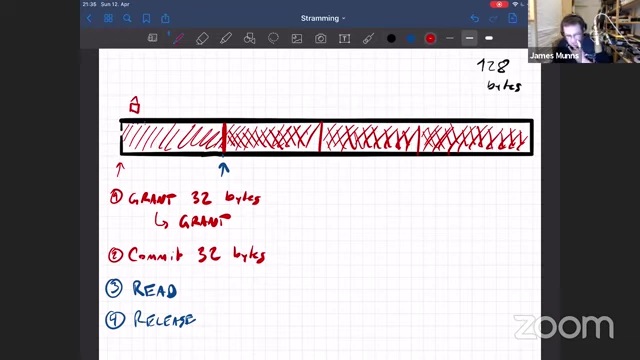
A diagram demonstrating the continuous operation of BBQueue, showing how data is granted, committed, read, and released in a circular fashion. [ 00:53:14 ]
Handling Buffer Wraps and Memory Efficiency [00:55:00]
Producer Wraps [00:57:09]
When the producer requests a grant and there isn't enough contiguous space at the end of the buffer to fulfill the request, BBQueue introduces a "watermark."
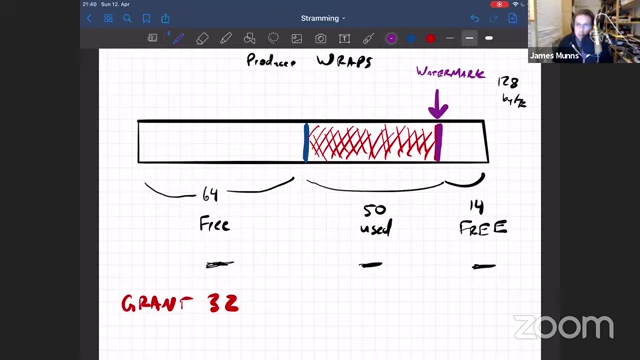
- Watermark: A conceptual "wall" is placed at the current end of the available contiguous space.
- This forces the producer's write pointer to wrap around to the beginning of the buffer.
- Any small, unused space between the watermark and the physical end of the buffer is temporarily "wasted" but ensures that all granted regions are continuous.
- The amount of wasted space is limited to less than the size of the largest single grant.
- This mechanism guarantees continuous memory regions for
grantoperations, which is crucial for DMA.
Reader Wraps [01:01:37]
Similarly, when the consumer tries to read data that spans the physical end of the buffer and the beginning, it only receives the current contiguous section.
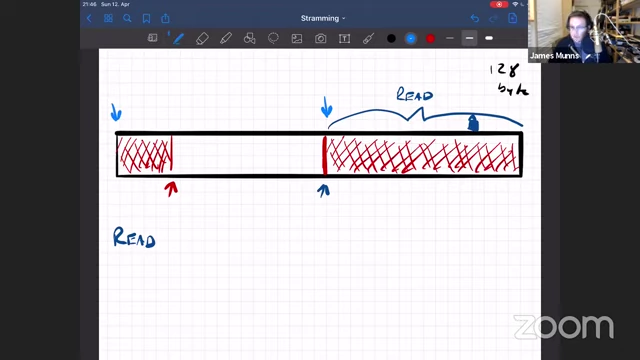
- Disjoint Regions: If the available data is split across the buffer's wrap-around point, the
readoperation will only return the first contiguous segment. - The consumer must then release that segment and issue another
readrequest to obtain the subsequent segment from the beginning of the buffer. - While this requires multiple
read/releasecycles from the consumer, it maintains the guarantee of continuous memory slices per operation, aligning with DMA requirements.
Framed Mode for Variable Messages [01:09:37]
A new feature, "framed mode," allows BBQueue to handle variable-length messages (frames) more elegantly.
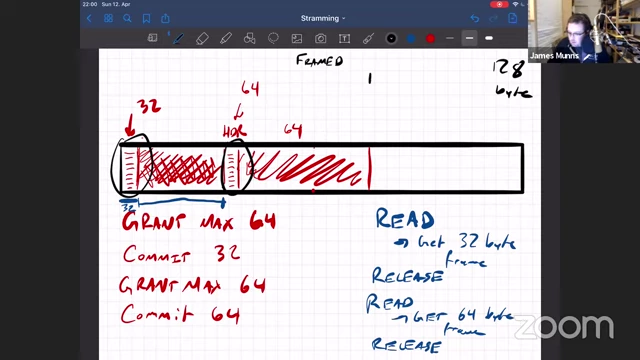
- Header Inclusion: When a producer commits data in framed mode, BBQueue automatically prepends a small, variable-sized header to the data.
- This header stores the actual length of the message/frame.
- The producer requests a grant for the maximum possible frame size + header size.
- Consumer Access: When the consumer
reads in framed mode, BBQueue automatically parses this header.- It then presents the consumer with a read grant that is precisely the size of the frame (excluding the header), ensuring that the consumer always receives one complete, unfragmented message.
- No Inter-Frame Wrapping: Framed mode ensures that individual messages (frames) never wrap around the buffer's physical end. If a frame cannot fit contiguously at the end, the producer will automatically wrap and place the entire frame at the beginning, similar to the producer wrap behavior.
- Minimal Overhead: The header size is small (1-2 bytes for most common frame sizes), adding minimal overhead compared to the benefits of guaranteed frame integrity and simplified message handling.
Performance and Implementation Notes [01:08:01]
- High Throughput: BBQueue is designed for very low overhead, achieving high data transfer rates (e.g., 18 gigabytes per second on a desktop, limited by RAM copy speed).
- Atomic Operations: Its lock-free nature relies on atomic operations for updating internal pointers, ensuring thread safety without traditional mutexes.
- Complexity: Designing and verifying lock-free algorithms is notoriously difficult, requiring meticulous state modeling to avoid subtle bugs. The core logic has remained stable since its initial robust design and verification.