Progressive Infrastructure Delivery with Kargo and Argo CD
CNCF [Cloud Native Computing Foundation]
This lightning talk by Engin Diri from Pulumi introduces progressive infrastructure delivery using Kargo and Argo CD, addressing the pain points of promoting infrastructure changes across multiple environments in GitOps.
- GitOps requires Kubernetes operators like Crossplane or Pulumi for infrastructure deployment.
- Deploying infrastructure via GitOps with Argo CD typically only syncs to a single environment (e.g., dev).
- Promoting infrastructure changes beyond dev often leads to complex, obscure, and difficult-to-maintain CI/CD pipelines.
- Using Git branches for environment promotion is problematic due to configuration drift, merge conflicts, and scalability issues.
- A better approach is to model environments using separate folders in a Git repository, leveraging tools like Helm and Kustomize.
- Kargo, an open-source GitOps-native project, provides multi-stage promotion capabilities for various artifacts (container images, Kubernetes manifests, Helm charts).
- Kargo enforces a strict separation of CI (building artifacts) and CD (everything else), offering flexible, manual, and automatic promotion pipelines with native Argo CD integration.
- It also enables progressive delivery by listening to monitoring systems and can roll back unsuccessful deployments.
Introduction to Progressive Infrastructure Delivery and Pain Points [0:00:00]
The speaker, Engin Diri from Pulumi, introduces the topic of progressive infrastructure delivery using Kargo and Argo CD. He highlights the common pain points experienced in large-scale GitOps environments, particularly when promoting artifacts and infrastructure changes between different environments.
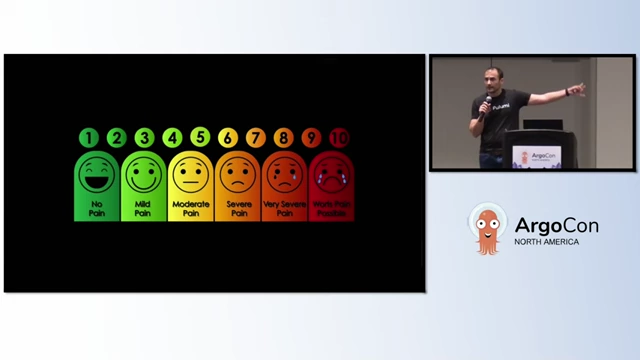
- The "Pain Scale" of GitOps
- Promoting artifacts across different environments in a large enterprise GitOps setup is identified as a source of significant operational pain, similar to a high number on a pain scale.
GitOps and Operators for Infrastructure [0:01:04]
The presentation delves into the foundational concepts of GitOps and the role of Kubernetes operators in deploying infrastructure.
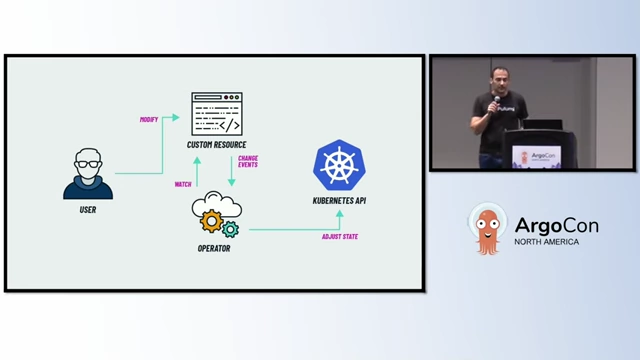
- The Necessity of Operators for GitOps [0:01:04]
- GitOps, especially in a Kubernetes context, relies heavily on operators to manage and deploy infrastructure.
- What are Kubernetes Operators? [0:01:19]
- Operators extend the Kubernetes API through custom resource definitions (CRDs) and custom controllers.
- A user defines a custom resource, which the operator watches.
- Upon detecting changes, the operator takes predefined actions to achieve the desired state in the Kubernetes cluster.
- Tools for Infrastructure as Code (IaC) with GitOps [0:01:44]
- Crossplane and Pulumi are used as examples of tools that provide operators to define and deploy infrastructure as code on Kubernetes clusters.
- Basic GitOps Deployment with Argo CD [0:02:00]
- A typical workflow involves defining infrastructure in a Git repository.
- Argo CD picks up these definitions and deploys them to a target Kubernetes cluster.
- This initial deployment usually targets a single environment, such as a "dev" environment.
Challenges of Environment Promotion in GitOps [0:02:30]
A core problem discussed is how to effectively promote infrastructure changes beyond the initial development environment to staging, UAT, and production environments.
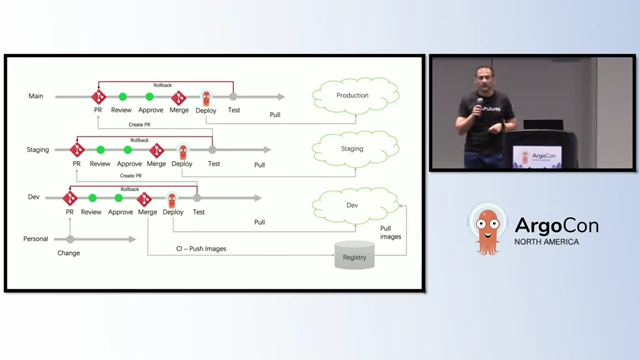
- Limitations of Single-Environment Syncs [0:02:30]
- Simply syncing to a "dev" environment is insufficient for real-world scenarios, as most organizations have multiple environments.
- Complex and Obscure Promotion Pipelines [0:02:59]
- Organizations often resort to highly complex, "mystical, obscure" pipelines involving various CI/CD tools (e.g., Azure DevOps, GitLab) to manage promotions.
- These custom scripts become difficult to understand and maintain over time.
- The Need for Better GitOps Promotion Patterns [0:03:30]
- The central question is identifying a better, GitOps-native way to promote infrastructure changes across environments.
Promotion Patterns: Why Not Branches? [0:03:39]
The talk addresses a common but problematic approach to environment promotion: using Git branches.
- Definition of Promotion Patterns [0:03:41]
- Promotion patterns describe different ways to implement and manage environments (stages like Test, Staging, Production) with GitOps.
- Disadvantages of Using Branches for Environments [0:04:08]
- Outdated and Problematic: Using Git branches for different environments leads to configuration drift and significant maintenance challenges.
- Merge Conflicts: Promotion via Git merges can cause unwanted changes and frequent merge conflicts, making the process painful.
- Scalability Issues: Branch-per-environment models are difficult to scale when managing many environments.
- Tool Recommendations: Popular Kubernetes tools like Helm and Kustomize advocate for using file folders (overlay mechanisms) rather than branches for environment modeling.
Promotion Patterns: Using Folders for Environments [0:05:08]
The recommended best practice for modeling GitOps environments is to use a folder-based approach.
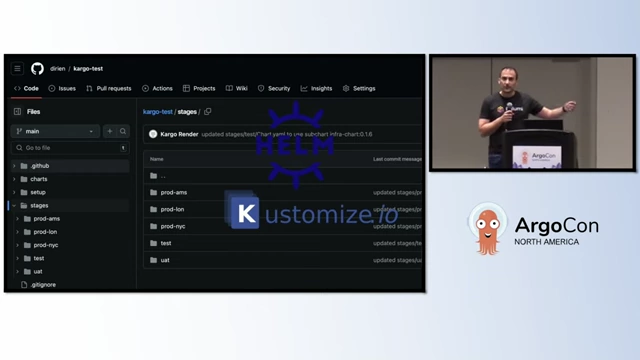
- Benefits of Folder-Based Environments [0:05:28]
- Cleaner Management: Separating configuration and environment-specific files into distinct folders simplifies management.
- Simple Promotion: Environment promotions can be handled with straightforward file-copy operations.
- Gradual Transitions: Ensures smooth transitions between environments without causing disruptions.
- Trunk-Based Development: Encourages trunk-based development and using Git tags for versioning, improving consistency.
- Leveraging Helm and Kustomize [0:05:45]
- This approach integrates well with tools like Kustomize (using base folders and overlays) and Helm (using different value files to override properties).
- It's also possible to mix and match both approaches.
Introducing Kargo for Smoother Promotions [0:06:01]
Kargo is presented as a solution designed to streamline multi-stage environment promotions in a GitOps-native way.
- What is Kargo? [0:06:14]
- An open-source project from Akuity, launched approximately a year prior to the talk, focused on progressive delivery.
- Key Features of Kargo [0:06:23]
- Multi-stage Promotion: Enables promotion of artifacts through various stages.
- GitOps Native: Fully adheres to GitOps principles, eliminating the need for complex CI push pipelines for CD logic.
- Flexible Promotion Pipelines: Allows creation of flexible pipelines for artifacts.
- Supported Artifacts: Handles container images, Kubernetes manifests, and Helm charts.
- Manual and Automatic Promotion: Supports both manual and automated promotion workflows.
- Native Integration: Seamlessly integrates with existing ecosystems, with Argo CD as the primary first-class citizen implementation, and future support for Flux.
- Progressive Delivery Capabilities: Can listen to monitoring system data or deployment statuses within clusters to determine promotion success or trigger automatic rollbacks to previous versions if issues arise.
- How Kargo Works [0:07:23]
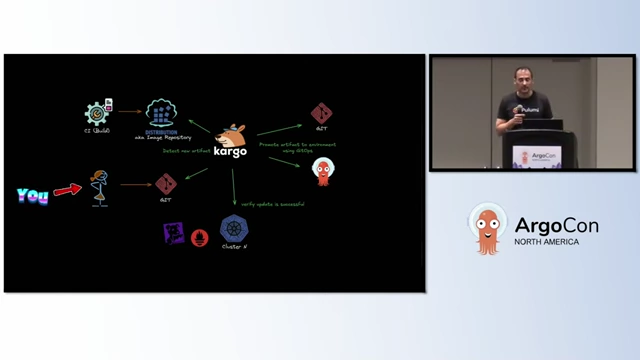
- CI builds an image and pushes it to an image repository.
- Platform/DevOps engineers define infrastructure as code (IaC) in a Git repository.
- Kargo observes both the image repository and the Git repository.
- It detects changes and promotes artifacts to the defined environment.
- For progressive delivery, Kargo integrates with monitoring systems to validate deployments and initiate rollbacks if necessary.
Demo of Kargo with Pulumi and Crossplane [0:08:23]
The speaker demonstrates Kargo's capabilities by deploying infrastructure defined using Pulumi and Crossplane.
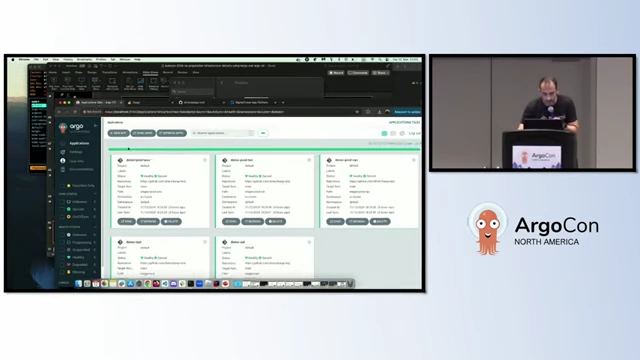
- Demo Setup [0:08:23]
- An umbrella Helm chart is used to deploy infrastructure, containing both Crossplane and Pulumi definitions for a basic static application on Digital Ocean.
- Different stages (Test, UAT, Production) are defined, each referencing a specific version of the infrastructure chart.
- The Helm umbrella chart defines dependencies on other charts, including the infrastructure chart.
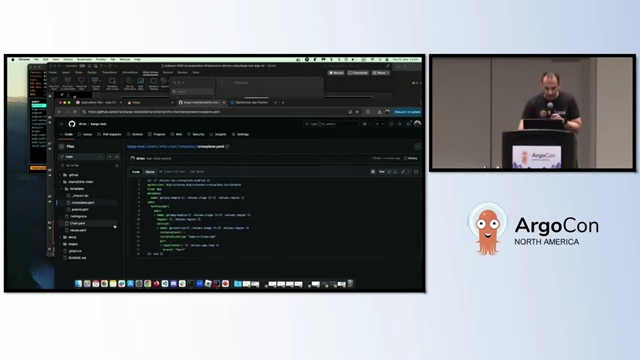
Helm umbrella chart definition specifying infrastructure chart versions [ 00:08:48 ] - Specific configurations like the deployment region are defined in the Helm values.
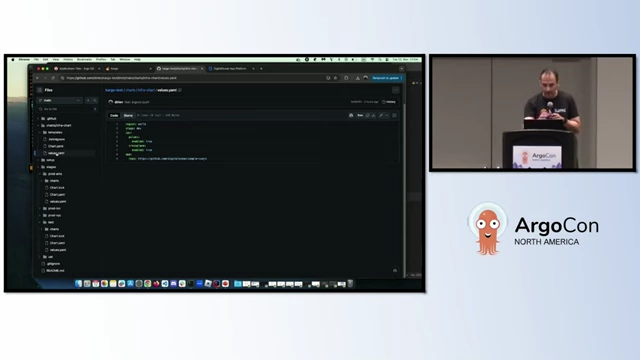
Helm values.yaml defining region for infrastructure deployment [ 00:09:49 ]
- Kargo UI Overview [0:09:08]
- The Kargo UI visualizes the deployed infrastructure versions across different stages.
- It shows, for example, that Test and UAT might be on version 1.8, while Production (New York City) is on 1.6.
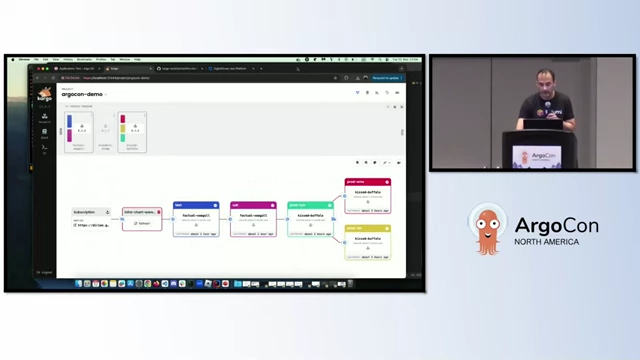
Kargo UI displaying multi-stage infrastructure promotion workflow [ 00:09:08 ]
- Promoting a New Infrastructure Version [0:10:08]
- The speaker demonstrates promoting a newer version [1] of the infrastructure definition from a pre-deployed stage to the Production (New York City) stage using the Kargo UI.
- The UI enforces dependencies between stages, allowing promotion only when previous stages are aligned.
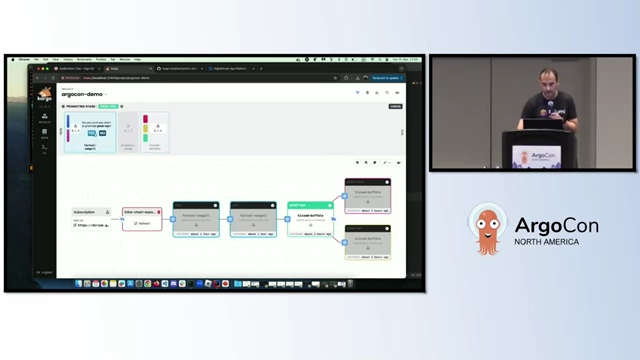
Kargo UI demonstrating the promotion of an infrastructure version [ 00:10:30 ] - (During the live demo, there were minor delays in the update reflecting in the Argo CD UI for the Digital Ocean application, but Kargo confirmed the promotion.)
Key Takeaways [0:13:07]
The presentation concludes with three main takeaways regarding Kargo and progressive infrastructure delivery.
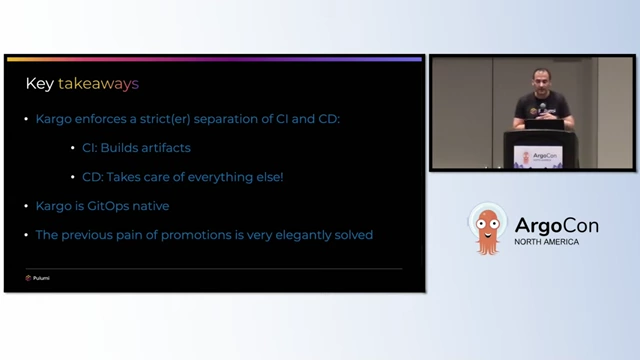
- Stricter CI/CD Separation: Kargo enforces a clear separation where CI builds artifacts, and CD (handled by Kargo and Argo CD) manages everything else, including promotion and deployment.
- GitOps Native: Kargo is fundamentally GitOps native, aligning with best practices.
- Elegant Promotion Solution: Kargo provides an elegant solution to the previously complex and painful process of promoting infrastructure changes across multiple environments.