How Kiyoshi Kurosawa's "Kiyoshi Open" Reveals a Film's Entire Thesis in the First Five Minutes
This video analyzes how director Kiyoshi Kurosawa masterfully uses the first few minutes of his films, dubbed the "Kiyoshi Open," as a thesis statement for the entire narrative.
- Film openings, rather than mere handshakes, quietly prime audience expectations and lay the foundation for the story to unfold.
- Kurosawa, renowned for his subtle horror and genre-spanning work, embeds the film's core architecture and themes in these initial, often unassuming, sequences.
- Examples like
Serpent's Pathestablish indiscriminate revenge through a single line, whileCharismareveals a character's tragic flaw of trying to save everything. Bright Futureuses a venomous jellyfish metaphor to represent societal discontent and directionless rage, andCureforeshadows meaningless violence with the Blue Beard story.- Although some films feature looser interpretations or deviate from this structure, the "Kiyoshi Open" is a hallmark of Kurosawa's brilliant, often overlooked, storytelling technique.

The Importance of Film Openings [0:00:12]
Film openings are not merely polite introductions but serve as critical thesis statements that quietly prime the audience, shaping expectations and laying the foundation for the entire film's narrative.
- Directors use openings for various purposes:
- Some use them as mood setters.
- Others employ them as misdirects or for pure exposition.
- A select few, like Kiyoshi Kurosawa, use them as a "hidden code," embedding the film's entire architecture in unassuming sequences whose significance is often realized only in hindsight.
Introducing Kiyoshi Kurosawa's Approach: The "Kiyoshi Open" [0:00:55]
Kiyoshi Kurosawa is highlighted as a filmmaker who profoundly understands the power of these opening minutes.
- His style of horror:
- Does not rely on jump scares or grotesque imagery.
- Instead, it materializes slowly through stillness and atmosphere, creating an "existential static" humming beneath every frame.
- Kurosawa's genre-spanning work:
- While famous for horror, his films cover Yakuza dramas, family tragedies, and unique hybrids like
Charisma. - Across genres, he consistently manages to discomfort the audience without overt sensationalism.

A collection of movie posters from Kiyoshi Kurosawa's diverse filmography, including dramas and genre hybrids. [ 00:01:39 ]
- While famous for horror, his films cover Yakuza dramas, family tragedies, and unique hybrids like
- The "Kiyoshi Open" concept:
- Kurosawa tells almost everything about a film in its first five minutes through "strange, awkward, sometimes disconnected openings."
- These serve as preambles, revealing the film's core idea or "beating heart."
Examples of the Kiyoshi Open in Action [0:03:02]
Several films are presented to illustrate the "Kiyoshi Open" technique.
1. Serpent's Path [0:03:02]
- Opening Scene: Two men drive in grim silence, preparing for a revenge kidnapping for a murdered daughter.
- Key Dialogue: One man asks if they have the right guy; the other replies, "They're all involved anyway." [0:03:18]
- Thesis Revealed: This line establishes the film's core theme: revenge is indiscriminate, and anyone connected to the original crime is deemed guilty.
- The film then proceeds to show them kidnapping and killing Yakuza members without regard for direct involvement.
- The opening acts as a "confession" of the film's devastating logic.

A screenshot from Serpent's Path where one character states, "They're all involved anyway." [ 00:03:20 ]
2. Charisma [0:04:00]
- Opening Scene: Detective Yabake is in a hostage situation.
- Core Directive: A note instructs, "Restore the Rules of the World." [0:04:13]
- Yabake's Flaw: Yabake hesitates to shoot the hostage taker, stating he "wanted to help them both." [0:04:18]
- Dilemma and Tragedy: These two ideas (restoring order vs. saving everyone) collide as Yabake later confronts the dilemma of saving a unique tree ("charisma") or the entire forest.
- His desire to save everything ultimately leads to the destruction of both, as revealed by the "Kiyoshi Open."
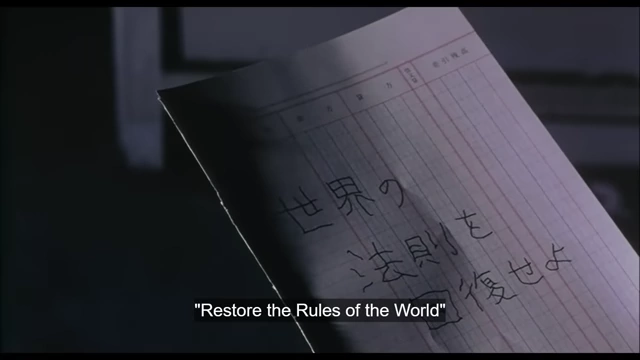
A note with Japanese characters translates to "Restore the Rules of the World." [ 00:04:13 ]
- His desire to save everything ultimately leads to the destruction of both, as revealed by the "Kiyoshi Open."
3. Bright Future [0:05:01]
- Opening Scene: Yugji expresses frustration over peaceful dreams ceasing, leading to unfocused anger and snapping at people.
- Metaphorical Warning: The introduction of a venomous jellyfish is accompanied by the warning, "Don't mock the jellyfish's venom." [0:05:23]
- Film's Themes: The opening establishes themes of disillusioned youth, directionless rage, and the deadly consequences of ignoring underlying dangers.
- The jellyfish symbolizes the quiet, simmering discontent that Yugji embodies.

Two characters interacting, with the subtitle "You're mocking the jellyfish's venom." [ 00:05:24 ]
- The jellyfish symbolizes the quiet, simmering discontent that Yugji embodies.
4. Cure [0:06:04]
- Opening Scene: The protagonist's wife reads the story of Blue Beard to a psychiatrist. [0:06:13]
- Key Insight: She states the woman kills Blue Beard because of his "one notable flaw, his blue beard." [0:06:25]
- Film's Structure: This encapsulates the entire film's structure: characters commit murders against ordinary victims for tiny, irrational flaws, driven by a human desire to assign meaning where there is none.

Variations and Exceptions to the Kiyoshi Open [0:07:00]
While effective, not every Kurosawa film features a perfect "Kiyoshi Open."
- Looser Interpretations:
Pulse: The greenhouse scene somewhat connects to the "dot algorithm" theme of people drifting apart and then supernaturally reuniting before death.
A dark screen displaying several white dots, illustrating the 'dot algorithm' concept. [ 00:07:12 ] Eyes of the Spider: The theme of violence becoming routine is conveyed by a man committing murder and returning home casually.
- Films Abandoning the Structure:
Retribution: Opens directly with the central murder.Creepy: Hints at themes of personal morality but doesn't form a true "Kiyoshi Open."
Conclusion: Kurosawa's Unnoticed Brilliance [0:07:56]
Kurosawa's ability to encode the entire film's essence into small, quiet opening moments often goes unnoticed despite his decades-long career across diverse genres.
- Recognizing the "Kiyoshi Open" reveals the brilliant construction of his narratives, allowing viewers to appreciate how he crafts not just horror, but "prophecies" hidden within the first five minutes of his films.

A grid displaying multiple movie posters from Kiyoshi Kurosawa's filmography. [ 00:08:04 ]