The Future of AI in Music Production: Niche Tools, MIDI Workflows, and the Evolving Plugin Market
Summary:
This episode discusses the future direction of AI in music, moving away from generic prompt-based generation towards more specialized, niche tools.
- AI in audio is shifting from broad generative applications to specific functionalities like stem separation, noise removal, and AI-assisted mixing, aiming to enhance creative workflows rather than replace them.
- The ideal future for AI in music involves MIDI generation, allowing producers to use AI as a co-producer that provides tweakable parameters instead of final audio.
- The 2025 plugin market experienced fatigue and stagnation despite commercial efforts like bundling and discounts.
- Technical advancements, such as new plugin formats like CLAP and the open-sourcing of VST3, are lowering the barrier to entry for developers and fostering innovation.
- The industry needs to move beyond simply emulating analog hardware and focus on developing truly digital-first solutions that solve modern problems for music creators.
2025]">
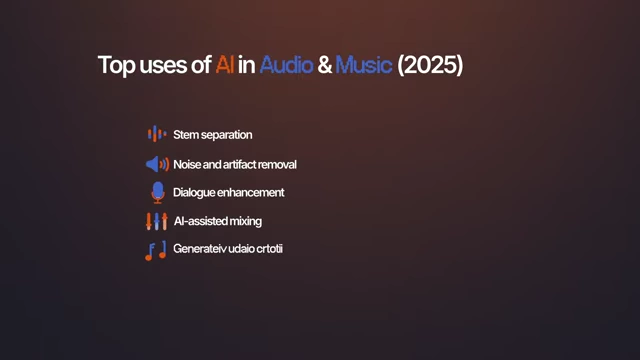
Top uses of AI in Audio & Music [ 00:03:20 ]
The Evolution of AI in Audio & Music [0:00]
The video kicks off by addressing the current state and future trajectory of AI in the audio and music industry, noting that AI generally has a negative perception.
Current AI Uses and the Shift Away from Generic Prompting [0:00]
- Top 5 Uses of AI in Audio & Music [2025] [0:00]
- Stem separation
- Noise and artifact removal
- Dialogue enhancement
- AI-assisted mixing
- Generative audio creation
Top uses of AI in Audio & Music [<a href="https://youtube.com/watch?v=pvsrIpHG0Fc&t=2025">2025</a>] [ 00:03:20 ]
- The host has used tools like LA AI for stem separation and 11 Labs for voice-over generation.
- Experience with Suno for generative audio was underwhelming due to its generic sound.
- The Problem with Generic Prompt-Based AI [0:00]
- In 2025, tools like Suno were primarily prompt-based, generating entire songs from text, which often resulted in "half-baked, generic ideas."
- Professionals do not want to simply prompt their creations; they desire tools that allow them to "get their hands dirty" and actively engage in the creative process.
- The creator's perspective emphasizes the importance of the creative process itself, which is often bypassed by fully generative tools.
- Future Direction of AI: Niche Applications and MIDI Generation [2026] [0:00]
- AI in audio is moving towards more niche applications, such as precise noise removal, mastering assistance, or generating specific instruments within a composition.
- The expectation for 2026 is a focus on MIDI generation, where AI provides generic parameters or foundational elements (e.g., a drum sound) that users can then extensively tweak.
- This "co-producer" model allows for human intervention and control, making AI an augmentative tool rather than a replacement.
- Symbolic generation (like MIDI) is preferred over full audio generation because MIDI is easier to parse and parameterize, offering greater flexibility and control to the creator.
- MIDI generation also helps in mitigating artifacts common in AI-generated audio, as users can directly modify the MIDI data.
Challenges and Innovations in the Music Tech Industry [0:00]
The discussion broadens to a retrospective of the music tech space in 2025 and predictions for 2026, touching on plugin market dynamics and core technical advancements.
Decline of Generative AI Prompting and the Role of AI as a Tool [0:00]
- Prompt-based generative AI is expected to decline because it doesn't align with the creative workflow desired by professionals.
- AI is seen as a tool to streamline workflows and handle "cookie-cutter, repeatable" tasks, but not as a replacement for human producers or engineers.
- For AI to be truly context-aware and useful in DAWs, significant technical challenges need to be overcome, such as classifying audio in real-time across multiple tracks and enabling communication between plugins.
The 2025 Plugin Market Retrospective [0:00]
- 2025 was a challenging year for plugin makers, marked by a sense of "fatigue" and underperformance in sales.
- The industry responded with bundling and heavy discounting, indicating a struggle to attract consumers.
- Exceptions included highly anticipated major updates like Serum 2 and Omnisphere 3.
- This commercial stagnation occurred despite ongoing technical innovation.
Technical Shifts and Open Innovation [0:00]
- New Plugin Formats: The introduction of CLAP (Clever Audio Plug-in) aims to modernize audio formats, with some DAWs like Bitwig already supporting it.
- Open-Sourcing: Steinberg open-sourced VST3, which could foster more developer contributions and innovation in the plugin ecosystem.
- Lower Barrier to Entry:
- Embedded web view UIs make it easier for web developers to enter the audio space.
- Support for languages like Rust, beyond traditional C++, further democratizes audio tool development.
- Indie developers can now build serious, value-providing tools more easily.
- The Disconnect: Despite increased ease of innovation, sales are stagnating, indicating a market fatigue with existing offerings.
The Need for Digital-First Solutions and New DAWs [0:00]
- Outdated DAWs: Current Digital Audio Workstations (DAWs) are described as "dinosaurs," built decades ago, which inherently limit full context-aware AI integration and dynamic workflow adaptation.
- Beyond Analog Emulation: The industry has largely focused on digitally emulating historical analog hardware, a pursuit with diminishing returns where digital will always be an "asymptote" to analog perfection for discerning ears.
- Focus on Modern Problems: The call is for innovation that solves contemporary problems for music creators, such as DAW interoperability and plugins with cross-track context.
- New DAWs, built from the ground up with modern architectures, are needed to fully embrace advanced AI and collaborative features, like a "Figma of DAWs."
Conclusion: Optimism for Future Innovation [0:00]
Despite current challenges and the initial generic nature of some AI tools, there's optimism for the future of music technology.
- Technical innovations, particularly in AI and new plugin formats, will eventually trickle down into products that genuinely solve problems and enhance the creative lives of music makers.
- The current "wild west" phase of AI funding will lead to many failed experiments, but the few successful ones will be transformative for the industry.
- Creators are encouraged to remain focused on their craft, as meaningful innovation is on the horizon.